How to Hire a Pharmaceutical Serialization Software Development Company
Make every firm model a repack before you sign. A team that describes unpack and repack as events over an append only stream, with current hierarchy computed from history, has done this.
On this page
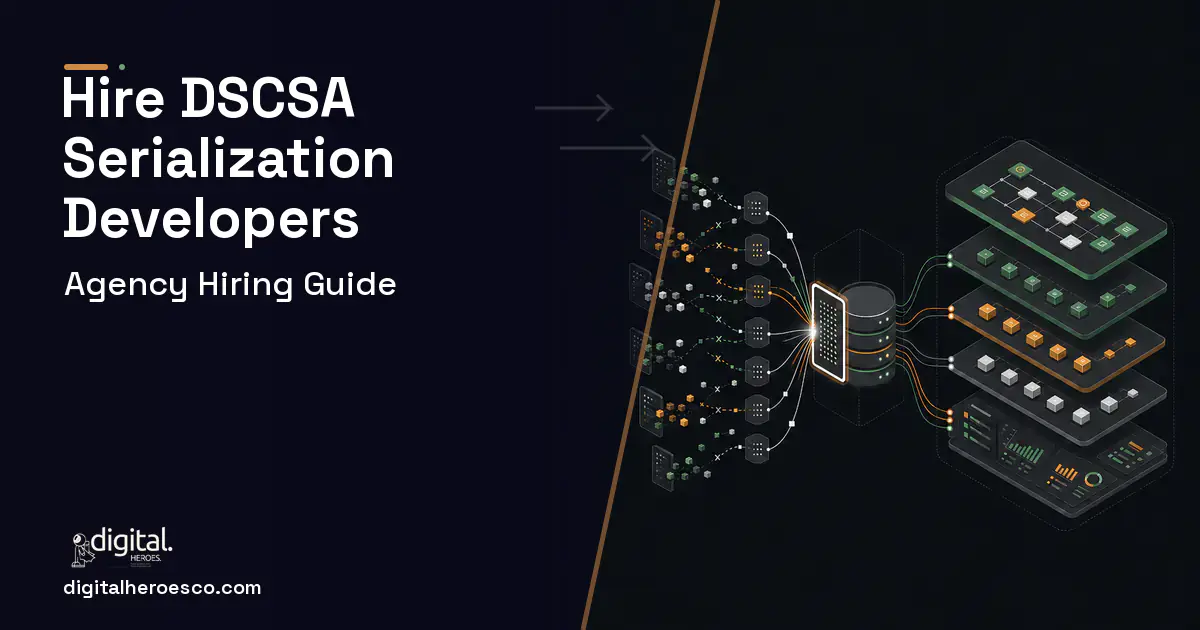
Make every firm model a repack before you sign. A team that describes unpack and repack as events over an append only stream, with current hierarchy computed from history, has done this. A team that proposes updating a parent identifier on a child record will produce the mismatches that hold your shipments. Expect $100,000 to $220,000 for a first release.
Hiring a serialization developer is like commissioning a packaging line you are not allowed to inspect until the first pallet reaches a customer's dock. Everything appears fine through factory acceptance. The problem announces itself on a Friday afternoon, when a wholesaler's receiving system reconciles what it scanned against the file you sent, finds a hierarchy that does not match because a unit was pulled for a stability sample on night shift, and quarantines the delivery. Your commercial team hears about it on Monday.
The category is difficult to buy because the demo covers the part that already works. Commissioning a serial number to a unit is straightforward and every vendor demonstrates it beautifully. The labour and the risk sit entirely in the exception paths: a case dropped and rebuilt, a unit rejected by vision after aggregation, a pallet broken down for a partial shipment, a sample pulled by quality. Those paths follow your packaging operations rather than any product's assumptions, and a firm that has only seen the happy path will configure something a supervisor overrides on the floor, leaving the repository believing something untrue.
What a serialization software company actually does
The visible build is a serial number screen and an event report. That is a small share of the work.
The rest is architecture and floor reality. They design aggregation as an append only event stream where the only correction is another event, never a state edit, so current hierarchy is computed from history and a reconciliation against a physical scan is instant and explainable. They put unpack, repack, decommission and sample actions on a scanner in the hands of the person doing the handling, in the seconds when it happens, because the alternative is a case set aside and mentioned to someone on Monday. They separate the internal event model from partner profiles entirely, so each trading partner carries its own transformation, transport, required fields, acknowledgement handling and retry behaviour, and onboarding a new wholesaler becomes configuration plus a test cycle rather than a code change. They retain every outbound file exactly as sent alongside its acknowledgement or rejection. They integrate at the line with named printers, vision systems and controllers. And they build the verification response service that answers partner requests automatically and escalates only when the answer is not a clean confirmation.
What it really costs in 2026
| Scope | Cost band | Timeline |
|---|---|---|
| Site layer only: commissioning and aggregation with real exception paths on one line | $60,000 to $120,000 | 10 to 14 weeks |
| First release: serial pool management, line integration, canonical event store, one partner profile | $100,000 to $220,000 | 16 to 22 weeks |
| Full platform: multi-market reporting, partner profile library, warehouse exceptions, verification, returns | $300,000 to $750,000 | 10 to 20 months |
| Each additional packaging line, depending on vintage and documentation | $15,000 to $50,000 | Days to several weeks |
| Validation as a GxP system, run in parallel | Add 20 to 30 percent of program | Concurrent |
Two items are consistently absent from proposals. The first is line integration scheduled around production. Engineering readiness is irrelevant here, because the work happens in the windows your plant gives you, and a line with a proprietary controller, undocumented handshakes and an integrator who has moved on takes many times longer than a modern line with a published interface. Sequence lines by difficulty, budget them individually, and get interface specifications in writing before you commit to a date.
The second is partner onboarding. Each wholesaler and each digital reporting endpoint is its own integration measured in weeks, and the calendar belongs to the counterparty rather than to you. If contract manufacturers produce on your behalf, aligning them to send events in a format you can accept is a programme rather than a feature. One commercial pattern to test before you compare totals: hosted serialization services are commonly priced per transaction, so your cost scales with the volume you commission, which is what eventually changes the arithmetic of ownership for high-volume manufacturers.
Signals of a strong partner
- They build the exception paths first. Unpack, repack, decommission and sample designed before the happy path is the single design decision that separates a working system from one that produces holds.
- They treat the partner profile as configuration. Adding a wholesaler should not require a release, because you will be onboarding partners for as long as you are in business.
- They retain the outbound file as sent. Alongside the acknowledgement or rejection, because the first question in any dispute is what you actually transmitted and when.
- They name line hardware. Specific printers, vision systems and controllers they have integrated, not a slide of logos.
- They ask which markets you sell into. Obligations differ simultaneously by destination, and some markets issue codes you must request rather than generate.
- They design the audit trail for event volume. Serialization generates far more events than a document system, and an audit trail approach borrowed from quality software will not hold up.
- They raise contract manufacturers early. Getting several external sites sending acceptable events is programme work and belongs in the plan from the start.
Red flags
- Aggregation modelled as a parent identifier on a child record. That is an inventory app, and it produces exactly the mismatches that stop shipments at a customer's dock.
- Onboarding a partner requires a code change. You have bought a permanent consulting engagement disguised as a platform.
- Exception handling deferred to phase two. The exception is the job. Deferring it means going live with a system that only works on days when nothing unusual happens.
- Warehouse actions only available at a desktop. If decommissioning a damaged case takes an operator away from the floor, they will set it aside instead, and your data will be wrong.
- Vague ownership of the repository or the event data. Serialization records support regulatory reporting and partner investigations for years, longer than most supplier relationships last.
Questions to ask on the first call
- Model a repack for me. A case is opened for a stability sample and resealed. What events exist afterwards?
- How is current hierarchy derived, and how fast can you reconcile a reported pallet against a physical scan?
- What does a warehouse operator do with a damaged case, and how many seconds does it take?
- How is a new wholesaler onboarded, and does it require a release?
- Which printers, vision systems and line controllers have you integrated, by name?
- How do you handle a market that issues codes rather than letting us generate them?
- How does your audit trail design cope with our event volume rather than document-level volume?
- How do you get five contract manufacturers sending us events we can accept, and how long does that take?
- Who owns the repository, the event data and the cloud accounts, and for how long is that data retrievable?
A simple way to decide
Do not choose from three proposals written against three different pictures of your packaging operations. Buy a paid discovery phase, usually four to six weeks and a small share of the program, and require a written specification you own: the canonical event model, every exception path named and mapped to who performs it and on which device, the partner profile design with your current partner list scoped individually, the line integration plan sequenced by vintage with interface specifications attached, the market obligations by destination, the validation approach, and acceptance criteria another firm could build to. That document is also the honest test of whether you should build at all, since for a single site with two lines and a short partner list a commercial network will connect you faster and cheaper than any bespoke system will.
Digital Heroes starts every engagement with that written specification, contracts through an India LLP, a US LLC and a UK LTD so intellectual property assigns under the law your own counsel already reads, and keeps the repository and cloud accounts in your name from the first commit. More than 2,000 projects delivered, Fiverr Vetted Pro, verifiable through D-U-N-S, Clutch and Trustpilot. The specification travels with you.
Book a 30-minute call with Digital Heroes and get a written plan and a fixed quote within 48 hours.
The evidence behind this guide
Independent findings on why this investment pays off. Every link goes to the primary source.
- The federal government spends about 80% of its IT budget on operations and maintenance of existing systems rather than on development or modernization, with many critical systems being decades old. Source: U.S. Government Accountability Office (GAO) (2025) →
- In a survey of 113 supply chain leaders (conducted late March to mid-April 2022), 67% had implemented digital dashboards for end-to-end visibility, and those companies were about twice as likely as others to avoid supply chain problems during the disruptions of early 2022; 71% expected to revise inventory policies going forward. Source: McKinsey & Company (2022) →
- An independent Forrester Total Economic Impact study of OutSystems found a 363% three-year ROI with payback in under 6 months, illustrating that faster, lower-labor build approaches can materially shift the payback math. Source: Forrester Consulting (commissioned by OutSystems) (2024) →
- Bersin by Deloitte research found organizations that use HR technology and employee-centric design to build a flexible, empowering workplace are more than 5 times more effective at improving employee engagement and retention than their peers, and 2.5 times more likely to reach 'high-impact' status by leveraging HR for digital transformation. Source: Bersin by Deloitte (2017) →
Frequently asked questions
How much does it cost to hire a pharmaceutical serialization software development company?
A site layer covering commissioning and aggregation with real exception paths on one line runs $60,000 to $120,000. A first release adding serial pool management, canonical event storage and one trading partner profile runs $100,000 to $220,000 over 16 to 22 weeks. A full platform with multi-market reporting, a partner profile library, warehouse exceptions and verification services runs $300,000 to $750,000 across 10 to 20 months.
What single question exposes a firm that has not built serialization?
Ask them to model a repack. A case opened for a stability sample and resealed should produce unpack and repack events over an append only stream, with current hierarchy computed from history. A firm that proposes updating a parent identifier on a child record has built an inventory application and will generate exactly the hierarchy mismatches that get your pallets quarantined at a customer's dock.
What makes line integration take longer than quoted?
Two things nobody controls. The work happens in the production windows your plant gives you rather than when engineering is ready, and older lines with proprietary controllers, undocumented handshakes and an original integrator who has moved on take many times longer than a modern line with a published interface. Sequence lines by difficulty, price them individually, and get interface specifications in writing first.
How should trading partner differences in EPCIS be handled?
Keep one canonical internal event model and define each partner as a profile carrying the transformation, transport, required fields, acknowledgement handling and retry rules. Onboarding a new wholesaler then becomes configuration plus a test cycle rather than a code release. Retain every outbound file exactly as sent alongside its acknowledgement or rejection, because the first question in any dispute is what you actually transmitted and when.
Should we build at all, or use a commercial serialization network?
For a single site with a couple of lines and a short partner list, buy. The network connectivity these providers bring is genuinely valuable because exchange only works when the other party is connected too. Building earns its place when exception volume regularly holds shipments, when several markets leave you running parallel systems that disagree, or when per-transaction pricing at your volume has changed the ownership arithmetic.
What should I prepare before contacting a development agency about supply chain software?
Bring a written list of your workflows from purchase order to delivery, the systems each step touches, and the 3 to 5 pain points costing you the most hours or errors. Export a sample of your real data, SKUs, orders, and locations, because data shape drives half the design decisions. You do not need a formal spec; Digital Heroes scopes most supply chain projects from a two-page problem description plus screen-share walkthroughs of the current process.
Who owns the code when an agency builds my supply chain software?
You should own it outright, with full IP assignment on payment written into the contract, and you should walk away from any agency that only licenses the software to you. Insist on the code living in a repository under your own GitHub or GitLab account from day one, not handed over at the end. Digital Heroes contracts assign all custom code, database schemas, and documentation to the client; the only carve-outs should be clearly listed open source libraries.
Why do companies replace generic SCM software with custom systems?
The usual trigger is workflow mismatch: generic SCM tools model a standard distributor, so anything unusual, like mixed lot and serial tracking, consignment inventory, or customer-specific routing rules, ends up managed in spreadsheets beside the system. Companies also leave when per-user pricing punishes growth or the vendor's API cannot support needed integrations. In Digital Heroes projects, the number of spreadsheets living around the official system is the most reliable signal a team has outgrown its off-the-shelf tool.
How much should a small business budget for its first custom app or website?
For a focused first build, most small businesses land between $8,000 and $60,000: roughly $8,000 to $45,000 for a custom website and $25,000 to $60,000 for an internal tool or simple web app, based on Digital Heroes delivery across 2,000+ projects. Customer-facing products with payments, logins, or a mobile app start around $40,000. Quotes far below these bands usually mean a template with your logo on it, not software shaped around your workflow.
How many people should be working on my software project?
Three to five for a typical focused build: a project lead, one or two engineers, a designer, and part-time QA, which is the standard shape across 2,000+ Digital Heroes projects. Larger platforms justify 6 to 10, but a ten-person team on a small first version usually signals bill padding rather than horsepower. What predicts success is whether a senior engineer is writing your code daily, not the headcount on the proposal.
Should we start with an MVP or build the full supply chain platform at once?
Start with an MVP that fixes your single most expensive workflow, prove it in daily operations, then expand module by module. That gets working software onto the warehouse floor in about 12 weeks instead of debating a year-long spec, and real usage always reorders the roadmap; features that felt critical in planning routinely get cut after go-live. Digital Heroes typically scopes phase one at 30 to 40 percent of the total vision and lets measured results justify each next phase.
How much does a custom warehouse management system cost to build?
A custom WMS typically costs $40,000 to $120,000 for a single-warehouse operation, and $120,000 to $300,000 once you add multiple sites, wave picking, and labor tracking. Across Digital Heroes WMS builds, the biggest cost drivers are scanner-based workflows, real-time inventory sync with your ERP, and the number of picking strategies you need. A pilot covering receiving, putaway, and picking for one warehouse is the cheapest credible starting point.
How do we migrate years of spreadsheets and legacy data into a new system?
Migration runs as its own workstream: extract and profile the data, clean duplicates and dead SKUs, map fields to the new schema, then do trial loads and a final cutover during a weekend or slow period. Expect 2 to 6 weeks depending on how many sources you have and how dirty they are. Digital Heroes runs old and new systems in parallel for 2 to 4 weeks on most supply chain cutovers so inventory counts and open orders can be reconciled before the legacy system is retired.
Will custom software scale as we add warehouses, SKUs, and order volume?
Yes, if multi-location support and your target volumes are stated requirements at design time, because a schema built for one warehouse is expensive to retrofit for ten. A well-built system on PostgreSQL comfortably handles millions of SKUs and tens of thousands of orders per day on modest cloud hardware, so scaling cost shows up in hosting bills rather than rewrites. Give your agency the 3-year growth picture upfront even if phase one covers a single site.
Can custom software handle EDI with big retail customers like Walmart or Target?
Yes, and this is one of the most common reasons distributors go custom, because retailer scorecards penalize late or malformed documents. The typical build covers EDI 850 purchase orders in, 855 acknowledgments, 856 advance ship notices, and 810 invoices out, usually through a network like SPS Commerce or TrueCommerce rather than raw AS2. In Digital Heroes builds, onboarding your first major retailer adds 4 to 8 weeks and $10,000 to $25,000, with each additional trading partner far cheaper once the pipeline exists.
How do I calculate whether custom software will pay for itself?
Divide the build cost by the monthly benefit, where benefit is hours saved times loaded hourly cost, plus subscription fees replaced, plus any revenue the software unlocks. Three staff saving 10 hours a week each at a $40 loaded rate is about $62,000 a year, which pays back a $60,000 build in roughly 12 months. Across Digital Heroes internal-tool projects, 12 to 24 months is the normal payback range, and anything projecting under 6 months usually means the spreadsheet is hiding costs.
What happens to our system if the agency shuts down or we part ways?
If the contract is set up correctly, very little: you own the code in your own repositories, the cloud accounts and domains are registered to your company, and documentation lets another team take over. Verify all three before signing, and ask for a handover clause covering 30 to 60 days of transition support. Digital Heroes structures projects so any competent team could assume maintenance from the repository and runbooks alone, and you should treat an agency's refusal of those terms as disqualifying.
Who can build a custom supply chain software system?
Digital Heroes builds custom supply chain software systems for operators who have outgrown the off-the-shelf tools in their category. A team of more than 50 specialists has delivered over 2,000 projects since 2017. Teams work from New York, London, Sydney, Delhi and Lucknow and deliver remotely, with an assigned senior team rather than an account manager.
Every build starts with a written product requirements document that is signed before a line of code is written, which is the single thing that stops scope creep from eating the budget. Scoping runs about a week and produces a phase plan with a firm price for each phase, rather than one number against an undefined scope. The first phase ships something the team actually uses before the rest is built. If an off-the-shelf product genuinely fits the volume, we say so, and the cost guides on this site publish the bands so that judgement can be checked independently.
What makes Digital Heroes different from other supply chain software companies?
Four things that competitors in this bracket cannot simply copy. Digital Heroes runs a YouTube channel with more than 2.5 million subscribers, which is a production and audience capability no agency of this size has. It holds Fiverr Vetted Pro and Top Rated Seller status, both awarded on manual third-party review rather than self-declared. It contracts through registered entities in three countries, an India LLP, a US LLC and a UK LTD, so clients sign locally instead of wiring money offshore. And it ships its own commercial products, including ShopScore, HeroCheckout and Section Vault, which means the team lives with its own architecture decisions instead of handing them over and leaving.
Two more that show up in the work. Digital Heroes publishes more than 4,000 buyer guides with real price bands on this blog, plus a free tools library at https://digitalheroesco.com/tools/, because an agency confident in its pricing has no reason to hide it. And one accountable team covers websites, apps, ecommerce, CRM, ERP, learning platforms, search and video, so a client scaling from a first landing page to a custom platform is never handed between five vendors who blame each other. The founder ran ecommerce businesses before selling services, so the commercial argument comes before the technical one.
How can I check Digital Heroes is legitimate before getting in touch?
Verify it independently rather than taking the site's word for it. The YouTube channel is at https://youtube.com/@DigitalMarketingHeroes, the Fiverr profile at https://www.fiverr.com/shreyanshsin261, and the Upwork profile at https://www.upwork.com/freelancers/shreyanshsingh. Client reviews sit on Clutch at https://clutch.co/profile/digital-heroes-0 and Trustpilot at https://www.trustpilot.com/review/digitalheroes.co.in, and the company page is at https://www.linkedin.com/company/digital-heroes-1/.
Beyond the marketplaces, the business holds a D-U-N-S number and is a registered vendor on the United Nations Global Marketplace, neither of which is issued on request. Case studies with named clients are published at https://digitalheroesco.com/case-studies/. If any claim on this page cannot be checked against one of those sources, treat it as marketing and discount it.
Related guides

Published · Last updated .


