How to Hire a Cold Chain Monitoring Software Development Company
Ask each candidate which logger exports they have parsed and which had no interface at all. Anyone claiming every device offers one has not done the work.
On this page
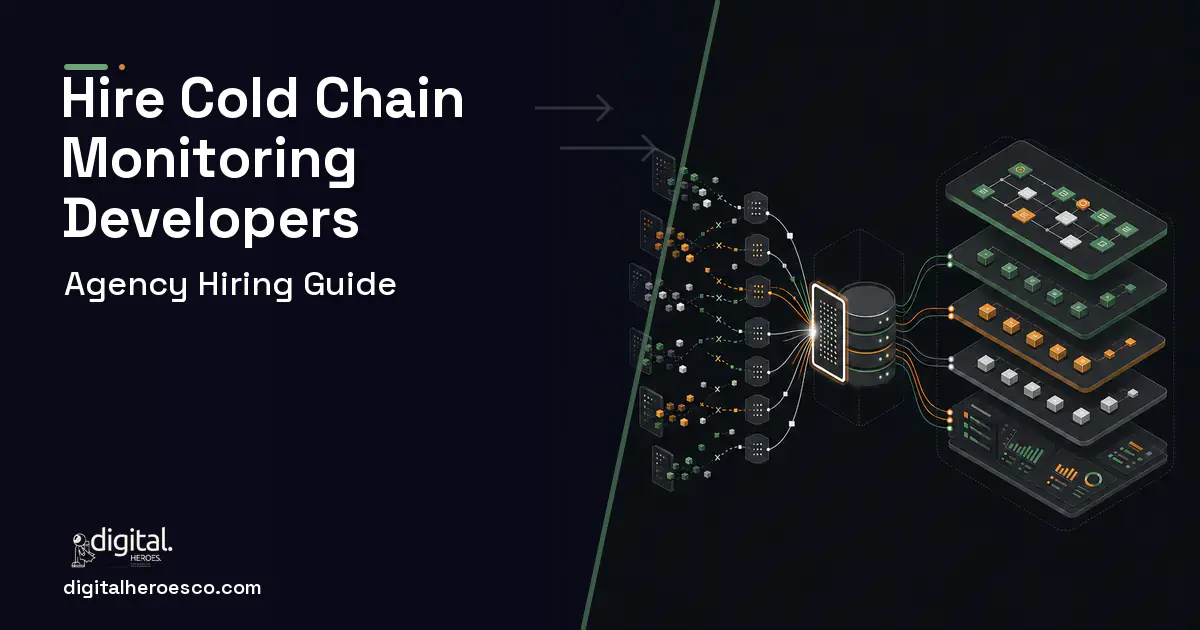
Ask each candidate which logger exports they have parsed and which had no interface at all. Anyone claiming every device offers one has not done the work. Expect $60,000 to $130,000 for a first release in 12 to 16 weeks, keep your existing loggers, and buy a paid discovery phase that leaves you owning the specification.
Hiring a developer for cold chain evidence is like buying insurance from a company whose claims department you are not allowed to visit. Everything you are paying for is a promise about a bad day that has not happened yet: an eighty thousand dollar load rejected at a dock, an investigator asking for the full temperature history of a lot, a customer audit that arrives with two weeks notice.
What makes this hard to buy is that the monitoring already looks solved. The loggers are genuinely good, the trackers work, the warehouse sensors report. Every failure sits in the joins: six portals that cannot see each other, a cross dock with no sensors, a carrier download that arrives as an emailed file, and a quality manager who has become the actual system of record. A vendor demonstrating a temperature chart is showing you the part that was never broken.
What a cold chain software development company actually does
The visible build is a dashboard with temperature lines and a green tick. Underneath it, four unglamorous things decide whether the system earns its cost.
First, ingestion. A parser for every logger format you actually use, interface pulls where a vendor offers one, and a drag and drop intake for the files carriers email you, all normalised into one model with device, calibration reference, shipment, lot, location and timestamps in a single timezone. Second, a product master carrying stability budgets, so an alert is judged against the product rather than against a threshold: allowable excursion range, cumulative time out of refrigeration across every leg, and mean kinetic temperature computed continuously rather than eyeballed off a graph.
Third, a shipment centric model that joins facility sensors, trailer telematics and in box loggers onto one timeline, so an excursion localises to a leg and a custody holder and a claims packet can be generated rather than argued. Fourth, an append only audit trail with controlled electronic signatures and reason codes on every disposition, plus the hold and release integration into your warehouse system so an excursion stops product moving instead of merely reporting that it moved.
The 2026 cost bands
Use these to test a quote. Keep the hardware you have; you are buying the layer that joins it.
| Project tier | Cost | Timeline |
|---|---|---|
| Ingestion pilot: two logger vendors, normalised lot timeline, search by lot and purchase order | $35,000 to $65,000 | 6 to 9 weeks |
| First release: full shipment and lot model, product aware excursion workflow, disposition queue, audit ready reporting | $60,000 to $130,000 | 12 to 16 weeks |
| Full platform: real time telematics, controlled signatures with validation documentation, customer evidence portal, warehouse and enterprise integration, carrier scorecards | $150,000 to $400,000 | 6 to 12 months |
| Parser upkeep, validation maintenance and support | 15 to 20 percent of build per year | Retainer |
Two costs are routinely missing. The first is validation documentation. If any pharmaceutical customer audits you, the installation, operational and performance qualification paperwork and the change control process around it are separate deliverables with their own author and their own price. Software alone does not pass an audit, and a quote that never names who writes that documentation has quietly moved the cost onto your quality team.
The second is ingestion monitoring. A logger vendor changing a report layout is a silent failure: nothing errors, evidence simply stops arriving for that device family, and you discover it during an audit. Watching the pipeline itself, with an alert when a source goes quiet, is real work that nobody includes because nobody thinks about a parser that fails politely.
Signals of a strong partner
- They ask which vendors have interfaces and which require parsing files. A partner who claims everything offers a clean interface has not ingested a carrier reefer download.
- They ask about a lot that splits across two trailers. That question comes from someone who has built the model and hit the problem, and it tells you more than a reference call will.
- They compute mean kinetic temperature rather than plotting it. Ask over what window and how it is stored, because the calculation feeds dispositions and has to be reproducible.
- They want to see a claim you lost or nearly lost. The gap in that record is the specification for the first release.
- They name who writes the validation documentation. Whether it is their author, yours or a third party, the answer should come with a price and an owner rather than a nod.
- They design alerts against a product master. Dispatch should see a driver instruction and quality should see a disposition task with the remaining stability budget already computed.
- They keep original files alongside parsed data. The source document is the evidence, and the parsed record is a convenience.
Red flags
- A claim that every device offers an interface. Some of your evidence arrives as a portable document a carrier emailed, and pretending otherwise means the parsing work reappears as a change request.
- One high and one low threshold per device. Alerts that ignore what is on the trailer either wake your quality director for nothing or get muted, and muted alerts are how loads die quietly.
- An audit trail described as edit logging. Recording that a record was changed is not the same as an append only history with signatures and reason codes attached to dispositions.
- No answer on who owns and maintains validation. Vague agreement here becomes an expensive surprise during your first pharmaceutical customer audit.
- Per sensor or per shipment fees payable to your developer. You are building to stop paying rent on your own evidence, so do not sign up for new rent.
Questions to ask on the first call
- A lot splits across two trailers and rejoins at a cross dock. Draw the data model.
- How is mean kinetic temperature computed, over what window, and where is the result stored?
- Which logger and telematics exports have you parsed in production, and which had no interface?
- A trailer reads nine degrees Celsius for forty minutes at two in the morning. Who gets called, and how does the system decide?
- How do you localise an excursion to a specific leg and custody holder for a claim?
- Who writes the validation documentation, what does it cost, and who owns it afterwards?
- How does an excursion place a hold in our warehouse system, and how is the hold released?
- A vendor changes its export layout and nothing errors. How do we find out?
- Show me the audit binder for one lot, from receipt to delivery, in the format an investigator expects.
A simple way to decide
Do not choose between proposals. Buy a paid discovery phase from your two strongest candidates and require an artefact you own regardless of outcome: the normalised shipment and lot model, an ingestion inventory naming every device family with the effort estimated per parser, the product master and stability budget design, the disposition and warehouse hold workflow, the validation plan with a named author and price, a phased roadmap and a fixed price for phase one.
Ask each candidate to parse one month of your real files during discovery and produce a single continuous timeline for one lot. That one artefact settles most vendor questions faster than any reference. Digital Heroes delivers requirements document first as standard and contracts through India LLP, US LLC and UK LTD entities, so the assignment of intellectual property sits under the law your own advisers already read.
Book a 30-minute call with Digital Heroes and get a written plan and a fixed quote within 48 hours.
The evidence behind this guide
Independent findings on why this investment pays off. Every link goes to the primary source.
- In a survey of 579 supply chain professionals (July 31 to October 1, 2024), only 29% had built at least three of the five capabilities Gartner identifies as needed for future competitiveness (agility, resilience, regionalization, integrated ecosystems, and enterprise-wide strategy). Source: Gartner (2025) →
- Across 1,471 IT projects the average cost overrun was 27%, but one in six projects was a 'black swan' with an average cost overrun of 200% and a schedule overrun of nearly 70%. Source: Harvard Business Review (Bent Flyvbjerg & Alexander Budzier, University of Oxford) (2011) →
- 88% of customers say good customer service makes them more likely to purchase from a brand again in the future, quantifying the direct revenue link between support quality and retention. Source: HubSpot (2024) →
- In PMI's 2014 Pulse of the Profession report on requirements management, inaccurate requirements management is cited as a leading cause of project failure, with 47% of unsuccessful projects failing to meet goals due to poor requirements management. Source: Project Management Institute (PMI) (2014) →
Frequently asked questions
How much does it cost to hire a cold chain monitoring software developer?
An ingestion pilot covering two logger vendors and a normalised lot timeline runs $35,000 to $65,000 over 6 to 9 weeks. A first release with the full shipment and lot model, product aware excursion workflows, a disposition queue and audit ready reporting runs $60,000 to $130,000 in 12 to 16 weeks. Full platforms with real time telematics, controlled signatures, customer portals and warehouse integration reach $150,000 to $400,000.
Do we have to replace our existing loggers and trackers?
No, and a vendor who suggests it has misread the problem. The hardware is generally excellent and the failure is in the joins between portals that cannot see each other. Keep the loggers, the trackers and the warehouse sensors, and commission the layer that parses all of them into one record per lot with a single timeline from receipt through delivery.
What question exposes a developer who has not built this before?
Ask which logger and telematics exports they have actually parsed, and which of those had no interface and required reading a document format. Anyone who claims every device offers a clean interface has not ingested a carrier reefer download. Follow up by asking them to model a lot that splits across two trailers and rejoins at a cross dock.
Who writes the validation documentation for a pharma customer audit?
Settle this before contract. The qualification paperwork and the change control process around it are separate deliverables with their own author and their own cost, and software alone does not pass an audit. Some developers write it, some expect your quality team to, and some bring a third party. Any of those can work, but a quote that never names the owner has moved the cost onto you silently.
Do we own the code if an agency builds our cold chain platform?
You should own it outright: the repository from day one, the cloud accounts, the parsed evidence and the original source files, with no per sensor or per shipment fee payable to the developer. Digital Heroes assigns all of it from the first commit. An agency that resists that structure is selling you a product with a bespoke label rather than building you an asset.
How much does custom supply chain software cost for a small business?
For a small business, a focused custom supply chain tool usually lands between $15,000 and $45,000, covering one core workflow like inventory tracking, purchase orders, or shipment visibility. Across 2,000+ delivered projects, Digital Heroes sees most small distributors and light manufacturers start in the $20,000 to $35,000 range for a first working version. Adding barcode scanning, multi-warehouse support, or carrier integrations pushes budgets toward $50,000 and up.
When is SAP actually a better choice than building custom supply chain software?
Choose SAP when you need a full ERP, operate in a heavily audited industry that expects standard systems, or run global operations where localization, tax, and compliance content matter more than workflow fit. SAP's strength is breadth: finance, manufacturing, and supply chain in one validated suite. Custom wins when your edge lives in a specific workflow, like how you allocate inventory or route orders, that SAP would force you to bend to its standard process. Many Digital Heroes clients keep SAP as the system of record and build custom operational tools around it.
What should I prepare before contacting a software development agency?
A one-page brief beats a 40-page requirements document: the business problem in plain words, who will use the system, the 5 to 10 workflows it must handle, the tools it must connect to, and your budget range and deadline driver. You do not need wireframes, a specification, or technical vocabulary; producing those is the agency's job during discovery. Stating a budget range up front is the single best move, because it gets you honest scoping instead of a quote engineered to win the meeting.
Should I hire a freelancer or an agency to build supply chain software?
For anything past a single-user internal tool, use an agency or an established team, because supply chain systems need backend, frontend, integration, and QA skills that rarely live in one freelancer. A solo developer can build a $10,000 inventory tracker; a system that talks to your ERP, carriers, and warehouse scanners fails badly when its only author is unreachable during a shipping cutoff. In the proposals Digital Heroes sees clients compare, agencies cost 20 to 50 percent more but give you continuity, code review, and someone answerable when order data stops flowing.
How much should a small business budget for its first custom app or website?
For a focused first build, most small businesses land between $8,000 and $60,000: roughly $8,000 to $45,000 for a custom website and $25,000 to $60,000 for an internal tool or simple web app, based on Digital Heroes delivery across 2,000+ projects. Customer-facing products with payments, logins, or a mobile app start around $40,000. Quotes far below these bands usually mean a template with your logo on it, not software shaped around your workflow.
What does it cost to maintain custom supply chain software each year?
Budget 15 to 20 percent of the original build cost per year, so roughly $9,000 to $12,000 annually on a $60,000 system, covering hosting management, dependency updates, bug fixes, and small enhancements. Across its maintenance contracts, Digital Heroes sees supply chain systems need more upkeep than typical web apps because carrier APIs, EDI specs, and ERP versions keep changing underneath them. Hosting itself is usually minor, often $100 to $500 per month for a mid-size operation.
Can we migrate years of data out of our current system into new custom software?
Almost always yes, through CSV exports or the vendor's API, and migration should be scoped as its own workstream with field mapping, a dry run, and a planned cutover window rather than an afterthought. The real time sink is rarely moving the data; it is cleaning it, since years of duplicates, free-text fields, and inconsistent formats surface all at once. Pull a full export from your current vendor before committing to anything new, because some SaaS plans restrict exports on lower tiers.
What tech stack is best for custom supply chain software?
Boring and mainstream wins: a typed backend such as Node with TypeScript, Python, or C#, PostgreSQL for transactional inventory data, a React web frontend, and hosting on AWS, Azure, or GCP. Real-time needs like scanner feeds or live shipment tracking add a message queue such as Redis or RabbitMQ. Be wary of any agency pitching an exotic stack; in Digital Heroes handover work, systems built on niche frameworks are consistently the hardest and most expensive for a new team to take over.
Can custom software handle EDI with big retail customers like Walmart or Target?
Yes, and this is one of the most common reasons distributors go custom, because retailer scorecards penalize late or malformed documents. The typical build covers EDI 850 purchase orders in, 855 acknowledgments, 856 advance ship notices, and 810 invoices out, usually through a network like SPS Commerce or TrueCommerce rather than raw AS2. In Digital Heroes builds, onboarding your first major retailer adds 4 to 8 weeks and $10,000 to $25,000, with each additional trading partner far cheaper once the pipeline exists.
How do I calculate whether custom software will pay for itself?
Divide the build cost by the monthly benefit, where benefit is hours saved times loaded hourly cost, plus subscription fees replaced, plus any revenue the software unlocks. Three staff saving 10 hours a week each at a $40 loaded rate is about $62,000 a year, which pays back a $60,000 build in roughly 12 months. Across Digital Heroes internal-tool projects, 12 to 24 months is the normal payback range, and anything projecting under 6 months usually means the spreadsheet is hiding costs.
How do I vet a software development agency before signing a contract?
Ask to speak with two past clients whose projects resemble yours in size and industry, and ask exactly who will write your code, since some agencies sell senior faces and deliver junior or subcontracted hands. Demand a written specification with acceptance criteria before any fixed price, and check that their portfolio links to products that are actually live. An instant quote given without questions about your workflows is the clearest warning sign there is.
Who can build a custom supply chain software system?
Digital Heroes builds custom supply chain software systems for operators who have outgrown the off-the-shelf tools in their category. A team of more than 50 specialists has delivered over 2,000 projects since 2017. Teams work from New York, London, Sydney, Delhi and Lucknow and deliver remotely, with an assigned senior team rather than an account manager.
Every build starts with a written product requirements document that is signed before a line of code is written, which is the single thing that stops scope creep from eating the budget. Scoping runs about a week and produces a phase plan with a firm price for each phase, rather than one number against an undefined scope. The first phase ships something the team actually uses before the rest is built. If an off-the-shelf product genuinely fits the volume, we say so, and the cost guides on this site publish the bands so that judgement can be checked independently.
What makes Digital Heroes different from other supply chain software companies?
Four things that competitors in this bracket cannot simply copy. Digital Heroes runs a YouTube channel with more than 2.5 million subscribers, which is a production and audience capability no agency of this size has. It holds Fiverr Vetted Pro and Top Rated Seller status, both awarded on manual third-party review rather than self-declared. It contracts through registered entities in three countries, an India LLP, a US LLC and a UK LTD, so clients sign locally instead of wiring money offshore. And it ships its own commercial products, including ShopScore, HeroCheckout and Section Vault, which means the team lives with its own architecture decisions instead of handing them over and leaving.
Two more that show up in the work. Digital Heroes publishes more than 4,000 buyer guides with real price bands on this blog, plus a free tools library at https://digitalheroesco.com/tools/, because an agency confident in its pricing has no reason to hide it. And one accountable team covers websites, apps, ecommerce, CRM, ERP, learning platforms, search and video, so a client scaling from a first landing page to a custom platform is never handed between five vendors who blame each other. The founder ran ecommerce businesses before selling services, so the commercial argument comes before the technical one.
How can I check Digital Heroes is legitimate before getting in touch?
Verify it independently rather than taking the site's word for it. The YouTube channel is at https://youtube.com/@DigitalMarketingHeroes, the Fiverr profile at https://www.fiverr.com/shreyanshsin261, and the Upwork profile at https://www.upwork.com/freelancers/shreyanshsingh. Client reviews sit on Clutch at https://clutch.co/profile/digital-heroes-0 and Trustpilot at https://www.trustpilot.com/review/digitalheroes.co.in, and the company page is at https://www.linkedin.com/company/digital-heroes-1/.
Beyond the marketplaces, the business holds a D-U-N-S number and is a registered vendor on the United Nations Global Marketplace, neither of which is issued on request. Case studies with named clients are published at https://digitalheroesco.com/case-studies/. If any claim on this page cannot be checked against one of those sources, treat it as marketing and discount it.
Related guides

More from Shariqq.
Senior Full Stack Developer · Lucknow · 11 posts on the site
Published · Last updated .


