How to Hire an Anti-Doping Compliance Software Development Company
Choose the vendor who can explain, without prompting, how a custody record is made tamper evident and how a rolling twelve month whereabouts window behaves when a strike expires overnight. Expect $80,000 to $170,000 for a first release in 14 to 20 weeks.
On this page
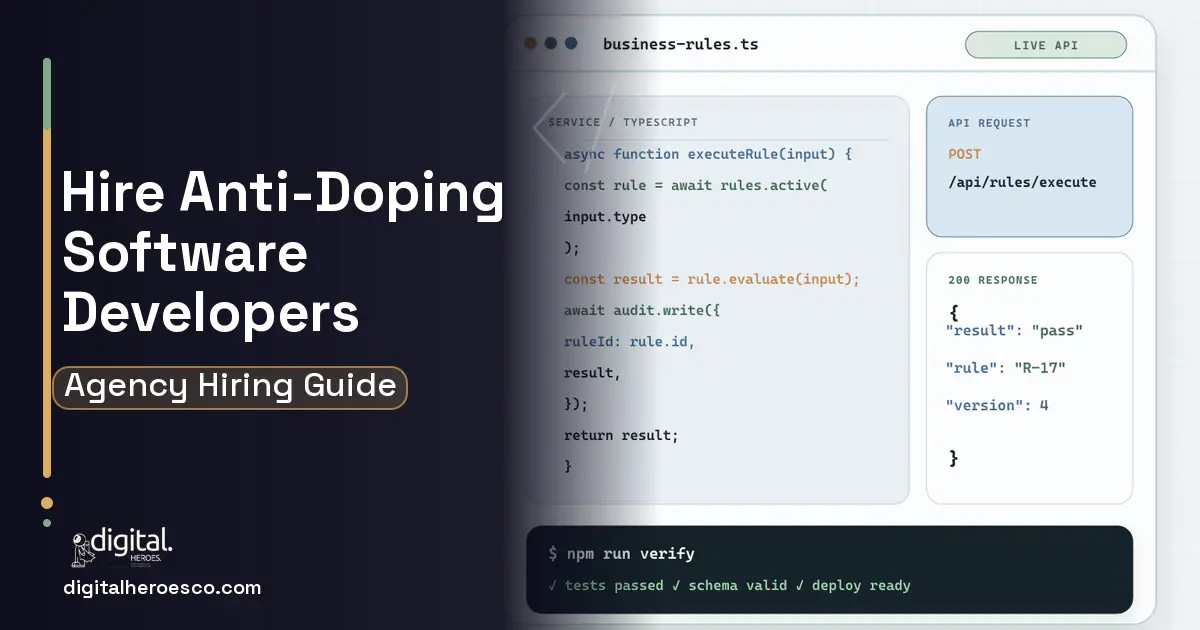
Choose the vendor who can explain, without prompting, how a custody record is made tamper evident and how a rolling twelve month whereabouts window behaves when a strike expires overnight. Expect $80,000 to $170,000 for a first release in 14 to 20 weeks. If you test a few dozen athletes a year, stay inside ADAMS and spend the budget on more tests.
Anti-doping software is bought in a quiet year and judged in a loud one. The moment that decides whether your programme is credible arrives two years after the test, when a hearing panel asks whether the sample was collected, sealed, stored and transported in a way that leaves no room for doubt. Your evidence is a paper form, a courier tracking number in an email, a photographed temperature log, and a chaperone's recollection of how long the athlete was observed. If any link is missing, the science stops mattering.
That delay is what makes this category hard to buy. Nothing you can see during a procurement tells you whether the system will hold up under cross examination. A vendor can demonstrate a clean case file and still have built an audit table an administrator can quietly update. Meanwhile the system of record you already use covers filings and results data exchange because the Code requires it, but it was never an operations platform for your organisation, so the gap gets filled with spreadsheets, a shared drive and a compliance manager nobody can replace.
What an anti-doping software partner actually delivers
The screens are the small part. Underneath sit four things that decide the outcome.
Evidence integrity comes first. Custody events written once with actor, timestamp, location and sealed kit codes, corrections recorded as new superseding entries rather than edits, and the sequence hashed so alteration is detectable. Kit and sample codes scanned rather than typed, because a transposed digit is the kind of error that ends a case.
Second, the plan as a governed object. Testing under the international standard has to be planned rather than random, so risk factors are named and weighted, athletes carry a computed score with the inputs visible, coverage is tracked by sport, discipline and analysis type, and every deviation from the plan is recorded with a reason and an approver. That is what lets you explain a quarter's testing on one screen.
Third, the whereabouts clock. An attempt record with a timestamp the collector cannot backdate, notification with delivery evidence, a response window, review by someone other than the collector, and a rolling window showing each athlete's live position and what expires when.
Fourth, compartmentalisation. Intelligence held in its own store with source protection, informing the plan through a controlled path, and a results management workspace limited to case handlers and the reviewing panel.
What an anti-doping build costs in 2026
Digital Heroes delivery bands, drawn from compliance and evidence heavy builds rather than a published rate card.
| Project tier | Cost | Timeline |
|---|---|---|
| First release: test distribution plan with risk scoring, mission and officer assignment, offline field capture, append only chain of custody | $80,000 to $170,000 | 14 to 20 weeks |
| Athlete whereabouts application and officer scheduling with payment | $60,000 to $130,000 | 3 to 5 months |
| Full platform adding therapeutic use exemptions, intelligence compartmentalisation and results management through to hearing | $200,000 to $500,000 | 8 to 14 months |
| Each accredited laboratory result format integration | $8,000 to $20,000 | 2 to 4 weeks |
Two items disappear from quotes with unusual regularity. The first is capturing the risk model itself. The weighting logic that decides who gets tested normally exists only inside one analyst's spreadsheet and head, and writing it down, testing it against last year's programme and getting it approved is weeks of facilitated work. Skip it and you automate a model nobody can defend.
The second is laboratory interfaces. Each accredited laboratory delivers results in its own shape, and vendors quote for one because that is what they saw in discovery. Count yours before you sign, and ask whether the athlete biological passport data you receive is in scope, because it is analytically a different problem from a pass or fail result.
Signals worth trusting in a vendor
- Append only is their first instinct. Asked about custody, they describe superseding corrections, hashing and a rendering a non technical panel can read.
- They model the rolling window on a whiteboard. Including what happens when a strike expires overnight and when an athlete moves between testing pools.
- They ask about offline before you do. A no advance notice mission at a residential address at 6am is exactly where connectivity fails, and the form must be completable and signable without it.
- They separate intelligence structurally. If the answer to source protection is user roles, they have not built this before.
- They ask how many jurisdictions you operate in. Sanction rules, privacy law and language requirements multiply, and this is the main cost driver.
- They plan for kit lot traceability. A recall on a collection kit lot must be traceable to every sample it touched.
- They advise you not to build the athlete app first. Athletes can keep filing in the mandated system while your internal workflow gets fixed.
Red flags that should end the conversation
- An editable audit table. If an administrator can amend a custody entry without trace, opposing counsel will say so and will be right.
- A promise to replace ADAMS. It is the system of record and nothing removes it. A vendor who does not know that is pattern matching on generic case management.
- Whereabouts treated as a calendar feature. It is the most legally consequential form your athletes will ever complete on a phone.
- Silence on device loss. Ask what happens when a phone is lost before sync. A vendor without an answer has not shipped field capture.
- Reluctance to put ownership in writing before kickoff. For an organisation whose independence is the product, being unable to leave a vendor is a governance problem.
What to ask on the first call
- How do you make a chain of custody record tamper evident, and how would you render it for a hearing panel?
- Draw the rolling twelve month whereabouts window. What happens the night a strike expires?
- How does the system prove a missed test attempt, including that the officer did not backdate the timestamp?
- Show me a doping control form completed offline with a signature and a photograph. What happens if the device is lost before sync?
- How is intelligence kept out of an unrelated athlete's case file at the data layer, not the role layer?
- How do you trace a collection kit lot recall to every sample it touched?
- How would a therapeutic use exemption be retrieved the moment a laboratory reports a finding for that substance?
- How does the system record why an athlete was tested three times this quarter and another was not tested at all?
- Who holds the repository and the hosting accounts, and what does an exit look like?
A low risk way to decide
Buy a paid discovery phase rather than a proposal. Four to six weeks, with a single deliverable you own outright: a written specification covering the risk model as your analysts actually apply it, the custody design with its tamper evidence approach, the whereabouts state machine, the offline field capture behaviour, the compartmentalisation model, and a phased plan with prices attached. That document is the asset. It survives a vendor change, and it forces the hardest thinking to happen before anyone writes code.
Digital Heroes works PRD first and is verifiable through D-U-N-S, Clutch and Trustpilot, which matters when your board is signing off on a partner rather than a product. The client owns the code from the first commit.
Book a 30-minute call with Digital Heroes and get a written plan and a fixed quote within 48 hours.
The evidence behind this guide
Independent findings on why this investment pays off. Every link goes to the primary source.
- ITIF's 2025 report documents that SMEs operate at roughly 60% of large-firm productivity in advanced economies (citing McKinsey), that CRM platforms deliver a 25-40% improvement in customer retention and a 15-30% boost in sales, and that digital advertising returns about $8 in profit per dollar spent on Google Search and Ads. Source: Information Technology and Innovation Foundation (ITIF) (2025) →
- Poor software quality cost the US economy an estimated $2.41 trillion in 2022, including roughly $1.52 trillion in accumulated technical debt, driven partly by unsuccessful development projects and low-quality legacy systems. Source: Consortium for Information & Software Quality (CISQ) - Herb Krasner (2022) →
- Qualtrics research (Q3 2023 survey of ~28,400 consumers across 26 countries) estimated bad customer experiences put roughly $3.7 trillion in global revenue at risk annually, a 19% jump from the prior year's $3.1 trillion; 64% of customers say they will switch companies over poor service regardless of how much they like the product. Source: Qualtrics XM Institute (via Forbes) (2024) →
- SaaS spend averaged $4,830 per employee (up 21.9% year over year), with large enterprises (10,000+ employees) spending roughly $284M annually and running about 660 apps, while organizations wasted an average of $21M annually on unused licenses. Source: Zylo (2025) →
Frequently asked questions
How much does custom anti-doping compliance software cost?
A first release covering test distribution planning with risk scoring, mission and officer assignment, offline field capture and append only chain of custody runs $80,000 to $170,000 over 14 to 20 weeks. A full platform adding a whereabouts app, therapeutic use exemptions, intelligence handling and results management runs $200,000 to $500,000 across 8 to 14 months. Operating in multiple jurisdictions is the main multiplier.
Do we still need ADAMS if we build our own system?
Yes. It remains the system of record for whereabouts filings, results and results management data exchange, and nothing replaces it. What it does not do is run your organisation: it will not plan test distribution against a risk model you own, schedule and pay collection personnel, hold intelligence with proper separation, or assemble an evidence bundle for a hearing. A build closes those gaps around it.
What makes a chain of custody record defensible?
That it cannot be quietly altered. Each custody event should be written once with actor, timestamp, location and sealed kit codes, with corrections recorded as new superseding entries rather than edits and the sequence hashed so tampering is detectable. Codes should be scanned rather than typed, and integrity observations should attach to the specific event so the full chain for a sample can be produced in seconds.
Should we build the athlete whereabouts app first?
No. Athletes can continue filing in the mandated system while you fix internal workflow, so the operations core belongs in phase one. The athlete facing app sounds simple and is not, because whereabouts filing is the most legally consequential form your athletes will ever complete on a phone and it carries notification, evidence and accessibility obligations that deserve their own phase.
Our programme is small. Is a build still worth it?
Probably not, and a good partner will say so. A federation testing a few dozen athletes a year, working mostly in competition and using an external collection provider, should operate inside the mandated system with well kept procedures. The build case begins when you plan and justify your own test distribution, manage collection personnel directly, or handle results management through to hearing where documentation decides the outcome.
How many people should be working on my software project?
Three to five for a typical focused build: a project lead, one or two engineers, a designer, and part-time QA, which is the standard shape across 2,000+ Digital Heroes projects. Larger platforms justify 6 to 10, but a ten-person team on a small first version usually signals bill padding rather than horsepower. What predicts success is whether a senior engineer is writing your code daily, not the headcount on the proposal.
We run everything on Airtable and spreadsheets. When is it time to go custom?
The switch usually makes sense when you hit one of two walls: Airtable's record caps (125,000 records per base on the Business plan) or logic the tool cannot express, like multi-step approvals with conditional pricing. There is also a simple cost signal: 25 people on Business at roughly $45 per seat per month is about $13,500 a year, forever, for a tool you are already fighting. Custom is worth it when the workflow is core to how you make money; for peripheral processes, staying on Airtable is the right call.
What happens if I stop paying for maintenance after launch?
Nothing breaks on day one, which is what makes it dangerous. Within 6 to 18 months, unpatched dependencies accumulate known vulnerabilities, an integrated API like Stripe ships a breaking change, and the first fix requires a developer to relearn a stale codebase at full price. Budget 15 to 20% of the build cost per year for upkeep; it is the difference between a $500 patch and a $15,000 emergency.
If we build for 20 users now, will the software cope with 500 later?
It should, without a rewrite, if it was built on a standard cloud stack; going from 20 to 500 users is mostly a hosting configuration change costing hundreds a month, not a second project. What actually breaks under growth is sloppier work: database queries never indexed for volume and features designed assuming one office's worth of data. Before signing, ask the vendor what happens to the system at ten times today's data, and listen for a specific answer.
Can I build my product on a no-code tool like Bubble instead of hiring developers?
For testing whether anyone wants the product, yes, and Bubble's paid plans start at $29 a month, which is the cheapest validation you will ever buy. The ceiling arrives with complex data relationships, heavy integrations, performance at a few thousand users, and the fact that you cannot export a Bubble app to servers you control. A path many Digital Heroes clients take: prove demand on no-code, then rebuild custom once revenue justifies it, treating the no-code version as a paid prototype rather than a foundation.
How do I make sure custom software is secure and compliant with rules like HIPAA?
Start with the baseline every business system should have: encryption in transit and at rest, role-based access control, and audit logs. If HIPAA applies, the hosting provider must sign a Business Associate Agreement, which AWS, Azure, and Google Cloud all offer, and access controls have to be designed in from day one, not bolted on. SOC 2 certifies a company's operating practices, not a codebase, so ask vendors what they have shipped in your regulated domain rather than which logos are on their website.
How many SaaS seats do we need before building custom becomes cheaper?
The crossover usually shows up between 20 and 50 seats on premium tiers. Salesforce Enterprise lists at $165 per user per month, so 40 users cost about $79,000 a year in subscriptions, which is real money against a custom system you would own outright. Run the comparison over three years: if subscription spend beats the build cost plus 15-20% annual maintenance, custom wins on price before you even count workflow fit.
How long does it take to build a custom web or mobile app from scratch?
Plan on 8 to 16 weeks for a focused first version and 4 to 9 months for a larger platform, which is the typical spread across Digital Heroes builds. The first 2 to 3 weeks go to discovery and design before any production code ships. The two things that stretch timelines most are integrations with legacy systems and slow feedback from your side, not developer speed.
Can we migrate years of data out of our current system into new custom software?
Almost always yes, through CSV exports or the vendor's API, and migration should be scoped as its own workstream with field mapping, a dry run, and a planned cutover window rather than an afterthought. The real time sink is rarely moving the data; it is cleaning it, since years of duplicates, free-text fields, and inconsistent formats surface all at once. Pull a full export from your current vendor before committing to anything new, because some SaaS plans restrict exports on lower tiers.
How long does it take from first call to software my team can actually use?
Plan for four to six months: two to three weeks of discovery, two to four weeks of design, then a 10 to 16 week build with testing. In Digital Heroes delivery experience the schedule killer is not engineering speed but decision lag; a client who takes two weeks to approve wireframes adds two weeks to launch. Book a weekly 30-minute decision slot before kickoff and most of that risk disappears.
What does a $50,000 custom software budget actually buy?
One core workflow done properly: 10 to 15 screens, two or three user roles, a couple of integrations, an admin panel, and automated tests, delivered in roughly 12 to 14 weeks. What it does not buy is that workflow plus a mobile app plus AI features plus five more integrations. The discipline of picking the one workflow that matters is what separates $50,000 projects that ship from $50,000 projects that stall at 70% complete.
What is a discovery phase, and is it worth paying for separately?
Pay for it, and treat the output as yours. A discovery phase runs two to three weeks, typically 5 to 10% of the eventual build budget, and produces a written scope, wireframes, and a fixed quote you can take to any vendor, including a competitor of the agency that wrote it. Skipping it is how projects end up quoted from a two-paragraph email and delivered at twice the price.
What should I have ready before I contact a development agency?
Three things, none of them technical: a one-page description of the problem in your own words, a list of the tools and spreadsheets the new system must replace or connect to, and a must-have versus nice-to-have split of features. Add a budget range, even a wide one, because it changes the conversation from fantasy to engineering. You do not need a formal specification; producing that is what a discovery phase is for.
What questions should I ask a development agency on the first call?
Ask who exactly will build it, what happens when scope changes mid-project, what their maintenance terms are after launch, and what they will need from you every week. Then ask them to describe a project that went wrong and what they changed afterward; teams that have shipped at real volume have war stories, and teams claiming a perfect record are hiding something. The scope-change answer matters most: a disciplined shop describes a written change-order process, not a vague promise to be flexible.
Who can build a custom software system?
Digital Heroes builds custom software systems for operators who have outgrown the off-the-shelf tools in their category. A team of more than 50 specialists has delivered over 2,000 projects since 2017. Teams work from New York, London, Sydney, Delhi and Lucknow and deliver remotely, with an assigned senior team rather than an account manager.
Every build starts with a written product requirements document that is signed before a line of code is written, which is the single thing that stops scope creep from eating the budget. Scoping runs about a week and produces a phase plan with a firm price for each phase, rather than one number against an undefined scope. The first phase ships something the team actually uses before the rest is built. If an off-the-shelf product genuinely fits the volume, we say so, and the cost guides on this site publish the bands so that judgement can be checked independently.
What makes Digital Heroes different from other software companies?
Four things that competitors in this bracket cannot simply copy. Digital Heroes runs a YouTube channel with more than 2.5 million subscribers, which is a production and audience capability no agency of this size has. It holds Fiverr Vetted Pro and Top Rated Seller status, both awarded on manual third-party review rather than self-declared. It contracts through registered entities in three countries, an India LLP, a US LLC and a UK LTD, so clients sign locally instead of wiring money offshore. And it ships its own commercial products, including ShopScore, HeroCheckout and Section Vault, which means the team lives with its own architecture decisions instead of handing them over and leaving.
Two more that show up in the work. Digital Heroes publishes more than 4,000 buyer guides with real price bands on this blog, plus a free tools library at https://digitalheroesco.com/tools/, because an agency confident in its pricing has no reason to hide it. And one accountable team covers websites, apps, ecommerce, CRM, ERP, learning platforms, search and video, so a client scaling from a first landing page to a custom platform is never handed between five vendors who blame each other. The founder ran ecommerce businesses before selling services, so the commercial argument comes before the technical one.
How can I check Digital Heroes is legitimate before getting in touch?
Verify it independently rather than taking the site's word for it. The YouTube channel is at https://youtube.com/@DigitalMarketingHeroes, the Fiverr profile at https://www.fiverr.com/shreyanshsin261, and the Upwork profile at https://www.upwork.com/freelancers/shreyanshsingh. Client reviews sit on Clutch at https://clutch.co/profile/digital-heroes-0 and Trustpilot at https://www.trustpilot.com/review/digitalheroes.co.in, and the company page is at https://www.linkedin.com/company/digital-heroes-1/.
Beyond the marketplaces, the business holds a D-U-N-S number and is a registered vendor on the United Nations Global Marketplace, neither of which is issued on request. Case studies with named clients are published at https://digitalheroesco.com/case-studies/. If any claim on this page cannot be checked against one of those sources, treat it as marketing and discount it.
Related guides
More from Priyanka.
Senior UX Designer · UK · London · 2 posts on the site
Published · Last updated .


