Your Denver Outdoor Brand Outgrew Off-the-Shelf ERP. Now What?
A custom ERP for a Denver mid-market company runs $140k to $300k and takes 6 to 9 months.
On this page
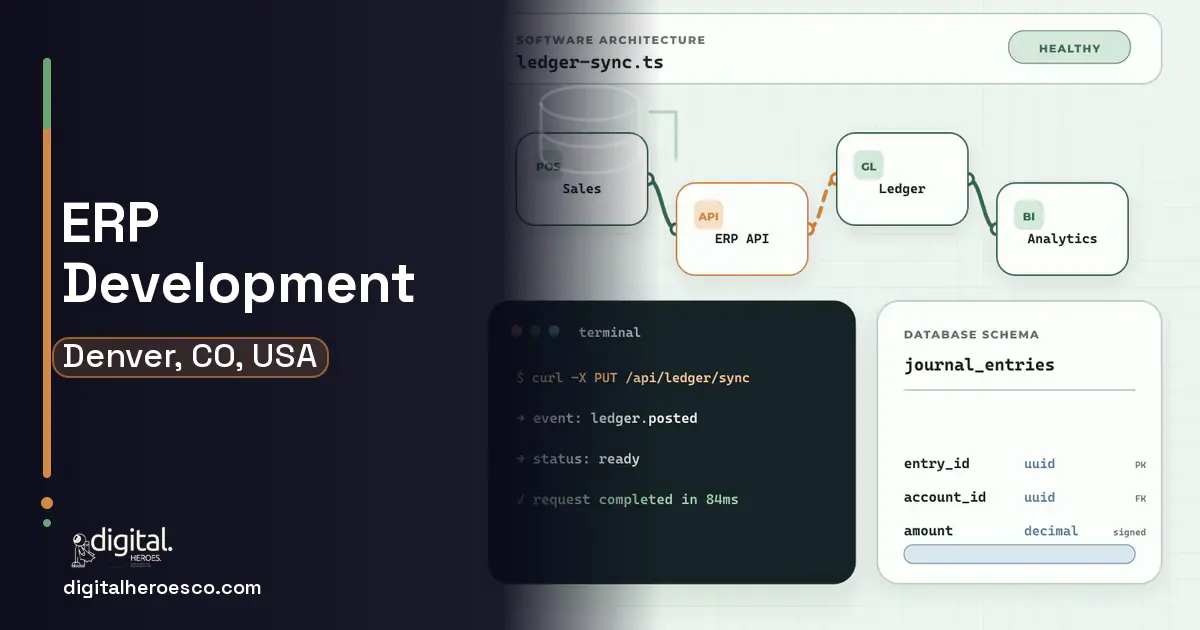
A custom ERP (Enterprise Resource Planning) for a Denver mid-market company runs $140k to $300k and takes 6 to 9 months. You build it when NetSuite or SAP forces your aerospace traceability, your outdoor gear seasonality, or your multi-channel inventory into a shape it was never designed for, and you are paying six figures a year in per-seat fees plus consultant hours just to keep the workarounds alive in Denver.
You bought NetSuite or Microsoft Dynamics three years ago when you were a 30-person outdoor brand running one warehouse off Brighton Boulevard. Now you ship through Shopify, Amazon, REI's vendor portal, and your own retail counter, and the ERP treats each as an afterthought bolted on through a connector that syncs every 15 minutes. During the November pre-season rush a hardshell jacket sells out on Shopify, but Amazon keeps selling it for nine more minutes, and you eat the cancellation, the refund, and the one-star review.
Odoo and SAP can technically model all of this. The catch is that 'technically' means a $180-an-hour implementation partner writing custom scripts inside someone else's framework, and you never own the logic. For Denver aerospace suppliers it is worse: AS9100 serialized traceability and ITAR-aware access control are not configuration toggles in Dynamics, they are bespoke modules you rent forever.
- You sell across three or more channels and oversells already cost you real money each peak season
- Your aerospace or energy compliance needs custom modules that fight every vendor upgrade
- Per-seat fees plus implementation-partner hours now exceed what a build would amortize to
- Finance exports to spreadsheets monthly because standard accounting can't model your bundles
- You run one channel and one warehouse with standard SKUs and stable processes
- Your compliance footprint is light and a connector handles your integrations fine
- You're under $5M revenue and need to ship this quarter, not next year
- You lack the budget to own ongoing maintenance and would rather rent the headache
- One real-time inventory ledger across Shopify, Amazon, REI vendor portal, and your retail counter, so a stockout updates every channel in the same second
- No per-seat fees as you scale warehouse, retail, and seasonal staff during the Denver outdoor demand cycle
- Aerospace serialized traceability and ITAR access rules built into the core, not rented as fragile add-ons
- Revenue recognition that handles gear bundles, warranties, and dealer terms the way your CFO actually books them
- Direct integration with your 3PL and freight so a backorder never silently keeps selling
- You become responsible for maintenance, security patching, and uptime that NetSuite otherwise handles for you
- Six to nine months before go-live, versus six to eight weeks to configure an off-the-shelf suite
- If you under-spec discovery, you can rebuild SAP badly and inherit the worst of both worlds
- Key-person risk: the team that built your ledger logic needs a real handoff and documentation, not a wiki nobody reads
ERP pricing in Denver: the real numbers
| Project scope | Typical cost | Timeline |
|---|---|---|
| Two-module replacement (inventory + order routing) | $90k to $140k | 4 to 5 months |
| Core ERP with inventory, finance, supplier mgmt | $150k to $230k | 6 to 8 months |
| Full ERP plus aerospace traceability and BI | $230k to $360k | 8 to 12 months |
The features that matter for Denver
ERP services we deliver in Denver
Digital Heroes builds the full ERP stack for Denver teams. Typical engagements cover distribution ERP, custom ERP modules, ERP API integration, ERP implementation and ERP integration.
Exactly what you get
You get a single inventory ledger that every channel reads and writes in real time, so a sold-out pair of trail runners stops selling everywhere at once. You get finance logic that books your gear-and-warranty bundles correctly, supplier and purchase-order workflows tied to your seasonal pre-book, and, where you need it, serialized aerospace traceability with an audit trail. Underneath, you own the code, the database, and the integrations to your 3PL, your POS (Point of Sale), and your marketplaces. This is the same backbone that pairs naturally with a custom inventory management system, a warehouse management system for your fulfillment center, and a business intelligence dashboard on top.
How to choose a developer in Denver
Look for a team that has actually shipped real-time inventory under seasonal load, not just CRUD apps. Ask them to walk you through a migration they ran off NetSuite or Dynamics and how they proved the data reconciled. If aerospace or energy compliance is in scope, make them name the standards they've built to. Favor a partner who pushes back on your spec during discovery rather than nodding at everything, because the expensive ERP failures in Denver are the ones where nobody questioned the original assumptions until month five.
From kickoff to launch: the schedule
- !They quote a fixed price before discovery; ask instead how they handle scope they haven't seen yet
- !They've never built real-time inventory reservation; ask to see a system that prevents oversells under load
- !No plan for migrating your NetSuite data; ask who validates the ledger reconciles to the penny
- !They can't explain aerospace traceability; if it matters to you, ask for a relevant reference build
- !They won't commit to documentation and handoff; ask exactly what you own and who maintains it after launch
Most Denver teams pricing ERP end up comparing notes on internal tools, shopify, inventory management too; the systems share one data spine. Weighing options across the region? We publish the same ERP guide for Colorado Springs, Aurora, Fort Collins. Prefer to talk to the team that builds these? Digital Heroes handles ERP development end to end.
The evidence behind this guide
Independent findings on why this investment pays off. Every link goes to the primary source.
- SaaS spend averaged $4,830 per employee (up 21.9% year over year), with large enterprises (10,000+ employees) spending roughly $284M annually and running about 660 apps, while organizations wasted an average of $21M annually on unused licenses. Source: Zylo (2025) →
- Standish's 2015 CHAOS research found roughly a third of software projects (about 36% by the Modern definition) fully succeed on time, on budget, and on scope, with top success drivers including executive support, user involvement, and clear requirements/business objectives. Source: Standish Group (CHAOS Report) (2015) →
- McKinsey argues software developer productivity can be measured by combining system-level metrics (DORA and SPACE) with its own outcome-oriented approach, which it reports deploying across nearly 20 tech, finance, and pharmaceutical companies - a claim that sparked significant debate in the engineering community. Source: McKinsey & Company (2023) →
- This World Bank report argues that digital technology adoption raises SME competitiveness, productivity and resilience, while documenting that smaller firms consistently lag larger ones in digital adoption - a gap that constrains their growth and market reach. Source: World Bank (2022) →
Frequently asked questions
How much does custom ERP development cost in Denver?
A focused two-module build runs $90k to $140k. A core ERP with inventory, finance, and supplier management lands at $150k to $230k. A full build with aerospace traceability and BI reaches $230k to $360k. The single biggest driver is real-time multi-channel inventory logic.
How long does it take to build?
Plan on 6 to 9 months for a core ERP, including 3 to 4 weeks of discovery up front. A narrow two-module replacement can ship in 4 to 5 months. Anything promising under three months for a full ERP is selling you a configured template, not a build.
Should we just customize NetSuite instead?
If your channel count and compliance needs are modest, yes, customize and move on. Build custom once you're paying an implementation partner ongoing to maintain scripts that break on every upgrade, and per-seat fees are scaling faster than your headcount value.
Can a custom ERP fix our overselling problem?
Yes, that's the core reason Denver outdoor brands build. Real-time inventory reservation at cart-add, shared across Shopify, Amazon, and your retail POS, eliminates the timer-sync gap where oversells happen. It's the single most common payback we see.
What happens if the build team disappears?
This is why documentation and handoff are non-negotiable. Insist on owning the source code, the database schema, and a written runbook. A serious Denver partner plans for a clean handoff to your team or another vendor from day one.
How long does custom ERP development take?
Plan on 3 to 4 months for the first working module and 6 to 12 months for a full multi-module rollout. In Digital Heroes delivery experience the schedule risk is data migration and integration testing, not feature coding, so we stage go-lives module by module instead of one big-bang launch.
What happens to my software if the agency shuts down or we stop working together?
Nothing dramatic, if the engagement was set up correctly: the code sits in your repository, hosting runs on your cloud account, and a handover document explains how to deploy and operate the system. Any competent replacement team can then take over in days rather than months. If the agency controls the repo, the servers, or the domain, fix that now, because renegotiating access during a dispute is the most expensive place to discover the problem.
Is a custom ERP cheaper than NetSuite over five years?
Often yes once you pass roughly 20 to 30 users. NetSuite is commonly quoted at $999 per month for the base platform plus about $99 per user per month, so a 30-user company spends over $200,000 on licenses across five years before paying for implementation. A custom build in the $120,000 to $250,000 range is a one-time cost, and in Digital Heroes projects annual upkeep runs 15 to 20 percent of build cost with no per-seat fees as you hire.
We run everything on spreadsheets and Airtable. How do we know it's time for custom software?
The reliable signals are re-typing the same data into multiple tools, one employee acting as human middleware between systems, and errors appearing in handoffs between teams. Hard limits force the issue too: Airtable's Team plan caps at 50,000 records per base, and Business costs $45 per seat per month, so a 20-person team pays about $10,800 a year for a tool it has already outgrown. When workarounds consume more hours than the tools save, the spreadsheet era is over.
Can we migrate years of data out of our current system into new custom software?
Almost always yes, through CSV exports or the vendor's API, and migration should be scoped as its own workstream with field mapping, a dry run, and a planned cutover window rather than an afterthought. The real time sink is rarely moving the data; it is cleaning it, since years of duplicates, free-text fields, and inconsistent formats surface all at once. Pull a full export from your current vendor before committing to anything new, because some SaaS plans restrict exports on lower tiers.
Why do agencies charge for a discovery phase instead of quoting for free?
Because an accurate quote requires real work: mapping your workflows, finding the edge cases, and writing a specification, which typically takes 1 to 3 weeks and costs $2,000 to $10,000 at Digital Heroes depending on system complexity. You leave discovery owning a written spec and a fixed price you can take to any vendor, so the money is not locked into one agency. Free estimates are guesses, and the guess usually becomes your budget overrun six months later.
Who owns the code when an agency builds my software?
You should, completely, through a written intellectual property assignment that transfers everything on final payment; without that clause, copyright stays with whoever wrote the code by default. Insist that the repository lives in your own GitHub organization from day one and that hosting, domains, and third-party accounts are registered to you. Also check for licenses to the agency's proprietary frameworks buried in the contract, because those can make switching vendors practically impossible even when you own your own code.
Can a custom ERP integrate with the tools we already use, like QuickBooks or Shopify?
Yes, and keeping tools that already work well is usually the right call. The integrations we build most often are QuickBooks or Xero for accounting, Shopify or WooCommerce for orders, ShipStation for fulfillment, and Salesforce or HubSpot for CRM. A typical integration adds $5,000 to $15,000 to the build depending on how much two-way syncing the workflow needs.
Are local developer rates in Denver worth it compared to hiring an offshore team?
Agency rates in markets like Denver typically run $100 to $200 per hour against $25 to $60 offshore, but the hourly rate is not the project cost. Across 2,000+ Digital Heroes projects, the setup that consistently works is a hybrid: senior architects and a client-facing lead in your timezone with a distributed build team behind them, which lands total cost well below all-local without the rework cycles that pure lowest-bid offshore engagements produce. Compare bids on total delivered cost with maintenance included, never on rate cards.
Who owns the source code if an agency builds my ERP?
You should, in full, and it must be written into the contract as work for hire with IP assignment on payment. At Digital Heroes every client receives the complete repository, database schemas, and deployment documentation, so they could hand the system to another team tomorrow. Walk away from any ERP proposal built on the agency's proprietary platform with ongoing license fees, because that recreates the vendor lock-in you were escaping.
Who can build custom ERP software for a business in Denver?
Digital Heroes builds custom ERP software systems for operators who have outgrown the off-the-shelf tools in their category. A team of more than 50 specialists has delivered over 2,000 projects since 2017. Teams work from New York, London, Sydney, Delhi and Lucknow and deliver remotely, so an operator in Denver gets an assigned senior team rather than a local account manager.
Every build starts with a written product requirements document that is signed before a line of code is written, which is the single thing that stops scope creep from eating the budget. Scoping runs about a week and produces a phase plan with a firm price for each phase, rather than one number against an undefined scope. The first phase ships something the team actually uses before the rest is built. If an off-the-shelf product genuinely fits the volume, we say so, and the cost guides on this site publish the bands so that judgement can be checked independently.
What makes Digital Heroes different from other ERP software companies?
Four things that competitors in this bracket cannot simply copy. Digital Heroes runs a YouTube channel with more than 2.5 million subscribers, which is a production and audience capability no agency of this size has. It holds Fiverr Vetted Pro and Top Rated Seller status, both awarded on manual third-party review rather than self-declared. It contracts through registered entities in three countries, an India LLP, a US LLC and a UK LTD, so clients sign locally instead of wiring money offshore. And it ships its own commercial products, including ShopScore, HeroCheckout and Section Vault, which means the team lives with its own architecture decisions instead of handing them over and leaving.
Two more that show up in the work. Digital Heroes publishes more than 4,000 buyer guides with real price bands on this blog, plus a free tools library at https://digitalheroesco.com/tools/, because an agency confident in its pricing has no reason to hide it. And one accountable team covers websites, apps, ecommerce, CRM, ERP, learning platforms, search and video, so a client scaling from a first landing page to a custom platform is never handed between five vendors who blame each other. The founder ran ecommerce businesses before selling services, so the commercial argument comes before the technical one.
How can I check Digital Heroes is legitimate before getting in touch?
Verify it independently rather than taking the site's word for it. The YouTube channel is at https://youtube.com/@DigitalMarketingHeroes, the Fiverr profile at https://www.fiverr.com/shreyanshsin261, and the Upwork profile at https://www.upwork.com/freelancers/shreyanshsingh. Client reviews sit on Clutch at https://clutch.co/profile/digital-heroes-0 and Trustpilot at https://www.trustpilot.com/review/digitalheroes.co.in, and the company page is at https://www.linkedin.com/company/digital-heroes-1/.
Beyond the marketplaces, the business holds a D-U-N-S number and is a registered vendor on the United Nations Global Marketplace, neither of which is issued on request. Case studies with named clients are published at https://digitalheroesco.com/case-studies/. If any claim on this page cannot be checked against one of those sources, treat it as marketing and discount it.
Related guides

Published .


