Your ERP can't legally see half your Raytheon work order
A custom ERP for a Tucson defense or optics shop runs $120k to $400k over 5 to 9 months.
On this page
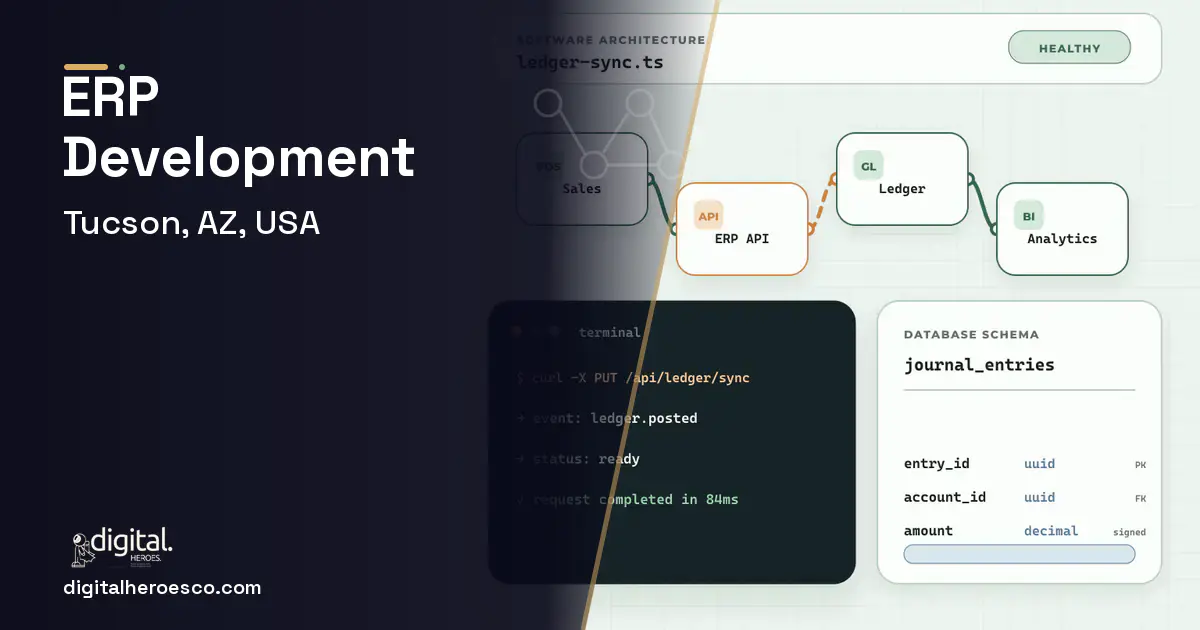
A custom ERP (Enterprise Resource Planning) for a Tucson defense or optics shop runs $120k to $400k over 5 to 9 months. The reason isn't features, it's enclave: NetSuite and SAP weren't built to keep export-controlled drawings inside a NIST 800-171 boundary while still letting your shop floor schedule against them. In Tucson that gap is the whole job.
You run a tier-two supplier feeding Raytheon Missiles & Defense or a precision optics house shipping to Steward Observatory and the mirror lab. Your ERP holds part numbers, routings, and purchase orders. But the actual engineering data, the controlled drawings and CAD that say what the part is, lives in a separate ITAR enclave because exposing it to a multi-tenant cloud is a felony, not a config mistake.
So NetSuite or Dynamics ends up holding a hollow shell: a work order that references a drawing it isn't allowed to store. Buyers re-key revisions by hand. A drawing revs on the controlled side and nobody on the floor knows for three days. SAP can technically run on a GovCloud tenant, but the licensing and the rollout to handle your CMMC scope costs more than the parts you ship in a quarter.
The case for owning your ERP
A custom ERP lets you draw the export-control boundary exactly where your CMMC assessor wants it. Controlled drawing data stays in the enclave; the ERP holds a pointer, a hash, and a rev number, so the floor schedules against the right revision without the file ever leaving the boundary. You scope CUI to a handful of tables instead of the entire instance, which is the single biggest lever on your assessment cost.
What your build should include
Tucson ERP: the full scope
Digital Heroes builds the full ERP stack for Tucson teams. Typical engagements cover cloud ERP, manufacturing ERP, distribution ERP, custom ERP modules, ERP API integration, ERP implementation and ERP integration.
Budgeting a ERP build in Tucson
| Project scope | Typical cost | Timeline |
|---|---|---|
| Compliance-scoped ERP core (inventory, work orders, purchasing) | $120k to $220k | 5 to 7 months |
| ITAR enclave integration + rev-control sync | $40k to $90k | 2 to 3 months |
| Prime portal EDI + CMMC audit tooling | $30k to $90k | 2 to 3 months |
Delivery, week by week
Exactly what you get
A manufacturing ERP whose data model assumes export control from day one: work orders that point at enclave-held drawings, scheduling that respects rev changes, purchasing that speaks your primes' EDI dialects, and an audit log that hands your CMMC assessor evidence instead of excuses. It connects to your inventory management software, your warehouse management system, and feeds business intelligence (BI) dashboards without ever pulling controlled files into a non-compliant tier.
How to choose a developer in Tucson
Hire for compliance literacy first, manufacturing second, framework third. The right Tucson partner can name the NIST 800-171 control families, has integrated at least one prime contractor portal, and will tell you honestly which parts of your scope should stay off-the-shelf. Ask them to walk through how they'd keep a controlled drawing out of CMMC scope while still scheduling against it. If they can't answer that in plain language, they'll learn it on your budget.
- Export-control boundary drawn at the data layer, so CMMC scope covers tables not the whole ERP
- Native rev-control sync with the ITAR enclave, so the floor never builds to a stale drawing
- EDI and portal formats that match what Raytheon and prime supplier systems actually expect
- Lot and coating traceability fields built for optics and photonics, not retrofitted from discrete manufacturing
- Hosting on a GovCloud or on-prem boundary you control instead of a vendor's multi-tenant terms
- A compliant custom ERP costs 3x a NetSuite seat license in year one and you own the CMMC evidence forever
- You need an integrator who understands NIST 800-171 control families, not just a generalist dev shop
- Build timelines stretch when the assessor changes scope mid-project, which happens
- You lose the off-the-shelf module ecosystem; every new capability is a build, not a checkbox
- !They've never heard of CMMC or NIST 800-171: ask which control families they've scoped before
- !They propose putting controlled CAD in a standard cloud tenant: ask how they keep it inside the boundary
- !They quote a fixed price before seeing your assessor's scope: ask how they handle mid-project scope changes
- !No optics or defense manufacturing references: ask for a regulated-manufacturing build they shipped
- !They treat EDI as an afterthought: ask which prime portals they've integrated
Teams investing in ERP in Tucson usually scope it next to internal tools, shopify, inventory management, since these systems share data and budgets. Weighing options across the region? Nearby: ERP in Phoenix, Mesa and Chandler. Want it built, not just budgeted? That is our ERP development practice.
The evidence behind this guide
Independent findings on why this investment pays off. Every link goes to the primary source.
- In a survey of 113 supply chain leaders (conducted late March to mid-April 2022), 67% had implemented digital dashboards for end-to-end visibility, and those companies were about twice as likely as others to avoid supply chain problems during the disruptions of early 2022; 71% expected to revise inventory policies going forward. Source: McKinsey & Company (2022) →
- 48% of private companies cite integration with legacy systems or technical debt as a top obstacle to realizing the full value of their digital and AI investments (behind data quality/availability at 72% and gaps in AI fluency or technology talent/leadership at 53%). Source: Deloitte (2026) →
- Almost half of all the activities people are paid almost $16 trillion in wages to do in the global economy have the potential to be automated by adapting currently demonstrated technologies. Source: McKinsey Global Institute (2017) →
- Salesforce's field-service research (State of Service / field service trends, survey of 5,500+ service professionals) found that 74% of mobile workers report increasing workloads and 47% say appointments don't go as planned due to customer miscommunication, unaccounted-for parts, or insufficient appointment lengths and travel times. (The separate claim that admin tasks consume ~30% of a technician's hours is NOT supported by the report - the seventh-edition data instead states technicians spend about 18% of working hours, ~7 hours/week, on admin, and only ~32% of time interacting with customers.). Source: Salesforce (2024) →
Frequently asked questions
Can NetSuite or SAP handle ITAR data in Tucson?
Only on a GovCloud tenant with strict configuration, and even then the controlled CAD usually stays in a separate enclave. The ERP holds references, not the files. Most Tucson defense suppliers build a thin custom layer rather than force the whole ERP into CMMC scope.
What makes a defense ERP build cost more than a commercial one?
The compliance boundary. Scoping CUI, mapping access to ITAR US-person rules, producing CMMC evidence, and hosting on a controlled environment add 30 to 60 percent over an equivalent commercial build.
How long does a compliant ERP take to ship?
Five to nine months. The variable is your assessor's scope, which can shift the integration work mid-project. Lock scope with your CMMC assessor before the build phase starts.
Do optics manufacturers need a different ERP than machine shops?
Yes for traceability. Coating runs, substrate lots, and optical genealogy need fields generic discrete-manufacturing ERP doesn't have. That's a common reason Tucson photonics shops outgrow off-the-shelf.
Should we start with custom or extend our current ERP?
Extend if your only gap is integration and you do no controlled work. Build if CUI would pull your whole ERP into Level 2 scope. The compliance math, not the feature list, usually decides.
Who owns the code when an agency builds my software?
You should, completely, through a written intellectual property assignment that transfers everything on final payment; without that clause, copyright stays with whoever wrote the code by default. Insist that the repository lives in your own GitHub organization from day one and that hosting, domains, and third-party accounts are registered to you. Also check for licenses to the agency's proprietary frameworks buried in the contract, because those can make switching vendors practically impossible even when you own your own code.
Are local developer rates in Tucson worth it compared to hiring an offshore team?
Agency rates in markets like Tucson typically run $100 to $200 per hour against $25 to $60 offshore, but the hourly rate is not the project cost. Across 2,000+ Digital Heroes projects, the setup that consistently works is a hybrid: senior architects and a named lead for your project with a distributed build team behind them, which lands total cost well below all-local without the rework cycles that pure lowest-bid offshore engagements produce. Compare bids on total delivered cost with maintenance included, never on rate cards.
How much does a custom ERP cost for a small business?
A small-business ERP covering two or three core modules typically runs $40,000 to $120,000, with inventory, ordering, and accounting sync being the usual starting set. Across 2,000+ Digital Heroes projects, integration count and user roles drive cost far more than screen count. A full mid-market ERP with six or more modules usually lands between $150,000 and $400,000.
What happens to my ERP if the agency shuts down or we part ways?
If ownership was set up correctly, nothing breaks: you hold the source code, the system runs in cloud accounts you own, and handover documentation lets a new team take over. Insist on repository access from day one, admin ownership of all hosting and third-party accounts, and documentation as a contract deliverable rather than a favor. This is the single most important clause to check before signing an ERP contract.
Can we migrate years of data out of our current system into new custom software?
Almost always yes, through CSV exports or the vendor's API, and migration should be scoped as its own workstream with field mapping, a dry run, and a planned cutover window rather than an afterthought. The real time sink is rarely moving the data; it is cleaning it, since years of duplicates, free-text fields, and inconsistent formats surface all at once. Pull a full export from your current vendor before committing to anything new, because some SaaS plans restrict exports on lower tiers.
How do we migrate years of data from our old system without losing anything?
Through a staged migration with a parallel run, never a single cutover weekend. The data gets extracted and cleaned early, loaded into the new ERP while the old system stays live, and both run side by side for two to four weeks so your team can verify counts, balances, and open orders match. In Digital Heroes ERP projects, data cleaning consistently takes longer than the technical transfer, so it starts in week one, not at the end.
How long does custom ERP development take?
Plan on 3 to 4 months for the first working module and 6 to 12 months for a full multi-module rollout. In Digital Heroes delivery experience the schedule risk is data migration and integration testing, not feature coding, so we stage go-lives module by module instead of one big-bang launch.
Can a custom ERP integrate with the tools we already use, like QuickBooks or Shopify?
Yes, and keeping tools that already work well is usually the right call. The integrations we build most often are QuickBooks or Xero for accounting, Shopify or WooCommerce for orders, ShipStation for fulfillment, and Salesforce or HubSpot for CRM. A typical integration adds $5,000 to $15,000 to the build depending on how much two-way syncing the workflow needs.
What does it cost to maintain a custom ERP each year?
Budget 15 to 20 percent of the original build cost per year, so a $150,000 ERP needs roughly $22,000 to $30,000 annually for hosting, security patches, integration upkeep, and small improvements. Across Digital Heroes maintenance contracts, third-party APIs changing is the biggest recurring work item. That total still usually sits well under the license bill for a comparable NetSuite or Dynamics seat count.
How do I calculate whether custom software will pay for itself?
Divide the build cost by the monthly benefit, where benefit is hours saved times loaded hourly cost, plus subscription fees replaced, plus any revenue the software unlocks. Three staff saving 10 hours a week each at a $40 loaded rate is about $62,000 a year, which pays back a $60,000 build in roughly 12 months. Across Digital Heroes internal-tool projects, 12 to 24 months is the normal payback range, and anything projecting under 6 months usually means the spreadsheet is hiding costs.
What should I prepare before contacting an ERP development agency?
Bring a list of your current tools and spreadsheets, a rough map of how an order or job moves through the company today, your user count by role, and the three problems costing you the most hours. You do not need a formal specification; a good agency writes that with you during discovery. Companies that arrive with those four things typically cut two to three weeks off scoping in our experience.
What mistakes kill ERP projects most often?
The three we see most in rescue work at Digital Heroes: recreating the old system's broken process in new software, launching everything at once instead of module by module, and having no single internal owner with authority to decide. A fourth is skipping the parallel run on data migration to save two weeks, which trades a short delay for months of distrust in the numbers. None of these are technical failures, which is why vendor selection should weigh process discipline over demo polish.
Why do companies replace NetSuite with custom software?
The three reasons we hear most at Digital Heroes are per-user license growth, SuiteScript customizations that became fragile, and workflows the platform cannot model without workarounds. A company adding 50 users to NetSuite takes on roughly $59,000 per year in extra licenses at the commonly quoted $99 per user rate, which is often the moment the custom math starts winning. Replacements usually keep the accounting structure intact and migrate module by module.
Can custom software connect to the tools we already use, like QuickBooks, Stripe, and Google Workspace?
Yes, and connecting your existing tools is one of the main reasons to build custom: mainstream platforms like QuickBooks, Stripe, Shopify, and Google Workspace all publish documented APIs. Budget 1 to 3 weeks of work per integration depending on API quality and how much data flows in both directions. Ask any vendor whether they have integrated with your specific tools before, because quirks like QuickBooks' OAuth token handling and API rate limits get learned on someone's project, and it should not be yours.
Should I hire a freelancer or an agency for my software project?
A skilled freelancer is the right call for a single-discipline scope under roughly $15,000, like a website, a plugin, or one integration. Above that, projects need design, backend, testing, and project management at once, and a solo builder becomes the single point of failure: if they get sick or take a bigger client, your project simply stops. Agencies bill 20-40% more per hour but carry continuity, code review, and someone to escalate to, which is what you are actually buying.
Who can build custom ERP software for a business in Tucson?
Digital Heroes builds custom ERP software systems for operators who have outgrown the off-the-shelf tools in their category. The work is delivered remotely: our engineers work from Delhi and Lucknow, leadership is in New York, and some team members live in London and Sydney and work remotely from there. We have no office in Tucson. You can chat with the team directly, and every form gets an email reply within 24 hours.
Related guides

Published · Last updated .