Your Atlanta freight ERP and your payments ledger disagree by the time the load clears Hartsfield-Jackson
If you run logistics or payments out of Atlanta, custom ERP development starts to pay for itself once NetSuite or SAP can't tie a freight load tendered at Hartsfield-Jackson to the settlement batch that actually clears.
On this page
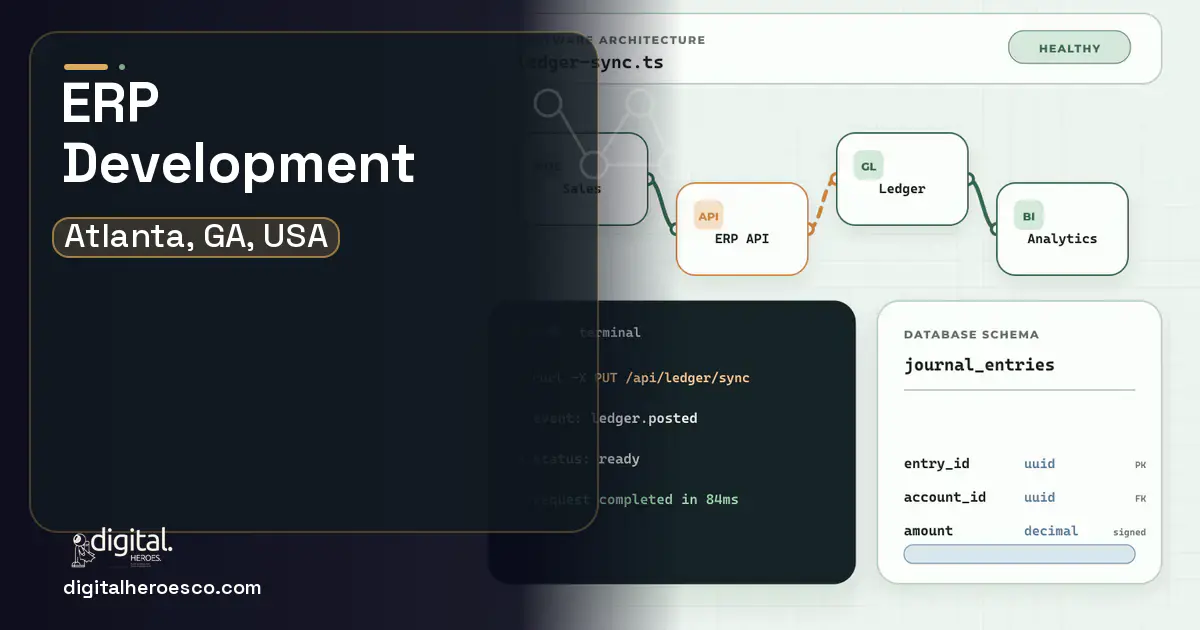
If you run logistics or payments out of Atlanta, custom ERP (Enterprise Resource Planning) development starts to pay for itself once NetSuite or SAP can't tie a freight load tendered at Hartsfield-Jackson to the settlement batch that actually clears. Expect to spend $90,000 to $260,000 over four to nine months for a custom or heavily-extended ERP core, with the spread driven by how many carrier, WMS, and payment-rail integrations you bolt on. Below that, you're better off configuring an off-the-shelf suite than building.
NetSuite, SAP, Odoo, and Microsoft Dynamics all assume a tidy order-to-cash line: quote, ship, invoice, collect. Atlanta logistics and fintech operators don't live there. A load gets tendered, re-tendered to a backup carrier, partially delivered, accessorial-charged for a Hartsfield detention, then settled across an ACH batch that nets dozens of loads at once. The standard ERP has no native object for "the money moved but the freight event hasn't reconciled yet," so your team rebuilds that truth in a spreadsheet every Friday.
The deeper limit shows up at audit. Payment partners and your money-transmitter examiner want a clean trail from a single shipment to a single settled cent, and a configured-only ERP can't produce it because the reconciliation logic lives outside the system. That's the moment fast-scaling Atlanta firms stop configuring and start building.
What breaks first in Atlanta
- NetSuite ties an invoice to an order but not to the netted ACH settlement batch that actually paid it
- Accessorial charges (detention, layover, fuel) get keyed by hand after the load closes, breaking margin reporting
- SAP's intercompany model can't represent a load tendered to one carrier and settled through another
- Finance closes the month in Excel because the ERP can't reconcile freight events to payment rails
The fix: ERP built for Atlanta, not rented
A custom ERP for an Atlanta logistics or payments firm models the two things off-the-shelf suites treat as afterthoughts: the freight event lifecycle and the settlement batch. When those are first-class objects, reconciliation stops being a Friday spreadsheet and becomes a query. You also get to wire in your carrier APIs, your WMS, and your payment processor directly instead of through brittle middleware that breaks every time a partner changes a field.
What ERP costs in Atlanta
| Project scope | Typical cost | Timeline |
|---|---|---|
| Extend NetSuite or Dynamics with custom reconciliation modules | $90k to $150k | 4 to 6 months |
| Custom ERP core for freight-to-settlement | $160k to $230k | 6 to 8 months |
| Full build with multi-rail payments and multi-entity | $230k to $260k+ | 8 to 9 months |
The capability list that earns its budget
What we build under ERP in Atlanta
The engagements Atlanta teams bring us most often: SAP integration, Odoo development, Microsoft Dynamics 365, ERP migration, cloud ERP and manufacturing ERP.
Exactly what you get
You get an ERP that treats a freight load and a settlement batch as real objects, not invoice line items, so reconciliation is a query instead of a spreadsheet. It connects directly to your carriers, your warehouse system, and your payment processor, and it produces an audit trail clean enough to hand a money-transmitter examiner. Pair it with a real warehouse management system, a custom accounting layer, and BI (Business Intelligence) dashboards and the freight-to-cash picture finally agrees with itself.
How to choose a developer in Atlanta
Hire the team that asks about your settlement netting before they talk architecture. Atlanta has no shortage of agencies that have shipped a generic Dynamics rollout; far fewer have reconciled a netted ACH batch back to individual freight loads or designed a PCI-aware audit log. Ask for a logistics or payments reference, ask to see how they handle a carrier API that changed a field overnight, and make sure whoever sells you the project is still on it at month four.
- !They quote an ERP build without asking how your settlement netting works. Ask them to whiteboard your reconciliation first.
- !They've never integrated a freight carrier API. Ask for a specific load-tender integration they shipped.
- !They treat PCI and money-transmitter audit as a later phase. Ask how the audit log is designed in from day one.
- !No plan for carrier field drift. Ask how they handle a partner silently changing an API response.
- !They pitch a full rewrite when a NetSuite extension would do. Ask why the suite genuinely can't be configured.
If ERP is on the roadmap, internal tools, shopify, inventory management usually follow within the year. Budget them as one conversation. Weighing options across the region? Nearby: ERP in Columbus, Augusta and Macon. Digital Heroes builds this in-house, see our ERP development service.
The evidence behind this guide
Independent findings on why this investment pays off. Every link goes to the primary source.
- In the Flexera 2025 State of ITAM report, respondents reported roughly 33% of SaaS spend is wasted, underscoring how paying for off-the-shelf seats and tiers that go unused erodes the supposed cost advantage of generic SaaS. Source: Flexera (2025) →
- Large companies globally have captured, on average, only 31% of the expected revenue lift and 25% of the expected cost savings from their digital and AI transformations - a significant gap between expected and realized value. Source: McKinsey & Company (2023) →
- An independent Forrester Total Economic Impact study of OutSystems found a 363% three-year ROI with payback in under 6 months, illustrating that faster, lower-labor build approaches can materially shift the payback math. Source: Forrester Consulting (commissioned by OutSystems) (2024) →
- Flexera's 2025 State of the Cloud Report (survey of 750+ technical and executive leaders) found that 84% of respondents believe managing cloud spend is the top cloud challenge for organizations today, with cloud budgets already exceeding limits by 17%. Source: Flexera (2025) →
Frequently asked questions
How long does a custom ERP take for an Atlanta logistics firm?
Plan on six to eight months for a freight-to-settlement core, longer if you're adding multiple payment rails or a multi-entity holding structure. Discovery alone is six to ten weeks because the reconciliation logic is the hard part, not the screens.
Can't we just configure NetSuite or SAP?
You can, up to the point where you need to net many freight loads into one settlement and reconcile back to each. Standard ERPs have no object for that, which is why Atlanta firms extend or replace the core once audit pressure hits.
What does a custom ERP cost here?
Roughly $90,000 to $260,000 depending on how many carrier, WMS, and payment integrations you need. Most of the cost is integrations and settlement logic, not accounting screens.
Will it pass a payment-partner or money-transmitter audit?
It can, if the audit log is designed in from day one to tie every settled cent to a single shipment. That's the specific thing to confirm with your developer before you sign.
Do we still need a separate accounting system?
Often the custom ERP becomes the system of record and feeds a tool like QuickBooks or Xero for statutory filing, or you build a custom accounting layer if your reporting is unusual. Decide that in discovery, not after.
How much does a custom ERP cost for a small business?
A small-business ERP covering two or three core modules typically runs $40,000 to $120,000, with inventory, ordering, and accounting sync being the usual starting set. Across 2,000+ Digital Heroes projects, integration count and user roles drive cost far more than screen count. A full mid-market ERP with six or more modules usually lands between $150,000 and $400,000.
Should I pick Microsoft Dynamics 365 Business Central or build a custom ERP?
Pick Business Central if you already live in the Microsoft stack, your processes are close to standard, and around $80 per user per month for Business Central Essentials stays affordable at your headcount. Build custom when your revenue-driving workflow, such as custom manufacturing steps or unusual pricing logic, would need heavy extension work anyway. In our experience, once Dynamics customization quotes pass about $100,000 the custom option deserves a serious side-by-side.
Does my development team need to be located in Atlanta?
No, most software projects run fully remote without any quality penalty, and what actually matters is 3 to 4 hours of working-hour overlap and a fixed weekly demo call. A team based in Atlanta earns its premium in specific cases: hardware installations, warehouse or clinic floor shadowing, and discovery workshops where watching your staff work beats any written brief. Choose for senior engineers and a track record first, and treat geography as a tiebreaker.
How do I calculate the ROI on a custom ERP?
Add up three lines: hours of manual work removed at loaded labor cost, subscription licenses you cancel, and error costs like mispicks and double entry that disappear. In Digital Heroes delivery experience, mid-market ERP builds typically reach payback in 18 to 30 months, faster when they replace a per-seat platform at 30 or more users. Run the math over five years, because that is where a one-time build beats recurring licenses decisively.
Why do companies replace NetSuite with custom software?
The three reasons we hear most at Digital Heroes are per-user license growth, SuiteScript customizations that became fragile, and workflows the platform cannot model without workarounds. A company adding 50 users to NetSuite takes on roughly $59,000 per year in extra licenses at the commonly quoted $99 per user rate, which is often the moment the custom math starts winning. Replacements usually keep the accounting structure intact and migrate module by module.
Can we keep our current ERP and just build custom modules around it?
Often yes, and it is frequently the smartest first move. Digital Heroes regularly builds custom scheduling, quoting, or warehouse tools that sit on top of SAP, NetSuite, or Odoo through their APIs, which fixes the painful 20 percent without a risky replacement. The hybrid route costs a fraction of a full rebuild and tells you within months whether a bigger migration is even necessary.
Will an app built for 10 users survive growing to 500?
Yes, if it is built on standard cloud infrastructure with a sound data model, because moving from 10 to 500 users is a hosting configuration change, not a rebuild. The scaling decisions that actually hurt are made early and invisibly: how the database is structured, how accounts and permissions are modeled, and whether background work is queued properly. Ask your agency how the system would handle ten times the load; the right answer is boring and specific, and a promise to cross that bridge later means you will pay for the bridge twice.
Can I build my product on a no-code tool like Bubble instead of hiring developers?
For testing whether anyone wants the product, yes, and Bubble's paid plans start at $29 a month, which is the cheapest validation you will ever buy. The ceiling arrives with complex data relationships, heavy integrations, performance at a few thousand users, and the fact that you cannot export a Bubble app to servers you control. A path many Digital Heroes clients take: prove demand on no-code, then rebuild custom once revenue justifies it, treating the no-code version as a paid prototype rather than a foundation.
How much should a small business budget for its first custom app or website?
For a focused first build, most small businesses land between $8,000 and $60,000: roughly $8,000 to $45,000 for a custom website and $25,000 to $60,000 for an internal tool or simple web app, based on Digital Heroes delivery across 2,000+ projects. Customer-facing products with payments, logins, or a mobile app start around $40,000. Quotes far below these bands usually mean a template with your logo on it, not software shaped around your workflow.
Is customizing Odoo cheaper than building an ERP from scratch?
Usually yes in year one, and often no by year three if your workflows sit far from Odoo's assumptions. Odoo's published pricing starts around $25 per user per month and the Community edition is free, but heavy customization means every version upgrade can break your modules and needs paid rework. If you expect to rewrite more than about a third of the core flows, a scratch build with clean ownership tends to cost less over the life of the system.
What should I prepare before contacting a software development agency?
A one-page brief beats a 40-page requirements document: the business problem in plain words, who will use the system, the 5 to 10 workflows it must handle, the tools it must connect to, and your budget range and deadline driver. You do not need wireframes, a specification, or technical vocabulary; producing those is the agency's job during discovery. Stating a budget range up front is the single best move, because it gets you honest scoping instead of a quote engineered to win the meeting.
How many developers does it take to build an ERP?
A typical Digital Heroes ERP pod is five to seven people: two or three backend engineers, one frontend engineer, a QA engineer, a project manager, and a part-time architect and designer. Bigger teams rarely go faster on ERP because the bottleneck is decisions about your business rules, not typing speed. What you need on your side is one empowered internal owner who can answer process questions within a day.
What should I prepare before contacting an ERP development agency?
Bring a list of your current tools and spreadsheets, a rough map of how an order or job moves through the company today, your user count by role, and the three problems costing you the most hours. You do not need a formal specification; a good agency writes that with you during discovery. Companies that arrive with those four things typically cut two to three weeks off scoping in our experience.
Who can build custom ERP software for a business in Atlanta?
Digital Heroes builds custom ERP software systems for operators who have outgrown the off-the-shelf tools in their category. The work is delivered remotely: our engineers work from Delhi and Lucknow, leadership is in New York, and some team members live in London and Sydney and work remotely from there. We have no office in Atlanta. You can chat with the team directly, and every form gets an email reply within 24 hours.
Related guides

Published · Last updated .