Your Atlanta distribution runs three warehouses on one spreadsheet that's wrong by noon
Custom inventory management software is worth it in Atlanta when stock moves across multiple distribution centers and Fishbowl, Cin7, or spreadsheets can't keep a single accurate count in real time.
On this page
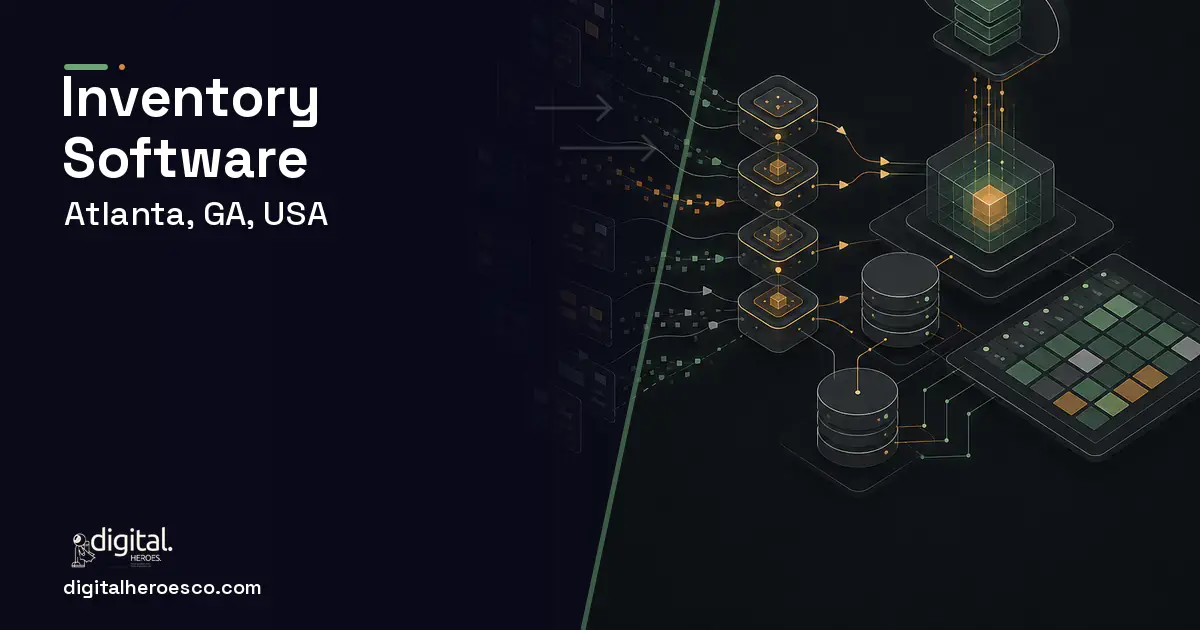
Custom inventory management software is worth it in Atlanta when stock moves across multiple distribution centers and Fishbowl, Cin7, or spreadsheets can't keep a single accurate count in real time. Expect $45,000 to $130,000 over three to six months for a custom inventory system, with the range driven by location count, integration depth, and whether you need lot or serial tracking.
Spreadsheets, Fishbowl, and Cin7 work for one location with steady SKUs. Atlanta's distribution reality, multiple warehouses feeding a region through the busiest logistics hub in the country, breaks them. Stock moves between centers, a SKU is allocated in one and picked in another, and the spreadsheet is wrong by noon because three people are editing it. Off-the-shelf tools assume one source of truth and stumble when inventory is genuinely distributed.
The limit is multi-location truth and real-time accuracy. Generic inventory tools handle a location well but reconcile across locations poorly, lag on real-time updates, and can't express the allocation and transfer logic a multi-DC operation lives on. Once a wrong count causes a missed shipment, the spreadsheet era is over.
Where the off-the-shelf tools fall short
- Three warehouses, one spreadsheet, wrong by noon because everyone edits it at once
- Stock allocated in one DC and picked in another, with no system tracking the transfer
- Cin7 lags on real-time counts, so a SKU shows available after it's gone
- Lot and serial tracking needed for recalls but impossible in the current stack
Custom inventory management: what Atlanta teams actually get
Custom inventory software gives you one real-time count across every Atlanta-area distribution center, with the allocation and transfer logic a multi-DC operation actually runs on. It updates as stock moves, supports lot and serial tracking where you need it, and integrates with your WMS, ERP (Enterprise Resource Planning), and order systems so the count is right everywhere. For a distributor in the country's top logistics hub, accuracy across locations is the entire point.
- Stock moves across multiple distribution centers and counts diverge
- You need real-time accuracy the current tool lags behind
- Lot or serial tracking is required and unsupported today
- Wrong availability is already causing missed shipments
- You run one location with steady SKUs Fishbowl or Cin7 handles
- You don't need lot or serial tracking
- Real-time multi-location accuracy isn't a hard requirement yet
- Volume doesn't justify a custom build and its upkeep
- One real-time count across every distribution center, not a spreadsheet per site
- Allocation and inter-DC transfer logic the off-the-shelf tools can't express
- Lot and serial tracking for recalls and traceability
- Live integration with WMS, ERP, and order systems so counts agree everywhere
- Fewer missed and short shipments from wrong availability
- Real-time multi-location accuracy is genuinely hard and not cheap to build
- You own the system as warehouses, SKUs, and integrations change
- Tight WMS and ERP integration adds complexity and dependency
- For a single location with simple SKUs, Cin7 or Fishbowl is fine
Feature priorities for Atlanta teams
What we build under inventory management in Atlanta
The engagements Atlanta teams bring us most often: demand forecasting, inventory management software, stock control system, barcode scanning, multi-location inventory and inventory tracking.
The honest cost picture for Atlanta
| Project scope | Typical cost | Timeline |
|---|---|---|
| Custom inventory for two locations | $45k to $70k | 3 to 4 months |
| Multi-DC real-time inventory with lot tracking | $70k to $100k | 4 to 5 months |
| Full system with WMS and ERP integration | $100k to $130k | 5 to 6 months |
Timeline: what happens, and when
Exactly what you get
You get one real-time count across all your Atlanta-area distribution centers, with transfer and allocation logic that fits a multi-DC operation, lot and serial tracking where you need it, and live integration so every system shows the same number. It works tightly with your warehouse management system, ERP, supply chain software, and order systems.
How to choose a developer in Atlanta
Hire the team that has built real-time multi-location inventory, because reconciling counts across DCs is the hard part. The test: ask how a SKU stays accurate when it's reserved in one warehouse and picked in another. A strong shop describes transfer logic and real-time sync; a weak one assumes one location. Confirm WMS and ERP integration experience and ask how they'd handle a recall via lot tracking.
- !They treat multi-location as an afterthought. Ask how counts stay accurate across DCs in real time.
- !No transfer logic. Ask how stock moving between warehouses is tracked.
- !Lot tracking is hand-waved. Ask how a recall would actually work.
- !No WMS or ERP integration plan. Ask how counts agree everywhere.
- !No reference with distributed inventory. Ask for one with multiple warehouses.
If inventory management is on the roadmap, accounting, project management, lms usually follow within the year. Budget them as one conversation. Weighing options across the region? Nearby: inventory management in Columbus, Augusta and Macon. Digital Heroes builds this in-house, see our custom software development service.
The evidence behind this guide
Independent findings on why this investment pays off. Every link goes to the primary source.
- Inventory carrying cost commonly runs about 20% to 30% of inventory value, covering capital cost, storage/warehousing, insurance, taxes, handling, shrinkage, and obsolescence - a recurring cost that better inventory and warehouse software aims to reduce. Source: APQC (2023) →
- Digital Champions expect to achieve about 16% in cost savings and around 15% in revenue gains from digital operations over five years; the study surveyed 1,155 manufacturing executives across 26 countries. Source: PwC / Strategy& (2018) →
- One in four US employees report lacking career advancement opportunities; 48% of employees who participated in mentorship programs report high job satisfaction versus 29% of non-participants, and access to advancement opportunities ranges from 33% at organizations under 10 employees to 74% at those with 1,000+. Source: Gallup (2025) →
- Per the Standish Group CHAOS 2020 report (reviewed at this URL), across tens of thousands of software projects roughly 31% end successfully, about 50% are 'challenged', and roughly 19% fail outright; small projects succeed far more often than large ones, and Agile approaches succeed at markedly higher rates than Waterfall. Source: The Standish Group (2020) →
Frequently asked questions
When do spreadsheets or Cin7 stop working?
When inventory is genuinely distributed across multiple Atlanta-area warehouses and you need a single real-time count. Off-the-shelf tools reconcile across locations poorly and lag on updates.
How much does custom inventory software cost?
Roughly $45,000 to $130,000. Multi-DC real-time inventory with lot tracking lands around $70,000 to $100,000.
Can it handle transfers between warehouses?
Yes, and that's a core reason to build custom. Allocation and inter-DC transfer logic is exactly what generic tools can't express.
Do we need lot or serial tracking?
If you face recalls or traceability requirements, yes. It's hard to add to off-the-shelf tools later, so build it in if you need it.
How does it stay in sync with our WMS and ERP?
Through live integration so receiving, picking, and orders update the same count everywhere, instead of each system holding its own divergent number.
Will a custom system keep up if we grow to more SKUs, orders, and warehouses?
Yes, if the architecture is designed for it up front, which is much of the point of building custom. A properly structured stock ledger handles 100,000+ SKUs and peak-season order volume without per-record or per-user pricing, and adding a second warehouse becomes a configuration change rather than a plan upgrade. Systems that fail at scale were built against a demo-sized dataset with a quantity field that gets overwritten.
Does it matter which tech stack the agency wants to use?
Yes, but not in the way most buyers expect: the goal is boring, popular technology such as React, Node.js or Python, and PostgreSQL, because any future team can maintain it and hiring a replacement developer takes days, not months. The red flag is an agency-proprietary framework or an unusual language, which welds you to that one vendor no matter what your contract says about code ownership. A useful test: could you find three freelancers fluent in this stack within a week? If not, push back.
How much should a small business budget for its first custom app or website?
For a focused first build, most small businesses land between $8,000 and $60,000: roughly $8,000 to $45,000 for a custom website and $25,000 to $60,000 for an internal tool or simple web app, based on Digital Heroes delivery across 2,000+ projects. Customer-facing products with payments, logins, or a mobile app start around $40,000. Quotes far below these bands usually mean a template with your logo on it, not software shaped around your workflow.
How do I vet a software agency for an inventory project specifically?
Ask three technical questions before discussing price: how they stop two simultaneous orders claiming the same last unit, whether stock is stored as an append-only movement ledger or a single overwritable quantity field, and how they test channel sync under load before launch. A team that answers fluently has built inventory systems before; one that steers the conversation to screens and design has not. Then ask for a reference from a client whose system has survived at least one peak season.
What's a realistic timeline for building a custom inventory system?
A usable first version covering receiving, stock movements, scanning, and low-stock alerts ships in 8 to 12 weeks across Digital Heroes inventory builds. Full multi-warehouse systems with Shopify, Amazon, and accounting integrations run 4 to 6 months. Any quote under 6 weeks usually means the vendor has not scoped concurrency handling or data migration.
What happens to my software if the agency shuts down or we stop working together?
Nothing dramatic, if the engagement was set up correctly: the code sits in your repository, hosting runs on your cloud account, and a handover document explains how to deploy and operate the system. Any competent replacement team can then take over in days rather than months. If the agency controls the repo, the servers, or the domain, fix that now, because renegotiating access during a dispute is the most expensive place to discover the problem.
What does upkeep on a custom inventory system cost per year?
Budget 15 to 20 percent of the build cost per year, so a $50,000 system runs roughly $8,000 to $10,000 annually across Digital Heroes maintenance contracts. That covers hosting, security patches, integration updates when Shopify or Amazon change their APIs, and small improvements. Skipping it is how a channel sync quietly breaks in month nine and corrupts your counts.
Can a custom system handle barcode scanning and mobile stock counts?
Yes, usually with hardware you already own, from Zebra scanners to a phone camera. Scanning workflows for receiving, picking, and cycle counts are standard in Digital Heroes inventory builds and typically add two to three weeks to the schedule. They are also faster on the warehouse floor than generic apps because the flow matches your exact process.
Should we start with an MVP or build the full inventory system in one go?
Start with a minimum viable product covering the single most painful workflow, usually receiving, movements, and scanning for one location, then extend in phases. In Digital Heroes delivery experience, phased builds put a working system on the warehouse floor in 8 to 12 weeks and let real feedback shape phase two, while big-bang builds routinely ship features nobody uses. Phasing also spreads the budget across quarters instead of demanding it all up front.
How many people does it take to build inventory management software?
A typical build runs with 4 to 6 people: a project lead, one or two backend developers, a frontend or mobile developer for the scanning interface, and a QA engineer. The backend carries most of the effort, because stock logic and integrations are where these systems succeed or fail. Be cautious of a one-person team quoting a multi-warehouse, multi-channel build.
Can custom inventory software connect to QuickBooks, Shopify, and Amazon?
Yes, and integrations are where custom usually beats off-the-shelf, because they are built to your exact field mapping instead of a connector's assumptions. A typical build syncs orders and stock with Shopify and Amazon in near real time and pushes purchase and cost of goods sold data to QuickBooks or Xero on your accounting schedule. Each production-grade integration adds roughly $3,000 to $8,000 in Digital Heroes builds, so list every system during scoping.
Why do agencies charge for a discovery phase instead of quoting for free?
Because an accurate quote requires real work: mapping your workflows, finding the edge cases, and writing a specification, which typically takes 1 to 3 weeks and costs $2,000 to $10,000 at Digital Heroes depending on system complexity. You leave discovery owning a written spec and a fixed price you can take to any vendor, so the money is not locked into one agency. Free estimates are guesses, and the guess usually becomes your budget overrun six months later.
Who can build custom inventory management software for a business in Atlanta?
Digital Heroes builds custom inventory management software systems for operators who have outgrown the off-the-shelf tools in their category. The work is delivered remotely: our engineers work from Delhi and Lucknow, leadership is in New York, and some team members live in London and Sydney and work remotely from there. We have no office in Atlanta. You can chat with the team directly, and every form gets an email reply within 24 hours.
Related guides

More from Theo.
UX Researcher · UK · London · 2 posts on the site
Published · Last updated .