Air Cargo and Freight Forwarding Software: Build or Buy at Your Shipment Volume
The threshold is roughly 400 shipments a month. Below that, on one or two trade lanes with customs going through an outside broker, buy CargoWise or Magaya and put the money into sales instead, because your constraint is freight, not software.
On this page
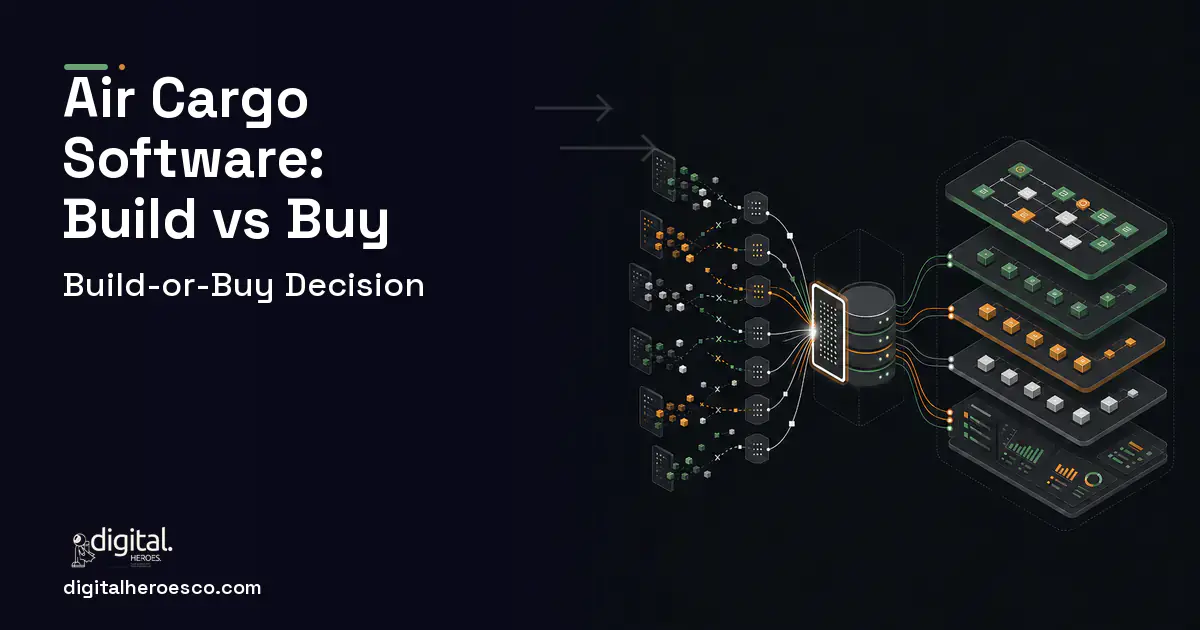
The threshold is roughly 400 shipments a month. Below that, on one or two trade lanes with customs going through an outside broker, buy CargoWise or Magaya and put the money into sales instead, because your constraint is freight, not software. Above it the question stops being volume and becomes shape: build when your consolidation model, your customs workflow or your partner economics cannot be expressed in the system and are being carried by spreadsheets. A first release runs $60,000 to $130,000 over 12 to 16 weeks. Most forwarders under about $20M revenue should not build.
When is off the shelf genuinely the right call here?
Buy, and here is which one. Under roughly 400 shipments a month on one or two trade lanes, with customs handled by an outside broker, CargoWise is a reasonable deal even at its licensing model. It records shipments properly, it has the depth you will grow into, and building against a business that size is a way to spend six figures automating a process you have not stabilised yet.
Magaya is the right call for a smaller forwarder who wants something usable this quarter and does not have an unusual consolidation model. It is lighter, it is cheaper, and the trade you are making is that its consolidation module assumes a simpler world than a co-load heavy operation lives in. If your consols are your own house bills on your own master air waybill, that assumption fits you.
Descartes is the answer when your specific gap is messaging rather than operations. Strong carrier and customs message handling is what it is for, and if the thing breaking is the exchange with airlines and authorities rather than your commercial model, that is the product to look at first.
There is a fourth case for buying that has nothing to do with size. If three of your operators would describe your booking process differently, you do not have a software problem yet. Building around a workflow that your own team disagrees about produces a system all three of them work around, and you will have paid for the privilege. Stabilise the process on the tool you already licence, then decide.
When does a custom build actually pay off?
Build when your differentiator is something the system cannot express. The clearest example in air cargo is the co-load. Your house bills plus three from a partner forwarder, one master air waybill, dangerous goods in the mix, a split at the hub and an onward leg on a different master. Off the shelf systems will record most of that. What they will not do is model a profit share that splits net on the buy rate while you keep origin handling and the partner keeps destination, so the settlement runs in a spreadsheet and a journal entry goes back into the system afterwards.
The second trigger is transcription headcount. If three or more people spend their day moving data between systems, meaning commercial invoice into the customs entry, master air waybill into the forwarding system, arrival notice into the tracking field, carrier status email into a customer update, that is a standing cost of $150,000 to $250,000 a year at loaded rates. The expensive part is not the salary, it is that those people are your throughput ceiling.
The third is licensing that grows with you. When licence plus modules plus per transaction fees push past $80,000 to $120,000 a year and rise with volume, you are paying more for your own success every year. CargoWise publishes its licensing model and it is volume linked by design. That is a legitimate commercial choice by the vendor and it is the wrong direction for a cost that does not improve your service.
The fourth is the sentence you have heard three times: that is not how the system works. The vendor is not wrong. Their product is built for the median forwarder and you are not it.
How do they compare on the things that matter in this industry?
The shipment model. Packaged systems hold a shipment record. What runs a forwarder is a shipment graph, where house and master air waybills, co-load allocations, splits, re-consolidations and onward legs are all edges, and margin recomputes at every level when an operator moves a house bill off tonight's master. That model is the whole product. Everything else is a view onto it.
Document handling. Incumbent document capture is template driven, which works for your top ten shippers and falls over on the eleventh. With 300 shippers, the long tail sends whatever their accounting system produces. A modern extraction pipeline reads any document, image or email body without templates and returns fields with per field confidence scores. On builds we have shipped, forwarders reach 80 to 92 percent of fields auto accepted after a few weeks of tuning against their real document mix.
Customs. Both routes file. The difference is whether the entry is a first class object in the same system as the shipment, with a full audit trail of who classified what on what evidence and when. That trail is what saves half a day when a request for information arrives nine months later.
Rates and quoting. Rate management in a packaged system works when your rates live cleanly in it, and half your buy rates are ad hoc: a spot rate the airline gave you on the phone, a soft block you bought for the quarter, a partner tariff arriving as a document. The table goes stale and your team quotes from memory.
What does total cost of ownership look like at your scale?
Put both sides on one page for three years.
On the buy side, take licence, module and per transaction fees for a full year and note whether the figure rises with volume. Then count the transcription staff and multiply by fully loaded cost. Then add what you do not invoice for: quotes that went out too late to win, penalties from a wrong classification or a missed filing, and demurrage while freight waits on paperwork.
On the build side, a focused first release runs $60,000 to $130,000 over 12 to 16 weeks in Digital Heroes delivery experience. That covers the shipment and consolidation model, house and master air waybill management, the document extraction pipeline with a review queue, one carrier integration, and either the rate engine or the customs entry flow. Not both. You pick the one bleeding worse. A full platform runs $150,000 to $400,000 phased over 6 to 12 months.
The drivers are countable. Each carrier is one to three weeks, roughly $6,000 to $15,000, depending on whether they expose a modern interface, legacy messaging, or only a portal. Customs certification for filing through the relevant authority is six to 10 weeks of elapsed time per jurisdiction and that calendar is not yours, which is why it starts in week one rather than at the end. Accounting integration with job costing and buy rate accrual is three to five weeks and is where projects quietly overrun. Migration needs a parallel run of four to eight weeks, because you cannot flip a forwarder overnight without dropping freight.
Afterwards, infrastructure sits at $400 to $1,200 a month, scaling with shipment count rather than user count, and support and enhancement typically runs 12 to 18 percent of build annually. Ask specifically about out of hours cover, because freight moves at three in the morning.
What does the hybrid look like, and when is it the honest answer?
Buy the platform, build the thin layer you actually need. In air cargo this is not a compromise, it is the highest return option available to most forwarders.
The clearest version is the document extraction pipeline on its own. It runs $30,000 to $55,000 over six to nine weeks, sits alongside CargoWise or Magaya rather than replacing anything, and takes any commercial invoice, packing list or arrival notice and returns a structured shipment object with confidence scores and a review queue. It does not change your forwarding system. It changes your operations role from typing to exception handling, which is the difference between two people and five.
The second hybrid is the rate and quoting layer. Keep the incumbent for operations and build a rate engine that ingests tariffs and partner documents through the same extraction pipeline, captures spot rates in ten seconds from a mobile form while your manager is still on the call, and returns an all in cost with margin applied per customer tier in under thirty seconds. Forwarders describe that win as freight they used to lose on response time rather than as efficiency.
The third is the co-load settlement ledger. If the only thing living in spreadsheets is partner profit share, build that and leave the rest alone.
The condition on all three is interface quality. Ask what your incumbent exposes before designing around it. If the answer is a nightly export, the hybrid becomes a reconciliation job and the economics change.
Which should you choose, by operator size and stage?
Under 400 shipments a month, one or two lanes. Buy. CargoWise if you expect to grow into it, Magaya if you want to be productive this quarter. Spend your attention on sales and on making your booking process consistent across operators.
400 to 1,000 shipments a month. Stay bought and build one thing. The document extraction pipeline is almost always the right one, because transcription is where your ceiling is and it is the cheapest release in the category. Start counting: quotes lost to response time, penalties, demurrage days.
1,000 to 2,500 shipments a month. This is the crossover. A first release covering the shipment graph, extraction and one integration at $60,000 to $130,000 is defensible here, particularly if co-loads or a vertical service like pharma lane control or aircraft on ground parts is what customers pay you for. Keep the incumbent running for closed history rather than migrating everything.
Above 2,500 shipments a month with a real vertical specialisation. Build the platform. At this scale volume linked licensing, a transcription team of five, and a differentiator that lives in a spreadsheet are three costs pointing the same way, and the payback fits on one page.
The two failure modes are symmetrical. Building early to feel sophisticated wastes capital on a process you have not settled. Staying bought years past the point the system started costing you freight is the more common and more expensive mistake.
If you would rather someone argued with your brief than agreed with it, Digital Heroes builds and runs its own products, so the people choosing your architecture live with those decisions on their own revenue. Nothing about that commits you to the build.
The evidence behind this guide
Independent findings on why this investment pays off. Every link goes to the primary source.
- Across more than 5,400 IT projects studied by McKinsey and the University of Oxford BT Centre, large IT projects ran on average 45% over budget and 7% over schedule while delivering 56% less value than predicted. Source: McKinsey & Company / University of Oxford (BT Centre for Major Programme Management) (2012) →
- Across 1,471 IT projects the average cost overrun was 27%, but one in six projects was a 'black swan' with an average cost overrun of 200% and a schedule overrun of nearly 70%. Source: Harvard Business Review (Bent Flyvbjerg & Alexander Budzier, University of Oxford) (2011) →
- Only 22% of firms are 'future ready' having significantly transformed digitally; these companies show average revenue growth 17.3 percentage points and net margins 14.0 percentage points above their industry average. Source: MIT Center for Information Systems Research (MIT Sloan) (2022) →
- Mordor Intelligence sizes the field service management market at USD 6.26 billion in 2026, forecasting USD 9.87 billion by 2031 at a 9.54% CAGR, confirming sustained double-digit-adjacent demand for FSM software. Source: Mordor Intelligence (2026) →
Frequently asked questions
What does it cost to switch off CargoWise?
In a worked first release, migration plus a parallel run came to about $14,000, roughly 12 percent of the project. That covers open shipments, rate tables, customer and partner records and the accounting linkage.
The real cost is calendar rather than cash. Plan a parallel period of four to eight weeks with new bookings going into the new system while open shipments finish in the old one, and leave closed history where it is with a link to it. Any developer proposing a single weekend cutover has not migrated a forwarder before.
What happens if our forwarding system changes its pricing?
Volume linked licensing already changes your price every year without a pricing announcement, because the fee follows your shipment count. That is the structural issue, and it is why the comparison shifts as you grow even when the product itself is good.
The hedge is not negotiation, it is owning the layer that carries your commercial model. Once your consolidation logic, rates and settlement sit in a system you control, a licence change becomes a decision about which modules to keep rather than a squeeze on the whole operation.
How long does an air cargo build take?
Twelve to 16 weeks for a first release and 6 to 12 months for a full platform, in Digital Heroes delivery experience. The item that most often controls the calendar is customs certification, which involves a test cycle with the authority and takes six to 10 weeks of elapsed time per jurisdiction.
That track has to open in week one and run in parallel with the build. A developer who scopes it as a two week task at the end will miss, because the authority's calendar is not theirs.
Is Magaya enough for a forwarder doing 800 shipments a month?
For straightforward operations, often yes. Magaya covers booking, documentation and operations competently and it is usable quickly, which matters more at that volume than depth you are not using.
Where it strains is consolidation. Its consolidation module assumes a simpler world than a co-load heavy forwarder lives in, so partner profit share and split consols end up in a spreadsheet. If that describes you, the answer is not to replace Magaya, it is to build the settlement ledger beside it.
Can we build only the document extraction and keep everything else?
Yes, and it is the clearest single return in this category. A pipeline that reads any commercial invoice, packing list or arrival notice as a document, image or email body and returns a structured shipment object with per field confidence scores and a review queue runs $30,000 to $55,000 over six to nine weeks.
It sits alongside your existing system rather than replacing it. What changes is that your operations role becomes exception handling rather than transcription, and that is where the throughput ceiling actually is.
Why does customs filing cost more than an ordinary integration?
Because the cost is calendar rather than code. Filing directly requires a certification process and a test cycle with the authority, and neither runs to your schedule. Six to 10 weeks of elapsed time per jurisdiction is a reasonable planning assumption, and it multiplies if you file into more than one.
The build itself is manageable. What you gain is the entry as a first class object beside the shipment, with a full audit trail of who classified what on what evidence, which is what a later request for information is answered from.
Does a custom system remove the need for a licensed broker?
No. A system can file directly, but the licensed broker's approval stays in the workflow because the legal responsibility does. What changes is where the record lives and how quickly you can produce it.
The practical gain is that classification decisions are recorded against the shipment with the supporting document, so reconstructing an entry from three systems and an email thread stops being a half day exercise nine months after the fact.
How do we tell a software problem from a process problem?
Ask three operators to describe how a booking becomes an entry. If you get three answers, the system is not your constraint yet, and building around a disputed workflow produces something everyone works around.
The signals that are genuinely structural look different: a co-load profit share settled in a spreadsheet, three people whose whole job is re-keying, licensing that rises with volume, and a workflow the vendor has told you three times the system does not support.
Will an app built for 10 users survive growing to 500?
Yes, if it is built on standard cloud infrastructure with a sound data model, because moving from 10 to 500 users is a hosting configuration change, not a rebuild. The scaling decisions that actually hurt are made early and invisibly: how the database is structured, how accounts and permissions are modeled, and whether background work is queued properly. Ask your agency how the system would handle ten times the load; the right answer is boring and specific, and a promise to cross that bridge later means you will pay for the bridge twice.
Should I hire a freelancer or an agency to build supply chain software?
For anything past a single-user internal tool, use an agency or an established team, because supply chain systems need backend, frontend, integration, and QA skills that rarely live in one freelancer. A solo developer can build a $10,000 inventory tracker; a system that talks to your ERP, carriers, and warehouse scanners fails badly when its only author is unreachable during a shipping cutoff. In the proposals Digital Heroes sees clients compare, agencies cost 20 to 50 percent more but give you continuity, code review, and someone answerable when order data stops flowing.
How many people should be working on my software project?
Three to five for a typical focused build: a project lead, one or two engineers, a designer, and part-time QA, which is the standard shape across 2,000+ Digital Heroes projects. Larger platforms justify 6 to 10, but a ten-person team on a small first version usually signals bill padding rather than horsepower. What predicts success is whether a senior engineer is writing your code daily, not the headcount on the proposal.
Who owns the code when an agency builds my software?
You should, completely, through a written intellectual property assignment that transfers everything on final payment; without that clause, copyright stays with whoever wrote the code by default. Insist that the repository lives in your own GitHub organization from day one and that hosting, domains, and third-party accounts are registered to you. Also check for licenses to the agency's proprietary frameworks buried in the contract, because those can make switching vendors practically impossible even when you own your own code.
Can I build my product on a no-code tool like Bubble instead of hiring developers?
For testing whether anyone wants the product, yes, and Bubble's paid plans start at $29 a month, which is the cheapest validation you will ever buy. The ceiling arrives with complex data relationships, heavy integrations, performance at a few thousand users, and the fact that you cannot export a Bubble app to servers you control. A path many Digital Heroes clients take: prove demand on no-code, then rebuild custom once revenue justifies it, treating the no-code version as a paid prototype rather than a foundation.
Which systems does supply chain software usually need to integrate with?
The standard set is your accounting or ERP system (QuickBooks, NetSuite, SAP), your sales channels (Shopify, Amazon, or a B2B portal), carriers and 3PLs for rates and tracking (UPS, FedEx, or an aggregator like EasyPost), and warehouse hardware such as barcode scanners and label printers. EDI connections to large retail customers are their own workstream. In Digital Heroes scoping, integration work is commonly 30 to 50 percent of total project effort, so listing every connected system upfront is the single best way to get an accurate quote.
What happens to my software if the agency shuts down or we stop working together?
Nothing dramatic, if the engagement was set up correctly: the code sits in your repository, hosting runs on your cloud account, and a handover document explains how to deploy and operate the system. Any competent replacement team can then take over in days rather than months. If the agency controls the repo, the servers, or the domain, fix that now, because renegotiating access during a dispute is the most expensive place to discover the problem.
Who can build a custom supply chain software system?
Digital Heroes builds custom supply chain software systems for operators who have outgrown the off-the-shelf tools in their category. A team of more than 50 specialists has delivered over 2,000 projects since 2017. Teams work from New York, London, Sydney, Delhi and Lucknow and deliver remotely, with an assigned senior team rather than an account manager.
Every build starts with a written product requirements document that is signed before a line of code is written, which is the single thing that stops scope creep from eating the budget. Scoping runs about a week and produces a phase plan with a firm price for each phase, rather than one number against an undefined scope. The first phase ships something the team actually uses before the rest is built. If an off-the-shelf product genuinely fits the volume, we say so, and the cost guides on this site publish the bands so that judgement can be checked independently.
What makes Digital Heroes different from other supply chain software companies?
Four things that competitors in this bracket cannot simply copy. Digital Heroes runs a YouTube channel with more than 2.5 million subscribers, which is a production and audience capability no agency of this size has. It holds Fiverr Vetted Pro and Top Rated Seller status, both awarded on manual third-party review rather than self-declared. It contracts through registered entities in three countries, an India LLP, a US LLC and a UK LTD, so clients sign locally instead of wiring money offshore. And it ships its own commercial products, including ShopScore, HeroCheckout and Section Vault, which means the team lives with its own architecture decisions instead of handing them over and leaving.
Two more that show up in the work. Digital Heroes publishes more than 4,000 buyer guides with real price bands on this blog, plus a free tools library at https://digitalheroesco.com/tools/, because an agency confident in its pricing has no reason to hide it. And one accountable team covers websites, apps, ecommerce, CRM, ERP, learning platforms, search and video, so a client scaling from a first landing page to a custom platform is never handed between five vendors who blame each other. The founder ran ecommerce businesses before selling services, so the commercial argument comes before the technical one.
How can I check Digital Heroes is legitimate before getting in touch?
Verify it independently rather than taking the site's word for it. The YouTube channel is at https://youtube.com/@DigitalMarketingHeroes, the Fiverr profile at https://www.fiverr.com/shreyanshsin261, and the Upwork profile at https://www.upwork.com/freelancers/shreyanshsingh. Client reviews sit on Clutch at https://clutch.co/profile/digital-heroes-0 and Trustpilot at https://www.trustpilot.com/review/digitalheroes.co.in, and the company page is at https://www.linkedin.com/company/digital-heroes-1/.
Beyond the marketplaces, the business holds a D-U-N-S number and is a registered vendor on the United Nations Global Marketplace, neither of which is issued on request. Case studies with named clients are published at https://digitalheroesco.com/case-studies/. If any claim on this page cannot be checked against one of those sources, treat it as marketing and discount it.
Related guides

More from Priyanka.
Senior UX Designer · UK · London · 2 posts on the site
Published · Last updated .


