Calendly books a meeting; it can't allocate beam time on a shared optics bench
Custom booking software for a Tucson research lab, optics facility, or clinic runs $40k to $130k over 2 to 5 months. Calendly and Acuity book a person's calendar.
On this page
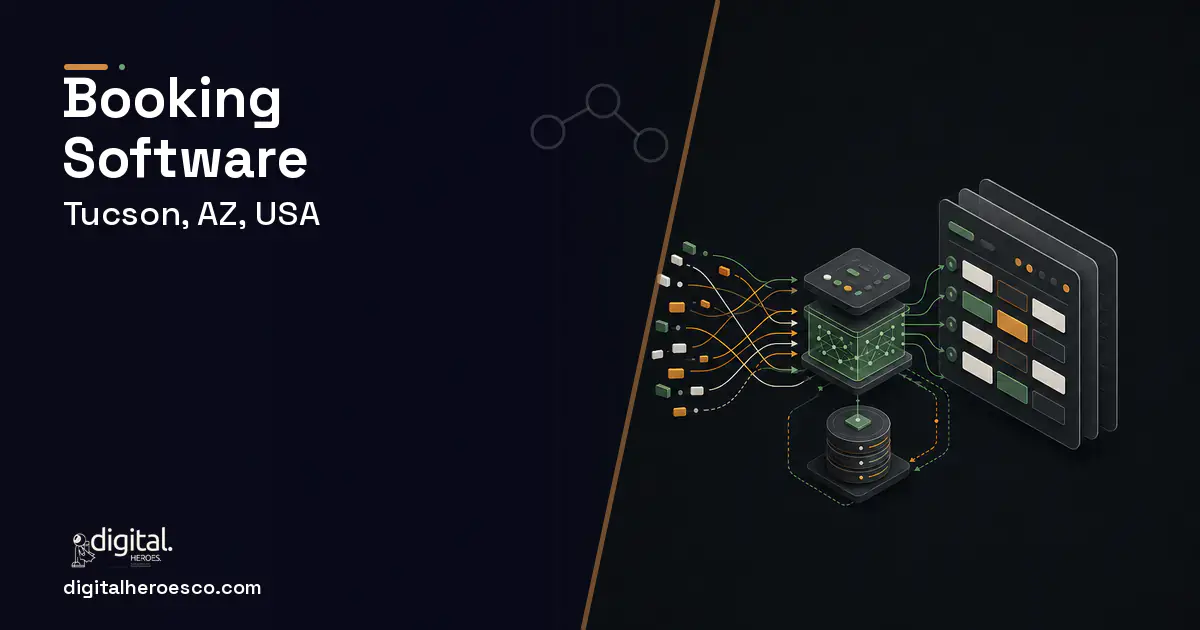
Custom booking software for a Tucson research lab, optics facility, or clinic runs $40k to $130k over 2 to 5 months. Calendly and Acuity book a person's calendar. They can't allocate a shared instrument with dependencies, enforce who's authorized to reserve it, or coordinate the chain of resources a real lab session or clinical procedure requires.
Your scheduling isn't one calendar. Booking time on a shared optics bench, a characterization instrument, or a research telescope means reserving the equipment, an authorized operator, a prep window, and sometimes a clean-room slot, all at once, and only for users qualified and trained on that instrument. Calendly books a 30-minute slot against one person and has no concept of a resource with prerequisites, dependencies, and an access list.
A clinic or bioscience lab has a parallel problem: a procedure needs a room, a device, a trained tech, and a follow-up slot, with eligibility rules per patient or study. Mindbody handles fitness classes, not multi-resource clinical or research bookings with authorization. So the lab manager runs a shared spreadsheet calendar and referees conflicts by email, which is exactly the coordination a booking system should own.
The problems nobody warns you about
- Shared instruments need multi-resource booking (equipment, operator, prep, clean room) Calendly can't model
- Only qualified, trained users should be able to reserve specific instruments
- Clinical and study bookings need room, device, tech, and eligibility coordinated together
- Lab managers referee a shared spreadsheet calendar by email
The case for owning your booking & scheduling
Custom booking software reserves the whole chain at once, equipment, operator, prep window, and clean-room slot, and only lets authorized, trained users book a given instrument. Dependencies and prerequisites are enforced, double-bookings of a shared resource become impossible, and the lab manager stops refereeing a spreadsheet because the system owns the coordination.
Budgeting a booking & scheduling build in Tucson
| Project scope | Typical cost | Timeline |
|---|---|---|
| Booking core with multi-resource scheduling | $40k to $80k | 2 to 3 months |
| Authorization + dependency rules | $10k to $35k | 1 to 2 months |
| Reporting + integrations | $10k to $30k | 1 to 2 months |
What your build should include
Tucson booking & scheduling: the full scope
Digital Heroes builds the full booking & scheduling stack for Tucson teams. Typical engagements cover calendar integration, class scheduling, automated reminders, booking and scheduling software, appointment scheduling, online reservation system and Calendly alternative.
Exactly what you get
Booking software that reserves the whole chain, instrument, operator, prep window, room, in one action, and only for authorized users. It checks training status against your LMS, ties usage to your accounting software for cost recovery or billing, coordinates with your field service management software for instrument maintenance windows, and reports utilization to your business intelligence (BI) dashboards.
How to choose a developer in Tucson
Choose a partner who has built multi-resource scheduling, ideally for a lab, shared facility, or clinic, not just a Calendly-style booker. Ask how they'd reserve an instrument plus operator plus clean-room slot together and enforce that only trained users can book it. The right team handles resource dependencies and authorization as core logic, which is exactly what simple scheduling tools can't do.
- !They model bookings as single-calendar slots: ask how they reserve multiple resources together
- !No shared-resource experience: ask for a lab or instrument scheduling build
- !They ignore authorization: ask how only trained users can book an instrument
- !No dependency handling: ask how prep windows and prerequisites are enforced
- !No utilization reporting: ask how grant and capacity planning gets usage data
Most Tucson teams pricing booking & scheduling end up comparing notes on crm, custom software, hr too; the systems share one data spine. Weighing options across the region? Nearby: booking & scheduling in Phoenix, Mesa and Chandler. Prefer to talk to the team that builds these? Digital Heroes handles custom software development end to end.
The evidence behind this guide
Independent findings on why this investment pays off. Every link goes to the primary source.
- In an RCT, the no-show rate was 23.5% for patients receiving a text-message reminder versus 38.1% for the control group - a 14.6 percentage-point reduction (p = 0.04). Source: Clinical Pediatrics / PubMed Central (Lin et al.) (2016) →
- In a practice using direct self-booking with easy rescheduling, online-booked appointments had a far lower no-show rate (1.8% median) than offline bookings (5.9%), though a hospital's request/triage system showed the opposite pattern - indicating booking-system design, not online booking per se, drives no-show outcomes. Source: GMS / PubMed Central (German medical practice & university hospital study) (2025) →
- Digital Champions expect to achieve about 16% in cost savings and around 15% in revenue gains from digital operations over five years; the study surveyed 1,155 manufacturing executives across 26 countries. Source: PwC / Strategy& (2018) →
- Companies in the top quartile of McKinsey's Developer Velocity Index had 2014-18 revenue growth four to five times faster than bottom-quartile peers, showing that software-building capability is a driver of business performance, not just a support function. Source: McKinsey & Company (2020) →
Frequently asked questions
Why doesn't Calendly work for shared lab instruments?
Calendly books a person's calendar in fixed slots and has no concept of a resource with dependencies, prep windows, or an authorized-user list. Shared instruments need multi-resource booking with prerequisites, which is custom work.
How does the system stop unqualified users from booking?
By checking authorization and training status, often against an LMS, before allowing a reservation on a given instrument. Only trained, qualified users can book it, which a generic scheduler can't enforce.
Can it coordinate clinical or study bookings?
Yes. It reserves the room, device, and trained tech together and applies eligibility rules per patient or study, replacing the spreadsheet-and-email coordination that tools like Mindbody can't handle for multi-resource clinical work.
Does it prevent double-booking shared equipment?
Yes. Because it models each instrument and room as a finite resource with dependencies, it makes conflicting reservations impossible rather than relying on a human to catch them in a shared calendar.
Is custom booking worth it for simple scheduling?
No. If you just need to book a person's time in simple slots, Calendly or Acuity is the right, cheaper tool. Custom booking pays off specifically for shared instruments, multi-resource coordination, and authorization.
What should I prepare before contacting a software development agency?
A one-page brief beats a 40-page requirements document: the business problem in plain words, who will use the system, the 5 to 10 workflows it must handle, the tools it must connect to, and your budget range and deadline driver. You do not need wireframes, a specification, or technical vocabulary; producing those is the agency's job during discovery. Stating a budget range up front is the single best move, because it gets you honest scoping instead of a quote engineered to win the meeting.
What would a custom scheduling app cost for a small business with one location?
A single-location scheduling app typically runs $8,000 to $25,000 when scoped as an MVP: a public booking page, staff calendars, Stripe payments, and SMS reminders. In Digital Heroes projects, small businesses keep the budget down by launching with a mobile-friendly web app instead of native iOS and Android apps, which cuts 30 to 40 percent off the initial build. Native apps can follow in phase two once bookings prove the demand.
How many people should be working on my software project?
Three to five for a typical focused build: a project lead, one or two engineers, a designer, and part-time QA, which is the standard shape across 2,000+ Digital Heroes projects. Larger platforms justify 6 to 10, but a ten-person team on a small first version usually signals bill padding rather than horsepower. What predicts success is whether a senior engineer is writing your code daily, not the headcount on the proposal.
What mistakes do businesses make when building custom booking software?
The most expensive mistake is under-specifying scheduling rules; teams say they want Calendly but for their business, then discover 40 edge cases mid-build, each one a change order. The second is rebuilding every feature of the old tool, including ones staff never used, which inflates scope 20 to 30 percent in Digital Heroes audits of inherited projects. The third is skipping a parallel-run at launch; keep the old system live for two weeks so a bug never means an empty calendar.
How much does it cost to build a custom booking system for my business?
Most custom booking systems cost $15,000 to $60,000 to build, based on what Digital Heroes has delivered across service businesses from salons to clinics. The low end covers a single-service scheduler with payments and automated reminders; the high end adds multi-staff calendars, memberships, packages, and a client mobile app. The single biggest cost driver is how many scheduling rules your business runs on: staff availability layers, buffer times, room or equipment conflicts, and cancellation policies.
What should the first version of a booking app include?
Ship four things: a public booking page, staff calendars with availability rules, card payments or deposits, and automated email and SMS reminders. Leave memberships, packages, gift cards, and reporting dashboards for phase two; they roughly double the build cost and get redesigned after real usage anyway. In Digital Heroes MVP scopes, that four-feature core covers about 80 percent of daily front-desk work from day one.
How long does it take to build custom booking software?
Plan on 6 to 10 weeks for a working MVP and 3 to 5 months for a full platform with memberships, reporting, and integrations. Across Digital Heroes booking projects, the calendar engine takes about a third of the timeline because recurring availability, time zones, and double-booking prevention need heavy testing. Migrating data from your old tool usually adds 1 to 2 weeks at the end.
What tech stack should a booking and scheduling platform use?
The stack that has aged best across our booking builds is React or Next.js on the frontend, Node.js or Django on the backend, PostgreSQL for data, Stripe for payments, and Twilio for SMS. PostgreSQL matters more than people expect because booking systems live or die on transactional integrity: two people must never win the same slot. Be wary of anyone proposing a no-code tool for the core calendar engine; those work for booking pages, not for concurrency-safe scheduling.
Is Mindbody worth the price, or should my studio build its own booking platform?
Mindbody earns its price while you run a single location; plans start around $129 per month and bundle scheduling, payments, and marketing in one place. The switch point we see at Digital Heroes is two or more locations, where combined fees reach $700 to $1,000 a month and a $35,000 custom build pays back in 3 to 4 years. The bigger reason studios go custom is that the Mindbody marketplace shows your clients competing studios, and owning the platform means owning the client relationship.
Are local developer rates in Tucson worth it compared to hiring an offshore team?
Agency rates in markets like Tucson typically run $100 to $200 per hour against $25 to $60 offshore, but the hourly rate is not the project cost. Across 2,000+ Digital Heroes projects, the setup that consistently works is a hybrid: senior architects and a named lead for your project with a distributed build team behind them, which lands total cost well below all-local without the rework cycles that pure lowest-bid offshore engagements produce. Compare bids on total delivered cost with maintenance included, never on rate cards.
How do I vet a software agency for a booking system project?
Ask to see a live booking system they built and break it yourself: try booking overlapping slots, cancelling inside the penalty window, and switching time zones mid-booking. An agency that has shipped scheduling before will talk unprompted about double-booking prevention, calendar sync conflicts, and no-show handling; one that has not will only talk about screens. Also ask who writes the booking-rules specification, because at Digital Heroes that document is the single best predictor of a project landing on budget.
Who owns the code when an agency builds my software?
You should, completely, through a written intellectual property assignment that transfers everything on final payment; without that clause, copyright stays with whoever wrote the code by default. Insist that the repository lives in your own GitHub organization from day one and that hosting, domains, and third-party accounts are registered to you. Also check for licenses to the agency's proprietary frameworks buried in the contract, because those can make switching vendors practically impossible even when you own your own code.
How many SaaS seats do we need before building custom becomes cheaper?
The crossover usually shows up between 20 and 50 seats on premium tiers. Salesforce Enterprise lists at $165 per user per month, so 40 users cost about $79,000 a year in subscriptions, which is real money against a custom system you would own outright. Run the comparison over three years: if subscription spend beats the build cost plus 15-20% annual maintenance, custom wins on price before you even count workflow fit.
Who can build custom booking & scheduling software for a business in Tucson?
Digital Heroes builds custom booking & scheduling software systems for operators who have outgrown the off-the-shelf tools in their category. The work is delivered remotely: our engineers work from Delhi and Lucknow, leadership is in New York, and some team members live in London and Sydney and work remotely from there. We have no office in Tucson. You can chat with the team directly, and every form gets an email reply within 24 hours.
Related guides
Published · Last updated .