Calendly books a 30-minute call fine and has no idea what a breeding season or a boarding reservation is
Custom booking and scheduling software in Lexington runs $35,000 to $110,000 and ships in 3 to 6 months.
On this page
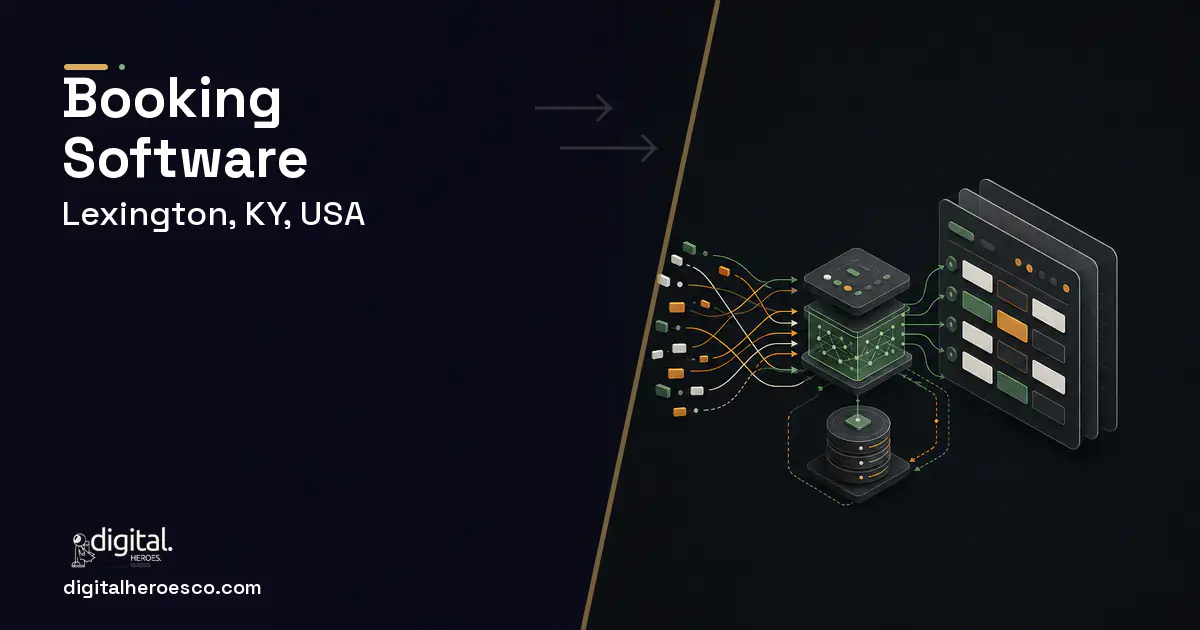
Custom booking and scheduling software in Lexington runs $35,000 to $110,000 and ships in 3 to 6 months. You build past Calendly, Acuity, and Mindbody when what you book isn't a time slot, it's a stall reservation, a breeding season, a vet farm call, or an event facility, with rules and resources those tools can't model. Generic booking schedules a meeting; yours schedules a constrained resource with real-world dependencies.
Calendly, Acuity, and Mindbody schedule appointments against a person's availability. A Lexington operation books things with far more structure. A boarding facility reserves a specific stall for a date range, against capacity. A stallion farm books breeding seasons against a stud's book and a mare's cycle. An equine clinic schedules farm calls that depend on routing and travel time. None of that is a 30-minute slot, so generic booking tools can't represent what's actually being reserved.
The breakdown is resource and rule complexity. Booking a stall means checking capacity, stall type, and overlapping reservations. Booking a season means deadlines, guarantees, and availability against the book. Generic tools have no concept of these resources or rules, so the real booking happens by phone and gets recorded in a spreadsheet, and double-bookings or missed deadlines slip through because nothing enforces the constraints.
Where the off-the-shelf tools fall short
- Booking a stall reservation against capacity and stall type isn't a Calendly time slot
- Breeding-season bookings depend on a stud's book, deadlines, and guarantees
- Farm-call scheduling depends on routing and travel time generic tools ignore
- Real bookings happen by phone and land in a spreadsheet, so double-bookings slip through
Custom booking & scheduling: what Lexington teams actually get
Custom booking software models the actual resource and its rules: a stall with capacity and type, a season against the stud's book and deadlines, a farm call with travel time. It enforces constraints so double-bookings and missed deadlines can't happen, and it lets clients book online against real availability. You replace phone-and-spreadsheet booking with a system that understands what you're actually reserving.
- You book resources (stalls, seasons, facilities), not just time slots
- Bookings carry rules like capacity, deadlines, or guarantees
- Phone-and-spreadsheet booking is causing double-bookings
- Scheduling depends on routing or resource constraints
- You book simple time slots against a person's availability
- Calendly or Acuity already fits your needs
- You have no resource or capacity constraints
- Budget and team can't support a custom build
- Resource-aware booking for stalls, seasons, or facilities with real capacity rules
- Constraint enforcement that prevents double-bookings and missed deadlines
- Online self-booking against true availability, not a generic calendar
- Season and reservation logic with deadlines, guarantees, and ranges
- Integration with billing so a booking flows into an invoice or deposit
- Costs more than a Calendly or Acuity subscription
- Requires modeling your resources and rules carefully upfront
- You own maintenance as your offerings change
- Overkill if you really just book simple time slots
Feature priorities for Lexington teams
Lexington booking & scheduling: the full scope
The engagements Lexington teams bring us most often: Calendly alternative, Acuity alternative, Mindbody alternative, calendar integration, class scheduling, automated reminders and booking and scheduling software.
The honest cost picture for Lexington
| Project scope | Typical cost | Timeline |
|---|---|---|
| Core resource booking | $35,000 to $55,000 | 3 to 4 months |
| Season logic, deposits, constraints | $55,000 to $85,000 | 4 to 5 months |
| Full integrations and self-service | $85,000 to $110,000 | 5 to 6 months |
Timeline: what happens, and when
Exactly what you get
You get booking software that understands what you actually reserve: a stall against capacity, a breeding season against the stud's book, a farm call with travel time. Constraints are enforced so double-bookings can't happen, clients book online against real availability, and a booking flows straight into a deposit or invoice.
How to choose a developer in Lexington
Pick a developer who asks what resource is being booked and what rules govern it before talking calendars. A stall, a season, and a farm call each have different constraints. The right partner models those and enforces them so double-bookings vanish; the wrong one hands you a branded Calendly that has no idea what a stall reservation is.
- !They treat bookings as time slots; ask how they'd reserve a stall against capacity
- !No constraint enforcement; ask how double-bookings are prevented
- !No season logic; ask how a breeding season with deadlines is modeled
- !No billing integration; ask how a booking becomes a deposit or invoice
- !They quote without mapping your resources; ask them to model a reservation first
Teams investing in booking & scheduling in Lexington usually scope it next to crm, custom software, hr, since these systems share data and budgets. Weighing options across the region? Nearby: booking & scheduling in Louisville. Want it built, not just budgeted? That is our custom software development practice.
The evidence behind this guide
Independent findings on why this investment pays off. Every link goes to the primary source.
- SMS reminders that stated the specific cost of the appointment to the health system reduced missed appointments in Trial One, with the DNA (did-not-attend) rate falling from 11.1% (control) to 8.4% (specific-costs message) - an odds ratio of 0.74 (95% CI 0.61-0.89), i.e. roughly a 24-26% relative reduction - at no additional cost. (Trial Two replicated this at an 8.2% DNA rate.). Source: PLOS ONE (Hallsworth et al.) (2015) →
- In an RCT, text-message reminders (11.7% missed) were non-inferior to telephone reminders (10.2% missed; difference not significant, within the 2% non-inferiority margin) but far cheaper - total cost EUR 230 for SMS versus EUR 8,910 for telephone over 6 months - making SMS more cost-effective. Source: BMC Health Services Research / PubMed Central (Junod Perron et al.) (2013) →
- PMI's Pulse of the Profession research found organizations waste an average of roughly 9.9% of every dollar invested in projects due to poor performance - equivalent to about $1 million wasted every 20 seconds collectively worldwide. Source: Project Management Institute (PMI) (2018) →
- Only about 30% of digital transformations succeed at meeting their objectives, but getting six critical success factors in place (leadership commitment, talent, agile culture, progress monitoring, clear strategy, and a modernized platform) raises the odds of success from 30% to 80%. Source: Boston Consulting Group (BCG) (2020) →
Frequently asked questions
Why isn't Calendly enough?
Calendly books a time slot against a person's availability. A boarding stall, a breeding season, or a farm call is a constrained resource with capacity, deadlines, and routing rules that Calendly can't represent, so the real booking ends up on the phone and in a spreadsheet.
Can it prevent double-bookings?
Yes. The system enforces capacity, stall type, and overlapping-reservation rules, so a stall or season can't be booked twice. That constraint enforcement is exactly what spreadsheets and generic calendars fail to do.
Can clients book online themselves?
Yes. Clients can self-book against true availability, place deposits, and get confirmations, which reduces phone back-and-forth while still respecting all your capacity and deadline rules.
Does it handle breeding-season bookings?
Yes. Season booking can run against a stud's book with deadlines and guarantees, modeling the real equine logic that a generic appointment tool has no concept of.
Does a booking connect to billing?
Yes. A confirmed booking can flow straight into a deposit or invoice in your billing system, so reserving a stall or a season starts the financial side automatically instead of as a separate manual step.
How long does it take to build a custom web or mobile app from scratch?
Plan on 8 to 16 weeks for a focused first version and 4 to 9 months for a larger platform, which is the typical spread across Digital Heroes builds. The first 2 to 3 weeks go to discovery and design before any production code ships. The two things that stretch timelines most are integrations with legacy systems and slow feedback from your side, not developer speed.
What happens to my software if the agency shuts down or we stop working together?
Nothing dramatic, if the engagement was set up correctly: the code sits in your repository, hosting runs on your cloud account, and a handover document explains how to deploy and operate the system. Any competent replacement team can then take over in days rather than months. If the agency controls the repo, the servers, or the domain, fix that now, because renegotiating access during a dispute is the most expensive place to discover the problem.
We have outgrown Calendly. When is it actually worth building our own booking system?
Build when your scheduling no longer fits Calendly's model of one person, one event type, one slot. The triggers we see most: bookings tied to rooms or equipment, appointments needing multiple staff at once, pricing that varies by client or demand, or paying for 20+ seats at Calendly's $16 per user per month and still exporting everything to spreadsheets. Below roughly 10 users running simple 1:1 meetings, Calendly stays the cheaper option and custom rarely pays off.
How many people should be working on my software project?
Three to five for a typical focused build: a project lead, one or two engineers, a designer, and part-time QA, which is the standard shape across 2,000+ Digital Heroes projects. Larger platforms justify 6 to 10, but a ten-person team on a small first version usually signals bill padding rather than horsepower. What predicts success is whether a senior engineer is writing your code daily, not the headcount on the proposal.
How do I calculate whether custom software will pay for itself?
Divide the build cost by the monthly benefit, where benefit is hours saved times loaded hourly cost, plus subscription fees replaced, plus any revenue the software unlocks. Three staff saving 10 hours a week each at a $40 loaded rate is about $62,000 a year, which pays back a $60,000 build in roughly 12 months. Across Digital Heroes internal-tool projects, 12 to 24 months is the normal payback range, and anything projecting under 6 months usually means the spreadsheet is hiding costs.
Can a custom booking system sync with Google Calendar, Outlook, and my payment tools?
Yes, two-way sync with Google Calendar and Outlook is standard in any competent booking build, alongside Stripe or Square for payments and Twilio for SMS reminders. The part needing real engineering is conflict handling: what happens when a staff member drops a personal event onto a calendar that overlaps an existing booking. In Digital Heroes builds, integrations take 20 to 30 percent of the project timeline; they are rarely the quick part vendors imply.
Can we migrate years of data out of our current system into new custom software?
Almost always yes, through CSV exports or the vendor's API, and migration should be scoped as its own workstream with field mapping, a dry run, and a planned cutover window rather than an afterthought. The real time sink is rarely moving the data; it is cleaning it, since years of duplicates, free-text fields, and inconsistent formats surface all at once. Pull a full export from your current vendor before committing to anything new, because some SaaS plans restrict exports on lower tiers.
Why do agencies charge for a discovery phase instead of quoting for free?
Because an accurate quote requires real work: mapping your workflows, finding the edge cases, and writing a specification, which typically takes 1 to 3 weeks and costs $2,000 to $10,000 at Digital Heroes depending on system complexity. You leave discovery owning a written spec and a fixed price you can take to any vendor, so the money is not locked into one agency. Free estimates are guesses, and the guess usually becomes your budget overrun six months later.
What tech stack should a booking and scheduling platform use?
The stack that has aged best across our booking builds is React or Next.js on the frontend, Node.js or Django on the backend, PostgreSQL for data, Stripe for payments, and Twilio for SMS. PostgreSQL matters more than people expect because booking systems live or die on transactional integrity: two people must never win the same slot. Be wary of anyone proposing a no-code tool for the core calendar engine; those work for booking pages, not for concurrency-safe scheduling.
What should the first version of a booking app include?
Ship four things: a public booking page, staff calendars with availability rules, card payments or deposits, and automated email and SMS reminders. Leave memberships, packages, gift cards, and reporting dashboards for phase two; they roughly double the build cost and get redesigned after real usage anyway. In Digital Heroes MVP scopes, that four-feature core covers about 80 percent of daily front-desk work from day one.
What should I prepare before contacting an agency about a booking system?
Bring three things: a list of every service with its duration and price, your scheduling rules written in plain language (buffers, cancellation policy, staff availability), and screenshots of your current tool annotated with what fails. That package gets you a real estimate in the first call instead of a placeholder range. In Digital Heroes discovery calls, clients who arrive with documented booking rules receive proposals roughly twice as fast and file far fewer change requests later.
Does my booking system need to be HIPAA compliant?
Only if an appointment reveals health information, which it does for therapy practices, medical clinics, physiotherapy, and wellness treatments tied to a condition. In Digital Heroes healthcare builds, HIPAA adds encryption at rest, audit logs, role-based access, and a signed business associate agreement with the hosting provider, which typically adds $5,000 to $10,000 and 2 to 3 weeks. Salons, gyms, and consultants generally do not need it, but confirm with a lawyer rather than a developer.
Who can build custom booking & scheduling software for a business in Lexington?
Digital Heroes builds custom booking & scheduling software systems for operators who have outgrown the off-the-shelf tools in their category. The work is delivered remotely: our engineers work from Delhi and Lucknow, leadership is in New York, and some team members live in London and Sydney and work remotely from there. We have no office in Lexington. You can chat with the team directly, and every form gets an email reply within 24 hours.
Related guides

More from Zayn.
Director of Strategy · UK · London · 2 posts on the site
Published · Last updated .