Calendly Books One Person at a Time, but Your Louisville Distillery Tour Has 24 Seats, a Tasting Fee, and a VIP Hold
Custom booking software for a Louisville business runs $40k to $140k and takes 3 to 7 months.
On this page
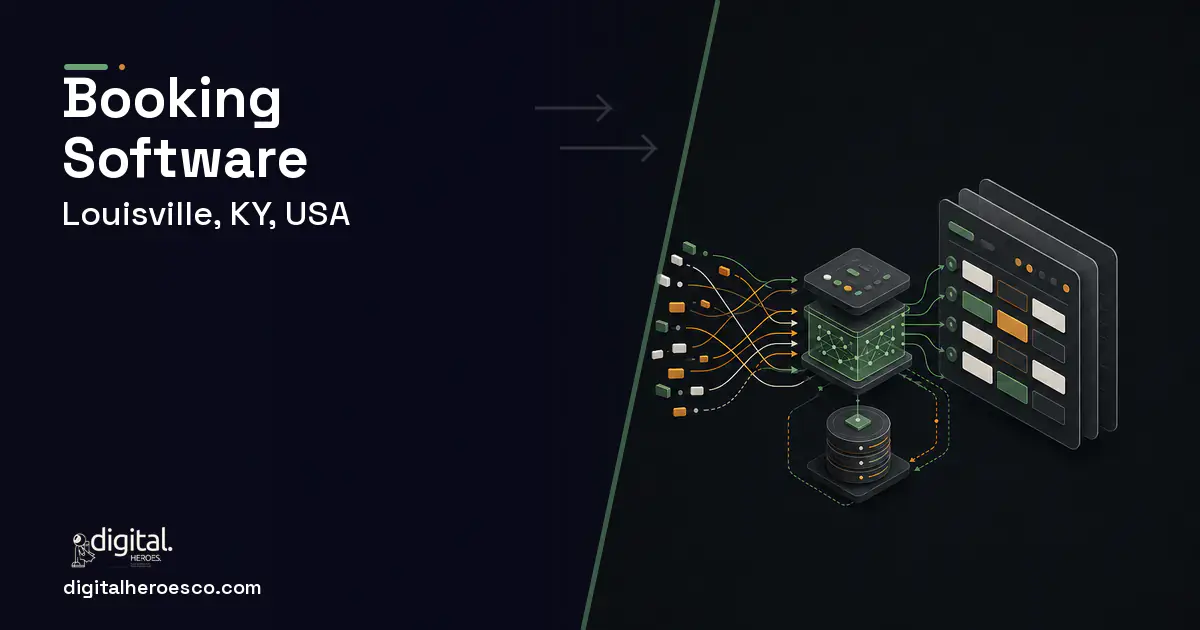
Custom booking software for a Louisville business runs $40k to $140k and takes 3 to 7 months. You build it when Calendly, Acuity, or Mindbody can't handle group tour capacity, paid tastings, VIP allocation holds, or the deposit and cancellation rules a Bourbon Trail experience operation actually runs on.
Your distillery sells tours and tastings, not one-on-one meetings, and Calendly was built for the meeting. A tour has a fixed seat count, a guide constraint, a tasting fee, an age requirement, and often a VIP or club hold on the best time slots, none of which a generic scheduler models. So you cobble together Acuity for the calendar, a separate payment link for the fee, and a spreadsheet for the holds, and the three never reconcile, leading to overbooked tours and double-charged guests.
For a multi-venue operation, a tasting room, a tour, an event space, the problem compounds: shared resources like guides and rooms get booked across channels with no central capacity view, so two tours get scheduled for one guide. The painPoint in this town is real, staff rekeying between systems that should share data, and nowhere does it sting more than a guest standing at the door for a tour the calendar oversold.
Why the usual tools struggle in Louisville
- Calendly books one-on-one meetings and can't model a 24-seat tour with a guide constraint and a fee
- Tour calendar, payment link, and VIP holds live in three tools that never reconcile
- Shared guides and rooms get double-booked across channels with no central capacity view
- Overbooked tours and double-charged guests come from systems that should share data but don't
What a custom booking & scheduling build changes
Custom booking software is worth it once your bookings are group, paid, resource-constrained experiences with allocation holds, which is exactly a Bourbon Trail operation. You build group capacity, integrated payment, VIP holds, and one central view of every guide and room. For a Louisville distillery or experience operator, the build pays back the first season tours stop overbooking and guests stop getting double-charged.
- You sell group experiences with capacity, fees, and constraints
- Calendar, payment, and holds live in separate tools that don't reconcile
- Shared guides or rooms get double-booked across channels
- VIP or club holds on premium slots need managing in one place
- You book one-on-one meetings without capacity or fees
- Calendly or Acuity covers your scheduling needs
- You have no allocation holds or shared-resource conflicts
- You need scheduling live this week, not a build
- Group capacity with seat counts, guide constraints, and age rules a meeting scheduler can't model
- Integrated payment for tasting fees and deposits, so the calendar and the charge are one transaction
- VIP and club allocation holds on premium slots managed in the same system
- One central capacity view so shared guides and rooms never double-book
- Integration to your pos-system-development, crm, and accounting-software so bookings feed operations
- More expensive than a Calendly or Acuity subscription
- Three to seven months to build versus an instant signup
- You own payment integration and PCI scope
- Simple one-on-one scheduling doesn't justify a custom build
The features that matter for Louisville
Louisville booking & scheduling: the full scope
Everything a booking & scheduling build here can cover: appointment scheduling, online reservation system, Calendly alternative, Acuity alternative, Mindbody alternative, calendar integration and class scheduling.
Booking & Scheduling pricing in Louisville: the real numbers
| Project scope | Typical cost | Timeline |
|---|---|---|
| Group booking with payment | $40k to $70k | 3 to 4 months |
| Booking with VIP holds and multi-venue calendar | $70k to $105k | 4 to 6 months |
| Full platform with waitlists and integrations | $105k to $150k | 6 to 8 months |
From kickoff to launch: the schedule
Exactly what you get
Booking software built for experiences, not meetings: group tours with seat capacity, guide constraints, and age rules, integrated tasting fees and deposits so the calendar and the charge are one transaction, and VIP or club holds on premium slots. One central calendar keeps shared guides and rooms from double-booking, and it syncs to your pos-system-development, crm, and accounting-software so bookings feed operations instead of three tools that never reconcile.
How to choose a developer in Louisville
Pick a team that has built group, paid, resource-constrained booking before and asks about capacity and holds before quoting. Louisville experience operators reward vendors who deliver and stay reachable, so weigh payment-integration and multi-venue experience over the cheapest scheduler. If they pitch a Calendly-style one-on-one flow, they've missed that your tours overbook because of exactly what that flow can't do.
- !They demo one-on-one scheduling for a group-tour business, so ask how they handle seat capacity and a guide constraint
- !No questions about payment, deposits, or VIP holds
- !They ignore shared-resource conflicts across venues
- !No central capacity view, so double-booking continues
- !They treat payment as an afterthought instead of part of the booking
Most Louisville teams pricing booking & scheduling end up comparing notes on crm, custom software, hr too; the systems share one data spine. Weighing options across the region? Nearby: booking & scheduling in Lexington. Prefer to talk to the team that builds these? Digital Heroes handles custom software development end to end.
The evidence behind this guide
Independent findings on why this investment pays off. Every link goes to the primary source.
- In an RCT, the no-show rate was 23.5% for patients receiving a text-message reminder versus 38.1% for the control group - a 14.6 percentage-point reduction (p = 0.04). Source: Clinical Pediatrics / PubMed Central (Lin et al.) (2016) →
- In an RCT, text-message reminders (11.7% missed) were non-inferior to telephone reminders (10.2% missed; difference not significant, within the 2% non-inferiority margin) but far cheaper - total cost EUR 230 for SMS versus EUR 8,910 for telephone over 6 months - making SMS more cost-effective. Source: BMC Health Services Research / PubMed Central (Junod Perron et al.) (2013) →
- Digital Champions expect to achieve about 16% in cost savings and around 15% in revenue gains from digital operations over five years; the study surveyed 1,155 manufacturing executives across 26 countries. Source: PwC / Strategy& (2018) →
- The global point-of-sale terminal market is projected to reach approximately $181.47 billion by 2030, growing at an 8.1% CAGR from 2025 to 2030, driven by digital payment adoption and demand across retail, restaurant, and hospitality sectors. Source: Grand View Research (2025) →
Frequently asked questions
How much does custom booking software cost in Louisville?
It runs $40k to $140k. Group booking with payment starts near $40k; a full platform with waitlists and integrations reaches $150k.
Why can't Calendly handle distillery tours?
Calendly books one-on-one meetings. A tour has a fixed seat count, a guide constraint, a fee, and age rules, plus VIP holds on the best slots, none of which a meeting scheduler models, so operators stitch together three tools that don't reconcile.
Can custom booking software prevent double-booked guides?
Yes. A central multi-venue resource calendar gives one capacity view across tours, tastings, and events, so a shared guide or room can't be booked twice across channels.
How long does custom booking software take?
3 to 7 months. Group booking with payment lands in 3 to 4 months; a full platform with waitlists and integrations runs 6 to 8 months.
When is Calendly or Acuity the right choice?
When you book one-on-one meetings without capacity, fees, or allocation holds. For simple scheduling, an off-the-shelf tool is faster and cheaper than a build.
How do I calculate whether custom software will pay for itself?
Divide the build cost by the monthly benefit, where benefit is hours saved times loaded hourly cost, plus subscription fees replaced, plus any revenue the software unlocks. Three staff saving 10 hours a week each at a $40 loaded rate is about $62,000 a year, which pays back a $60,000 build in roughly 12 months. Across Digital Heroes internal-tool projects, 12 to 24 months is the normal payback range, and anything projecting under 6 months usually means the spreadsheet is hiding costs.
Is custom software more secure than off-the-shelf SaaS?
Neither is secure by default; security tracks the practices of whoever builds and operates the system, not the model. SaaS gives you the vendor's certifications and patching but puts your data in a shared multi-tenant platform on their terms, while custom gives you full control over data residency, access rules, and compliance requirements like HIPAA, with the responsibility sitting with you and your agency. Before hiring anyone for a system holding sensitive data, ask for their security checklist: encryption at rest and in transit, an OWASP Top 10 review, role-based access, and a penetration test before launch.
Does my booking system need to be HIPAA compliant?
Only if an appointment reveals health information, which it does for therapy practices, medical clinics, physiotherapy, and wellness treatments tied to a condition. In Digital Heroes healthcare builds, HIPAA adds encryption at rest, audit logs, role-based access, and a signed business associate agreement with the hosting provider, which typically adds $5,000 to $10,000 and 2 to 3 weeks. Salons, gyms, and consultants generally do not need it, but confirm with a lawyer rather than a developer.
How many people does it take to build a booking platform?
A typical booking system team is four to five people: a project manager, a designer, one backend developer, one frontend developer, and part-time QA. On Digital Heroes projects that team ships an MVP in 6 to 10 weeks; a solo developer can build the same system but usually needs about three times the calendar time. You only need a larger team if native iOS and Android apps ship at the same time as the web platform.
Can I take payments through my booking system without per-booking platform fees?
Yes, with a custom system you pay only your payment processor; Stripe's standard rate is 2.9 percent plus 30 cents per transaction with no platform fee stacked on top. Booking platforms often add their own layer through marketplace commissions, premium payment tiers, or per-transaction surcharges, which becomes dead money as volume grows. At 500 paid bookings a month averaging $60, even a 1 percent platform layer costs $3,600 a year that a custom build hands back.
How do I vet a software agency for a booking system project?
Ask to see a live booking system they built and break it yourself: try booking overlapping slots, cancelling inside the penalty window, and switching time zones mid-booking. An agency that has shipped scheduling before will talk unprompted about double-booking prevention, calendar sync conflicts, and no-show handling; one that has not will only talk about screens. Also ask who writes the booking-rules specification, because at Digital Heroes that document is the single best predictor of a project landing on budget.
Can we migrate years of data out of our current system into new custom software?
Almost always yes, through CSV exports or the vendor's API, and migration should be scoped as its own workstream with field mapping, a dry run, and a planned cutover window rather than an afterthought. The real time sink is rarely moving the data; it is cleaning it, since years of duplicates, free-text fields, and inconsistent formats surface all at once. Pull a full export from your current vendor before committing to anything new, because some SaaS plans restrict exports on lower tiers.
Will a custom booking system scale if we open more locations?
Yes, provided multi-location support is designed in from day one: location-scoped staff, services, pricing, and reporting with a shared client record underneath. Retrofitting locations onto a single-site build is one of the costlier changes we handle at Digital Heroes, often 30 to 40 percent of the original build price. If expansion is even a maybe, say so during scoping; the data-model decision costs almost nothing upfront and prevents a rebuild later.
What would a custom scheduling app cost for a small business with one location?
A single-location scheduling app typically runs $8,000 to $25,000 when scoped as an MVP: a public booking page, staff calendars, Stripe payments, and SMS reminders. In Digital Heroes projects, small businesses keep the budget down by launching with a mobile-friendly web app instead of native iOS and Android apps, which cuts 30 to 40 percent off the initial build. Native apps can follow in phase two once bookings prove the demand.
Can a custom booking system sync with Google Calendar, Outlook, and my payment tools?
Yes, two-way sync with Google Calendar and Outlook is standard in any competent booking build, alongside Stripe or Square for payments and Twilio for SMS reminders. The part needing real engineering is conflict handling: what happens when a staff member drops a personal event onto a calendar that overlaps an existing booking. In Digital Heroes builds, integrations take 20 to 30 percent of the project timeline; they are rarely the quick part vendors imply.
Who can build custom booking & scheduling software for a business in Louisville?
Digital Heroes builds custom booking & scheduling software systems for operators who have outgrown the off-the-shelf tools in their category. The work is delivered remotely: our engineers work from Delhi and Lucknow, leadership is in New York, and some team members live in London and Sydney and work remotely from there. We have no office in Louisville. You can chat with the team directly, and every form gets an email reply within 24 hours.
Related guides

Published · Last updated .