QuickBooks does your Sunderland books, but it can't cost a Nissan sequence change or tie labour to the shift that caused it
Custom accounting software in Sunderland costs £25k to £80k over 10 to 16 weeks. Most firms shouldn't build one, because QuickBooks, Xero and FreshBooks are excellent.
On this page
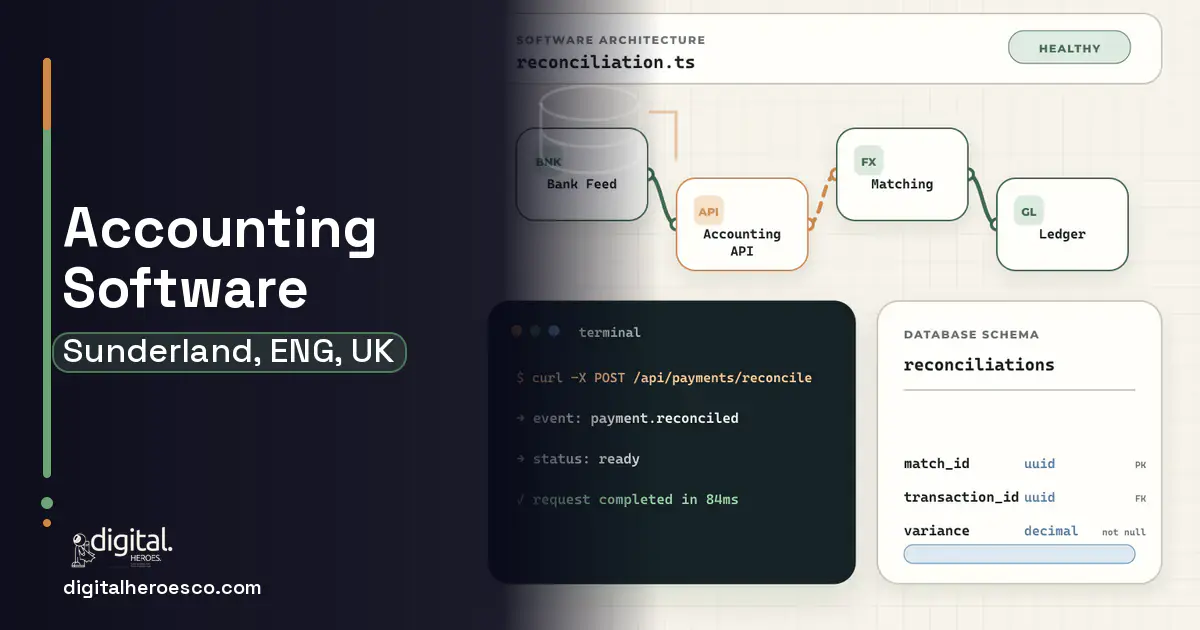
Custom accounting software in Sunderland costs £25k to £80k over 10 to 16 weeks. Most firms shouldn't build one, because QuickBooks, Xero and FreshBooks are excellent. You build, or more often build around them, when you need real job and product costing tied to production, or an accounting layer that finally connects to your ERP (Enterprise Resource Planning), inventory and payroll under Making Tax Digital.
QuickBooks, Xero and FreshBooks are genuinely good at bookkeeping, VAT and Making Tax Digital filing, and for most Sunderland businesses they're the right answer. The gap isn't the ledger, it's costing. These tools can't tell you the true cost of a job that consumed specific materials, machine hours and a particular shift's labour, because they were never connected to production. So your margins are estimates, not facts.
The second gap is integration. Finance ends up re-keying data from the ERP, the inventory system and payroll into the accounts, then reconciling the differences. The books are accurate at month-end and useless for a decision on a Tuesday. You don't need to replace the ledger, you need to connect it to reality.
Where the off-the-shelf tools fall short
- Off-the-shelf accounting can't cost a job by the materials, machine hours and shift it actually consumed
- Finance re-keys data from ERP, inventory and payroll, then reconciles the gaps
- Margins are estimated because true cost per job or product isn't captured
- The books are accurate at month-end but can't answer a question mid-week
Custom accounting: what Sunderland teams actually get
Usually the right move isn't replacing QuickBooks or Xero, it's building the costing and integration layer around them, though some firms do need a full custom accounting system. Either way you get true job and product costing fed by production, MTD-compliant VAT that still files to HMRC cleanly, and one flow of data from ERP, inventory and payroll into finance. Margins become facts you can act on, not month-end guesses.
- You need true job or product costing tied to production, not estimates
- Finance re-keys and reconciles data between systems every month
- Margins matter enough to quote from facts, not guesses
- Your ledger can't see materials, machine hours or shift labour
- QuickBooks, Xero or FreshBooks already covers your bookkeeping and VAT
- You don't need production-linked job costing
- Your operation is simple enough that estimates are fine
- You have no other systems worth integrating to
- True cost per job and product, fed by real materials, machine hours and shift labour
- One data flow from ERP, inventory and payroll into finance, ending the re-key and reconcile
- MTD-compliant VAT filing to HMRC built on connected, accurate data
- Live margin visibility so you can price and quote from facts, not estimates
- Keep the QuickBooks or Xero ledger you trust while gaining the costing you lack
- A full custom accounting system is rarely justified when Xero and QuickBooks are so capable
- Costing accuracy depends on good production data, so it relies on your other systems
- You own maintenance and the responsibility to keep MTD rules current
- Integration work is real effort even when the ledger stays off-the-shelf
Feature priorities for Sunderland teams
Sunderland accounting: the full scope
The engagements Sunderland teams bring us most often: financial reporting, accounts payable automation, accounts receivable, general ledger, expense management, custom accounting software and QuickBooks integration.
The honest cost picture for Sunderland
| Project scope | Typical cost | Timeline |
|---|---|---|
| Costing and reporting layer over Xero or QuickBooks | £25k to £42k | 10 to 12 wks |
| Integrated finance with ERP and payroll feeds | £42k to £62k | 12 to 14 wks |
| Full custom accounting with job costing and MTD | £62k to £80k | 14 to 16 wks |
Timeline: what happens, and when
Exactly what you get
The costing and integration layer your off-the-shelf ledger lacks, or a full custom system if you truly need one. Jobs are costed by real materials, machine hours and shift labour, data flows from your ERP, inventory and payroll, and VAT files to HMRC under MTD. Margins are live and factual, controls are auditable, and you own the system and data.
How to choose a developer in Sunderland
Favour a partner honest enough to say keep Xero and build the costing layer when that's the right call. Ask how they'll tie a job's cost to production data and keep MTD filing clean. A North East team that understands manufacturing finance will get costing right where a generic developer won't. Confirm MTD responsibility and data ownership in writing.
- !They push a full ledger rebuild when Xero already works. Ask why not build the costing layer instead
- !No plan for MTD and HMRC filing. Ask how VAT stays compliant on a custom system
- !Costing is vague. Ask how they'll tie a job's cost to materials, machine time and shift
- !They ignore your ERP and payroll. Ask how data flows in without a re-key
- !No financial controls. Ask about audit trails and role-based access
Teams investing in accounting in Sunderland usually scope it next to warehouse management, field service management, erp, since these systems share data and budgets. Weighing options across the region? Nearby: accounting in London, Birmingham and Manchester. Want it built, not just budgeted? That is our custom software development practice.
The evidence behind this guide
Independent findings on why this investment pays off. Every link goes to the primary source.
- A study (led by Prof. Pak-Lok Poon, published in Frontiers of Computer Science, 2024) reviewing decades of spreadsheet-quality research found that about 94% of spreadsheets used in business decision-making contain errors, illustrating the hidden risk of manual spreadsheet workarounds that custom software is built to replace. Source: Central Queensland University / phys.org (Prof. Pak-Lok Poon et al.) (2024) →
- APQC's Open Standards Benchmarking data on the monthly financial close found median performers take about 6.4 calendar days to close the books, while top performers (top 25%) do it in 4.8 days or fewer and bottom performers (bottom 25%) take 10 or more days. Source: APQC (2018) →
- The average developer spends more than 17 hours a week dealing with maintenance issues such as debugging and refactoring, and about four of those hours on 'bad code' - waste that equates to nearly $85 billion annually worldwide in opportunity cost. Source: Stripe (2018) →
- The EY survey of 508 payroll professionals at U.S. companies with 250-10,000 employees quantifies the direct and indirect cost of payroll inaccuracy, reinforcing the ROI case for payroll automation; the study is the original source of the frequently cited $291-per-error figure. Source: BusinessWire / EY (Ernst & Young) (2022) →
Frequently asked questions
How much does custom accounting software cost in Sunderland?
Typically £25k to £80k. A costing and reporting layer over Xero or QuickBooks is £25k to £42k, while a full custom system with job costing and MTD reaches £80k. Costing logic and integrations drive the cost, and most firms need the layer, not a full rebuild.
Should we replace QuickBooks or Xero or build around them?
Almost always build around them. QuickBooks and Xero handle bookkeeping, VAT and MTD filing well, so the value is a costing and integration layer that connects them to production. A full custom ledger is rarely justified, and a good partner will say so.
Can custom accounting give us true job costing?
Yes, that's the main reason to build. It ties a job's cost to the actual materials, machine hours and shift labour it consumed, turning estimated margins into facts. Off-the-shelf tools can't do this because they were never connected to your production.
Will a custom system stay MTD compliant with HMRC?
Yes, VAT filing under Making Tax Digital is built in and runs on connected, accurate data. Keeping MTD rules current is part of the ongoing arrangement, so confirm who owns that. Compliance sits alongside the costing, not against it.
How does it stop finance re-keying data every month?
By integrating your ERP, inventory and payroll so production events post automatically into the accounts. That ends the copy-paste and the month-end reconciliation of differences. The books become useful mid-week, not just at close.
How long does an accounting build take?
Ten to sixteen weeks. A costing layer over your existing ledger can be live in ten to twelve weeks, while a full custom system takes fourteen to sixteen. Testing against real month-end data is a stage you don't rush.
Do we own the accounting system and financial data?
Yes, on a custom build you own the system and the financial data outright, confirmed in the contract. That control matters for sensitive financial information and audit. Vague ownership terms are a reason to pause.
Can it report margins by job, product and customer?
Yes. Because cost is captured against real production, you get live profitability by job, product and customer rather than a blended month-end figure. That's what lets you quote and price from facts.
Should we hire a Sunderland accounting developer or go remote?
For production-linked costing, a partner who understands manufacturing finance and can sit with your finance team will model it correctly. A North East team familiar with local industry is ideal. Once the costing rules are set, ongoing work can be remote.
What should I prepare before contacting an agency about accounting software?
Bring three things: the 5 to 10 workflows that hurt most today, sample data such as your chart of accounts and a redacted month of transactions, and a list of every system the software must connect to, including banks and payroll. You do not need a formal spec; a good agency writes that with you during discovery. In our experience buyers who arrive with concrete workflow pain get accurate quotes, and buyers who arrive with a feature wishlist get padded ones.
Who owns the code when an agency builds my accounting software?
You should, outright, and the contract must say so with an explicit IP assignment clause rather than a usage license. Insist that the code lives in a repository you control from day one, so nothing, including the ledger schema and migration scripts, can be held back at the final invoice. Third-party libraries and any framework the agency reuses stay under their own licenses, and a clean contract lists exactly which those are.
Can we migrate years of data out of our current system into new custom software?
Almost always yes, through CSV exports or the vendor's API, and migration should be scoped as its own workstream with field mapping, a dry run, and a planned cutover window rather than an afterthought. The real time sink is rarely moving the data; it is cleaning it, since years of duplicates, free-text fields, and inconsistent formats surface all at once. Pull a full export from your current vendor before committing to anything new, because some SaaS plans restrict exports on lower tiers.
How many people should be working on my software project?
Three to five for a typical focused build: a project lead, one or two engineers, a designer, and part-time QA, which is the standard shape across 2,000+ Digital Heroes projects. Larger platforms justify 6 to 10, but a ten-person team on a small first version usually signals bill padding rather than horsepower. What predicts success is whether a senior engineer is writing your code daily, not the headcount on the proposal.
What are the biggest mistakes companies make when building accounting software?
The three we see most across Digital Heroes rescue projects: replacing everything at once instead of automating the most painful workflow first, skipping the parallel run so errors surface in live books, and letting developers design the ledger without an accountant reviewing the data model. A fourth is quietly expensive: no assigned owner for tax rate and compliance updates after launch. Every one of these is cheap to prevent and costly to unwind.
What can custom accounting software do that QuickBooks, Xero, and FreshBooks can't?
It encodes your actual business rules: progress billing tied to project milestones, revenue recognition for your specific contract types, landed cost tracking, or approval chains that match your org chart. Off-the-shelf tools handle generic bookkeeping well but force every business into the same chart of accounts and workflow. FreshBooks, for example, is built around freelancer-style invoicing, so inventory or multi-entity accounting means leaving the product entirely.
Who can build custom accounting software for a business in Sunderland?
Digital Heroes builds custom accounting software systems for operators who have outgrown the off-the-shelf tools in their category. The work is delivered remotely: our engineers work from Delhi and Lucknow, leadership is in New York, and some team members live in London and Sydney and work remotely from there. We have no office in Sunderland. You can chat with the team directly, and every form gets an email reply within 24 hours.
Related guides

More from Kayum.
Senior Full Stack Developer · Lucknow · 2 posts on the site
Published · Last updated .