QuickBooks closes your Carrollton books in English. Your entities, margins, and franchise tax do not fit its boxes.
Custom accounting software for a Carrollton business typically runs $45,000 to $110,000 over 4 to 7 months. It fits multi-entity books, bilingual documents, and Texas franchise-tax reporting that QuickBooks, Xero, and FreshBooks handle awkwardly, so month-end and filing stop being a spreadsheet rebuild.
On this page
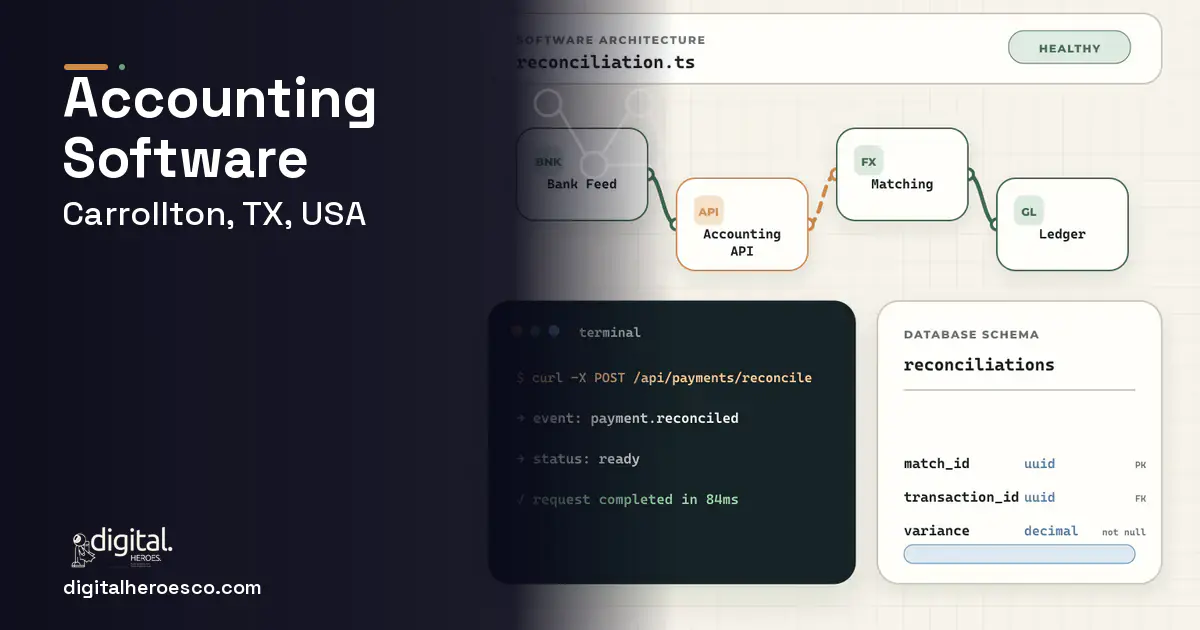
Custom accounting software for a Carrollton business typically runs $45,000 to $110,000 over 4 to 7 months. It fits multi-entity books, bilingual documents, and Texas franchise-tax reporting that QuickBooks, Xero, and FreshBooks handle awkwardly, so month-end and filing stop being a spreadsheet rebuild.
QuickBooks and Xero are built for a single, simple, English-speaking business. A Carrollton wholesaler often runs two or three related entities, bilingual invoices and vendor documents, and margins that depend on landed cost and consignment. So the bookkeeper exports everything to a spreadsheet to consolidate entities, calculate real margins, and prepare Texas franchise (margin) tax, and that spreadsheet is where the actual accounting happens.
FreshBooks is simpler still and built for service invoicing, not inventory-heavy wholesale. None of them handle bilingual documents or multi-entity consolidation natively, so your books look tidy inside the tool and messy the moment you need the full picture for a lender, a partner, or the Comptroller.
- You run multiple entities and consolidate them in a spreadsheet
- Bilingual invoices and vendor documents do not fit your accounting tool
- True margins depend on landed cost and consignment the tool ignores
- Franchise tax prep is an annual manual rebuild from exports
- You are a single entity with straightforward, English-only books
- QuickBooks or Xero already fits without a consolidation spreadsheet
- Your margins are simple and do not depend on landed cost
- You want low-cost, turnkey accounting
- Multi-entity consolidation inside the system instead of a month-end spreadsheet
- Bilingual invoices and vendor documents produced natively
- Real margin reporting based on landed cost and consignment, not list price
- Texas franchise tax and sales-and-use reporting mapped straight from the ledger
- One accurate financial picture for lenders, partners, and the Comptroller
- Custom accounting is a serious build and larger upfront than a QuickBooks subscription
- Accounting logic must be carefully validated, which lengthens testing
- You may still integrate a specialist for complex tax filing
- A single-entity, single-language business is well served by off-the-shelf tools
Accounting pricing in Carrollton: the real numbers
| Project scope | Typical cost | Timeline |
|---|---|---|
| Multi-entity ledger with bilingual documents | $45,000 to $65,000 | 4 to 5 months |
| Accounting with margin and tax reporting | $65,000 to $90,000 | 5 to 6 months |
| Accounting integrated with inventory and payroll | $90,000 to $110,000 | 6 to 7 months |
The features that matter for Carrollton
Carrollton accounting: the full scope
Everything an accounting build here can cover: financial reporting, accounts payable automation, accounts receivable, general ledger, expense management, custom accounting software and QuickBooks integration.
Exactly what you get
An accounting system that tells the truth without a month-end spreadsheet. It consolidates your related entities automatically, produces bilingual invoices and vendor documents, and computes real margins on landed cost and consignment rather than list price. Texas franchise (margin) tax and sales-and-use reporting map straight from the ledger, accounts payable and receivable fit wholesale terms, and the system integrates with inventory, POS, and payroll. You own the code and the financial data.
How to choose a developer in Carrollton
Accounting is unforgiving, so choose a developer who validates financial logic rigorously and who asks about your entities, cost basis, and franchise-tax filing before quoting. Favor teams that have built multi-entity and inventory-aware accounting, that handle bilingual documents natively, and that will integrate with inventory and payroll for one financial truth. Involve your accountant in the design, confirm code and data ownership, and value discretion given how sensitive these books are.
From kickoff to launch: the schedule
- !They assume one entity: ask how the system consolidates two or three related companies
- !They ignore cost basis: ask how landed cost and consignment feed real margins
- !They treat bilingual invoices as optional: ask how documents render in Korean and English
- !They hand-wave franchise tax: ask how reporting maps from the ledger to the margin-tax return
- !They avoid integration: ask how inventory and payroll feed the books
Teams investing in accounting in Carrollton usually scope it next to warehouse management, field service management, erp, since these systems share data and budgets. Weighing options across the region? Nearby: accounting in Houston, San Antonio and Dallas. Want it built, not just budgeted? That is our custom software development practice.
The evidence behind this guide
Independent findings on why this investment pays off. Every link goes to the primary source.
- A study (led by Prof. Pak-Lok Poon, published in Frontiers of Computer Science, 2024) reviewing decades of spreadsheet-quality research found that about 94% of spreadsheets used in business decision-making contain errors, illustrating the hidden risk of manual spreadsheet workarounds that custom software is built to replace. Source: Central Queensland University / phys.org (Prof. Pak-Lok Poon et al.) (2024) →
- McKinsey found that currently demonstrated technologies can fully automate about 42% of finance activities and mostly automate a further 19%, indicating roughly 60% of finance work is technically automatable. Source: McKinsey & Company (2018) →
- SaaS spend averaged $4,830 per employee (up 21.9% year over year), with large enterprises (10,000+ employees) spending roughly $284M annually and running about 660 apps, while organizations wasted an average of $21M annually on unused licenses. Source: Zylo (2025) →
- Poor software quality cost the US economy an estimated $2.41 trillion in 2022, including roughly $1.52 trillion in accumulated technical debt, driven partly by unsuccessful development projects and low-quality legacy systems. Source: Consortium for Information & Software Quality (CISQ) - Herb Krasner (2022) →
Frequently asked questions
What does custom accounting software cost for a Carrollton business?
Expect $45,000 to $110,000 depending on multi-entity consolidation, margin logic, and integrations. A multi-entity ledger with bilingual documents starts near $45,000 and ships in four to five months.
Why does QuickBooks force us into a spreadsheet at month end?
Because QuickBooks handles one entity cleanly but not the consolidation, bilingual documents, and landed-cost margins a Carrollton wholesaler needs. So the real accounting migrates to a spreadsheet, which a custom system replaces.
Can the software consolidate multiple related entities?
Yes. Multi-entity consolidation is built in, so two or three related companies roll up automatically instead of being stitched together by hand in a spreadsheet each period.
Does it handle Texas franchise tax reporting?
Yes. Reporting maps from your ledger to the Texas franchise (margin) tax return and the roughly 8.25% sales-and-use rate, so preparing your filing with the Comptroller is a report, not an annual manual rebuild.
Can invoices and vendor documents be bilingual?
Yes. The system generates invoices, statements, and vendor documents in Korean and English natively, so your bilingual customers and suppliers receive paperwork they can read.
Can it show our real margins including landed cost?
Yes. Margin reporting is based on landed cost and consignment rather than list price, so you see true profitability by product and account instead of a headline number that hides freight and duty.
How long does an accounting build take?
Four to seven months for most Carrollton businesses, longer with heavy inventory and payroll integration. Financial logic is validated carefully, which is why testing takes real time.
Do we own our financial data and the code?
Yes. On a custom build you own the ledger data and the source code, with documentation, so your sensitive financials stay under your control rather than inside a vendor platform.
Is custom accounting worth it over QuickBooks or Xero?
If you are a single entity with simple English-only books, QuickBooks or Xero is the right call. Build custom when multi-entity consolidation, bilingual documents, and landed-cost margins are pushing your real accounting into a spreadsheet.
How do I migrate years of QuickBooks data into a custom system?
Use a staged migration: export full history through the QuickBooks API or backup files, load it into the new system, then run both systems in parallel for at least one full closing cycle before cutting over. Expect cleanup work, because books older than three years almost always contain miscategorized transactions that surface during import. Digital Heroes schedules migration as its own project phase with its own sign-off, never as a launch-week task.
How many people should be working on my software project?
Three to five for a typical focused build: a project lead, one or two engineers, a designer, and part-time QA, which is the standard shape across 2,000+ Digital Heroes projects. Larger platforms justify 6 to 10, but a ten-person team on a small first version usually signals bill padding rather than horsepower. What predicts success is whether a senior engineer is writing your code daily, not the headcount on the proposal.
Should I hire a freelancer or an agency for my software project?
A skilled freelancer is the right call for a single-discipline scope under roughly $15,000, like a website, a plugin, or one integration. Above that, projects need design, backend, testing, and project management at once, and a solo builder becomes the single point of failure: if they get sick or take a bigger client, your project simply stops. Agencies bill 20-40% more per hour but carry continuity, code review, and someone to escalate to, which is what you are actually buying.
Can custom accounting software connect to my bank, payment processor, and payroll provider?
Yes, and it should be treated as standard scope rather than an add-on. Bank feeds typically come through aggregators like Plaid, payments through Stripe or your existing processor's API, and payroll providers such as Gusto and ADP publish APIs for pulling journal entries. The real constraint is smaller regional banks without feed coverage, which is worth verifying during scoping instead of discovering after launch.
Who owns the code when an agency builds my software?
You should, completely, through a written intellectual property assignment that transfers everything on final payment; without that clause, copyright stays with whoever wrote the code by default. Insist that the repository lives in your own GitHub organization from day one and that hosting, domains, and third-party accounts are registered to you. Also check for licenses to the agency's proprietary frameworks buried in the contract, because those can make switching vendors practically impossible even when you own your own code.
Who owns the code when an agency builds my accounting software?
You should, outright, and the contract must say so with an explicit IP assignment clause rather than a usage license. Insist that the code lives in a repository you control from day one, so nothing, including the ledger schema and migration scripts, can be held back at the final invoice. Third-party libraries and any framework the agency reuses stay under their own licenses, and a clean contract lists exactly which those are.
Can I extend QuickBooks with custom features instead of replacing it?
Yes, and it is often the right first step. QuickBooks Online has a public API, so an agency can build a custom layer for quoting, inventory, or field service that pushes clean transactions into QuickBooks, which stays your ledger of record. Roughly half of the accounting engagements Digital Heroes scopes start this way because it costs a fraction of a full build and leaves your accountant's workflow untouched.
Is custom software more secure than off-the-shelf SaaS?
Neither is secure by default; security tracks the practices of whoever builds and operates the system, not the model. SaaS gives you the vendor's certifications and patching but puts your data in a shared multi-tenant platform on their terms, while custom gives you full control over data residency, access rules, and compliance requirements like HIPAA, with the responsibility sitting with you and your agency. Before hiring anyone for a system holding sensitive data, ask for their security checklist: encryption at rest and in transit, an OWASP Top 10 review, role-based access, and a penetration test before launch.
Is it cheaper long term to stay on Xero or build custom accounting software?
Xero stays cheaper as long as its workflows fit your business, since even its top plan costs around $1,000 a year and custom development starts around $25,000. The math flips once you stack add-ons: companies Digital Heroes scopes after they have bolted inventory, job costing, and approval apps onto Xero are usually paying more for the app stack and the labor of keeping five tools in sync than for Xero itself. Custom wins when the real cost is that labor and its errors, not the license fee.
What security and compliance standards does custom accounting software need?
At minimum: encryption at rest and in transit, role-based access control, and immutable audit logs recording every change to the ledger. If outside parties rely on your numbers you will want SOC 2 style controls, and storing card data pulls you into PCI DSS, which most builds avoid by tokenizing payments through Stripe or a similar processor. Your industry adds its own rules, so compliance requirements belong in the written spec, not in a post-launch retrofit.
Who can build custom accounting software for a business in Carrollton?
Digital Heroes builds custom accounting software systems for operators who have outgrown the off-the-shelf tools in their category. The work is delivered remotely: our engineers work from Delhi and Lucknow, leadership is in New York, and some team members live in London and Sydney and work remotely from there. We have no office in Carrollton. You can chat with the team directly, and every form gets an email reply within 24 hours.
Related guides

Published · Last updated .