Your goods clear the port in Korean paperwork and hit a DFW dock that only reads English.
Custom supply chain software for a Carrollton importer or distributor typically runs $60,000 to $150,000 over 5 to 9 months.
On this page
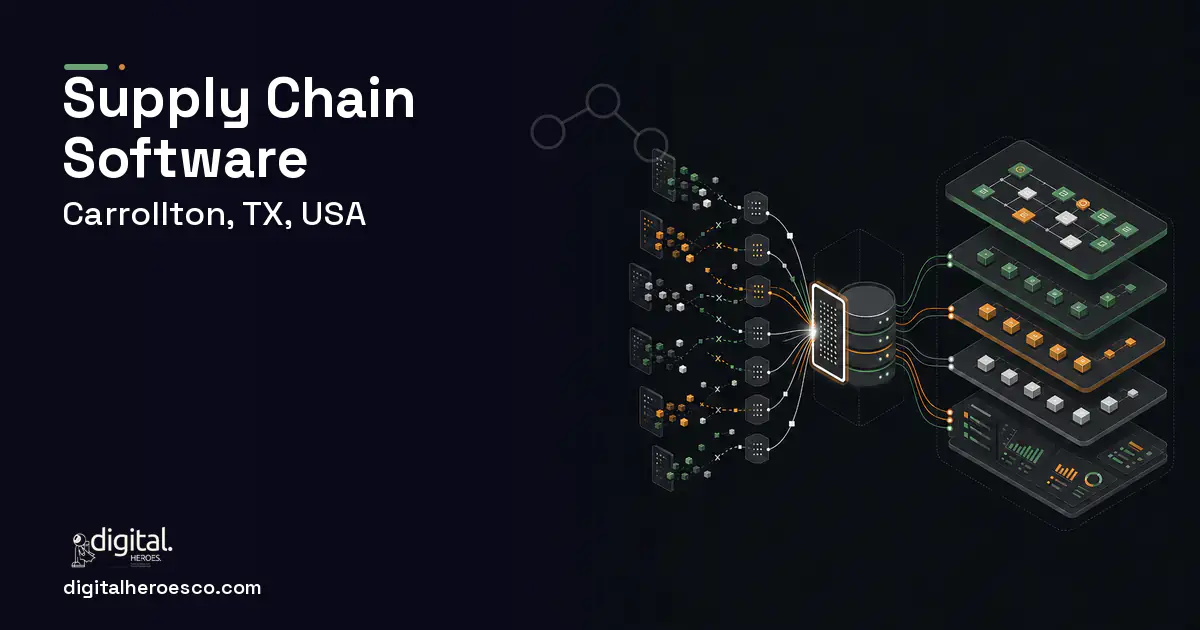
Custom supply chain software for a Carrollton importer or distributor typically runs $60,000 to $150,000 over 5 to 9 months. It ties bilingual supplier documents, landed-cost tracking, and inbound freight from ports to your Carrollton dock into one view, replacing SAP modules and generic SCM tools that never fit an import-heavy, bilingual operation.
A large share of Carrollton's Korean-owned wholesalers import goods, and the supply chain runs on documents in two languages: Korean supplier invoices and packing lists, English customs and freight paperwork. SAP and generic SCM platforms want clean, single-language data and standard domestic flows, so your team stitches together supplier emails, a freight forwarder's portal, and a landed-cost spreadsheet to know when goods will actually reach the dock and what they truly cost.
The gap between a container leaving a Korean port and arriving at your Carrollton warehouse is where money hides: duty, freight, demurrage, and a purchase order whose Korean line items do not match the English receiving system. Off-the-shelf SCM does not speak your suppliers' language or model your real landed cost, so you fly partly blind on the most expensive part of the business.
Where the off-the-shelf tools fall short
- Korean supplier documents and English customs paperwork never live in one system
- Landed cost with duty and freight is tracked in a spreadsheet, so true cost is always a guess
- Inbound container timing is stitched from supplier emails and a forwarder portal
- Purchase-order line items in Korean do not reconcile with English receiving, so shipments mismatch
Custom supply chain: what Carrollton teams actually get
Custom supply chain software models the import reality: bilingual supplier documents, landed cost with duty and freight, and inbound visibility from port to Carrollton dock. Purchase orders carry Korean and English line items that reconcile at receiving, and one view replaces the email-and-spreadsheet stitch, so you see true cost and real timing on the most expensive part of the operation.
- Your supply chain is import-heavy and runs on bilingual documents
- Landed cost lives in a spreadsheet and true cost is a guess
- Inbound timing is stitched from emails and a forwarder portal
- Korean purchase orders do not reconcile with English receiving
- Your supply chain is domestic, simple, and single-language
- A forwarder portal and light tools already give you enough visibility
- Landed cost is not a meaningful part of your margins
- You are too small to justify a dedicated system
- Bilingual supplier documents and English customs paperwork in one connected system
- Landed cost with duty and freight computed automatically, not guessed in a spreadsheet
- Inbound container visibility from port to Carrollton dock in one view
- Purchase orders that reconcile Korean and English line items at receiving
- Earlier, clearer signals to plan warehouse space and customer commitments
- Supply chain software is a substantial build and takes months to deliver value
- It depends on data from suppliers and forwarders whose systems vary in quality
- You own maintenance as trade lanes, suppliers, and tariffs change
- A small domestic, single-language supply chain does not need this
Feature priorities for Carrollton teams
What we build under supply chain in Carrollton
Digital Heroes builds the full supply chain stack for Carrollton teams. Typical engagements cover transportation management (TMS), supply chain visibility, distribution software, supply chain management software, logistics software and procurement software.
The honest cost picture for Carrollton
| Project scope | Typical cost | Timeline |
|---|---|---|
| Bilingual purchase order and landed-cost tracking | $60,000 to $90,000 | 5 to 6 months |
| Supply chain with inbound visibility and reconciliation | $90,000 to $120,000 | 6 to 8 months |
| Full platform integrated with inventory and accounting | $120,000 to $150,000 | 8 to 9 months |
Timeline: what happens, and when
Exactly what you get
One connected view of an import supply chain that currently lives in emails and spreadsheets. Bilingual purchase orders carry Korean and English line items that reconcile at receiving, landed cost rolls up duty, freight, and demurrage automatically, and inbound containers are visible from port to your Carrollton dock. Supplier performance and lead times become analytics you can act on, the system integrates with inventory and accounting, and you own the supplier and cost history outright.
How to choose a developer in Carrollton
Choose a developer who understands import supply chains, not just domestic logistics, and who asks about your suppliers, trade lanes, and landed cost before quoting. Favor teams that can model duty and freight into true cost, reconcile bilingual purchase orders, and integrate forwarder and inventory data. Given how much money moves through this, confirm code and data ownership and choose a partner the Koreatown business community would vouch for on discretion and competence.
- !They assume domestic single-language freight: ask how the system handles Korean supplier documents
- !They ignore landed cost: ask how duty and freight roll into true product cost
- !They cannot reconcile bilingual purchase orders: ask how Korean line items match English receiving
- !They have no plan for forwarder data: ask how inbound container timing gets into the system
- !They lock away your data: ask how you own supplier and cost history
If supply chain is on the roadmap, project management, helpdesk & ticketing, crm usually follow within the year. Budget them as one conversation. Weighing options across the region? Nearby: supply chain in Houston, San Antonio and Dallas. Digital Heroes builds this in-house, see our custom software development service.
The evidence behind this guide
Independent findings on why this investment pays off. Every link goes to the primary source.
- Digital Champions expect to achieve about 16% in cost savings and around 15% in revenue gains from digital operations over five years; the study surveyed 1,155 manufacturing executives across 26 countries. Source: PwC / Strategy& (2018) →
- In a survey of 579 supply chain professionals (July 31 to October 1, 2024), only 29% had built at least three of the five capabilities Gartner identifies as needed for future competitiveness (agility, resilience, regionalization, integrated ecosystems, and enterprise-wide strategy). Source: Gartner (2025) →
- Per the Standish Group CHAOS 2020 report (reviewed at this URL), across tens of thousands of software projects roughly 31% end successfully, about 50% are 'challenged', and roughly 19% fail outright; small projects succeed far more often than large ones, and Agile approaches succeed at markedly higher rates than Waterfall. Source: The Standish Group (2020) →
- Qualtrics research (Q3 2023 survey of ~28,400 consumers across 26 countries) estimated bad customer experiences put roughly $3.7 trillion in global revenue at risk annually, a 19% jump from the prior year's $3.1 trillion; 64% of customers say they will switch companies over poor service regardless of how much they like the product. Source: Qualtrics XM Institute (via Forbes) (2024) →
Frequently asked questions
What does custom supply chain software cost for a Carrollton importer?
Expect $60,000 to $150,000 depending on landed-cost logic, inbound tracking, and integrations. Bilingual purchase orders with landed-cost tracking start near $60,000 and ship in five to six months.
Can it handle Korean supplier documents and English customs paperwork together?
Yes. A custom system keeps bilingual supplier documents and English customs and freight paperwork in one place, so your team stops stitching two languages of paperwork across email and portals.
How does the software calculate true landed cost?
It rolls duty, freight, and demurrage into product cost automatically, so you know real cost per item instead of estimating it in a spreadsheet after the fact. That true cost then feeds accurate margins.
Can we see where our inbound containers are?
Yes. Inbound shipment tracking gives you visibility from the origin port to your Carrollton dock in one view, so you can plan warehouse space and customer commitments instead of guessing from supplier emails.
How does it reconcile purchase orders with receiving?
Purchase orders carry Korean and English line items tied to the same records, so when goods arrive the receiving team matches them without the language mismatch that currently causes shipment errors.
Does it connect to our inventory and accounting?
Yes. Integrating supply chain with inventory and accounting means landed cost, stock, and the ledger stay consistent, which is what turns import data into reliable margins.
How long does a supply chain build take?
Five to nine months for most Carrollton importers, depending on landed-cost complexity, inbound tracking, and integrations. Bilingual purchase orders and landed cost come first.
Do we own the supplier and cost data?
Yes. On a custom build you own the supplier, purchase-order, and cost history along with the code, so this competitive data stays yours rather than locked in an SCM vendor's platform.
Is custom supply chain software worth it over SAP modules?
If your supply chain is domestic, simple, and single-language, a lighter tool or SAP module may suffice. Build custom when import-heavy, bilingual, landed-cost-driven freight is where your money and your errors actually live.
Should we start with an MVP or build the full supply chain platform at once?
Start with an MVP that fixes your single most expensive workflow, prove it in daily operations, then expand module by module. That gets working software onto the warehouse floor in about 12 weeks instead of debating a year-long spec, and real usage always reorders the roadmap; features that felt critical in planning routinely get cut after go-live. Digital Heroes typically scopes phase one at 30 to 40 percent of the total vision and lets measured results justify each next phase.
How much does custom supply chain software cost for a small business?
For a small business, a focused custom supply chain tool usually lands between $15,000 and $45,000, covering one core workflow like inventory tracking, purchase orders, or shipment visibility. Across 2,000+ delivered projects, Digital Heroes sees most small distributors and light manufacturers start in the $20,000 to $35,000 range for a first working version. Adding barcode scanning, multi-warehouse support, or carrier integrations pushes budgets toward $50,000 and up.
Why do agencies charge for a discovery phase instead of quoting for free?
Because an accurate quote requires real work: mapping your workflows, finding the edge cases, and writing a specification, which typically takes 1 to 3 weeks and costs $2,000 to $10,000 at Digital Heroes depending on system complexity. You leave discovery owning a written spec and a fixed price you can take to any vendor, so the money is not locked into one agency. Free estimates are guesses, and the guess usually becomes your budget overrun six months later.
Are local developer rates in Carrollton worth it compared to hiring an offshore team?
Agency rates in markets like Carrollton typically run $100 to $200 per hour against $25 to $60 offshore, but the hourly rate is not the project cost. Across 2,000+ Digital Heroes projects, the setup that consistently works is a hybrid: senior architects and a named lead for your project with a distributed build team behind them, which lands total cost well below all-local without the rework cycles that pure lowest-bid offshore engagements produce. Compare bids on total delivered cost with maintenance included, never on rate cards.
What are the biggest mistakes first-time software buyers make?
Choosing the lowest bid, paying more than 30-40% upfront instead of on milestones, skipping a written specification, and having no maintenance plan for after launch. The most expensive of the four in Digital Heroes rescue projects is the missing spec: without written acceptance criteria, done becomes an argument instead of a checklist, and every disagreement resolves in the vendor's favor. Fix those four and you have avoided most of the ways these projects fail.
How many people should be working on my software project?
Three to five for a typical focused build: a project lead, one or two engineers, a designer, and part-time QA, which is the standard shape across 2,000+ Digital Heroes projects. Larger platforms justify 6 to 10, but a ten-person team on a small first version usually signals bill padding rather than horsepower. What predicts success is whether a senior engineer is writing your code daily, not the headcount on the proposal.
Who can build custom supply chain software for a business in Carrollton?
Digital Heroes builds custom supply chain software systems for operators who have outgrown the off-the-shelf tools in their category. The work is delivered remotely: our engineers work from Delhi and Lucknow, leadership is in New York, and some team members live in London and Sydney and work remotely from there. We have no office in Carrollton. You can chat with the team directly, and every form gets an email reply within 24 hours.
Related guides
Published · Last updated .