Your Dallas logistics network runs on SAP screens that don't match how freight actually moves
Custom supply chain software in Dallas runs $90k to $300k over 5 to 10 months, and the operations that need it are logistics and distribution firms whose real freight network, carrier mix, and exception handling don't fit a generic SCM or a rigid SAP configuration.
On this page
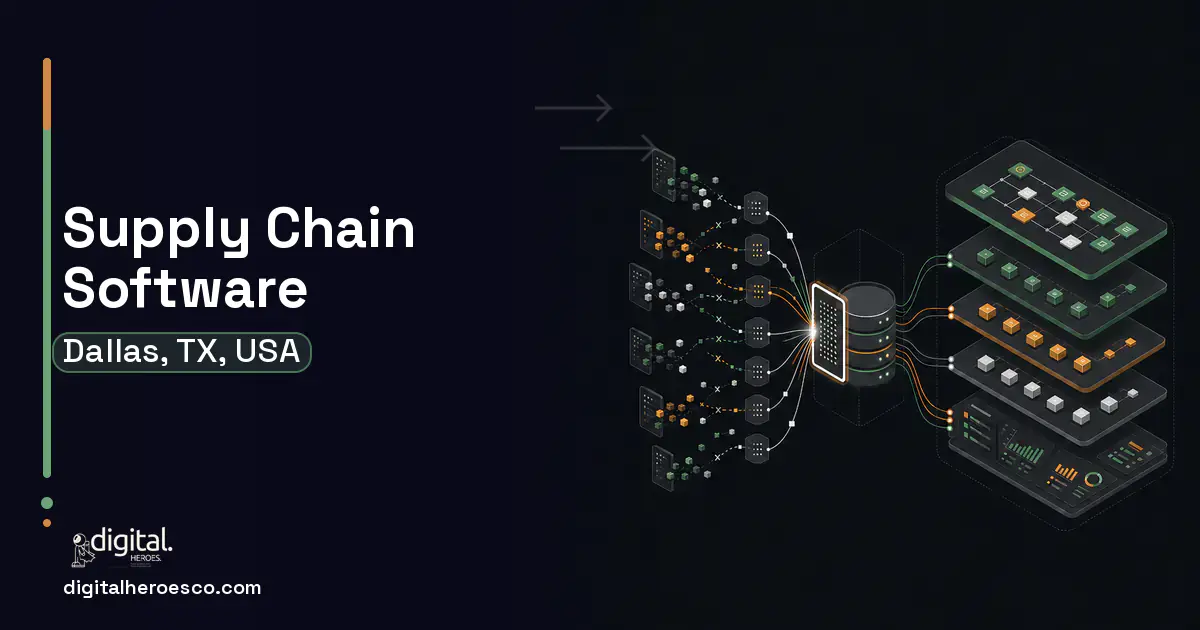
Custom supply chain software in Dallas runs $90k to $300k over 5 to 10 months, and the operations that need it are logistics and distribution firms whose real freight network, carrier mix, and exception handling don't fit a generic SCM or a rigid SAP configuration. SAP and generic supply-chain platforms model an idealized chain. They struggle with the messy reality of a Dallas logistics hub: multiple carriers, cross-dock flows, real-time exceptions, and the inland-port freight movement that defines the region.
Your Dallas operation sits in one of the country's busiest freight corridors, moving goods through cross-docks and carriers in patterns that a generic SCM platform flattens into screens nobody trusts. Planners run the real network in spreadsheets alongside SAP, because the system's idealized model doesn't match how freight actually moves through DFW, and exceptions (a delayed carrier, a re-route) get handled by phone, not software.
SAP and generic SCM platforms assume a clean, predictable chain. Real logistics in a hub like Dallas is full of exceptions, multi-carrier optimization, and dynamic routing the standard configuration can't express without enormous cost. The result is expensive software that planners work around, while the actual decisions live in their heads and their spreadsheets, which means no institutional memory and no scalability.
The fix: supply chain built for Dallas, not rented
Custom supply chain software models your actual network: your carriers, your cross-dock flows, your exception patterns, and the dynamic routing a Dallas freight hub demands. It encodes the decisions your best planners make by instinct, handles exceptions systematically instead of by phone, and integrates with your ERP (Enterprise Resource Planning) and warehouse systems so the plan reflects real inventory and orders. You stop paying for an idealized model nobody uses and get software that matches how freight actually moves.
The capability list that earns its budget
What we build under supply chain in Dallas
The engagements Dallas teams bring us most often: transportation management (TMS), supply chain visibility, distribution software, supply chain management software, logistics software and procurement software.
What supply chain costs in Dallas
| Project scope | Typical cost | Timeline |
|---|---|---|
| Network visibility and exception-handling layer | $90k to $160k | 5 to 6 months |
| Custom routing and optimization for your network | $160k to $240k | 6 to 8 months |
| Full supply chain platform with ERP and WMS integration | $230k to $300k+ | 8 to 10 months |
How long it takes, phase by phase
Exactly what you get
Supply chain software modeled on your real Dallas freight network: your carriers, your DFW cross-dock flows, and the exception patterns that define a busy logistics hub. It optimizes multi-carrier routing, handles delays and re-routes through systematic workflows instead of phone calls, and captures the decisions your best planners make by instinct so the knowledge scales. It integrates with your ERP, warehouse management system, and inventory so plans reflect real orders and stock, not an idealized model nobody trusts.
How to choose a developer in Dallas
Hire a team that has built real logistics software, not configured a generic SCM and called it custom. Ask how they handle dirty carrier data, how they design exception workflows, and how they keep an optimization engine from making confidently wrong decisions. Supply chain is complex, so scope discipline matters; ask what they'd deliberately leave out of phase one. A strong partner integrates the platform with your warehouse management system, inventory software, and ERP so the plan, the stock, and the books all agree.
- A model of your real freight network, carriers, and cross-dock flows instead of an idealized chain
- Systematic exception handling so a delayed carrier triggers a workflow, not a panicked phone call
- Multi-carrier optimization and dynamic routing encoded in software, not trapped in planners' heads
- Institutional knowledge captured in the system, so it scales beyond your best two planners
- Integration with ERP and warehouse systems so plans reflect real inventory and orders
- Supply chain software is among the most complex to build; scope discipline is critical and easy to lose
- It depends on quality data from carriers and systems; garbage in produces plans nobody trusts
- You own the ongoing modeling as your network and carrier mix change
- Optimization logic is sophisticated; getting it wrong can produce confidently bad routing decisions
- !They promise optimization without discussing data quality; ask how they handle bad carrier data
- !No exception-handling design; ask how a delayed carrier is detected and re-routed
- !They underestimate complexity; ask how they scope to avoid building forever
- !No carrier integration plan; ask which carrier systems they connect and how
- !Generic SCM resellers in disguise; ask what they build versus configure for your network
If supply chain is on the roadmap, project management, helpdesk & ticketing, crm usually follow within the year. Budget them as one conversation. Weighing options across the region? Nearby: supply chain in Houston, San Antonio and Austin. Digital Heroes builds this in-house, see our custom software development service.
The evidence behind this guide
Independent findings on why this investment pays off. Every link goes to the primary source.
- 48% of private companies cite integration with legacy systems or technical debt as a top obstacle to realizing the full value of their digital and AI investments (behind data quality/availability at 72% and gaps in AI fluency or technology talent/leadership at 53%). Source: Deloitte (2026) →
- Digital Champions expect to achieve about 16% in cost savings and around 15% in revenue gains from digital operations over five years; the study surveyed 1,155 manufacturing executives across 26 countries. Source: PwC / Strategy& (2018) →
- Sensor Tower's State of Mobile 2026 reports that global users spent 5.3 trillion hours in iOS and Google Play apps in 2025 (+3.8% YoY), roughly 3.6 hours per day per mobile user. (Note: the page does not itself contrast app time vs. mobile-browser time, so the 'overwhelming majority of time in apps vs browsers' framing is not directly supported by this source.). Source: Sensor Tower (2026) →
- The right combination of digital transformation actions can unlock as much as US$1.25 trillion in additional market capitalization across Fortune 500 companies, while the wrong combinations put more than US$1.5 trillion at risk; companies with all three core factors (strategy, aligned technology, and change capability) saw a 5% market-value lift relative to peers. Source: Deloitte (2023) →
Frequently asked questions
Can't SAP's supply chain modules handle this?
They can model an idealized chain, but expressing a real Dallas freight network's multi-carrier routing and exception handling in SAP often costs as much as a custom build and still fights your reality. For network-specific logic, custom frequently fits better.
What makes supply chain software so hard to build?
Optimization and exception handling are genuinely complex, and the software is only as good as the carrier and inventory data feeding it. Scope discipline and data quality are the two things that make or break these projects.
How do you capture knowledge that lives in planners' heads?
By working closely with them to encode the decisions they make by instinct into rules and workflows. That discovery work is intensive but it's the whole point: turning individual expertise into scalable institutional capability.
Will it integrate with our warehouse and ERP?
It must. A supply chain plan disconnected from real inventory and orders is fiction. A capable build integrates with your warehouse management system, inventory software, and ERP so the plan reflects reality.
How do we avoid a runaway project?
Phase it tightly. Start with visibility and exception handling, prove value, then add optimization. Trying to build the full optimized network in one phase is how supply chain projects balloon and fail.
How much does custom supply chain software cost for a small business?
For a small business, a focused custom supply chain tool usually lands between $15,000 and $45,000, covering one core workflow like inventory tracking, purchase orders, or shipment visibility. Across 2,000+ delivered projects, Digital Heroes sees most small distributors and light manufacturers start in the $20,000 to $35,000 range for a first working version. Adding barcode scanning, multi-warehouse support, or carrier integrations pushes budgets toward $50,000 and up.
When is SAP actually a better choice than building custom supply chain software?
Choose SAP when you need a full ERP, operate in a heavily audited industry that expects standard systems, or run global operations where localization, tax, and compliance content matter more than workflow fit. SAP's strength is breadth: finance, manufacturing, and supply chain in one validated suite. Custom wins when your edge lives in a specific workflow, like how you allocate inventory or route orders, that SAP would force you to bend to its standard process. Many Digital Heroes clients keep SAP as the system of record and build custom operational tools around it.
Why do agencies charge for a discovery phase instead of quoting for free?
Because an accurate quote requires real work: mapping your workflows, finding the edge cases, and writing a specification, which typically takes 1 to 3 weeks and costs $2,000 to $10,000 at Digital Heroes depending on system complexity. You leave discovery owning a written spec and a fixed price you can take to any vendor, so the money is not locked into one agency. Free estimates are guesses, and the guess usually becomes your budget overrun six months later.
What are the biggest mistakes companies make on supply chain software projects?
The top three: replacing every system at once instead of one workflow at a time, skipping data cleanup so the new system inherits years of bad SKUs and phantom stock, and designing screens without the warehouse staff who will use them daily. A fourth is underscoping integrations and discovering mid-project that the ERP connection is half the work. Digital Heroes sees more supply chain projects fail from scope and data problems than from any technical cause.
How many people should be working on my software project?
Three to five for a typical focused build: a project lead, one or two engineers, a designer, and part-time QA, which is the standard shape across 2,000+ Digital Heroes projects. Larger platforms justify 6 to 10, but a ten-person team on a small first version usually signals bill padding rather than horsepower. What predicts success is whether a senior engineer is writing your code daily, not the headcount on the proposal.
What should I prepare before contacting a software development agency?
A one-page brief beats a 40-page requirements document: the business problem in plain words, who will use the system, the 5 to 10 workflows it must handle, the tools it must connect to, and your budget range and deadline driver. You do not need wireframes, a specification, or technical vocabulary; producing those is the agency's job during discovery. Stating a budget range up front is the single best move, because it gets you honest scoping instead of a quote engineered to win the meeting.
Will custom software scale as we add warehouses, SKUs, and order volume?
Yes, if multi-location support and your target volumes are stated requirements at design time, because a schema built for one warehouse is expensive to retrofit for ten. A well-built system on PostgreSQL comfortably handles millions of SKUs and tens of thousands of orders per day on modest cloud hardware, so scaling cost shows up in hosting bills rather than rewrites. Give your agency the 3-year growth picture upfront even if phase one covers a single site.
What does it cost to keep custom software running after launch?
Budget 15-20% of the original build cost per year, which on a $100,000 system means $15,000 to $20,000 for security patches, dependency updates, bug fixes, and small improvements as real usage reveals what the spec missed. Cloud hosting for a typical business application adds $50 to $300 a month on top. Skipping maintenance does not save the money; in Digital Heroes rescue work, unmaintained systems typically need a far more expensive rebuild within about three years.
Do the developers need to be near our warehouse in Dallas, or can this be done remotely?
Most of the build works fine remotely, but plan 2 or 3 on-site visits to your Dallas warehouse: one during discovery to watch receiving and picking firsthand, and one or two around go-live for scanner setup and floor training. Warehouse software designed purely over video calls consistently misses physical realities like glove-friendly button sizes, scan distances, and dead Wi-Fi zones near racking. Remote build with on-site milestones is how Digital Heroes runs most warehouse projects.
Who owns the code when an agency builds my software?
You should, completely, through a written intellectual property assignment that transfers everything on final payment; without that clause, copyright stays with whoever wrote the code by default. Insist that the repository lives in your own GitHub organization from day one and that hosting, domains, and third-party accounts are registered to you. Also check for licenses to the agency's proprietary frameworks buried in the contract, because those can make switching vendors practically impossible even when you own your own code.
How many SaaS seats do we need before building custom becomes cheaper?
The crossover usually shows up between 20 and 50 seats on premium tiers. Salesforce Enterprise lists at $165 per user per month, so 40 users cost about $79,000 a year in subscriptions, which is real money against a custom system you would own outright. Run the comparison over three years: if subscription spend beats the build cost plus 15-20% annual maintenance, custom wins on price before you even count workflow fit.
We run everything on spreadsheets and Airtable. How do we know it's time for custom software?
The reliable signals are re-typing the same data into multiple tools, one employee acting as human middleware between systems, and errors appearing in handoffs between teams. Hard limits force the issue too: Airtable's Team plan caps at 50,000 records per base, and Business costs $45 per seat per month, so a 20-person team pays about $10,800 a year for a tool it has already outgrown. When workarounds consume more hours than the tools save, the spreadsheet era is over.
Can we migrate years of data out of our current system into new custom software?
Almost always yes, through CSV exports or the vendor's API, and migration should be scoped as its own workstream with field mapping, a dry run, and a planned cutover window rather than an afterthought. The real time sink is rarely moving the data; it is cleaning it, since years of duplicates, free-text fields, and inconsistent formats surface all at once. Pull a full export from your current vendor before committing to anything new, because some SaaS plans restrict exports on lower tiers.
Who can build custom supply chain software for a business in Dallas?
Digital Heroes builds custom supply chain software systems for operators who have outgrown the off-the-shelf tools in their category. The work is delivered remotely: our engineers work from Delhi and Lucknow, leadership is in New York, and some team members live in London and Sydney and work remotely from there. We have no office in Dallas. You can chat with the team directly, and every form gets an email reply within 24 hours.
Related guides

More from Dhruv.
Director of DevOps & Infrastructure · Delhi · 5 posts on the site
Published · Last updated .