Your Saint John supply chain runs on tide tables and rail cutoffs SAP has never heard of
Custom supply chain software in Saint John runs CAD $70k to $180k over 4 to 8 months. It coordinates the pieces generic SCM ignores here: tidal berth windows, CBSA customs, rail cutoffs and the vessels moving through the port.
On this page
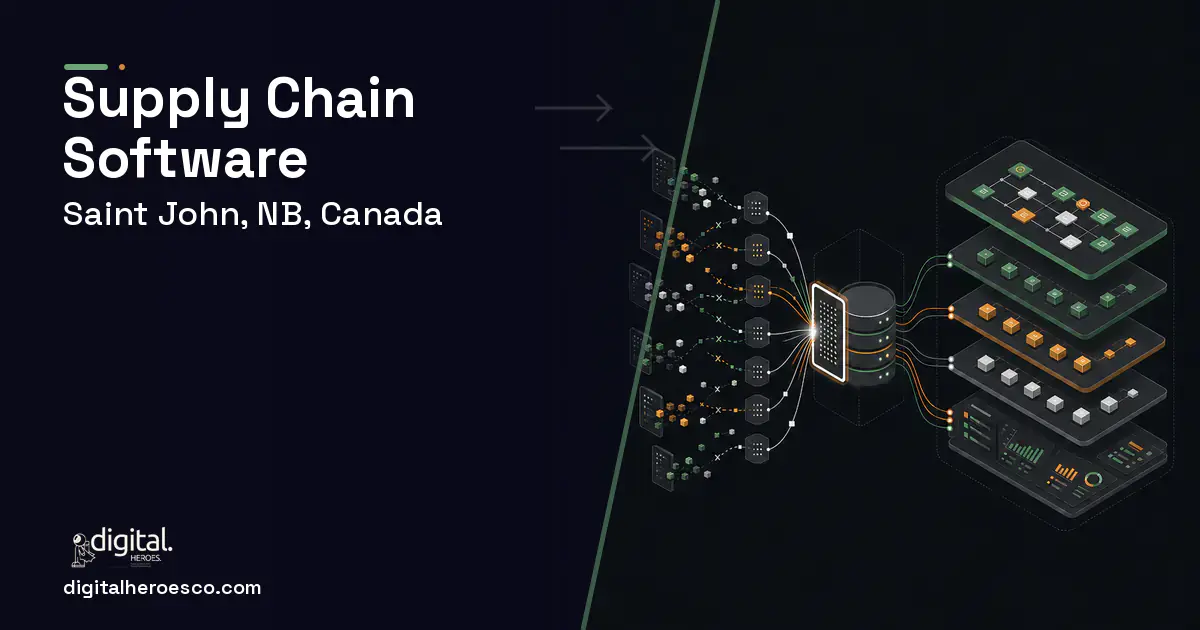
Custom supply chain software in Saint John runs CAD $70k to $180k over 4 to 8 months. It coordinates the pieces generic SCM (Supply Chain Management) ignores here: tidal berth windows, CBSA customs, rail cutoffs and the vessels moving through the port.
SAP and generic SCM tools model warehouses and trucks, not a Bay of Fundy port where berth windows follow the tide, customs runs through CBSA, and cargo waits on rail and vessel schedules. Potash, pulp and general cargo each move on constraints the standard tool cannot express.
So planners run the real schedule in spreadsheets and email, and every delay ripples further than it should.
What supply chain costs in Saint John
| Project scope | Typical cost | Timeline |
|---|---|---|
| Core scheduling and customs tracking | CAD $70k to $110k | 4 to 5 months |
| With rail, vessel and partner data | CAD $110k to $150k | 5 to 7 months |
| Full platform with ERP (Enterprise Resource Planning) integration | CAD $150k to $180k+ | 7 to 8 months |
The fix: supply chain built for Saint John, not rented
Custom supply chain software encodes tide-aware berth windows, CBSA customs milestones and rail and vessel schedules in one view. It links to your warehouse, inventory and ERP, and surfaces exceptions on dashboards before they become delays.
- Tides, customs and rail drive your schedule
- Delays cascade without warning
- Planning lives in spreadsheets and email
- Simple truck-based distribution
- No port, customs or rail complexity
- A standard SCM tool already fits
The capability list that earns its budget
Supply Chain services we deliver in Saint John
Digital Heroes builds the full supply chain stack for Saint John teams. Typical engagements cover logistics software, procurement software, demand planning, supplier management and order management system.
How long it takes, phase by phase
Exactly what you get
Supply chain software that coordinates tide-aware berth windows, CBSA customs milestones and rail and vessel schedules in one view, with exception alerts and links to your warehouse and ERP. You own the code and integrations.
How to choose a developer in Saint John
Choose a team that understands port and customs logistics, not just warehouse distribution. Ask how they will model tidal windows and CBSA steps, and how they integrate carrier data. Confirm ownership and a phased plan.
- Tide-aware berth and terminal scheduling
- CBSA customs milestones tracked in one place
- Rail and vessel cutoffs coordinated automatically
- Early warning on cascading delays
- One view across warehouse, inventory and ERP
- Significant upfront cost
- Complex integrations to external parties
- You own maintenance
- Needs cooperation from partners for data
- !No tide or customs awareness: ask how they model port constraints
- !Ignores rail and vessel data: ask about carrier integration
- !No exception logic: ask how delays are forecast
- !No ERP link: ask how it connects
- !No ownership: ask for handover
If supply chain is on the roadmap, project management, helpdesk & ticketing, crm usually follow within the year. Budget them as one conversation. Weighing options across the region? Nearby: supply chain in Moncton and Fredericton. Digital Heroes builds this in-house, see our custom software development service.
The evidence behind this guide
Independent findings on why this investment pays off. Every link goes to the primary source.
- In a survey of 579 supply chain professionals (July 31 to October 1, 2024), only 29% had built at least three of the five capabilities Gartner identifies as needed for future competitiveness (agility, resilience, regionalization, integrated ecosystems, and enterprise-wide strategy). Source: Gartner (2025) →
- Digital Champions expect to achieve about 16% in cost savings and around 15% in revenue gains from digital operations over five years; the study surveyed 1,155 manufacturing executives across 26 countries. Source: PwC / Strategy& (2018) →
- The performance gap between digital and AI leaders and laggards is widening: McKinsey reports leaders pull ahead on shareholder returns, and the average maturity spread between top and bottom performers jumped ~60% (from 10 points in 2016-19 to 16 points in 2020-22), reinforcing that the returns to transformation concentrate among top performers. Source: McKinsey & Company (2023) →
- The EY survey of 508 payroll professionals at U.S. companies with 250-10,000 employees quantifies the direct and indirect cost of payroll inaccuracy, reinforcing the ROI case for payroll automation; the study is the original source of the frequently cited $291-per-error figure. Source: BusinessWire / EY (Ernst & Young) (2022) →
Frequently asked questions
What does custom supply chain software cost for a Saint John shipper?
Most builds run CAD $70k to $180k, driven by external integrations and forecasting. A core scheduling and customs tool starts near $70k.
Why doesn't SAP or generic SCM fit our port operation?
They model warehouses and trucks, not tide-driven berth windows, CBSA customs and rail cutoffs. Those constraints are exactly what a Saint John port operation runs on.
Can it account for Bay of Fundy tides in scheduling?
Yes, tide-aware berth windows are built in so plans respect real access times. That prevents scheduling a berth the tide will not allow.
Does it track CBSA customs steps?
Yes, customs milestones and documentation are tracked in one place rather than by email. That reduces holds and surprises at the border.
How long does a supply chain build take?
Plan for 4 to 8 months from discovery to launch. External carrier and customs integrations extend the timeline.
Can it warn us about delays early?
Yes, exception logic forecasts cascading delays so you can react before they hit. Alerts surface on a dashboard rather than after the fact.
Does it integrate with our ERP and warehouse system?
Do we own the supply chain system?
Yes, you own the code and integration logic and can host it as you choose. There is no vendor lock-in.
Can we hire supply chain developers locally in Saint John?
Port and customs logistics experience is specialised, so most shippers use an agency with that background plus local support. Ask for a port or customs integration reference.
How much does custom supply chain software cost for a small business?
For a small business, a focused custom supply chain tool usually lands between $15,000 and $45,000, covering one core workflow like inventory tracking, purchase orders, or shipment visibility. Across 2,000+ delivered projects, Digital Heroes sees most small distributors and light manufacturers start in the $20,000 to $35,000 range for a first working version. Adding barcode scanning, multi-warehouse support, or carrier integrations pushes budgets toward $50,000 and up.
Should I hire a freelancer or an agency for my software project?
A skilled freelancer is the right call for a single-discipline scope under roughly $15,000, like a website, a plugin, or one integration. Above that, projects need design, backend, testing, and project management at once, and a solo builder becomes the single point of failure: if they get sick or take a bigger client, your project simply stops. Agencies bill 20-40% more per hour but carry continuity, code review, and someone to escalate to, which is what you are actually buying.
Who owns the code when an agency builds my supply chain software?
You should own it outright, with full IP assignment on payment written into the contract, and you should walk away from any agency that only licenses the software to you. Insist on the code living in a repository under your own GitHub or GitLab account from day one, not handed over at the end. Digital Heroes contracts assign all custom code, database schemas, and documentation to the client; the only carve-outs should be clearly listed open source libraries.
Who owns the code when an agency builds my software?
You should, completely, through a written intellectual property assignment that transfers everything on final payment; without that clause, copyright stays with whoever wrote the code by default. Insist that the repository lives in your own GitHub organization from day one and that hosting, domains, and third-party accounts are registered to you. Also check for licenses to the agency's proprietary frameworks buried in the contract, because those can make switching vendors practically impossible even when you own your own code.
Should I hire a freelancer or an agency to build supply chain software?
For anything past a single-user internal tool, use an agency or an established team, because supply chain systems need backend, frontend, integration, and QA skills that rarely live in one freelancer. A solo developer can build a $10,000 inventory tracker; a system that talks to your ERP, carriers, and warehouse scanners fails badly when its only author is unreachable during a shipping cutoff. In the proposals Digital Heroes sees clients compare, agencies cost 20 to 50 percent more but give you continuity, code review, and someone answerable when order data stops flowing.
What should I prepare before contacting a software development agency?
A one-page brief beats a 40-page requirements document: the business problem in plain words, who will use the system, the 5 to 10 workflows it must handle, the tools it must connect to, and your budget range and deadline driver. You do not need wireframes, a specification, or technical vocabulary; producing those is the agency's job during discovery. Stating a budget range up front is the single best move, because it gets you honest scoping instead of a quote engineered to win the meeting.
Can we migrate years of data out of our current system into new custom software?
Almost always yes, through CSV exports or the vendor's API, and migration should be scoped as its own workstream with field mapping, a dry run, and a planned cutover window rather than an afterthought. The real time sink is rarely moving the data; it is cleaning it, since years of duplicates, free-text fields, and inconsistent formats surface all at once. Pull a full export from your current vendor before committing to anything new, because some SaaS plans restrict exports on lower tiers.
What security and compliance requirements should supply chain software meet?
At minimum: role-based access control, encryption in transit and at rest, audit logs on inventory and order changes, and tested backups, because the system holds supplier pricing and customer purchase history your competitors would love to see. If enterprise customers connect to it, expect security questionnaires and possibly SOC 2 expectations; food, pharma, and aerospace add traceability rules like FDA lot tracking or ITAR data handling. Raise these in the first scoping call, since retrofitting audit trails onto a live system costs far more than designing them in.
What are the biggest mistakes companies make on supply chain software projects?
The top three: replacing every system at once instead of one workflow at a time, skipping data cleanup so the new system inherits years of bad SKUs and phantom stock, and designing screens without the warehouse staff who will use them daily. A fourth is underscoping integrations and discovering mid-project that the ERP connection is half the work. Digital Heroes sees more supply chain projects fail from scope and data problems than from any technical cause.
Who can build custom supply chain software for a business in Saint John?
Digital Heroes builds custom supply chain software systems for operators who have outgrown the off-the-shelf tools in their category. The work is delivered remotely: our engineers work from Delhi and Lucknow, leadership is in New York, and some team members live in London and Sydney and work remotely from there. We have no office in Saint John. You can chat with the team directly, and every form gets an email reply within 24 hours.
Related guides

More from Kayum.
Senior Full Stack Developer · Lucknow · 2 posts on the site
Published · Last updated .