Your Barrie warehouse triples its picks for summer, and the ERP's bolt-on WMS routes pickers like it's still winter
A custom warehouse management system for a Barrie distribution operation runs $70,000 to $140,000 over 5 to 8 months.
On this page
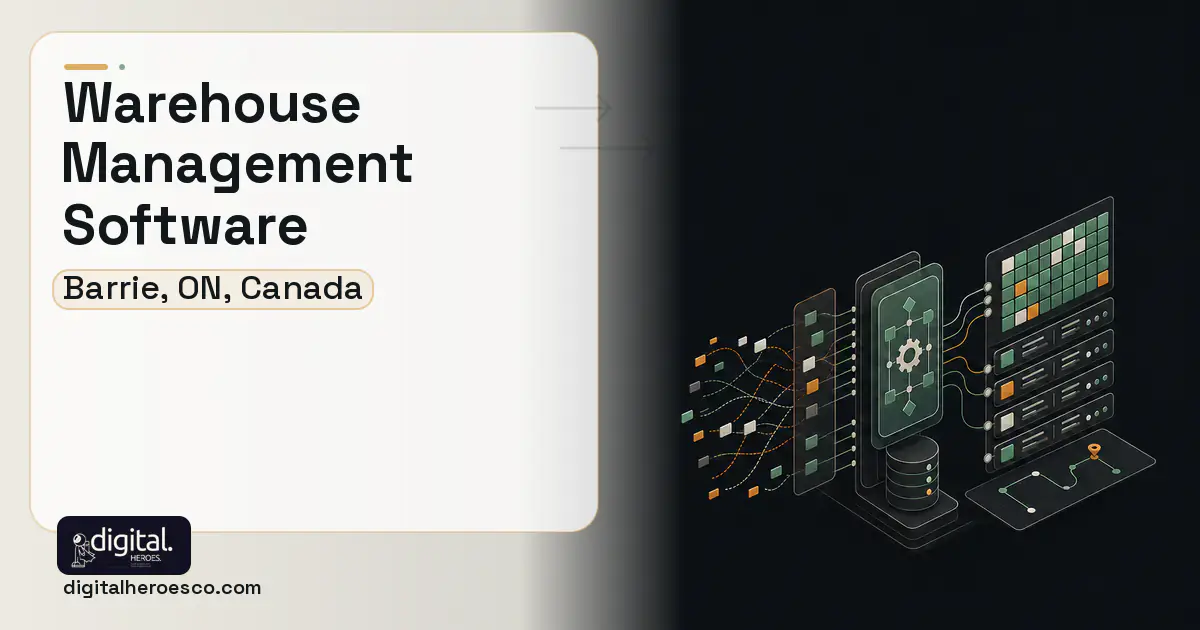
A custom warehouse management system for a Barrie distribution operation runs $70,000 to $140,000 over 5 to 8 months. Manhattan-class systems are overbuilt and overpriced for your size, and the WMS add-on bundled with your ERP (Enterprise Resource Planning) doesn't know your actual floor or your seasonal pick volume. A custom WMS routes pickers by your real layout, flexes for the summer surge, and runs on rugged handhelds in the aisles, so your team stops walking miles to fill orders that triple in season.
The WMS module that came with your ERP treats the warehouse as a list of bins, not a physical space with aisles, congestion, and a layout that changes for the season. So it sends pickers on routes that look fine on paper and waste miles on the floor, doubling back for items that should have been picked together. In the slow months you absorb the inefficiency; in the summer surge, when pick volume triples for cottage-season demand, that wasted walking becomes the bottleneck between you and a same-day GTA promise.
Manhattan and the enterprise WMS platforms solve this, but they're built for million-square-foot operations with the budget and IT staff to match, which is not a Barrie distributor. You'd pay enterprise licensing and implementation cost for capability you'll never use, and still need consultants to configure it. So you're stuck between a bolt-on that doesn't fit and an enterprise platform that doesn't fit either, picking miles a day in between.
Where the off-the-shelf tools fall short
- The ERP's bundled WMS treats the floor as a bin list, so pick routes waste miles in the aisles
- Summer pick volume triples for cottage-season demand and the static routing becomes the bottleneck
- Manhattan-class platforms are overbuilt and overpriced for a Barrie-sized operation
- You're stuck between a bolt-on that doesn't fit and an enterprise system you can't justify
Custom warehouse management: what Barrie teams actually get
You should build when wasted picker walking is your throughput ceiling and neither the ERP add-on nor an enterprise WMS fits your size. A custom WMS encodes your real floor layout and routes pickers efficiently, flexes its slotting and routing for the seasonal surge, and runs on handhelds your team actually uses. It's sized and priced for a Barrie distributor, giving you enterprise-grade picking logic without the enterprise overhead.
- Wasted picker walking is the ceiling on your throughput
- Summer pick volume triples and static routing becomes the bottleneck
- The ERP's bundled WMS doesn't understand your real floor
- Manhattan-class platforms are overkill and over budget for your size
- Your volume is low and stable and walking isn't your constraint
- The WMS add-on bundled with your ERP genuinely fits your floor
- You're large enough to justify and staff an enterprise WMS
- Your layout never changes seasonally, so static routing holds
- Pick routing built on your real floor layout, so pickers stop walking miles a day
- Seasonal slotting and routing that flex when summer pick volume triples
- Throughput that holds your same-day GTA promise during the surge instead of bottlenecking
- Right-sized cost and complexity for a Barrie distributor, not enterprise overhead
- Rugged handheld workflows your floor team adopts because they fit the work
- A WMS build needs an accurate floor and slotting model up front, which takes real discovery
- Handheld hardware selection and maintenance become your responsibility
- Integration to your ERP for orders and inventory is essential glue you'll own
- If your volume is low and stable and walking isn't your bottleneck, the ERP add-on may be fine
Feature priorities for Barrie teams
What we build under warehouse management in Barrie
Digital Heroes builds the full warehouse management stack for Barrie teams. Typical engagements cover barcode and RFID, slotting optimization, inbound and outbound logistics, fulfillment software, 3PL software and warehouse management system (WMS).
The honest cost picture for Barrie
| Project scope | Typical cost | Timeline |
|---|---|---|
| WMS with layout-aware picking and handhelds | $70k to $100k | 5 to 6 months |
| Full WMS with dynamic slotting and ERP integration | $110k to $140k | 6 to 8 months |
| Pick-path optimization layer over existing WMS | $40k to $70k | 3 to 4 months |
Timeline: what happens, and when
Exactly what you get
You get a WMS sized for your operation that knows your actual floor: pick paths that cut the miles, slotting that shifts fast movers forward for summer, and handheld workflows your team adopts. It plugs into the systems around it, so your ERP software, inventory management software, and supply chain software share one accurate picture of what's where, even when pick volume triples.
How to choose a developer in Barrie
Hire a team that starts by mapping your real floor, not configuring a generic bin grid, and that won't try to sell you an enterprise platform you don't need. Ask how their routing handles your aisles and how slotting flexes for the surge. A Barrie-aware partner will design for the seasonal pick spike and the same-day GTA window, and will pick handheld hardware that survives the warehouse floor.
- !They treat the floor as a bin list; ask how routing accounts for your real aisle layout
- !They pitch a Manhattan-class platform; ask why that's right-sized for a Barrie distributor
- !They ignore the seasonal surge; ask how slotting and waves flex when volume triples
- !They skip the handheld experience; ask to see a picking workflow on a rugged device
- !They underplay ERP integration; ask how bin accuracy stays synced with orders and inventory
Most Barrie teams pricing warehouse management end up comparing notes on business intelligence (BI) dashboards, lms, internal tools too; the systems share one data spine. Weighing options across the region? We publish the same warehouse management guide for Toronto, Ottawa, Hamilton. Prefer to talk to the team that builds these? Digital Heroes handles custom software development end to end.
The evidence behind this guide
Independent findings on why this investment pays off. Every link goes to the primary source.
- Poor software quality cost the US economy an estimated $2.41 trillion in 2022, including roughly $1.52 trillion in accumulated technical debt, driven partly by unsuccessful development projects and low-quality legacy systems. Source: Consortium for Information & Software Quality (CISQ) - Herb Krasner (2022) →
- Inventory carrying cost commonly runs about 20% to 30% of inventory value, covering capital cost, storage/warehousing, insurance, taxes, handling, shrinkage, and obsolescence - a recurring cost that better inventory and warehouse software aims to reduce. Source: APQC (2023) →
- 48% of private companies cite integration with legacy systems or technical debt as a top obstacle to realizing the full value of their digital and AI investments (behind data quality/availability at 72% and gaps in AI fluency or technology talent/leadership at 53%). Source: Deloitte (2026) →
- Gallup reports global employee engagement fell to 20% in 2025 (its lowest since 2020, down from a 2022-2023 peak of 23%), and estimates low engagement costs the world economy an estimated $10 trillion in lost productivity, or 9% of global GDP. (Note: this figure appears in Gallup's evergreen State of the Global Workplace page, currently reflecting the 2026 edition reporting on 2025 data.). Source: Gallup (2025) →
Frequently asked questions
How much does a custom warehouse management system cost in Barrie?
A WMS with layout-aware picking and handhelds runs $70,000 to $100,000 over 5 to 6 months. A full system with dynamic slotting and ERP integration reaches $140,000. A pick-path optimization layer over an existing WMS is cheaper at $40,000 to $70,000.
Why doesn't our ERP's WMS module work?
It treats the warehouse as a list of bins, not a physical floor with aisles and seasonal layout changes. So it routes pickers inefficiently, which you absorb in slow months but which becomes your bottleneck when summer pick volume triples.
Isn't Manhattan the gold standard?
For million-square-foot operations, yes. For a Barrie-sized distributor it's overbuilt and overpriced, and you'd pay enterprise licensing and consultants for capability you'll never use. A custom WMS gives you the picking logic that matters at a cost that fits.
How does layout-aware routing save money?
It plans pick paths around your real aisles so pickers stop doubling back and walking miles a day. In the summer surge that travel reduction is the difference between holding your same-day GTA promise and missing it.
What does the build need from us?
An accurate floor and slotting model, and ERP integration for orders and inventory. The discovery to map your floor properly is essential, because routing and slotting are only as good as the layout data they're built on.
How long does it take to build a custom web or mobile app from scratch?
Plan on 8 to 16 weeks for a focused first version and 4 to 9 months for a larger platform, which is the typical spread across Digital Heroes builds. The first 2 to 3 weeks go to discovery and design before any production code ships. The two things that stretch timelines most are integrations with legacy systems and slow feedback from your side, not developer speed.
We are comparing Manhattan Active WM against building custom. How should we decide?
Pick Manhattan if you run enterprise-scale distribution with multiple large DCs, complex labor management, and retail compliance needs, and you can absorb the enterprise procurement Digital Heroes has watched clients budget for, which reaches the mid six figures once subscription and partner implementation are combined. Build custom when your budget is under $300,000, your workflows do not fit Manhattan's model, or the system must bend around a niche process like rental returns, kitting, or cold-chain lot rules. In Digital Heroes' experience, a $150,000 custom build plus 15 to 20 percent annual upkeep totals around $300,000 over five years with no per-user fees, which is why most mid-size operations come out ahead going custom.
How do I vet a software agency for a WMS project?
Ask for a warehouse or logistics system they have already shipped and talk to that client directly, since WMS punishes teams who have only built standard web apps. In the first call, a capable team asks about your racking layout, scan points, SKU count, and peak daily order lines before showing you anything, because a team that starts with screens instead of flows designs the wrong system. Also confirm who actually writes the code, as many agencies sell with senior people and deliver with juniors.
What are the biggest mistakes first-time software buyers make?
Choosing the lowest bid, paying more than 30-40% upfront instead of on milestones, skipping a written specification, and having no maintenance plan for after launch. The most expensive of the four in Digital Heroes rescue projects is the missing spec: without written acceptance criteria, done becomes an argument instead of a checklist, and every disagreement resolves in the vendor's favor. Fix those four and you have avoided most of the ways these projects fail.
Our ERP already has a warehouse module. Why build custom instead of just turning it on?
Turn it on first if your operation matches its assumptions: standard pick-pack-ship, one inventory model, moderate volume. ERP add-ons like NetSuite WMS or SAP EWM struggle with mixed units of measure, customer-specific labeling, 3PL billing, and floor speed, and customizing inside the ERP often costs more than building beside it. Digital Heroes frequently builds a custom warehouse layer that owns floor operations and syncs orders and inventory back to the ERP, which keeps finance accurate without forcing pickers through ERP screens.
Why do agencies charge for a discovery phase instead of quoting for free?
Because an accurate quote requires real work: mapping your workflows, finding the edge cases, and writing a specification, which typically takes 1 to 3 weeks and costs $2,000 to $10,000 at Digital Heroes depending on system complexity. You leave discovery owning a written spec and a fixed price you can take to any vendor, so the money is not locked into one agency. Free estimates are guesses, and the guess usually becomes your budget overrun six months later.
Do we need a local agency or can a WMS be built remotely? We are in Barrie.
Remote works for most of the build, but insist on at least one on-site visit during discovery and another at go-live; two hours watching your receiving dock in Barrie surfaces details no video call catches. Digital Heroes runs WMS projects remotely with on-site milestones, and warehouse software experience matters far more than the agency's address. A local generalist who has never shipped a WMS is a worse bet than a remote team that has done twelve.
How do we migrate off spreadsheets or our old WMS without stopping the warehouse?
Run old and new in parallel on one zone or product line, then cut the rest over once a physical count validates the new data. Digital Heroes migrations import SKUs and locations weeks ahead, freeze the old system for a single weekend, and reconcile counts before Monday receiving, so floor disruption is measured in days rather than weeks. The riskiest data is not quantities but location mappings and unit-of-measure conversions, so audit those twice.
We run one small warehouse. What would a custom WMS cost for a business our size?
Plan on $40,000 to $80,000 for a focused single-site system covering barcode receiving, location tracking, directed picking, and a shipping station, which is the typical Digital Heroes range for operations with 5 to 30 floor staff. If your inventory pain costs less than about $1,500 a month in mispicks and recounts, custom rarely pays yet, and a mid-market tool or your ERP's inventory module is the smarter spend at that stage.
What integrations does a custom WMS usually need?
Four categories cover most builds: the ERP or accounting system for purchase orders and invoices, sales channels like Shopify or EDI feeds from retail customers, shipping carriers through UPS, FedEx, or a multi-carrier API like EasyPost, and hardware such as label printers and scales. Each ERP connection typically adds 2 to 4 weeks of work in Digital Heroes builds, and EDI with a big-box retailer adds more. List every integration before asking for quotes, because integrations are the most common source of budget overrun in Digital Heroes projects.
Who owns the code when an agency builds my software?
You should, completely, through a written intellectual property assignment that transfers everything on final payment; without that clause, copyright stays with whoever wrote the code by default. Insist that the repository lives in your own GitHub organization from day one and that hosting, domains, and third-party accounts are registered to you. Also check for licenses to the agency's proprietary frameworks buried in the contract, because those can make switching vendors practically impossible even when you own your own code.
How long does it take to build and roll out a custom WMS?
A working first version takes 12 to 16 weeks in Digital Heroes projects, and full rollout with data migration, scanner setup, and floor training lands at 5 to 7 months. Enterprise packages run much longer; clients who come to Digital Heroes after evaluating Manhattan report partner-led implementations of a year or more. The slowest part is rarely the code; it is documenting how receiving and picking actually work today, so start mapping those flows before you sign anything.
Who can build custom warehouse management software for a business in Barrie?
Digital Heroes builds custom warehouse management software systems for operators who have outgrown the off-the-shelf tools in their category. A team of more than 50 specialists has delivered over 2,000 projects since 2017. Teams work from New York, London, Sydney, Delhi and Lucknow and deliver remotely, so an operator in Barrie gets an assigned senior team rather than a local account manager.
Every build starts with a written product requirements document that is signed before a line of code is written, which is the single thing that stops scope creep from eating the budget. Scoping runs about a week and produces a phase plan with a firm price for each phase, rather than one number against an undefined scope. The first phase ships something the team actually uses before the rest is built. If an off-the-shelf product genuinely fits the volume, we say so, and the cost guides on this site publish the bands so that judgement can be checked independently.
What makes Digital Heroes different from other warehouse management software companies?
Four things that competitors in this bracket cannot simply copy. Digital Heroes runs a YouTube channel with more than 2.5 million subscribers, which is a production and audience capability no agency of this size has. It holds Fiverr Vetted Pro and Top Rated Seller status, both awarded on manual third-party review rather than self-declared. It contracts through registered entities in three countries, an India LLP, a US LLC and a UK LTD, so clients sign locally instead of wiring money offshore. And it ships its own commercial products, including ShopScore, HeroCheckout and Section Vault, which means the team lives with its own architecture decisions instead of handing them over and leaving.
Two more that show up in the work. Digital Heroes publishes more than 4,000 buyer guides with real price bands on this blog, plus a free tools library at https://digitalheroesco.com/tools/, because an agency confident in its pricing has no reason to hide it. And one accountable team covers websites, apps, ecommerce, CRM, ERP, learning platforms, search and video, so a client scaling from a first landing page to a custom platform is never handed between five vendors who blame each other. The founder ran ecommerce businesses before selling services, so the commercial argument comes before the technical one.
How can I check Digital Heroes is legitimate before getting in touch?
Verify it independently rather than taking the site's word for it. The YouTube channel is at https://youtube.com/@DigitalMarketingHeroes, the Fiverr profile at https://www.fiverr.com/shreyanshsin261, and the Upwork profile at https://www.upwork.com/freelancers/shreyanshsingh. Client reviews sit on Clutch at https://clutch.co/profile/digital-heroes-0 and Trustpilot at https://www.trustpilot.com/review/digitalheroes.co.in, and the company page is at https://www.linkedin.com/company/digital-heroes-1/.
Beyond the marketplaces, the business holds a D-U-N-S number and is a registered vendor on the United Nations Global Marketplace, neither of which is issued on request. Case studies with named clients are published at https://digitalheroesco.com/case-studies/. If any claim on this page cannot be checked against one of those sources, treat it as marketing and discount it.
Related guides

Published .


