Stellantis releases parts on a four-hour JIT window; your Windsor supply chain software syncs once a night
Custom supply chain software for a Windsor auto supplier or logistics firm runs $60,000 to $160,000 and 4 to 7 months. Generic SCM and SAP modules assume planned, batched replenishment.
On this page
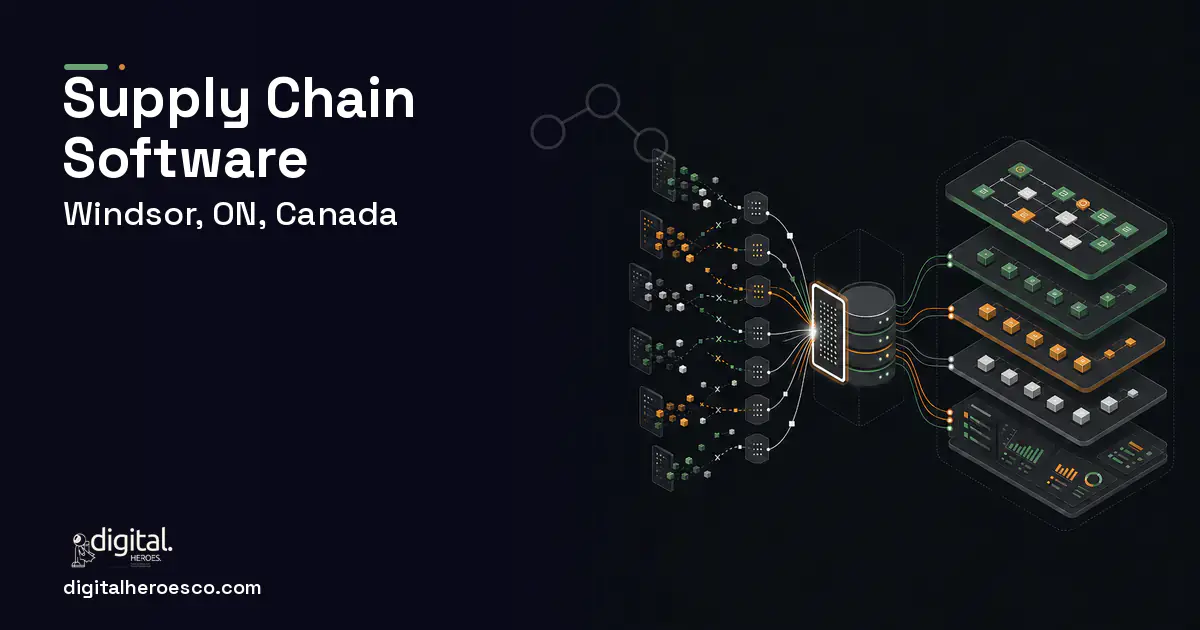
Custom supply chain software for a Windsor auto supplier or logistics firm runs $60,000 to $160,000 and 4 to 7 months. Generic SCM and SAP modules assume planned, batched replenishment. Your reality is just-in-time releases from Detroit OEMs on tight windows, trucks timed to a border crossing, and EDI schedules that change inside the day, which a once-nightly sync can't keep up with.
Your customer is a Detroit OEM running JIT, and they release parts on windows measured in hours, not days. The supply chain module in your SAP setup batches and syncs overnight, so by the time it reflects a release, the truck should already be loaded and timed to clear the Ambassador Bridge before the plant's line-side stock runs out. A planning cycle built for weekly replenishment is structurally wrong for a four-hour window.
The border makes it sharper. A load that misses its crossing window doesn't just arrive late, it can shut a line in Michigan and trigger chargebacks that dwarf the freight. Generic SCM has no model for border timing, EDI 862 release schedules that shift intraday, or the real lead time across a specific bridge. For a Windsor supplier, supply chain software that can't think in hours and crossings isn't fit for the job.
The fix: supply chain built for Windsor, not rented
Custom supply chain software thinks in hours and crossings. It ingests EDI releases in near real time, plans loads against actual border-crossing windows and lead times, and warns before a shipment will miss its slot at a Detroit plant. For a Windsor JIT supplier, that early warning is the whole point, the difference between a re-timed truck and a five-figure chargeback for stopping a line.
The capability list that earns its budget
Windsor supply chain: the full scope
Everything a supply chain build here can cover: supply chain visibility, distribution software, supply chain management software, logistics software, procurement software, demand planning and supplier management.
What supply chain costs in Windsor
| Project scope | Typical cost | Timeline |
|---|---|---|
| EDI + JIT visibility module | $60k to $90k | 4 to 5 months |
| Supply chain platform with border timing | $90k to $130k | 5 to 6 months |
| Full platform with carrier + chargeback tracking | $130k to $160k | 6 to 7 months |
How long it takes, phase by phase
Exactly what you get
A supply chain system that operates on JIT time: it ingests EDI releases as they arrive, plans loads against real border-crossing windows, and warns you before a Detroit slot will be missed, while you can still re-time the truck. The payoff is fewer five-figure chargebacks and a clean release-to-dock timeline. It connects to your ERP (Enterprise Resource Planning), warehouse management system and a warehouse-floor mobile app, and feeds business intelligence (BI) dashboards on OEM scorecards.
How to choose a developer in Windsor
Hire a team that has integrated OEM EDI and understands border timing as a first-class constraint, not a footnote. Ask exactly how their system reacts when an 862 release shifts at 10am and the load must clear by 2pm. Real-time integration is hard and depends on reliable feeds, so confirm their plan for EDI and carrier data. A JIT auto-supplier reference is non-negotiable here; weekly-replenishment experience won't transfer.
- Near-real-time EDI release ingestion instead of an overnight batch
- Load planning against actual border-crossing windows and lead times
- Early warnings before a shipment misses its Detroit delivery slot
- Visibility from release to crossing to dock in one timeline
- Fewer chargebacks because the system flags risk while you can still act
- A real-time supply chain build is expensive and integration-heavy
- It depends on reliable EDI and carrier data feeds you must secure
- Overkill if you ship on planned weekly cycles, not JIT windows
- OEM EDI onboarding and testing add time and coordination
- !Their SCM syncs nightly; ask how it reacts to an intraday EDI 862 change
- !No border-timing model; ask how crossing windows factor into planning
- !No missed-window alerting; ask how risk surfaces before a truck is late
- !No EDI onboarding experience; ask how they've integrated OEM feeds
- !No JIT auto-supplier reference; ask for one
If supply chain is on the roadmap, project management, helpdesk & ticketing, crm usually follow within the year. Budget them as one conversation. Weighing options across the region? Nearby: supply chain in Toronto, Ottawa and Hamilton. Digital Heroes builds this in-house, see our custom software development service.
The evidence behind this guide
Independent findings on why this investment pays off. Every link goes to the primary source.
- Digital Champions expect to achieve about 16% in cost savings and around 15% in revenue gains from digital operations over five years; the study surveyed 1,155 manufacturing executives across 26 countries. Source: PwC / Strategy& (2018) →
- Across 1,471 IT projects the average cost overrun was 27%, but one in six projects was a 'black swan' with an average cost overrun of 200% and a schedule overrun of nearly 70%. Source: Harvard Business Review (Bent Flyvbjerg & Alexander Budzier, University of Oxford) (2011) →
- The Standish Group 1995 CHAOS Report found only 16.2% of software projects fully succeeded; success varied sharply by size, with large-company projects succeeding about 9% of the time versus far higher rates for small projects - best treated as an industry survey, not an audited dataset. Source: Standish Group (1995) →
- The NRF discontinued its long-running annual shrink report, stating that a broad study of retail shrink 'is no longer sufficient for capturing the key challenges and needs of the industry' - important context that qualifies how POS/shrink benchmarks should be cited going forward. Source: Retail Dive (2024) →
Frequently asked questions
Why can't standard SCM handle JIT supply to Detroit?
Standard SCM and SAP modules plan on batched, often nightly cycles built for weekly replenishment. JIT releases from a Detroit OEM arrive on hour-long windows, so a nightly sync is structurally too slow. Custom software ingests releases in near real time and plans against border windows.
How does border timing factor into the software?
It models the actual crossing windows and lead times for the Ambassador and Gordie Howe bridges, so load planning accounts for clearance time and the system can warn when a truck will miss its Detroit slot.
What does missed-window alerting actually save?
A missed JIT window can stop a line in Michigan and trigger chargebacks that far exceed the freight cost. Early alerts let you re-time or expedite while it still matters, which is where the system pays for itself.
What does custom supply chain software cost here?
An EDI and JIT visibility module runs $60k to $90k. Add border-timing planning for $90k to $130k, and full carrier and chargeback tracking reaches $160k.
How long to build?
Four to five months for the EDI and visibility core, up to seven for a full platform. OEM EDI onboarding and testing are the long pole, so plan that coordination early.
Who owns the code when an agency builds my software?
You should, completely, through a written intellectual property assignment that transfers everything on final payment; without that clause, copyright stays with whoever wrote the code by default. Insist that the repository lives in your own GitHub organization from day one and that hosting, domains, and third-party accounts are registered to you. Also check for licenses to the agency's proprietary frameworks buried in the contract, because those can make switching vendors practically impossible even when you own your own code.
What tech stack is best for custom supply chain software?
Boring and mainstream wins: a typed backend such as Node with TypeScript, Python, or C#, PostgreSQL for transactional inventory data, a React web frontend, and hosting on AWS, Azure, or GCP. Real-time needs like scanner feeds or live shipment tracking add a message queue such as Redis or RabbitMQ. Be wary of any agency pitching an exotic stack; in Digital Heroes handover work, systems built on niche frameworks are consistently the hardest and most expensive for a new team to take over.
How much should a small business budget for its first custom app or website?
For a focused first build, most small businesses land between $8,000 and $60,000: roughly $8,000 to $45,000 for a custom website and $25,000 to $60,000 for an internal tool or simple web app, based on Digital Heroes delivery across 2,000+ projects. Customer-facing products with payments, logins, or a mobile app start around $40,000. Quotes far below these bands usually mean a template with your logo on it, not software shaped around your workflow.
Should I hire a freelancer or an agency for my software project?
A skilled freelancer is the right call for a single-discipline scope under roughly $15,000, like a website, a plugin, or one integration. Above that, projects need design, backend, testing, and project management at once, and a solo builder becomes the single point of failure: if they get sick or take a bigger client, your project simply stops. Agencies bill 20-40% more per hour but carry continuity, code review, and someone to escalate to, which is what you are actually buying.
When is SAP actually a better choice than building custom supply chain software?
Choose SAP when you need a full ERP, operate in a heavily audited industry that expects standard systems, or run global operations where localization, tax, and compliance content matter more than workflow fit. SAP's strength is breadth: finance, manufacturing, and supply chain in one validated suite. Custom wins when your edge lives in a specific workflow, like how you allocate inventory or route orders, that SAP would force you to bend to its standard process. Many Digital Heroes clients keep SAP as the system of record and build custom operational tools around it.
How do I vet a software development agency before signing a contract?
Ask to speak with two past clients whose projects resemble yours in size and industry, and ask exactly who will write your code, since some agencies sell senior faces and deliver junior or subcontracted hands. Demand a written specification with acceptance criteria before any fixed price, and check that their portfolio links to products that are actually live. An instant quote given without questions about your workflows is the clearest warning sign there is.
How many people should be working on my software project?
Three to five for a typical focused build: a project lead, one or two engineers, a designer, and part-time QA, which is the standard shape across 2,000+ Digital Heroes projects. Larger platforms justify 6 to 10, but a ten-person team on a small first version usually signals bill padding rather than horsepower. What predicts success is whether a senior engineer is writing your code daily, not the headcount on the proposal.
How fast does custom supply chain software pay for itself?
Most operations see payback in 12 to 24 months, faster when the system replaces manual data entry or per-user SaaS fees. Measure it concretely: hours of double entry removed, error and mis-ship rates, inventory carrying cost, and the license fees you stop paying. One recurring pattern from Digital Heroes projects: a distributor spending 60+ staff hours a week re-keying orders between systems can often justify a $50,000 build on labor recovery alone within the first year.
Should I hire a freelancer or an agency to build supply chain software?
For anything past a single-user internal tool, use an agency or an established team, because supply chain systems need backend, frontend, integration, and QA skills that rarely live in one freelancer. A solo developer can build a $10,000 inventory tracker; a system that talks to your ERP, carriers, and warehouse scanners fails badly when its only author is unreachable during a shipping cutoff. In the proposals Digital Heroes sees clients compare, agencies cost 20 to 50 percent more but give you continuity, code review, and someone answerable when order data stops flowing.
What does it cost to maintain custom supply chain software each year?
Budget 15 to 20 percent of the original build cost per year, so roughly $9,000 to $12,000 annually on a $60,000 system, covering hosting management, dependency updates, bug fixes, and small enhancements. Across its maintenance contracts, Digital Heroes sees supply chain systems need more upkeep than typical web apps because carrier APIs, EDI specs, and ERP versions keep changing underneath them. Hosting itself is usually minor, often $100 to $500 per month for a mid-size operation.
How much does custom supply chain software cost for a small business?
For a small business, a focused custom supply chain tool usually lands between $15,000 and $45,000, covering one core workflow like inventory tracking, purchase orders, or shipment visibility. Across 2,000+ delivered projects, Digital Heroes sees most small distributors and light manufacturers start in the $20,000 to $35,000 range for a first working version. Adding barcode scanning, multi-warehouse support, or carrier integrations pushes budgets toward $50,000 and up.
How long does it take to build a custom web or mobile app from scratch?
Plan on 8 to 16 weeks for a focused first version and 4 to 9 months for a larger platform, which is the typical spread across Digital Heroes builds. The first 2 to 3 weeks go to discovery and design before any production code ships. The two things that stretch timelines most are integrations with legacy systems and slow feedback from your side, not developer speed.
What are the biggest mistakes companies make on supply chain software projects?
The top three: replacing every system at once instead of one workflow at a time, skipping data cleanup so the new system inherits years of bad SKUs and phantom stock, and designing screens without the warehouse staff who will use them daily. A fourth is underscoping integrations and discovering mid-project that the ERP connection is half the work. Digital Heroes sees more supply chain projects fail from scope and data problems than from any technical cause.
Who can build custom supply chain software for a business in Windsor?
Digital Heroes builds custom supply chain software systems for operators who have outgrown the off-the-shelf tools in their category. The work is delivered remotely: our engineers work from Delhi and Lucknow, leadership is in New York, and some team members live in London and Sydney and work remotely from there. We have no office in Windsor. You can chat with the team directly, and every form gets an email reply within 24 hours.
Related guides

More from Anushka.
Android Lead · Delhi · 1 post on the site
Published · Last updated .