One supplier's allocation email shouldn't be the first you hear of a line-stopping shortage
Generic SCM and SAP modules assume a stable, single-tier supply chain. Fremont hardware and EV firms live in a volatile, multi-tier, allocation-driven one, where a sub-supplier's shortage stops your line weeks before you'd see it in SAP.
On this page
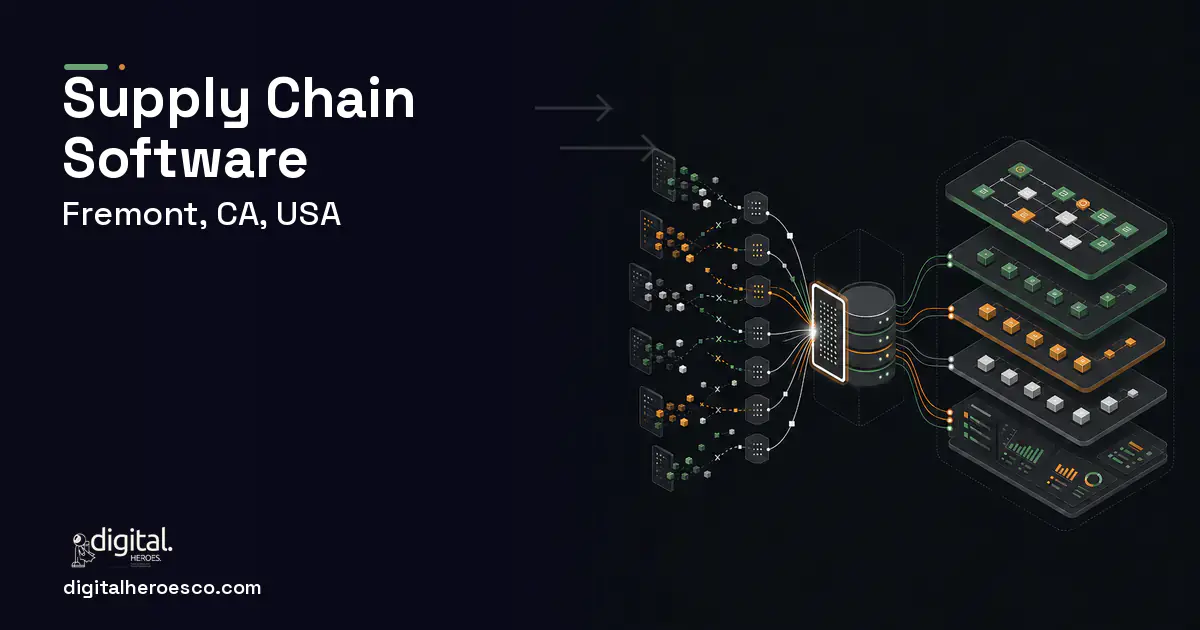
Generic SCM (Supply Chain Management) and SAP modules assume a stable, single-tier supply chain. Fremont hardware and EV firms live in a volatile, multi-tier, allocation-driven one, where a sub-supplier's shortage stops your line weeks before you'd see it in SAP. Custom supply chain software runs $70k to $200k and 5 to 9 months. You're buying multi-tier visibility and early-warning, not another planning module.
SAP and generic SCM tools track your direct suppliers and your POs. They go dark beyond tier one. In a Fremont hardware or semiconductor supply chain, the risk lives deeper: a foundry allocation, a sub-supplier's capacity crunch, a raw-material shortage two tiers down that ripples up to stop your EV line. By the time it shows up as a late PO in SAP, you've already lost the window to find a second source.
The expensive lesson is a line-down event traced to a component nobody was watching, where a supplier's allocation email was the first warning you got. For a Fremont firm whose supply chain is global, deep, and constantly constrained, software that only sees tier one isn't really managing the risk that actually hurts you.
The fix: supply chain built for Fremont, not rented
Your supply risk is multi-tier and volatile, which is exactly what off-the-shelf SCM doesn't see. Custom supply chain software maps your supply network beyond tier one, ingests supplier signals, and flags shortage and allocation risk early enough to act. For a Fremont hardware or EV firm, that converts a reactive scramble after a line-down event into a proactive response while there's still time to second-source.
The capability list that earns its budget
Fremont supply chain: the full scope
Everything a supply chain build here can cover: procurement software, demand planning, supplier management, order management system, transportation management (TMS), supply chain visibility and distribution software.
What supply chain costs in Fremont
| Project scope | Typical cost | Timeline |
|---|---|---|
| Multi-tier visibility and alerting module | $60k to $110k | 4 to 6 months |
| Supply chain platform with scenario modeling | $110k to $200k | 6 to 9 months |
| Full SCM with ERP and supplier integration | $180k to $320k | 9 to 14 months |
How long it takes, phase by phase
Exactly what you get
Supply chain software that sees past tier one. You get a multi-tier map of your supply network with risk scoring, an early-warning engine for allocation, capacity, and lead-time signals, and shortage impact analysis that links a constrained part to the exact builds and customers it threatens. Supplier signals come in through portals and feeds instead of buried emails, and integration with your ERP and inventory management software gives true exposure across on-hand and on-order. The deliverable is a warning early enough to second-source, not an after-the-fact explanation of a line-down event.
How to choose a developer in Fremont
A team that treats supply chain software as a planning tool is solving last decade's problem. The risk that hurts a Fremont hardware firm is multi-tier and signal-driven, so ask how they'll map beyond tier one and where shortage signals come from. The right partner understands allocation, second-sourcing, and the volatility of electronics supply, and integrates with your ERP for real exposure. Hardware or semiconductor supply-chain experience separates a useful build from a dashboard.
- Multi-tier supplier mapping that exposes risk beyond your direct suppliers
- Early-warning alerts on allocation, capacity, and lead-time changes before they hit your line
- Shortage scenario modeling so you know which builds a constrained part threatens
- Supplier signal ingestion from portals and feeds instead of buried emails
- Integration with ERP and inventory management software for true exposure across on-hand and on-order
- Multi-tier visibility depends on supplier data you may not fully control or receive
- Custom SCM is a significant build and a long-term commitment to maintain
- It's only as good as the supplier relationships that feed it real data
- If your supply chain is short and stable, SAP or generic SCM may be enough
- !They equate SCM with planning only; ask how they surface tier-two risk
- !No supplier signal ingestion plan; ask where shortage warnings come from
- !No shortage impact analysis; ask how a constrained part maps to affected builds
- !No ERP and inventory integration; ask how true exposure is calculated
- !No hardware or electronics supply-chain references; ask for a comparable client
If supply chain is on the roadmap, project management, helpdesk & ticketing, crm usually follow within the year. Budget them as one conversation. Weighing options across the region? Nearby: supply chain in Los Angeles, San Diego and San Jose. Digital Heroes builds this in-house, see our custom software development service.
The evidence behind this guide
Independent findings on why this investment pays off. Every link goes to the primary source.
- Digital Champions expect to achieve about 16% in cost savings and around 15% in revenue gains from digital operations over five years; the study surveyed 1,155 manufacturing executives across 26 countries. Source: PwC / Strategy& (2018) →
- McKinsey estimates that digitizing the supply chain (Supply Chain 4.0) can cut lost sales by up to 75%, reduce inventories by up to 75%, and lower supply chain operational costs by up to 30%, with up to 30% lower transport and warehousing costs. Source: McKinsey & Company (2016) →
- A study (led by Prof. Pak-Lok Poon, published in Frontiers of Computer Science, 2024) reviewing decades of spreadsheet-quality research found that about 94% of spreadsheets used in business decision-making contain errors, illustrating the hidden risk of manual spreadsheet workarounds that custom software is built to replace. Source: Central Queensland University / phys.org (Prof. Pak-Lok Poon et al.) (2024) →
- Only 16% of respondents said their organizations' digital transformations had successfully improved performance and equipped them to sustain gains over the long term; even in digitally savvy industries such as high tech, media, and telecom, self-reported success rates did not exceed 26%. Source: McKinsey & Company (2018) →
Frequently asked questions
Why isn't SAP enough for our supply chain?
SAP and generic SCM see your direct suppliers and POs but go dark beyond tier one. The risk that stops a Fremont hardware line usually lives deeper: a foundry allocation or a sub-supplier shortage two tiers down. By the time it shows as a late PO in SAP, the window to second-source is gone.
How much does custom supply chain software cost?
A multi-tier visibility and alerting module runs $60k to $110k. A platform with scenario modeling runs $110k to $200k. A full SCM with ERP and supplier integration runs $180k to $320k.
Can it see beyond our direct suppliers?
That's the entire point. The software maps your supply network across multiple tiers and scores risk per node, so a sub-supplier's capacity crunch becomes visible before it ripples up to stop your line. Off-the-shelf SCM can't do this, which is why it gets built custom.
Where do the shortage warnings come from?
From supplier portals, feeds, and structured signals the software ingests systematically, instead of an allocation email buried in someone's inbox. It turns scattered, late warnings into early alerts tied to the builds they threaten.
How does it connect to our other systems?
It integrates with your ERP, MES, and inventory management software to calculate true exposure across on-hand and on-order, then ties a constrained component to the specific builds and customers at risk, so the response is targeted rather than a plant-wide scramble.
Should I hire a freelancer or an agency to build supply chain software?
For anything past a single-user internal tool, use an agency or an established team, because supply chain systems need backend, frontend, integration, and QA skills that rarely live in one freelancer. A solo developer can build a $10,000 inventory tracker; a system that talks to your ERP, carriers, and warehouse scanners fails badly when its only author is unreachable during a shipping cutoff. In the proposals Digital Heroes sees clients compare, agencies cost 20 to 50 percent more but give you continuity, code review, and someone answerable when order data stops flowing.
We are a growing distributor. Should we pick SAP Business One or go custom?
If you need full accounting, purchasing, and inventory in one system today, SAP Business One is the faster path; if your pain is operational workflows the ERP handles badly, custom is usually the better spend. Business One gives you a proven ledger and stock control, but changing its workflows means paying certified consultants, and the customization quotes Digital Heroes clients share commonly run $150 to $250 per hour for changes you never own. A pattern Digital Heroes builds often is Business One or QuickBooks as the financial core with a custom order, warehouse, or logistics layer on top.
Do the developers need to be near our warehouse in Fremont, or can this be done remotely?
Most of the build works fine remotely, but plan 2 or 3 on-site visits to your Fremont warehouse: one during discovery to watch receiving and picking firsthand, and one or two around go-live for scanner setup and floor training. Warehouse software designed purely over video calls consistently misses physical realities like glove-friendly button sizes, scan distances, and dead Wi-Fi zones near racking. Remote build with on-site milestones is how Digital Heroes runs most warehouse projects.
How much should a small business budget for its first custom app or website?
For a focused first build, most small businesses land between $8,000 and $60,000: roughly $8,000 to $45,000 for a custom website and $25,000 to $60,000 for an internal tool or simple web app, based on Digital Heroes delivery across 2,000+ projects. Customer-facing products with payments, logins, or a mobile app start around $40,000. Quotes far below these bands usually mean a template with your logo on it, not software shaped around your workflow.
Why do companies replace generic SCM software with custom systems?
The usual trigger is workflow mismatch: generic SCM tools model a standard distributor, so anything unusual, like mixed lot and serial tracking, consignment inventory, or customer-specific routing rules, ends up managed in spreadsheets beside the system. Companies also leave when per-user pricing punishes growth or the vendor's API cannot support needed integrations. In Digital Heroes projects, the number of spreadsheets living around the official system is the most reliable signal a team has outgrown its off-the-shelf tool.
Can I build my product on a no-code tool like Bubble instead of hiring developers?
For testing whether anyone wants the product, yes, and Bubble's paid plans start at $29 a month, which is the cheapest validation you will ever buy. The ceiling arrives with complex data relationships, heavy integrations, performance at a few thousand users, and the fact that you cannot export a Bubble app to servers you control. A path many Digital Heroes clients take: prove demand on no-code, then rebuild custom once revenue justifies it, treating the no-code version as a paid prototype rather than a foundation.
How many people should be working on my software project?
Three to five for a typical focused build: a project lead, one or two engineers, a designer, and part-time QA, which is the standard shape across 2,000+ Digital Heroes projects. Larger platforms justify 6 to 10, but a ten-person team on a small first version usually signals bill padding rather than horsepower. What predicts success is whether a senior engineer is writing your code daily, not the headcount on the proposal.
Why do agencies charge for a discovery phase instead of quoting for free?
Because an accurate quote requires real work: mapping your workflows, finding the edge cases, and writing a specification, which typically takes 1 to 3 weeks and costs $2,000 to $10,000 at Digital Heroes depending on system complexity. You leave discovery owning a written spec and a fixed price you can take to any vendor, so the money is not locked into one agency. Free estimates are guesses, and the guess usually becomes your budget overrun six months later.
What happens to my software if the agency shuts down or we stop working together?
Nothing dramatic, if the engagement was set up correctly: the code sits in your repository, hosting runs on your cloud account, and a handover document explains how to deploy and operate the system. Any competent replacement team can then take over in days rather than months. If the agency controls the repo, the servers, or the domain, fix that now, because renegotiating access during a dispute is the most expensive place to discover the problem.
Does my development team need to be located in Fremont?
No, most software projects run fully remote without any quality penalty, and what actually matters is 3 to 4 hours of working-hour overlap and a fixed weekly demo call. A team based in Fremont earns its premium in specific cases: hardware installations, warehouse or clinic floor shadowing, and discovery workshops where watching your staff work beats any written brief. Choose for senior engineers and a track record first, and treat geography as a tiebreaker.
How fast does custom supply chain software pay for itself?
Most operations see payback in 12 to 24 months, faster when the system replaces manual data entry or per-user SaaS fees. Measure it concretely: hours of double entry removed, error and mis-ship rates, inventory carrying cost, and the license fees you stop paying. One recurring pattern from Digital Heroes projects: a distributor spending 60+ staff hours a week re-keying orders between systems can often justify a $50,000 build on labor recovery alone within the first year.
Does it matter which tech stack the agency wants to use?
Yes, but not in the way most buyers expect: the goal is boring, popular technology such as React, Node.js or Python, and PostgreSQL, because any future team can maintain it and hiring a replacement developer takes days, not months. The red flag is an agency-proprietary framework or an unusual language, which welds you to that one vendor no matter what your contract says about code ownership. A useful test: could you find three freelancers fluent in this stack within a week? If not, push back.
What security and compliance requirements should supply chain software meet?
At minimum: role-based access control, encryption in transit and at rest, audit logs on inventory and order changes, and tested backups, because the system holds supplier pricing and customer purchase history your competitors would love to see. If enterprise customers connect to it, expect security questionnaires and possibly SOC 2 expectations; food, pharma, and aerospace add traceability rules like FDA lot tracking or ITAR data handling. Raise these in the first scoping call, since retrofitting audit trails onto a live system costs far more than designing them in.
Who can build custom supply chain software for a business in Fremont?
Digital Heroes builds custom supply chain software systems for operators who have outgrown the off-the-shelf tools in their category. The work is delivered remotely: our engineers work from Delhi and Lucknow, leadership is in New York, and some team members live in London and Sydney and work remotely from there. We have no office in Fremont. You can chat with the team directly, and every form gets an email reply within 24 hours.
Related guides

More from Sanya.
Frontend Engineer · Delhi · 1 post on the site
Published · Last updated .