A single long-lead valve that misses the shutdown window can stall a whole Beaumont turnaround
SAP and generic supply chain tools optimize for steady, repeatable flow. A refinery turnaround is the opposite: a fixed shutdown window where one long-lead valve or specialty alloy that misses the dock can stall the whole job.
On this page
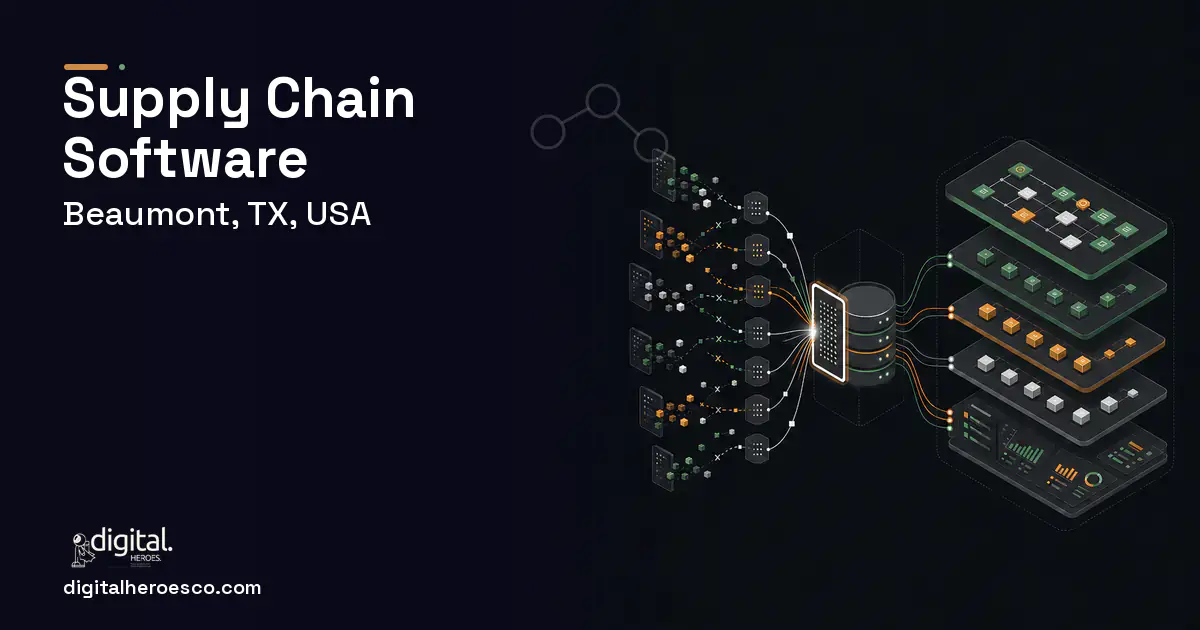
SAP and generic supply chain tools optimize for steady, repeatable flow. A refinery turnaround is the opposite: a fixed shutdown window where one long-lead valve or specialty alloy that misses the dock can stall the whole job. Custom supply chain software that ties procurement to the turnaround clock costs $60,000 to $150,000 and ships in 4 to 8 months.
Your supply chain has one immovable deadline: the unit comes down on a date set months ahead, and every long-lead item, specialty valves, alloy piping, custom spool pieces, must be on the dock before then. Generic SCM (Supply Chain Management) treats these as line items with lead times; it doesn't treat the turnaround window as the hard constraint that makes a slipped delivery a schedule catastrophe. So expediters chase critical items on spreadsheets and phone calls, and the first sign of a problem is often a vendor saying a part will be late.
The Gulf Coast layers in disruption that generic SCM never models: a hurricane can shut the Port of Beaumont, close highways, and idle suppliers for days right before a shutdown. Software built for stable logistics has no concept of re-planning a turnaround supply chain around a storm. The gap is between optimizing average flow and guaranteeing that a specific critical part hits a specific dock before a specific shutdown.
The fix: supply chain built for Beaumont, not rented
Custom supply chain software makes the turnaround window the organizing constraint: every long-lead and critical-path item tracked against the shutdown date, with expediting alerts before a slip becomes a stall, and storm-disruption re-planning for Gulf Coast realities. For a refinery contractor or owner, guaranteeing critical parts hit the dock on time protects a turnaround worth far more than the software.
The capability list that earns its budget
What we build under supply chain in Beaumont
The engagements Beaumont teams bring us most often: demand planning, supplier management, order management system, transportation management (TMS), supply chain visibility and distribution software.
What supply chain costs in Beaumont
| Project scope | Typical cost | Timeline |
|---|---|---|
| Critical-path tracking tied to turnaround windows | $60k to $90k | 4 to 5 months |
| Full SCM with expediting and storm re-planning | $110k to $150k | 6 to 8 months |
| Procurement and inventory integrations | $20k to $40k | 1 to 2 months |
How long it takes, phase by phase
Exactly what you get
You get supply chain software organized around the turnaround window: every long-lead and critical-path item tracked against the shutdown date, expediting alerts that fire before a slip becomes a stall, and storm-disruption re-planning for when the Port of Beaumont or the highways close. Vendor scorecards tie supplier reliability to turnaround outcomes. It integrates to procurement, your inventory management system, and the turnaround schedule, giving you a dock-readiness view of what must arrive before the unit comes down, alongside your warehouse and ERP (Enterprise Resource Planning) systems.
How to choose a developer in Beaumont
Choose a developer who treats the shutdown date as the hard constraint everything plans around. The right team tracks critical-path items against the turnaround window, builds proactive expediting instead of reactive chasing, and designs storm-disruption re-planning for the Gulf Coast realities of port and highway closures. They integrate to procurement and inventory for end-to-end flow and build vendor scorecards tied to on-time delivery. Avoid anyone who offers generic lead-time tracking, because optimizing average flow is not the same as guaranteeing one valve hits the dock on time.
- Long-lead and critical-path items tracked against the shutdown date
- Proactive expediting alerts before a slip stalls the turnaround
- Storm-disruption re-planning for port and highway closures
- Vendor performance visibility tied to turnaround outcomes
- Integration to procurement and inventory for end-to-end material flow
- Custom SCM is a substantial build needing clean vendor and lead-time data
- It depends on supplier cooperation for accurate delivery signals
- Storm-disruption logic adds complexity specific to the Gulf Coast
- For steady, non-turnaround procurement, generic tools may suffice
- !They model lead times generically. Ask how a turnaround window becomes the constraint
- !No storm-disruption logic. Ask how they re-plan around a port closure
- !Expediting is reactive. Ask how the system forecasts a slip
- !No vendor scorecards. Ask how supplier reliability ties to turnaround outcomes
- !No integration plan. Ask how it connects to procurement and inventory
If supply chain is on the roadmap, project management, helpdesk & ticketing, crm usually follow within the year. Budget them as one conversation. Weighing options across the region? Nearby: supply chain in Houston, San Antonio and Dallas. Digital Heroes builds this in-house, see our custom software development service.
The evidence behind this guide
Independent findings on why this investment pays off. Every link goes to the primary source.
- 48% of private companies cite integration with legacy systems or technical debt as a top obstacle to realizing the full value of their digital and AI investments (behind data quality/availability at 72% and gaps in AI fluency or technology talent/leadership at 53%). Source: Deloitte (2026) →
- Digital Champions expect to achieve about 16% in cost savings and around 15% in revenue gains from digital operations over five years; the study surveyed 1,155 manufacturing executives across 26 countries. Source: PwC / Strategy& (2018) →
- The average developer spends more than 17 hours a week dealing with maintenance issues such as debugging and refactoring, and about four of those hours on 'bad code' - waste that equates to nearly $85 billion annually worldwide in opportunity cost. Source: Stripe (2018) →
- Companies in the top quartile of McKinsey's Developer Velocity Index had 2014-18 revenue growth four to five times faster than bottom-quartile peers, showing that software-building capability is a driver of business performance, not just a support function. Source: McKinsey & Company (2020) →
Frequently asked questions
Why won't generic SCM work for turnarounds?
Generic SCM optimizes steady flow and treats deliveries as line items with lead times. A Beaumont turnaround has a fixed shutdown window where one late long-lead item stalls the whole job. Without modeling that window as the hard constraint, problems surface too late. Custom SCM organizes everything around the shutdown date.
What does custom supply chain software cost?
$60,000 to $150,000. Critical-path tracking tied to turnaround windows runs $60k to $90k; a full SCM with expediting and storm re-planning runs $110k to $150k. Procurement and inventory integrations add $20k to $40k.
How does it handle Gulf Coast storms?
With storm-disruption re-planning. When a hurricane threatens to close the Port of Beaumont or the highways, the system re-plans the turnaround supply chain around the disruption. Generic tools have no concept of this, but on the Gulf Coast it's the difference between a manageable delay and a stalled shutdown.
What's the cost of a single late part?
Potentially enormous. A long-lead valve or specialty alloy that misses the window can idle an entire turnaround crew and push the unit's restart, costing the owner far more than the part itself. That asymmetry is exactly why guaranteeing critical-path delivery justifies custom software.
Does it integrate with our other systems?
Yes. It connects to procurement, your inventory management system, and the turnaround schedule so material flow is end-to-end. The dock-readiness view ties directly to the shutdown calendar, sharing data with your warehouse and ERP systems rather than standing alone.
Who owns the code when an agency builds my supply chain software?
You should own it outright, with full IP assignment on payment written into the contract, and you should walk away from any agency that only licenses the software to you. Insist on the code living in a repository under your own GitHub or GitLab account from day one, not handed over at the end. Digital Heroes contracts assign all custom code, database schemas, and documentation to the client; the only carve-outs should be clearly listed open source libraries.
When is SAP actually a better choice than building custom supply chain software?
Choose SAP when you need a full ERP, operate in a heavily audited industry that expects standard systems, or run global operations where localization, tax, and compliance content matter more than workflow fit. SAP's strength is breadth: finance, manufacturing, and supply chain in one validated suite. Custom wins when your edge lives in a specific workflow, like how you allocate inventory or route orders, that SAP would force you to bend to its standard process. Many Digital Heroes clients keep SAP as the system of record and build custom operational tools around it.
How fast does custom supply chain software pay for itself?
Most operations see payback in 12 to 24 months, faster when the system replaces manual data entry or per-user SaaS fees. Measure it concretely: hours of double entry removed, error and mis-ship rates, inventory carrying cost, and the license fees you stop paying. One recurring pattern from Digital Heroes projects: a distributor spending 60+ staff hours a week re-keying orders between systems can often justify a $50,000 build on labor recovery alone within the first year.
Should we start with an MVP or build the full supply chain platform at once?
Start with an MVP that fixes your single most expensive workflow, prove it in daily operations, then expand module by module. That gets working software onto the warehouse floor in about 12 weeks instead of debating a year-long spec, and real usage always reorders the roadmap; features that felt critical in planning routinely get cut after go-live. Digital Heroes typically scopes phase one at 30 to 40 percent of the total vision and lets measured results justify each next phase.
How many SaaS seats do we need before building custom becomes cheaper?
The crossover usually shows up between 20 and 50 seats on premium tiers. Salesforce Enterprise lists at $165 per user per month, so 40 users cost about $79,000 a year in subscriptions, which is real money against a custom system you would own outright. Run the comparison over three years: if subscription spend beats the build cost plus 15-20% annual maintenance, custom wins on price before you even count workflow fit.
Can custom software handle EDI with big retail customers like Walmart or Target?
Yes, and this is one of the most common reasons distributors go custom, because retailer scorecards penalize late or malformed documents. The typical build covers EDI 850 purchase orders in, 855 acknowledgments, 856 advance ship notices, and 810 invoices out, usually through a network like SPS Commerce or TrueCommerce rather than raw AS2. In Digital Heroes builds, onboarding your first major retailer adds 4 to 8 weeks and $10,000 to $25,000, with each additional trading partner far cheaper once the pipeline exists.
How long does it take to build custom supply chain software?
Plan on 10 to 14 weeks for a first production release covering one or two core workflows, and 6 to 9 months for a full platform spanning procurement, inventory, and fulfillment. Digital Heroes ships most supply chain MVPs in about 12 weeks with a 4 to 6 person team. Integrations are the schedule risk: each ERP, EDI, or carrier connection typically adds 2 to 4 weeks of build and testing.
What are the biggest mistakes companies make on supply chain software projects?
The top three: replacing every system at once instead of one workflow at a time, skipping data cleanup so the new system inherits years of bad SKUs and phantom stock, and designing screens without the warehouse staff who will use them daily. A fourth is underscoping integrations and discovering mid-project that the ERP connection is half the work. Digital Heroes sees more supply chain projects fail from scope and data problems than from any technical cause.
How many people should be working on my software project?
Three to five for a typical focused build: a project lead, one or two engineers, a designer, and part-time QA, which is the standard shape across 2,000+ Digital Heroes projects. Larger platforms justify 6 to 10, but a ten-person team on a small first version usually signals bill padding rather than horsepower. What predicts success is whether a senior engineer is writing your code daily, not the headcount on the proposal.
Can we migrate years of data out of our current system into new custom software?
Almost always yes, through CSV exports or the vendor's API, and migration should be scoped as its own workstream with field mapping, a dry run, and a planned cutover window rather than an afterthought. The real time sink is rarely moving the data; it is cleaning it, since years of duplicates, free-text fields, and inconsistent formats surface all at once. Pull a full export from your current vendor before committing to anything new, because some SaaS plans restrict exports on lower tiers.
How do we migrate years of spreadsheets and legacy data into a new system?
Migration runs as its own workstream: extract and profile the data, clean duplicates and dead SKUs, map fields to the new schema, then do trial loads and a final cutover during a weekend or slow period. Expect 2 to 6 weeks depending on how many sources you have and how dirty they are. Digital Heroes runs old and new systems in parallel for 2 to 4 weeks on most supply chain cutovers so inventory counts and open orders can be reconciled before the legacy system is retired.
Is custom software more secure than off-the-shelf SaaS?
Neither is secure by default; security tracks the practices of whoever builds and operates the system, not the model. SaaS gives you the vendor's certifications and patching but puts your data in a shared multi-tenant platform on their terms, while custom gives you full control over data residency, access rules, and compliance requirements like HIPAA, with the responsibility sitting with you and your agency. Before hiring anyone for a system holding sensitive data, ask for their security checklist: encryption at rest and in transit, an OWASP Top 10 review, role-based access, and a penetration test before launch.
How much does custom supply chain software cost for a small business?
For a small business, a focused custom supply chain tool usually lands between $15,000 and $45,000, covering one core workflow like inventory tracking, purchase orders, or shipment visibility. Across 2,000+ delivered projects, Digital Heroes sees most small distributors and light manufacturers start in the $20,000 to $35,000 range for a first working version. Adding barcode scanning, multi-warehouse support, or carrier integrations pushes budgets toward $50,000 and up.
Who can build custom supply chain software for a business in Beaumont?
Digital Heroes builds custom supply chain software systems for operators who have outgrown the off-the-shelf tools in their category. The work is delivered remotely: our engineers work from Delhi and Lucknow, leadership is in New York, and some team members live in London and Sydney and work remotely from there. We have no office in Beaumont. You can chat with the team directly, and every form gets an email reply within 24 hours.
Related guides
Published · Last updated .