Your Fullerton taproom's Toast POS treats a beer flight like four separate pints
A custom POS or POS extension for a Fullerton taproom or multi-location maker runs $45k to $110k over 3 to 6 months.
On this page
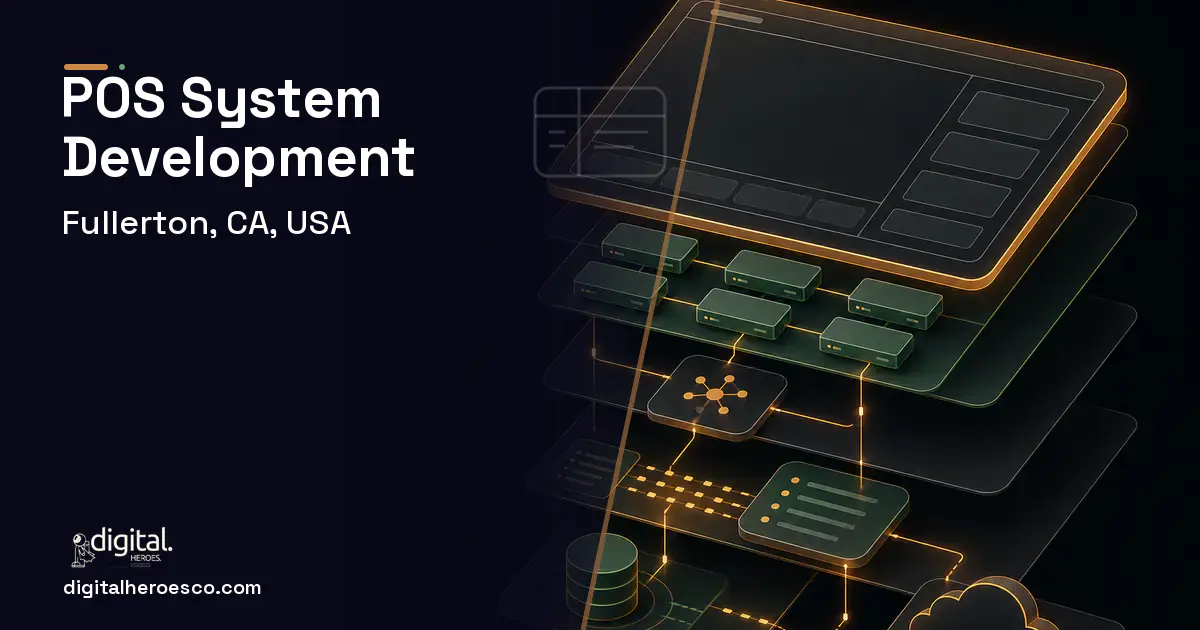
A custom POS or POS extension for a Fullerton taproom or multi-location maker runs $45k to $110k over 3 to 6 months. Square, Toast, and Clover ring up a sale fine, but they fumble beer flights, keg deposits, growler refills, and the club-membership logic a craft brewery taproom actually runs on.
At your Fullerton taproom, a customer orders a four-pour flight, refills a growler, buys a keg with a deposit, and scans their club membership for a discount. Toast treats the flight as four separate pints, has no native deposit logic, can't track the growler refill against the right SKU, and your club is a spreadsheet at the register. Every shift, your staff works around the POS instead of with it.
Square, Toast, Clover, and Lightspeed are built for general food-and-retail transactions. A craft brewery taproom has commerce they don't model: flights and tasters, keg and growler deposits, club memberships with perks, and inventory that has to sync back to your production and tank tracking. Generic POS handles the easy 80 percent and leaves the 20 percent that's specific to brewing as nightly manual cleanup.
Why the usual tools struggle in Fullerton
- Flights and tasters get rung as separate items, breaking pricing and inventory deduction
- Keg and growler deposits aren't native, so deposits and returns are tracked off-register
- Club memberships and perks live in a spreadsheet, not the POS, so discounts are manual
- Taproom sales don't sync to production and tank inventory, so pours and stock drift apart
What a custom POS build changes
A custom POS or extension models the way a Fullerton taproom actually sells: flights as a single priced item that deducts the right pours, keg and growler deposits handled at the register, club memberships with automatic perks, and sales that sync to production inventory. Staff stop working around the system, the nightly spreadsheet cleanup disappears, and your pour data finally matches your tank data.
The features that matter for Fullerton
What we build under POS in Fullerton
Digital Heroes builds the full POS stack for Fullerton teams. Typical engagements cover custom POS system, point of sale software, retail POS, restaurant POS, Square alternative and Toast alternative.
- Flights, deposits, and club logic break your off-the-shelf POS daily
- Taproom sales and production inventory don't reconcile
- You run multiple locations or a club that needs register integration
- You run a simple counter with standard items and no deposits or clubs
- Square or Toast covers your menu without nightly workarounds
- You're early and want low-cost transaction handling first
POS pricing in Fullerton: the real numbers
| Project scope | Typical cost | Timeline |
|---|---|---|
| POS extension on existing platform | $45k to $65k | 3 to 4 months |
| Custom taproom POS with deposits/club | $70k to $95k | 4 to 5 months |
| Multi-location POS + production sync | $85k to $110k | 5 to 6 months |
From kickoff to launch: the schedule
Exactly what you get
A POS that rings a flight as one priced item with correct pour deduction, handles keg and growler deposits and returns, applies club perks automatically, and syncs sales to your production and inventory in real time. Payments are PCI-compliant and the register survives an internet drop. It connects to your inventory management software, accounting software, and feeds business intelligence (BI) dashboards on pour mix and club performance.
How to choose a developer in Fullerton
Choose a team that has built POS or payment systems and understands PCI obligations, not a generalist learning compliance on your store. Ask how they'd model a flight, a keg deposit, and a club discount at the register, and how sales reconcile with production inventory. Confirm offline resilience, because a register that dies with the Wi-Fi is unusable on a busy Friday. Brewery or hospitality experience beats locality here.
- Flights and tasters as proper items that price and deduct inventory correctly
- Keg and growler deposit and return handling built into the register
- Club memberships with automatic perks and discounts at point of sale
- Taproom sales synced to production and tank inventory in real time
- Faster checkout and less nightly manual reconciliation for staff
- A custom POS costs more than an off-the-shelf Toast or Square subscription
- Payment processing and PCI compliance add real complexity and obligation
- Hardware compatibility and support become your responsibility
- For a simple counter with no brewery-specific needs, off-the-shelf is cheaper
- !They treat a flight as line items. Ask how flights deduct multi-pour inventory
- !No deposit logic. Ask how keg and growler deposits and returns work at the register
- !They wave at PCI. Ask exactly how payments and compliance are handled
- !No production-sync plan. Ask how taproom pours reconcile with tank inventory
- !No offline mode. Ask what happens to the register when the internet drops
Teams investing in POS in Fullerton usually scope it next to supply chain, business intelligence dashboards, booking & scheduling, since these systems share data and budgets. Weighing options across the region? Nearby: POS in Los Angeles, San Diego and San Jose. Want it built, not just budgeted? That is our custom software development practice.
The evidence behind this guide
Independent findings on why this investment pays off. Every link goes to the primary source.
- Item-level RFID tagging enabled 99.9% order accuracy in the retail supply chain, versus a baseline where 69% of orders shipped between brands and retailers contained data errors - showing how RFID-at-POS integration reduces inventory inaccuracy. Source: Auburn University RFID Lab & GS1 US (2018) →
- Global retail loses an estimated $1.73 trillion annually to inventory distortion (out-of-stocks and overstocks), equal to about 6.5% of global retail sales, despite $172 billion spent on improvements in the past year. Source: IHL Group (2025) →
- 48% of private companies cite integration with legacy systems or technical debt as a top obstacle to realizing the full value of their digital and AI investments (behind data quality/availability at 72% and gaps in AI fluency or technology talent/leadership at 53%). Source: Deloitte (2026) →
- An EY survey found one in five U.S. payrolls contains errors, each costing an average of $291 to remediate, with a typical 1,000-employee organization spending roughly 29 workweeks per year fixing common payroll errors. Source: EY (Ernst & Young) (2022) →
Frequently asked questions
Can't Toast or Square handle flights and deposits with workarounds?
They can be forced to, but the workarounds break inventory accuracy and create nightly reconciliation. A flight rung as separate pints deducts wrong, and deposits tracked off-register drift. For a Fullerton taproom doing flights, deposits, and a club at volume, a custom POS or extension removes the daily friction that off-the-shelf workarounds create.
Should we extend our existing POS or build new?
Often extending is the pragmatic choice: keep the proven payment and hardware layer of Toast or Square and add custom logic for flights, deposits, and clubs through their APIs. A fully custom POS makes sense only when platform limits genuinely block you. A good developer will recommend the lighter path when it fits rather than rebuilding everything.
How does PCI compliance affect the project?
Handling card payments brings PCI obligations that shape architecture and add cost. Most builds keep card data within a compliant payment processor rather than touching it directly, which limits your scope but still requires care. Treat any developer who is vague about PCI as a risk; payment handling is where shortcuts become liabilities.
Why does taproom-to-production sync matter?
Without it, your pour data and tank inventory drift, so you can't trust how much beer you've actually sold versus brewed. Syncing the POS to production and inventory keeps those numbers aligned, which matters for costing, tax reporting, and knowing true margins. It's a core reason breweries outgrow generic POS.
What about running multiple locations?
Multi-location adds complexity: shared menus, per-site inventory, consolidated reporting, and resilient offline operation at each register. Custom POS can handle this cleanly, but it raises scope and cost. If you're at one location now with growth plans, design for multi-site from the start so you don't rebuild later.
How do I calculate whether custom software will pay for itself?
Divide the build cost by the monthly benefit, where benefit is hours saved times loaded hourly cost, plus subscription fees replaced, plus any revenue the software unlocks. Three staff saving 10 hours a week each at a $40 loaded rate is about $62,000 a year, which pays back a $60,000 build in roughly 12 months. Across Digital Heroes internal-tool projects, 12 to 24 months is the normal payback range, and anything projecting under 6 months usually means the spreadsheet is hiding costs.
Can a custom POS beat Square's 2.6% plus 10 cents processing rate?
Yes, because a custom POS lets you choose interchange-plus processing instead of flat-rate pricing, which in the client migrations Digital Heroes has run commonly lands near 2 percent all-in on card-present volume for established businesses. On $1.5 million of annual card volume, each half point saved is worth $7,500 a year before you count software fees. Below about $250,000 in annual card volume the savings rarely justify the build, so run the math on your processing statements first.
If an agency builds my POS, who actually owns the source code?
You should own it outright, and the contract must say so through a full IP assignment clause that transfers copyright on payment, not a license to use it. Also require the code to live in a repository under your own account from day one, so ownership is a fact rather than a promise. Walk away from any agency that keeps the code and charges you to stay on their platform; that is a more expensive version of the vendor lock-in you were trying to escape.
Who owns the code when an agency builds my software?
You should, completely, through a written intellectual property assignment that transfers everything on final payment; without that clause, copyright stays with whoever wrote the code by default. Insist that the repository lives in your own GitHub organization from day one and that hosting, domains, and third-party accounts are registered to you. Also check for licenses to the agency's proprietary frameworks buried in the contract, because those can make switching vendors practically impossible even when you own your own code.
Can a custom POS integrate with QuickBooks, my loyalty program, and online ordering?
Yes, and integrations are often the strongest reason to go custom, since you control the sync logic instead of waiting on an app marketplace. QuickBooks and Xero have stable public APIs, and a daily sales journal sync is a 1 to 2 week build item in most Digital Heroes POS projects; loyalty and online ordering connections typically run 2 to 4 weeks each depending on the vendor's API. List every integration in the initial scope, because each one added mid-project reopens the data model.
Can we migrate years of data out of our current system into new custom software?
Almost always yes, through CSV exports or the vendor's API, and migration should be scoped as its own workstream with field mapping, a dry run, and a planned cutover window rather than an afterthought. The real time sink is rarely moving the data; it is cleaning it, since years of duplicates, free-text fields, and inconsistent formats surface all at once. Pull a full export from your current vendor before committing to anything new, because some SaaS plans restrict exports on lower tiers.
Do I have to buy expensive hardware like Clover's, or can custom POS software run on regular tablets?
Custom POS software can run on off-the-shelf iPads or Android tablets costing $200 to $500, versus Clover stations that list between roughly $799 and $1,799 each before monthly software fees. The one piece you should not improvise is the card reader; use a certified terminal from your processor, such as a Stripe Terminal or Adyen device, paired to your app. That combination keeps hardware costs low without your software ever touching raw card data.
What are the biggest mistakes first-time software buyers make?
Choosing the lowest bid, paying more than 30-40% upfront instead of on milestones, skipping a written specification, and having no maintenance plan for after launch. The most expensive of the four in Digital Heroes rescue projects is the missing spec: without written acceptance criteria, done becomes an argument instead of a checklist, and every disagreement resolves in the vendor's favor. Fix those four and you have avoided most of the ways these projects fail.
Should I use a freelancer or an agency to build my POS system?
A POS build needs backend, client app, payments integration, and hardware testing skills running at the same time, which is more surface area than one freelancer reliably covers. Freelancers make sense for narrow additions, like a reporting module on an existing system, at typical rates of $30 to $90 per hour. For a ground-up build, an agency with a dedicated QA function is the safer choice because a register failure stops your revenue at the counter in real time.
How many developers does it take to build a POS system?
A typical Digital Heroes POS team is 4 to 6 people: one backend developer, one or two client developers for the register app, a designer through the first half, a QA engineer, and a project lead. That size delivers a single-location system in about 3 to 4 months. Be skeptical of anyone pitching a one-developer POS build, because payments, offline sync, and hardware testing each demand dedicated attention.
How much does it cost to build a custom POS system for a small business?
A single-location custom POS covering checkout, inventory, receipts, and payment integration typically lands between $30,000 and $70,000, based on Digital Heroes delivery data across 2,000+ projects. Multi-location systems with kitchen displays, franchise reporting, or offline sync usually run $80,000 to $250,000. The biggest cost drivers are custom hardware support and how much of the payment flow you build versus integrate.
What tech stack should a custom POS be built on?
Choose the stack around one requirement: the register keeps selling when the internet drops. That points to a local-first client, commonly Flutter or React Native on tablets or Electron on desktop registers, with an embedded SQLite database and background sync to a cloud backend in Node.js or Python on PostgreSQL. Payment SDKs narrow the choice further, so confirm your processor, for example Stripe Terminal, officially supports your target platform before committing.
We run everything on spreadsheets and Airtable. How do we know it's time for custom software?
The reliable signals are re-typing the same data into multiple tools, one employee acting as human middleware between systems, and errors appearing in handoffs between teams. Hard limits force the issue too: Airtable's Team plan caps at 50,000 records per base, and Business costs $45 per seat per month, so a 20-person team pays about $10,800 a year for a tool it has already outgrown. When workarounds consume more hours than the tools save, the spreadsheet era is over.
What does it cost to keep custom software running after launch?
Budget 15-20% of the original build cost per year, which on a $100,000 system means $15,000 to $20,000 for security patches, dependency updates, bug fixes, and small improvements as real usage reveals what the spec missed. Cloud hosting for a typical business application adds $50 to $300 a month on top. Skipping maintenance does not save the money; in Digital Heroes rescue work, unmaintained systems typically need a far more expensive rebuild within about three years.
Who can build custom POS software for a business in Fullerton?
Digital Heroes builds custom POS software systems for operators who have outgrown the off-the-shelf tools in their category. The work is delivered remotely: our engineers work from Delhi and Lucknow, leadership is in New York, and some team members live in London and Sydney and work remotely from there. We have no office in Fullerton. You can chat with the team directly, and every form gets an email reply within 24 hours.
Related guides

Published · Last updated .