A Square till in Belfast handles sterling beautifully, right up until a customer from Dublin wants to pay in euro
A custom POS makes sense in Belfast when off-the-shelf tills cannot handle dual-currency, cross-border or complex trade the way your business runs it. Expect £25,000 to £75,000 and a 3 to 6 month build.
On this page
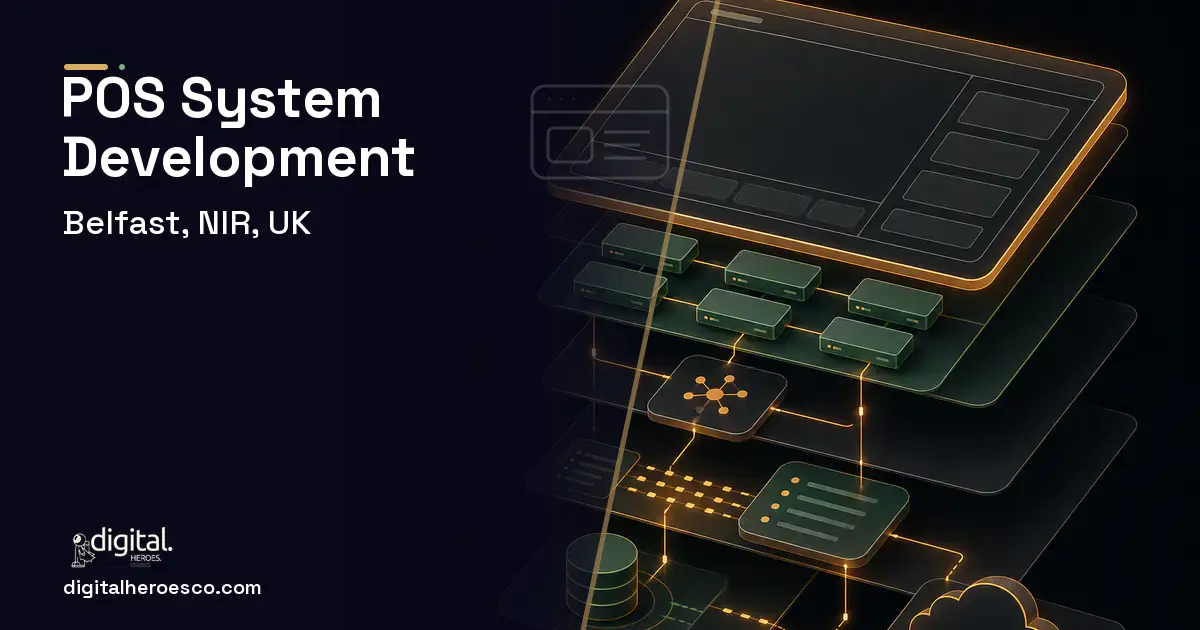
A custom POS (Point of Sale) makes sense in Belfast when off-the-shelf tills cannot handle dual-currency, cross-border or complex trade the way your business runs it. Expect £25,000 to £75,000 and a 3 to 6 month build. The Belfast angle is proximity to the border and a strong tourist and screen-tourism trade: customers arrive from the Republic and beyond, and Square, Toast or Clover assume a single home currency and a generic retail flow.
Your Belfast venue runs on Square, and it is fine until reality gets specific. A group over from Dublin wants to pay in euro, a Game of Thrones tour party wants a split bill across cards and currencies, and your loyalty scheme lives in a separate app that does not talk to the till. Off-the-shelf POS assumes one currency and a standard flow, so the moments that make cross-border and tourist trade lucrative are exactly the ones it handles worst.
Then there is the per-transaction and per-terminal cost, which quietly scales against you, and the locked ecosystem that will not integrate with your inventory or accounting the way you need. You bought a till to simplify things, and past a certain complexity it starts dictating how you can and cannot trade.
The fix: POS built for Belfast, not rented
A custom POS fits how a Belfast business actually trades: dual-currency payments for cross-border and tourist customers, flexible split billing, and loyalty, inventory and accounting joined into one flow. It runs on the hardware you choose without a per-terminal tax, and integrates with the systems you already run. For a venue whose best trade is cross-border and tourist-driven, a till that handles euro and complex bills natively turns awkward moments into smooth sales.
The capability list that earns its budget
Belfast POS: the full scope
Digital Heroes builds the full POS stack for Belfast teams. Typical engagements cover retail POS, restaurant POS, Square alternative, Toast alternative, Clover, Lightspeed and mobile POS.
What POS costs in Belfast
| Project scope | Typical cost | Timeline |
|---|---|---|
| Core POS with dual-currency payments | £22,000 to £40,000 | 2 to 3 months |
| POS with loyalty and inventory integration | £38,000 to £58,000 | 3 to 5 months |
| Full POS platform with accounting and multi-site | £58,000 to £95,000 | 5 to 7 months |
How long it takes, phase by phase
Exactly what you get
A POS that trades the way a Belfast venue actually does. It takes euro and sterling natively for cross-border and tourist customers, handles split and shared bills for group and tour trade, and joins loyalty, inventory and accounting into one flow. It runs on hardware you choose without a per-terminal tax, keeps working offline if the connection drops, and reports on the trade that matters to you rather than a generic retail template.
How to choose a developer in Belfast
Pick a developer who understands Belfast's cross-border and tourist trade and takes payment security seriously. Ask how the till handles a euro payment and a split tour-group bill, and how it behaves offline during a busy service. Given card handling, confirm they build to recognised payment security standards, and favour a partner who integrates loyalty, inventory and accounting rather than leaving them as separate apps.
- Native dual-currency payments for cross-border and tourist customers
- Flexible split billing across cards and currencies for group and tour trade
- Loyalty, inventory and accounting joined into one till flow
- Hardware freedom with no per-terminal licence tax
- Reporting matched to how your Belfast venue actually trades
- Higher upfront cost than a Square or Clover subscription
- You take on payment integration and its compliance requirements
- Hardware and support become your responsibility
- A simple single-currency shop would not need this
- !They assume sterling only, ask how the till takes a euro payment from a Dublin customer
- !No split-billing plan, ask how a tour group splits a bill across cards and currencies
- !They ignore offline mode, ask what happens to the till if the connection drops
- !No integration plan, ask how loyalty, inventory and accounting join the flow
- !They gloss over payment compliance, ask how card handling meets security standards
If POS is on the roadmap, supply chain, business intelligence (BI) dashboards, booking & scheduling usually follow within the year. Budget them as one conversation. Weighing options across the region? Nearby: POS in Derry. Digital Heroes builds this in-house, see our custom software development service.
The evidence behind this guide
Independent findings on why this investment pays off. Every link goes to the primary source.
- U.S. retailers lost an average of 1.6% of sales to shrink in FY2022 (up from 1.4% the prior year), equating to $112.1 billion in inventory losses - the benchmark case for POS-integrated loss prevention and inventory accuracy. Source: National Retail Federation (NRF) (2023) →
- Retailers connecting point-of-sale and loyalty data in an omnichannel strategy reported up to 15% lower cost per purchase and nearly 20% higher incremental store revenue. Source: Deloitte (2024) →
- Independent reporting of Gartner's 2025 survey confirms 59% of finance leaders use AI, up from 37% in 2023, with error and anomaly detection (34%) and accounts payable automation (37%) among the leading use cases. Source: CPA Practice Advisor (reporting Gartner) (2025) →
- Companies in the top quartile of McKinsey's Developer Velocity Index had 2014-18 revenue growth four to five times faster than bottom-quartile peers, showing that software-building capability is a driver of business performance, not just a support function. Source: McKinsey & Company (2020) →
Frequently asked questions
What does a custom POS cost for a Belfast retail or hospitality business?
Most builds run £25,000 to £75,000. A core POS with dual-currency payments sits at the lower end, while adding loyalty, inventory, accounting and multi-site support reaches higher. Payment and dual-currency handling is the main driver.
Can a custom till take euro as well as sterling?
Yes, natively. That matters in Belfast, where cross-border customers from the Republic and tourists regularly want to pay in euro. A custom POS handles both currencies in one flow rather than forcing awkward workarounds like a Square or Clover till does.
How does it handle split bills for tour and group trade?
It supports flexible split and shared billing across multiple cards and currencies, so a Game of Thrones tour party or a large group can divide a bill cleanly. This is exactly the scenario off-the-shelf tills handle worst and where a custom build earns its keep.
How long does a POS build take?
Between three and six months depending on scope. A core dual-currency till is quickest, while loyalty, inventory, accounting and multi-site support take longer. Payment integration and testing are important not to rush.
Will the till keep working if the internet drops during service?
Yes. A well-built custom POS includes an offline mode that keeps taking payments and recording sales when the connection drops, syncing once it returns, so a busy Belfast service is never held hostage to the wifi.
Does it integrate with our inventory and accounting?
Yes. Stock updates in real time as you sell, and sales feed your accounting software with correct tax lines, so a custom POS joins loyalty, inventory and finance into one flow instead of leaving them as disconnected apps.
Is a custom POS secure for card payments?
A good build follows recognised payment card security standards and uses compliant payment providers, so card handling is at least as secure as an off-the-shelf till. Ask your developer directly how they meet these standards before committing.
Do we own the POS and avoid per-terminal fees?
You own the software and can run it on hardware you choose, avoiding the per-terminal licence tax of proprietary tills. You still pay payment processing fees, but the recurring per-device cost that scales against a busy venue goes away.
What ongoing costs come with a custom POS?
Budget for payment processing fees, hardware support and a maintenance retainer for updates. For a busy multi-terminal Belfast venue, this often works out cheaper over time than the per-transaction and per-terminal fees of a proprietary system.
What happens to my software if the agency shuts down or we stop working together?
Nothing dramatic, if the engagement was set up correctly: the code sits in your repository, hosting runs on your cloud account, and a handover document explains how to deploy and operate the system. Any competent replacement team can then take over in days rather than months. If the agency controls the repo, the servers, or the domain, fix that now, because renegotiating access during a dispute is the most expensive place to discover the problem.
What does it cost to maintain a custom POS after it launches?
Budget 15 to 20 percent of the original build cost per year, so a $100,000 system runs $15,000 to $20,000 annually for hosting, OS and payment SDK updates, security patches, and small feature changes. Digital Heroes structures this as a monthly retainer for most POS clients, commonly $1,000 to $3,000 depending on location count. For multi-location operators that figure usually still undercuts the per-terminal subscription fees they were paying before.
How much should a small business budget for its first custom app or website?
For a focused first build, most small businesses land between $8,000 and $60,000: roughly $8,000 to $45,000 for a custom website and $25,000 to $60,000 for an internal tool or simple web app, based on Digital Heroes delivery across 2,000+ projects. Customer-facing products with payments, logins, or a mobile app start around $40,000. Quotes far below these bands usually mean a template with your logo on it, not software shaped around your workflow.
How long does it take to build a custom web or mobile app from scratch?
Plan on 8 to 16 weeks for a focused first version and 4 to 9 months for a larger platform, which is the typical spread across Digital Heroes builds. The first 2 to 3 weeks go to discovery and design before any production code ships. The two things that stretch timelines most are integrations with legacy systems and slow feedback from your side, not developer speed.
How do I vet a development agency for a POS project specifically?
Ask to see a live POS or payments product they built, then ask exactly how they handled offline mode, receipt printing, and PCI scope, because those three areas expose anyone who has only built ordinary web apps. A competent agency will name the payment SDKs they used, such as Stripe Terminal or Adyen, and describe their terminal certification process without checking notes. If the portfolio is all marketing sites and dashboards, keep looking.
Can I build my product on a no-code tool like Bubble instead of hiring developers?
For testing whether anyone wants the product, yes, and Bubble's paid plans start at $29 a month, which is the cheapest validation you will ever buy. The ceiling arrives with complex data relationships, heavy integrations, performance at a few thousand users, and the fact that you cannot export a Bubble app to servers you control. A path many Digital Heroes clients take: prove demand on no-code, then rebuild custom once revenue justifies it, treating the no-code version as a paid prototype rather than a foundation.
How do I calculate the payback period on a custom POS?
Add up what you pay per year today: subscription fees per terminal, add-on modules, and the gap between your effective processing rate and an interchange-plus rate, then divide the build cost by that total. A retail group paying $60,000 a year in fees and processing markup against a $150,000 build pays back in 2.5 years, before counting labor saved by workflows designed for your operation. Digital Heroes models 2 to 4 year payback for most multi-location operators and advises against building when the model shows longer.
We run everything on spreadsheets and Airtable. How do we know it's time for custom software?
The reliable signals are re-typing the same data into multiple tools, one employee acting as human middleware between systems, and errors appearing in handoffs between teams. Hard limits force the issue too: Airtable's Team plan caps at 50,000 records per base, and Business costs $45 per seat per month, so a 20-person team pays about $10,800 a year for a tool it has already outgrown. When workarounds consume more hours than the tools save, the spreadsheet era is over.
We run multiple restaurant locations on Toast. Would switching to a custom POS actually save money?
Usually only at 8 or more locations, where per-terminal software fees, add-on modules like online ordering and loyalty, and processing markup commonly total $8,000 to $20,000 per location per year in the statements Digital Heroes reviews for restaurant groups. A custom system converts that into a one-time build of $100,000 to $250,000 plus maintenance, which models out to 18 to 30 month payback for most groups. Under five locations, stay on Toast and put the money into operations.
Who can build custom POS software for a business in Belfast?
Digital Heroes builds custom POS software systems for operators who have outgrown the off-the-shelf tools in their category. The work is delivered remotely: our engineers work from Delhi and Lucknow, leadership is in New York, and some team members live in London and Sydney and work remotely from there. We have no office in Belfast. You can chat with the team directly, and every form gets an email reply within 24 hours.
Related guides

More from Riley.
Content Strategist · APAC · Sydney · 2 posts on the site
Published · Last updated .