BambooHR was built for hiring nine-to-five. Arlington staffs surges of hundreds for a single event.
Custom HR software for an Arlington operator runs $50,000 to $150,000 over 4 to 7 months.
On this page
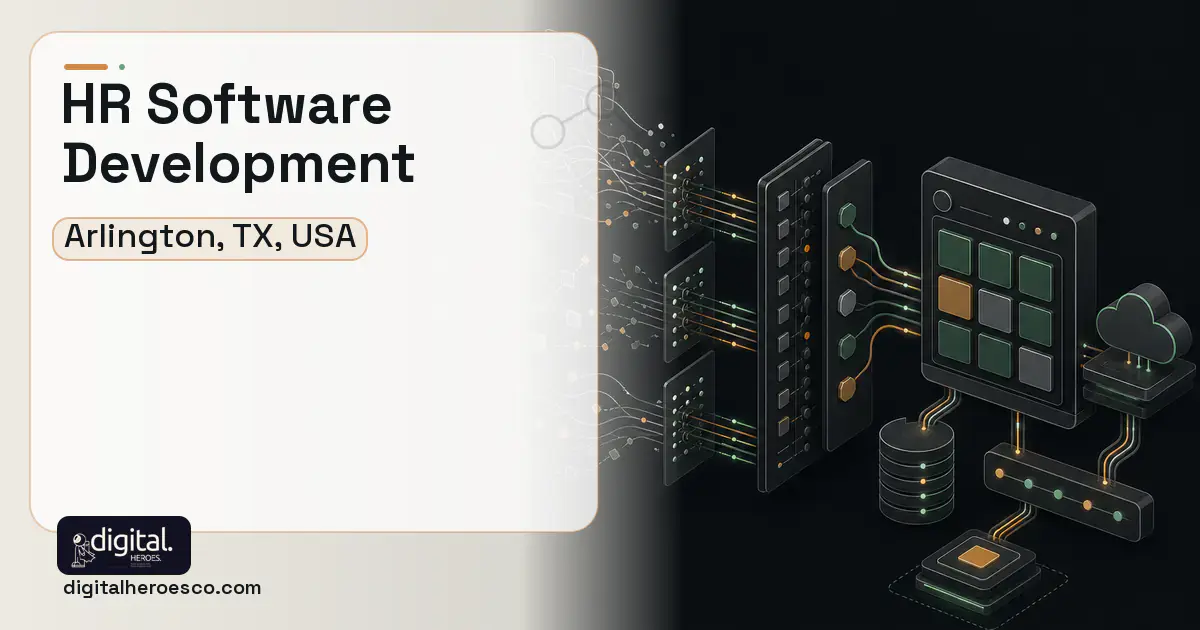
Custom HR (Human Resources) software for an Arlington operator runs $50,000 to $150,000 over 4 to 7 months. You build it when BambooHR, Gusto, or Workday assume a stable salaried workforce, and your reality is the opposite: staffing surges of hundreds of seasonal and event workers for a game day, then standing most of them down until the next one.
Standard HR platforms model a workforce that comes in Monday and is there Friday. Arlington event and hospitality operators model a workforce that triples for a Cowboys home game and shrinks the next Tuesday. BambooHR and Gusto handle the salaried core fine, then have no answer for onboarding, scheduling, credentialing, and paying hundreds of event-day workers on a calendar-driven cycle.
So you run the real workforce on spreadsheets and texts. Onboarding a surge crew, verifying credentials, scheduling against the event calendar, and getting everyone paid correctly becomes a manual scramble every event week. The HR platform you pay for covers the easy part and ignores the part that actually breaks under load.
What HR costs in Arlington
| Project scope | Typical cost | Timeline |
|---|---|---|
| Surge onboarding and scheduling module | $50k to $80k | 4 to 5 months |
| HR platform with credentialing and pay logic | $85k to $120k | 5 to 6 months |
| Full build with integrations and compliance | $120k to $150k | 6 to 7 months |
The fix: HR built for Arlington, not rented
Custom HR software models the surge workforce as a first-class case: fast onboarding and credentialing for event crews, scheduling tied to the venue calendar, and pay logic that handles a large variable headcount. The salaried core can stay where it is; the custom build owns the part that scales up and down with the schedule.
- You staff surges of hundreds of seasonal workers per event
- Onboarding, credentialing, and scheduling event crews is a manual scramble
- Stock HR tools cover the salaried core but ignore your surge workforce
- Your headcount is stable and salaried
- Gusto or BambooHR covers your full workforce comfortably
- Your seasonal hiring is small enough to manage manually
The capability list that earns its budget
Arlington HR: the full scope
Digital Heroes builds the full HR stack for Arlington teams. Typical engagements cover time and attendance, applicant tracking system (ATS), BambooHR alternative, Workday integration, leave management, performance management software and custom HR software.
How long it takes, phase by phase
Exactly what you get
You get HR software that owns the hard part: onboarding and credentialing surge crews fast, scheduling against the venue calendar, and paying a large variable workforce accurately, with rehire-ready rosters so returning staff are back in minutes. The salaried core stays where it works.
How to choose a developer in Arlington
Hire a team that has built workforce systems for variable or seasonal labor, not just configured Gusto. Ask them to walk through onboarding 300 event staff in a week. The right firm integrates the HR build with your scheduling, accounting software, and payroll so a shift worked becomes a paycheck without manual re-entry.
- Rapid onboarding and credentialing for surge crews of hundreds
- Scheduling tied directly to the AT&T Stadium and Globe Life Field calendars
- Pay logic that handles a large variable event-day workforce accurately
- A rehire-ready roster so returning event staff onboard in minutes, not hours
- Compliance records for a transient workforce kept in one place instead of texts
- Payroll tax and compliance logic that Gusto maintains becomes yours to keep current
- Benefits administration for the salaried core may still need a separate tool
- A custom HR system needs an owner to keep compliance rules updated
- If your headcount is stable, you are building for a surge you do not have
- !They model only a salaried workforce. Ask how they onboard hundreds of event staff fast.
- !They skip credentialing. Ask how certifications get verified for a surge crew.
- !They have no compliance plan. Ask how pay and tax rules stay current.
- !They ignore the venue calendar. Ask how scheduling ties to event dates.
- !They cannot integrate payroll. Ask which payroll systems they have connected.
Teams investing in HR in Arlington usually scope it next to pos, warehouse management, helpdesk & ticketing, since these systems share data and budgets. Weighing options across the region? Nearby: HR in Houston, San Antonio and Dallas. Want it built, not just budgeted? That is our custom software development practice.
The evidence behind this guide
Independent findings on why this investment pays off. Every link goes to the primary source.
- Organizations that scaled intelligent automation report an average cost reduction of 32% (up from 24% in 2020), and respondents expect an average 31% cost reduction over the next three years. Source: Deloitte (2022) →
- An EY survey found one in five U.S. payrolls contains errors, each costing an average of $291 to remediate, with a typical 1,000-employee organization spending roughly 29 workweeks per year fixing common payroll errors. Source: EY (Ernst & Young) (2022) →
- The average developer spends more than 17 hours a week dealing with maintenance issues such as debugging and refactoring, and about four of those hours on 'bad code' - waste that equates to nearly $85 billion annually worldwide in opportunity cost. Source: Stripe (2018) →
- Only about 30% of digital transformations succeed at meeting their objectives, but getting six critical success factors in place (leadership commitment, talent, agile culture, progress monitoring, clear strategy, and a modernized platform) raises the odds of success from 30% to 80%. Source: Boston Consulting Group (BCG) (2020) →
Frequently asked questions
Why won't BambooHR work for our event staffing?
BambooHR and Gusto assume a stable salaried workforce. Arlington event operators staff surges of hundreds for a single game day, which those tools cannot onboard, credential, schedule, or pay efficiently. That gap is the case for custom.
How long does custom HR software take?
Four to seven months. A surge onboarding and scheduling module lands near 4 to 5 months. A full platform with credentialing, pay logic, and compliance runs 6 to 7.
Can it onboard hundreds of event staff quickly?
Yes. That is the core reason to build. Custom HR software supports rapid onboarding with rehire-ready rosters so returning event crews are processed in minutes.
What does custom HR software cost in Arlington?
Between $50,000 and $150,000 depending on credentialing, pay logic, compliance, and integrations.
Do we still need Gusto or a payroll provider?
Often yes for the salaried core and tax filing. The custom build owns the surge workforce and integrates with payroll so the two stay in sync.
What happens to my software if the agency shuts down or we stop working together?
Nothing dramatic, if the engagement was set up correctly: the code sits in your repository, hosting runs on your cloud account, and a handover document explains how to deploy and operate the system. Any competent replacement team can then take over in days rather than months. If the agency controls the repo, the servers, or the domain, fix that now, because renegotiating access during a dispute is the most expensive place to discover the problem.
Should we build our own payroll engine or integrate with a payroll provider?
Integrate, almost without exception; payroll tax across US federal, state, and local jurisdictions is a compliance business rather than a software feature, and getting it wrong creates real liability. Keep ADP, Gusto, or Paychex as the engine and build your workflows on top through their APIs. Nearly every payroll-connected platform Digital Heroes has delivered integrates instead of rebuilding, and the exceptions regretted it.
What should I prepare before contacting a software development agency?
A one-page brief beats a 40-page requirements document: the business problem in plain words, who will use the system, the 5 to 10 workflows it must handle, the tools it must connect to, and your budget range and deadline driver. You do not need wireframes, a specification, or technical vocabulary; producing those is the agency's job during discovery. Stating a budget range up front is the single best move, because it gets you honest scoping instead of a quote engineered to win the meeting.
Is Workday realistic for a company under 500 employees?
Usually not; companies that bring Digital Heroes their Workday quotes have been looking at six-figure implementations with 6 to 12 month rollouts before any customization starts. A custom HR platform scoped to what a 200-person company actually uses typically costs less than that implementation alone. Under 500 employees you would be paying for enterprise depth you will not touch for years.
What does it cost to maintain custom HR software after launch?
Plan for 15 to 20 percent of the original build cost per year, the average across Digital Heroes maintenance contracts, covering security patches, dependency updates, small feature changes, and monitoring. Hosting for a company under 1,000 employees usually adds $100 to $400 a month on AWS or similar. Unlike BambooHR or Workday, the cost does not grow every time you hire ten more people.
How long does it take to build a custom HR system?
A working first version takes 12 to 16 weeks in Digital Heroes projects: employee records and onboarding first, then time off and reporting. A full platform with applicant tracking, performance reviews, and payroll integration is a 6 to 9 month effort. Anyone quoting a complete HR suite in 4 weeks is describing a template, not custom software.
What tech stack should custom HR software use?
Choose boring and hireable: React or Next.js on the front end, Node.js or Django behind it, and PostgreSQL for data, since Postgres row-level security maps cleanly onto salary visibility rules. That is the Digital Heroes default for HR systems because any future team can maintain it. Be wary of agencies pushing an exotic stack; you will be hiring for it for a decade.
Does my development team need to be located in Arlington?
No, most software projects run fully remote without any quality penalty, and what actually matters is 3 to 4 hours of working-hour overlap and a fixed weekly demo call. A team based in Arlington earns its premium in specific cases: hardware installations, warehouse or clinic floor shadowing, and discovery workshops where watching your staff work beats any written brief. Choose for senior engineers and a track record first, and treat geography as a tiebreaker.
How much should a small business budget for its first custom app or website?
For a focused first build, most small businesses land between $8,000 and $60,000: roughly $8,000 to $45,000 for a custom website and $25,000 to $60,000 for an internal tool or simple web app, based on Digital Heroes delivery across 2,000+ projects. Customer-facing products with payments, logins, or a mobile app start around $40,000. Quotes far below these bands usually mean a template with your logo on it, not software shaped around your workflow.
What are the biggest mistakes first-time software buyers make?
Choosing the lowest bid, paying more than 30-40% upfront instead of on milestones, skipping a written specification, and having no maintenance plan for after launch. The most expensive of the four in Digital Heroes rescue projects is the missing spec: without written acceptance criteria, done becomes an argument instead of a checklist, and every disagreement resolves in the vendor's favor. Fix those four and you have avoided most of the ways these projects fail.
Who owns the code if an agency builds our HR software?
You should own it outright, with the contract assigning full intellectual property to you on final payment and the code living in a repository you control from week one. Watch for agencies that license you their platform, because that recreates the vendor lock-in you left BambooHR to escape. Digital Heroes assigns 100 percent of custom code to the client; the only carve-outs should be standard open source libraries.
We run everything on spreadsheets and Airtable. How do we know it's time for custom software?
The reliable signals are re-typing the same data into multiple tools, one employee acting as human middleware between systems, and errors appearing in handoffs between teams. Hard limits force the issue too: Airtable's Team plan caps at 50,000 records per base, and Business costs $45 per seat per month, so a 20-person team pays about $10,800 a year for a tool it has already outgrown. When workarounds consume more hours than the tools save, the spreadsheet era is over.
How many SaaS seats do we need before building custom becomes cheaper?
The crossover usually shows up between 20 and 50 seats on premium tiers. Salesforce Enterprise lists at $165 per user per month, so 40 users cost about $79,000 a year in subscriptions, which is real money against a custom system you would own outright. Run the comparison over three years: if subscription spend beats the build cost plus 15-20% annual maintenance, custom wins on price before you even count workflow fit.
Who can build custom HR software for a business in Arlington?
Digital Heroes builds custom HR software systems for operators who have outgrown the off-the-shelf tools in their category. The work is delivered remotely: our engineers work from Delhi and Lucknow, leadership is in New York, and some team members live in London and Sydney and work remotely from there. We have no office in Arlington. You can chat with the team directly, and every form gets an email reply within 24 hours.
Related guides
Published · Last updated .