QuickBooks closes a normal Arlington month cleanly. It can't pull apart revenue from one packed event weekend.
Custom accounting software for an Arlington operator runs $50,000 to $150,000 over 4 to 7 months.
On this page
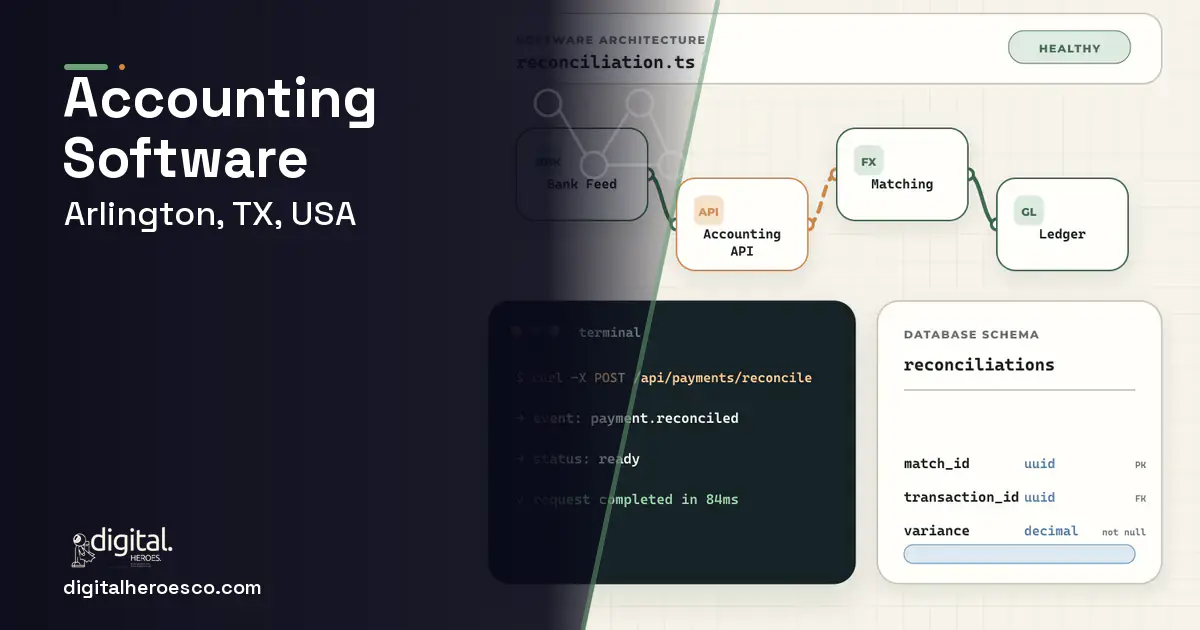
Custom accounting software for an Arlington operator runs $50,000 to $150,000 over 4 to 7 months. You build it when QuickBooks or Xero cannot represent how you actually earn: revenue from multiple centers across a single event, costs that spike for a game day, and inter-entity activity between your venue, parking, and concession arms that off-the-shelf accounting forces you to untangle by hand.
QuickBooks and Xero are excellent for a single business with steady transactions. They strain when one Arlington event weekend generates revenue across parking, concessions, merch, and hospitality, each needing its own center, and costs spike in the same window. Closing the books means manually splitting and allocating activity that the software has no native way to separate.
It gets worse with multiple entities. If your venue-services, parking, and distribution arms are separate businesses sharing customers and an event calendar, off-the-shelf accounting cannot handle inter-company activity cleanly. You end up with spreadsheets bridging your books, and the month-end close becomes a multi-day archaeology project instead of a report you run.
Where the off-the-shelf tools fall short
- Revenue from multiple centers across one event cannot be split cleanly in QuickBooks
- Event-day cost spikes are hard to allocate against the revenue they generated
- Inter-entity activity between venue, parking, and distribution arms is manual
- Month-end close drags into days of spreadsheet reconciliation
Custom accounting: what Arlington teams actually get
Custom accounting software models your real structure: multiple revenue centers, event-level allocation, and inter-entity activity handled natively. The books reflect how Arlington earns, an event weekend allocates cleanly, and month-end close becomes a report you run rather than a reconstruction you survive.
- One event generates revenue across centers QuickBooks cannot split
- You run multiple entities with inter-company activity
- Month-end close is a multi-day manual reconciliation
- You are a single entity with steady transactions
- QuickBooks or Xero closes your books cleanly
- You have no inter-company or multi-center complexity
- Revenue split cleanly across centers within a single event
- Event-level cost allocation so you see true margin per event
- Native inter-entity handling across venue, parking, and distribution arms
- A faster, cleaner month-end close instead of spreadsheet bridging
- Reporting that reflects your real economics rather than a blended view
- You take on tax and compliance logic QuickBooks maintains for you
- Bank feeds and reconciliation that come standard now need building or integrating
- A custom ledger needs accounting expertise to design correctly and safely
- For a single steady-state entity, QuickBooks is cheaper and entirely sufficient
Feature priorities for Arlington teams
Accounting services we deliver in Arlington
Everything an accounting build here can cover: accounts payable automation, accounts receivable, general ledger, expense management and custom accounting software.
The honest cost picture for Arlington
| Project scope | Typical cost | Timeline |
|---|---|---|
| Multi-center accounting core | $50k to $80k | 4 to 5 months |
| Accounting with inter-entity handling | $85k to $120k | 5 to 6 months |
| Full build with bank feeds and reporting | $120k to $150k | 6 to 7 months |
Timeline: what happens, and when
Exactly what you get
You get accounting that fits Arlington's structure: multi-center revenue split cleanly across an event, costs allocated to the revenue they generated, and inter-entity activity handled natively, so a packed event weekend closes as a report rather than a multi-day reconciliation.
How to choose a developer in Arlington
Hire a team with real accounting and financial-systems expertise, not just general developers. Ask who designs the ledger and how they handle inter-company eliminations. The right firm integrates accounting with your ERP (Enterprise Resource Planning), POS (Point of Sale) system, and business intelligence (BI) dashboards so revenue books once and reports everywhere.
- !They have no accounting expertise on the team. Ask who designs the ledger logic.
- !They cannot handle inter-entity. Ask how they eliminate inter-company activity.
- !They ignore event allocation. Ask how costs tie to the revenue they generated.
- !They skip the audit trail. Ask how event-window activity is traceable.
- !They underestimate compliance. Ask how tax logic stays current.
Teams investing in accounting in Arlington usually scope it next to warehouse management, field service management, erp, since these systems share data and budgets. Weighing options across the region? Nearby: accounting in Houston, San Antonio and Dallas. Want it built, not just budgeted? That is our custom software development practice.
The evidence behind this guide
Independent findings on why this investment pays off. Every link goes to the primary source.
- Inventory carrying cost commonly runs about 20% to 30% of inventory value, covering capital cost, storage/warehousing, insurance, taxes, handling, shrinkage, and obsolescence - a recurring cost that better inventory and warehouse software aims to reduce. Source: APQC (2023) →
- Gartner estimates RPA can eliminate up to 25,000 hours of avoidable rework caused by human errors in the finance function each year, equating to savings of roughly $878,000 for an organization with 40 full-time accounting staff (based on interviews with more than 150 corporate controllers and chief accounting officers). Source: Gartner (2019) →
- IBM frames first-time fix rate as a core field service KPI, noting the industry average sits around 80% (roughly one in five jobs needs a return visit). Correction: IBM cites best-in-class providers at 89-98%, not '85%+'. Source: IBM (2024) →
- 48% of private companies cite integration with legacy systems or technical debt as a top obstacle to realizing the full value of their digital and AI investments (behind data quality/availability at 72% and gaps in AI fluency or technology talent/leadership at 53%). Source: Deloitte (2026) →
Frequently asked questions
Why can't QuickBooks handle our event revenue?
QuickBooks suits a single steady business. An Arlington event weekend generates revenue across parking, concessions, merch, and hospitality with cost spikes in the same window, which QuickBooks cannot split or allocate natively. Custom accounting models that structure directly.
How long does custom accounting software take?
Four to seven months. A multi-center accounting core lands near 4 to 5 months. A full build with inter-entity handling, bank feeds, and reporting runs 6 to 7.
Can it handle multiple entities?
Yes. That is a primary reason to build. Custom accounting software handles inter-entity transactions with automatic eliminations across your venue, parking, and distribution arms.
What does custom accounting software cost in Arlington?
Between $50,000 and $150,000 depending on inter-entity complexity, allocation logic, and integrations.
Should it integrate with our POS and ERP?
Yes. Scope it alongside your POS system and ERP so revenue books once at the source and flows into reporting without re-entry.
Is custom software more secure than off-the-shelf SaaS?
Neither is secure by default; security tracks the practices of whoever builds and operates the system, not the model. SaaS gives you the vendor's certifications and patching but puts your data in a shared multi-tenant platform on their terms, while custom gives you full control over data residency, access rules, and compliance requirements like HIPAA, with the responsibility sitting with you and your agency. Before hiring anyone for a system holding sensitive data, ask for their security checklist: encryption at rest and in transit, an OWASP Top 10 review, role-based access, and a penetration test before launch.
We run everything on spreadsheets and Airtable. How do we know it's time for custom software?
The reliable signals are re-typing the same data into multiple tools, one employee acting as human middleware between systems, and errors appearing in handoffs between teams. Hard limits force the issue too: Airtable's Team plan caps at 50,000 records per base, and Business costs $45 per seat per month, so a 20-person team pays about $10,800 a year for a tool it has already outgrown. When workarounds consume more hours than the tools save, the spreadsheet era is over.
What are the biggest mistakes first-time software buyers make?
Choosing the lowest bid, paying more than 30-40% upfront instead of on milestones, skipping a written specification, and having no maintenance plan for after launch. The most expensive of the four in Digital Heroes rescue projects is the missing spec: without written acceptance criteria, done becomes an argument instead of a checklist, and every disagreement resolves in the vendor's favor. Fix those four and you have avoided most of the ways these projects fail.
Can I extend QuickBooks with custom features instead of replacing it?
Yes, and it is often the right first step. QuickBooks Online has a public API, so an agency can build a custom layer for quoting, inventory, or field service that pushes clean transactions into QuickBooks, which stays your ledger of record. Roughly half of the accounting engagements Digital Heroes scopes start this way because it costs a fraction of a full build and leaves your accountant's workflow untouched.
How much does custom accounting software cost for a small business?
Most small business accounting builds land between $25,000 and $75,000 for a working first version, while a full double-entry platform with invoicing, payroll, and reporting runs $100,000 to $250,000. Across 2,000+ projects at Digital Heroes, the biggest cost driver is how many external systems the software must connect to, not the accounting logic itself. A tool that automates a single painful workflow, like reconciliation or job costing, can come in under $20,000.
What tech stack should custom accounting software use?
A boring, proven one. Digital Heroes defaults to PostgreSQL for the ledger because transactional integrity is non-negotiable, a typed backend such as Node with TypeScript, .NET, or Java, and standard React on the front end. The avoid list is clearer than the pick list: floating point math for money, a NoSQL database as the primary ledger store, and any framework young enough that hiring for it in three years will be a problem.
How long does it take to build custom accounting software?
A focused first version takes 10 to 16 weeks, and a complete QuickBooks-class replacement takes 6 to 9 months. In Digital Heroes delivery data, schedules slip most often during data migration and bank feed integration, so we budget those two phases at double the first estimate. Treat any promise of a full accounting system in under two months as a warning sign.
Will custom accounting software scale as my company grows?
It scales exactly as far as its data model was designed to, so multi-entity support, multi-currency, and consolidation should be day-one design decisions even if you launch with a single company. Retrofitting multi-entity onto a single-entity ledger is among the most expensive changes we handle, and in Digital Heroes rescue work it often costs a third of the original build. Compare that with QuickBooks Online, which requires a separate subscription for every company you add.
Should I hire an accounting software developer in Arlington or work with a remote team?
Location matters for discovery, not for code. If your workflows involve a warehouse, job sites, or a back office in Arlington that a developer should walk through, a few on-site scoping days are worth paying for; after that, remote delivery works fine and widens your options. Judge candidates on shipped accounting systems and communication cadence, not office proximity.
Does it matter which tech stack the agency wants to use?
Yes, but not in the way most buyers expect: the goal is boring, popular technology such as React, Node.js or Python, and PostgreSQL, because any future team can maintain it and hiring a replacement developer takes days, not months. The red flag is an agency-proprietary framework or an unusual language, which welds you to that one vendor no matter what your contract says about code ownership. A useful test: could you find three freelancers fluent in this stack within a week? If not, push back.
What happens to my accounting software if the agency shuts down?
If you own the repository, the hosting accounts, and the documentation, another team can take over within weeks, usually before a missed closing cycle does real damage; if the agency owns any of those, you have a hostage situation. Before signing, confirm the code sits in your GitHub or GitLab organization, hosting bills to your card, and a written deployment runbook exists. A competent agency agrees to all three without friction, and hesitation is itself the answer.
Are local developer rates in Arlington worth it compared to hiring an offshore team?
Agency rates in markets like Arlington typically run $100 to $200 per hour against $25 to $60 offshore, but the hourly rate is not the project cost. Across 2,000+ Digital Heroes projects, the setup that consistently works is a hybrid: senior architects and a named lead for your project with a distributed build team behind them, which lands total cost well below all-local without the rework cycles that pure lowest-bid offshore engagements produce. Compare bids on total delivered cost with maintenance included, never on rate cards.
What should I prepare before contacting an agency about accounting software?
Bring three things: the 5 to 10 workflows that hurt most today, sample data such as your chart of accounts and a redacted month of transactions, and a list of every system the software must connect to, including banks and payroll. You do not need a formal spec; a good agency writes that with you during discovery. In our experience buyers who arrive with concrete workflow pain get accurate quotes, and buyers who arrive with a feature wishlist get padded ones.
Does my development team need to be located in Arlington?
No, most software projects run fully remote without any quality penalty, and what actually matters is 3 to 4 hours of working-hour overlap and a fixed weekly demo call. A team based in Arlington earns its premium in specific cases: hardware installations, warehouse or clinic floor shadowing, and discovery workshops where watching your staff work beats any written brief. Choose for senior engineers and a track record first, and treat geography as a tiebreaker.
Who can build custom accounting software for a business in Arlington?
Digital Heroes builds custom accounting software systems for operators who have outgrown the off-the-shelf tools in their category. The work is delivered remotely: our engineers work from Delhi and Lucknow, leadership is in New York, and some team members live in London and Sydney and work remotely from there. We have no office in Arlington. You can chat with the team directly, and every form gets an email reply within 24 hours.
Related guides

More from Olivia.
Performance Marketing Lead · New-york · 4 posts on the site
Published · Last updated .