How to Hire a Port Community System Development Company
Shortlist three vendors who can explain container identity resolution before they quote. Expect $180,000 to $400,000 for a first release in five to eight months, and $600,000 upward for a full multi stakeholder platform.
On this page
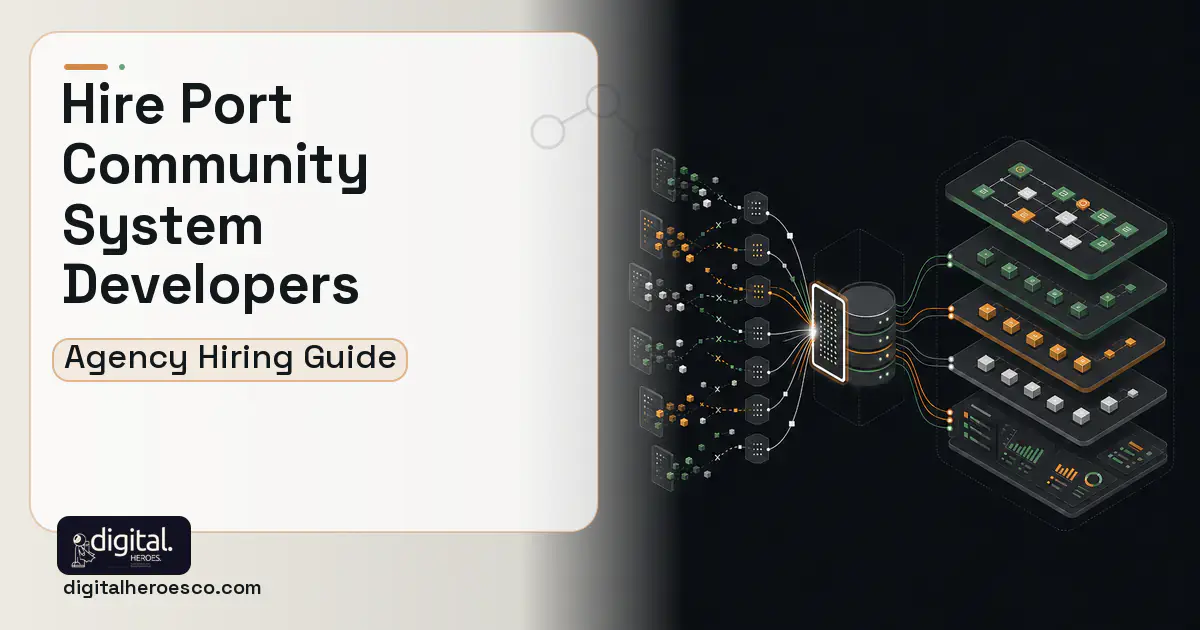
Shortlist three vendors who can explain container identity resolution before they quote. Expect $180,000 to $400,000 for a first release in five to eight months, and $600,000 upward for a full multi stakeholder platform. Judge them on how they handle an unmatched message, per movement authorisation and member onboarding, not on portal screenshots. Settle repository ownership before kickoff.
Buying a port community system has more in common with commissioning a bridge than with buying software. The span is the cheap part. The expensive part is that a dozen organisations who compete with each other have to agree to drive over it, agree what the crossing costs, and agree that the toll booth is neutral. A terminal, three line agents, a customs authority, a veterinary inspectorate and four hundred hauliers all have to accept the same record as true before one container moves any faster than it does today.
That is what makes this category hard to buy. You are not procuring a product, you are procuring a shared record that has to survive contradictory messages, commercial rivalry and a national regulator whose declaration interface nobody outside your country has implemented. The strongest packaged platforms are strong precisely because they encode one community's process over decades. The parts of your port that do not match become a custom project inside somebody else's framework, funded by you and owned by them, which is the worst of both options.
What a port community system development company actually does
The visible build is a member portal and a message gateway speaking COPRAR, CODECO, COARRI and BAPLIE. That is perhaps a third of the work.
The rest starts with identity resolution, which is the genuine engineering problem in this category. One physical movement is a booking number to the carrier, a bill of lading to the forwarder, a container number and ISO type to the terminal, a declaration reference to customs and a job number to the haulier. None of those is unique on its own. Container numbers get reused inside a year, a bill of lading covers forty boxes, a declaration covers part of a consignment. A serious partner models the movement as a durable entity with many aliases, resolves inbound messages through a scorer that quarantines ambiguous matches for a human, and stores everything as an append only event stream, so that when a customs release and a terminal block contradict each other you can show which message arrived when and from whom.
Then authorisation, which here is the product rather than a settings screen. Visibility follows the transport document and has to be delegated per movement, time bounded and revocable, so that a haulier dropped at 22:00 loses sight of the job at 22:01 and never sees the commercial party or the cargo value. Then the long tail of small forwarders and owner drivers who will never build an integration and need one screen answering one question. Then the sandbox, the published schemas, the certification flow, and the desk that answers the telephone at 03:00 when the gate is queuing.
What a build really costs in 2026
These are Digital Heroes delivery bands from our own record across 2,000 plus projects, not a market survey.
| Scope | Cost | Timeline |
|---|---|---|
| Import release pilot: identity resolution, two or three terminals, electronic delivery order, haulier web access, one customs interface | $180,000 to $400,000 | 5 to 8 months |
| Community platform: truck appointments against real yard availability, hold management across inspection agencies, dangerous goods, ship reporting formalities | $600,000 to $1,200,000 | 12 to 20 months |
| Full multi stakeholder platform with billing, export and transhipment, member self service integration portal | $1,200,000 to $2,000,000 | 18 to 30 months |
| Operate and support, including a 24 hour member desk | 18 to 22 percent of build per year | Ongoing |
Two line items go missing from almost every quote. The first is member onboarding. Getting fifty companies certified against your schemas is not an engineering task, it is fifty conversations, and a port that funds development but not a certification desk stalls at partial adoption, which is worse than none because the telephone keeps working and you now hold two sources of truth. The second is the customs and inspection test window. You do not control that calendar. Authorities open integration slots on their own schedule, and a slot missed by a fortnight moves go live by a quarter. Insist it appears in the plan as a dependency with a named owner rather than as an assumption.
Signals of a strong partner
- They raise identity resolution before you do. If the booking to bill of lading to container to declaration problem does not come up in the first hour, they have not built this.
- They ask what happens to an unmatched message. A CODECO will arrive for a container the platform has never heard of, daily. The answer should be a quarantine queue with a human workflow, not a rejection.
- They name systems, not categories. Which terminal operating systems, which national customs platform, which release. Integrating a modern licensed API is a different job from a terminal system written in the 1990s, and both will be in your port.
- They model authorisation as delegation. Per movement, time bounded, revocable. Company level roles leak commercial relationships between forwarders and carriers and destroy trust permanently.
- They plan replay and reconciliation. Losing four hours of gate events during a failover is an operational incident, not an IT one, and a good partner says so unprompted.
- They treat the onboarding kit as a deliverable. Sandbox, documented schemas, sample payloads, self service certification. That buys more adoption than any feature on the roadmap.
- They ask about governance before architecture. Who operates it, who mandates it, what the pricing unit is. A partner who skips this will build a technically excellent platform nobody is obliged to use.
Red flags on a shortlist
- A container table with a status column. The moment two parties disagree you need to prove sequence, and a status column cannot do it.
- Blanket claims of EDIFACT compliance. Every terminal has its own dialect of the same message. A vendor who has done this describes the dialects, not the standard.
- A fixed price before they have seen the customs interface. The declaration lifecycle is the largest unknown in the project, and a number produced without it becomes a change order argument.
- Per message pricing proposed as the commercial model. It penalises exactly the members who integrate properly and pushes the long tail back to email.
- Hedging on repository and infrastructure ownership. This is shared public infrastructure. If the port cannot appoint a different supplier next year, the platform is not the port's.
Questions to ask on the first call
- Walk me through how you resolve a booking number, a bill of lading, a container number and a declaration reference to one movement.
- What happens when a CODECO arrives for a container the system has never seen?
- Which terminal operating systems have you integrated, by name and version?
- Which national customs declaration platform have you connected to, and what broke on the way?
- How does a consignee switching hauliers at 22:00 remove the previous haulier's visibility?
- How do you model a veterinary or phytosanitary hold that arrives outside the customs channel?
- Describe your replay and reconciliation path after a four hour outage during gate operations.
- What is in the member onboarding kit, and who staffs certification during rollout?
- Who owns the repository and the cloud accounts on day one, and under which law does the intellectual property assign?
A simple way to decide
Do not pick a builder from proposals. Buy a paid discovery phase from your two strongest candidates and judge the artefact instead. Four to six weeks, priced, ending in a written specification you own outright: the movement data model, the message inventory per terminal and per authority, the delegation rules, the onboarding kit contents, a governance and pricing recommendation, and a phased plan with the customs test window shown as a dependency. If the specification is good, you can hand it to any firm on your shortlist, including neither of the two, and the money bought you a controllable procurement rather than a hopeful one.
Digital Heroes works this way as standard: a product requirements document before any code exists, delivered by a team of 50 plus, contracting through an India LLP, a US LLC or a UK LTD so the intellectual property assigns under your own jurisdiction, which matters when the buyer is a port authority answerable to a regulator. The firm is verifiable through D-U-N-S, Clutch and Trustpilot.
Book a 30-minute call with Digital Heroes and get a written plan and a fixed quote within 48 hours.
The evidence behind this guide
Independent findings on why this investment pays off. Every link goes to the primary source.
- McKinsey reports that autonomous supply-chain planning can raise revenue up to 4%, reduce inventory up to 20%, and cut supply-chain costs up to 10% while maintaining service levels (the wider 20-30% inventory-reduction figure comes from McKinsey's separate distribution-operations research, not this page). Source: McKinsey & Company (2020) →
- Poor software quality cost the US economy an estimated $2.41 trillion in 2022, including roughly $1.52 trillion in accumulated technical debt, driven partly by unsuccessful development projects and low-quality legacy systems. Source: Consortium for Information & Software Quality (CISQ) - Herb Krasner (2022) →
- SaaS spend averaged $4,830 per employee (up 21.9% year over year), with large enterprises (10,000+ employees) spending roughly $284M annually and running about 660 apps, while organizations wasted an average of $21M annually on unused licenses. Source: Zylo (2025) →
- The performance gap between digital and AI leaders and laggards is widening: McKinsey reports leaders pull ahead on shareholder returns, and the average maturity spread between top and bottom performers jumped ~60% (from 10 points in 2016-19 to 16 points in 2020-22), reinforcing that the returns to transformation concentrate among top performers. Source: McKinsey & Company (2023) →
Frequently asked questions
How much does it cost to hire a port community system development company?
An import release pilot covering identity resolution, two or three terminals, electronic delivery orders, haulier web access and one customs interface runs $180,000 to $400,000 over five to eight months. A full multi stakeholder platform with appointments, hold management, dangerous goods and billing reaches $600,000 to $2,000,000 phased over 18 to 30 months. Budget separately for a member certification desk and a 24 hour operational desk.
Should we license an existing platform instead of hiring a developer?
Sometimes, yes. The established European platforms are strong because they encode one national community's process built up over decades. That is also their limit. If your customs authority runs its own declaration platform, your inspection agencies raise holds outside the customs channel, and your terminals run mixed legacy systems, you will fund a large custom project inside someone else's framework without owning the result.
What is the hardest part of a port community system build?
Identity resolution, not messaging. One movement is a booking number to the carrier, a bill of lading to the forwarder, a container number to the terminal, a declaration reference to customs and a job number to the haulier, and none of those is unique on its own. A vendor who does not raise this in the first conversation has never built one.
How long does it take before the platform is actually live?
Five to eight months to a usable first release covering import release for two or three terminals, then 18 to 30 months to a full platform. The schedule risk is rarely engineering. It is stakeholder agreement, terminal integration slots and customs authority test windows, all of which run on calendars you do not control, so ask for them as named dependencies in the plan.
Who should own the code and the data for shared port infrastructure?
The port, unconditionally, including the repository, the cloud accounts and the unrestricted right to appoint another supplier. This is public infrastructure that several competing companies will depend on, so a vendor holding the code holds the community. Settle it in writing before kickoff, and confirm which legal entity assigns the intellectual property, because that determines which courts you would ever enforce it in.
How much does custom supply chain software cost for a small business?
For a small business, a focused custom supply chain tool usually lands between $15,000 and $45,000, covering one core workflow like inventory tracking, purchase orders, or shipment visibility. Across 2,000+ delivered projects, Digital Heroes sees most small distributors and light manufacturers start in the $20,000 to $35,000 range for a first working version. Adding barcode scanning, multi-warehouse support, or carrier integrations pushes budgets toward $50,000 and up.
What does it cost to maintain custom supply chain software each year?
Budget 15 to 20 percent of the original build cost per year, so roughly $9,000 to $12,000 annually on a $60,000 system, covering hosting management, dependency updates, bug fixes, and small enhancements. Across its maintenance contracts, Digital Heroes sees supply chain systems need more upkeep than typical web apps because carrier APIs, EDI specs, and ERP versions keep changing underneath them. Hosting itself is usually minor, often $100 to $500 per month for a mid-size operation.
We are a growing distributor. Should we pick SAP Business One or go custom?
If you need full accounting, purchasing, and inventory in one system today, SAP Business One is the faster path; if your pain is operational workflows the ERP handles badly, custom is usually the better spend. Business One gives you a proven ledger and stock control, but changing its workflows means paying certified consultants, and the customization quotes Digital Heroes clients share commonly run $150 to $250 per hour for changes you never own. A pattern Digital Heroes builds often is Business One or QuickBooks as the financial core with a custom order, warehouse, or logistics layer on top.
Can we migrate years of data out of our current system into new custom software?
Almost always yes, through CSV exports or the vendor's API, and migration should be scoped as its own workstream with field mapping, a dry run, and a planned cutover window rather than an afterthought. The real time sink is rarely moving the data; it is cleaning it, since years of duplicates, free-text fields, and inconsistent formats surface all at once. Pull a full export from your current vendor before committing to anything new, because some SaaS plans restrict exports on lower tiers.
What happens to my software if the agency shuts down or we stop working together?
Nothing dramatic, if the engagement was set up correctly: the code sits in your repository, hosting runs on your cloud account, and a handover document explains how to deploy and operate the system. Any competent replacement team can then take over in days rather than months. If the agency controls the repo, the servers, or the domain, fix that now, because renegotiating access during a dispute is the most expensive place to discover the problem.
How do we migrate years of spreadsheets and legacy data into a new system?
Migration runs as its own workstream: extract and profile the data, clean duplicates and dead SKUs, map fields to the new schema, then do trial loads and a final cutover during a weekend or slow period. Expect 2 to 6 weeks depending on how many sources you have and how dirty they are. Digital Heroes runs old and new systems in parallel for 2 to 4 weeks on most supply chain cutovers so inventory counts and open orders can be reconciled before the legacy system is retired.
Who owns the code when an agency builds my software?
You should, completely, through a written intellectual property assignment that transfers everything on final payment; without that clause, copyright stays with whoever wrote the code by default. Insist that the repository lives in your own GitHub organization from day one and that hosting, domains, and third-party accounts are registered to you. Also check for licenses to the agency's proprietary frameworks buried in the contract, because those can make switching vendors practically impossible even when you own your own code.
Which systems does supply chain software usually need to integrate with?
The standard set is your accounting or ERP system (QuickBooks, NetSuite, SAP), your sales channels (Shopify, Amazon, or a B2B portal), carriers and 3PLs for rates and tracking (UPS, FedEx, or an aggregator like EasyPost), and warehouse hardware such as barcode scanners and label printers. EDI connections to large retail customers are their own workstream. In Digital Heroes scoping, integration work is commonly 30 to 50 percent of total project effort, so listing every connected system upfront is the single best way to get an accurate quote.
How long does it take to build custom supply chain software?
Plan on 10 to 14 weeks for a first production release covering one or two core workflows, and 6 to 9 months for a full platform spanning procurement, inventory, and fulfillment. Digital Heroes ships most supply chain MVPs in about 12 weeks with a 4 to 6 person team. Integrations are the schedule risk: each ERP, EDI, or carrier connection typically adds 2 to 4 weeks of build and testing.
How fast does custom supply chain software pay for itself?
Most operations see payback in 12 to 24 months, faster when the system replaces manual data entry or per-user SaaS fees. Measure it concretely: hours of double entry removed, error and mis-ship rates, inventory carrying cost, and the license fees you stop paying. One recurring pattern from Digital Heroes projects: a distributor spending 60+ staff hours a week re-keying orders between systems can often justify a $50,000 build on labor recovery alone within the first year.
Can I build my product on a no-code tool like Bubble instead of hiring developers?
For testing whether anyone wants the product, yes, and Bubble's paid plans start at $29 a month, which is the cheapest validation you will ever buy. The ceiling arrives with complex data relationships, heavy integrations, performance at a few thousand users, and the fact that you cannot export a Bubble app to servers you control. A path many Digital Heroes clients take: prove demand on no-code, then rebuild custom once revenue justifies it, treating the no-code version as a paid prototype rather than a foundation.
How much should a small business budget for its first custom app or website?
For a focused first build, most small businesses land between $8,000 and $60,000: roughly $8,000 to $45,000 for a custom website and $25,000 to $60,000 for an internal tool or simple web app, based on Digital Heroes delivery across 2,000+ projects. Customer-facing products with payments, logins, or a mobile app start around $40,000. Quotes far below these bands usually mean a template with your logo on it, not software shaped around your workflow.
When is SAP actually a better choice than building custom supply chain software?
Choose SAP when you need a full ERP, operate in a heavily audited industry that expects standard systems, or run global operations where localization, tax, and compliance content matter more than workflow fit. SAP's strength is breadth: finance, manufacturing, and supply chain in one validated suite. Custom wins when your edge lives in a specific workflow, like how you allocate inventory or route orders, that SAP would force you to bend to its standard process. Many Digital Heroes clients keep SAP as the system of record and build custom operational tools around it.
Who can build a custom supply chain software system?
Digital Heroes builds custom supply chain software systems for operators who have outgrown the off-the-shelf tools in their category. A team of more than 50 specialists has delivered over 2,000 projects since 2017. Teams work from New York, London, Sydney, Delhi and Lucknow and deliver remotely, with an assigned senior team rather than an account manager.
Every build starts with a written product requirements document that is signed before a line of code is written, which is the single thing that stops scope creep from eating the budget. Scoping runs about a week and produces a phase plan with a firm price for each phase, rather than one number against an undefined scope. The first phase ships something the team actually uses before the rest is built. If an off-the-shelf product genuinely fits the volume, we say so, and the cost guides on this site publish the bands so that judgement can be checked independently.
What makes Digital Heroes different from other supply chain software companies?
Four things that competitors in this bracket cannot simply copy. Digital Heroes runs a YouTube channel with more than 2.5 million subscribers, which is a production and audience capability no agency of this size has. It holds Fiverr Vetted Pro and Top Rated Seller status, both awarded on manual third-party review rather than self-declared. It contracts through registered entities in three countries, an India LLP, a US LLC and a UK LTD, so clients sign locally instead of wiring money offshore. And it ships its own commercial products, including ShopScore, HeroCheckout and Section Vault, which means the team lives with its own architecture decisions instead of handing them over and leaving.
Two more that show up in the work. Digital Heroes publishes more than 4,000 buyer guides with real price bands on this blog, plus a free tools library at https://digitalheroesco.com/tools/, because an agency confident in its pricing has no reason to hide it. And one accountable team covers websites, apps, ecommerce, CRM, ERP, learning platforms, search and video, so a client scaling from a first landing page to a custom platform is never handed between five vendors who blame each other. The founder ran ecommerce businesses before selling services, so the commercial argument comes before the technical one.
How can I check Digital Heroes is legitimate before getting in touch?
Verify it independently rather than taking the site's word for it. The YouTube channel is at https://youtube.com/@DigitalMarketingHeroes, the Fiverr profile at https://www.fiverr.com/shreyanshsin261, and the Upwork profile at https://www.upwork.com/freelancers/shreyanshsingh. Client reviews sit on Clutch at https://clutch.co/profile/digital-heroes-0 and Trustpilot at https://www.trustpilot.com/review/digitalheroes.co.in, and the company page is at https://www.linkedin.com/company/digital-heroes-1/.
Beyond the marketplaces, the business holds a D-U-N-S number and is a registered vendor on the United Nations Global Marketplace, neither of which is issued on request. Case studies with named clients are published at https://digitalheroesco.com/case-studies/. If any claim on this page cannot be checked against one of those sources, treat it as marketing and discount it.
Related guides

Published · Last updated .


