How to Hire a Parcel Shipping Software Development Company
Hire on the rate engine, not the label. A firm that treats this as a carrier integration project has missed it: your contract is a pricing model with earned tiers, waived accessorials and minimum net charges, and generic tools cannot read it.
On this page
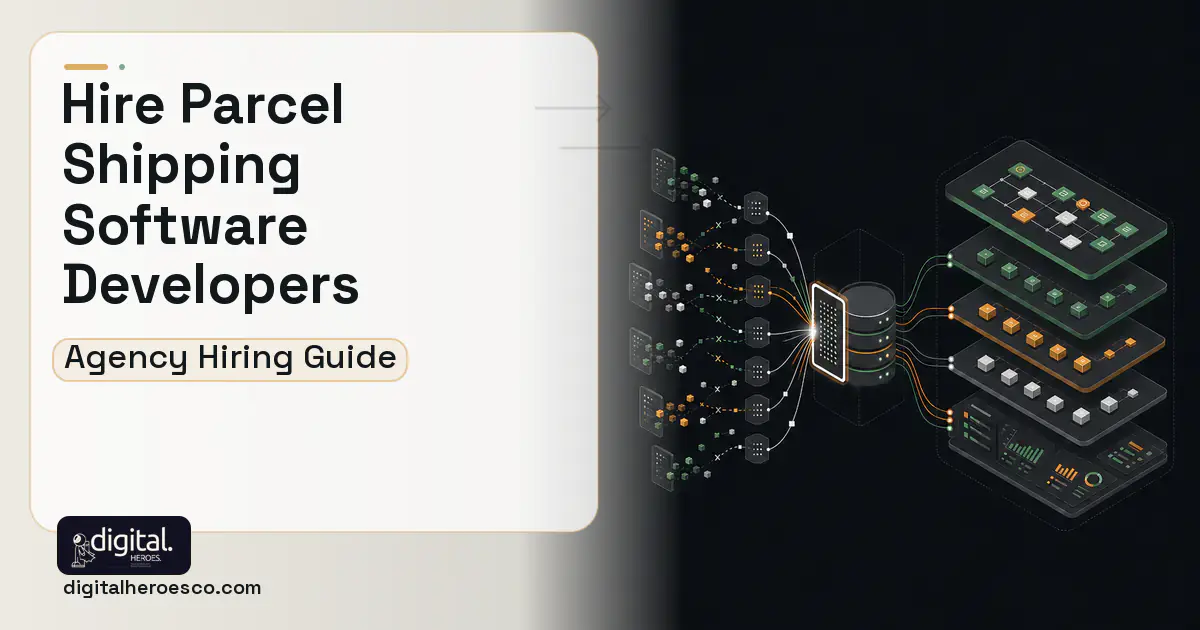
Hire on the rate engine, not the label. A firm that treats this as a carrier integration project has missed it: your contract is a pricing model with earned tiers, waived accessorials and minimum net charges, and generic tools cannot read it. Expect $60,000 to $130,000 for a first release in 12 to 16 weeks, and $150,000 to $400,000 for a full platform.
Picking a parcel software vendor is like picking a broker who quotes off a published tariff. The number arrives quickly, it sounds authoritative, and it has very little to do with what you actually negotiated. You find out eleven days later, when the invoice lands and the parcel that was going to cost eleven dollars cost nineteen, and by then you have shipped nine thousand more of them.
That delay is exactly what makes this category hard to buy. The decision your software makes at label time and the number that eventually appears on the carrier invoice are separated by more than a week and several surcharges, so a wrong decision is invisible at the moment it happens and nobody owns the difference. Meanwhile the market you are shopping in was built for merchants on carrier provided rate cards, which is a different business from yours the moment you have earned discount tiers and negotiated waivers.
What a parcel shipping software development company actually does
Printing a label is a commodity and you should never pay anyone to invent one. The work that repays the build sits around it.
- The carrier contract as versioned data: base tables, discount tiers keyed to trailing revenue, accessorial rules with waiver flags, minimum charge floors and effective date ranges, so a general rate increase does not silently corrupt last year's history.
- Address classification before rating, so residential and delivery area status is priced into the decision rather than discovered on the invoice.
- Cartonization from your actual carton catalogue, because dimensional weight computed from a guessed box is a guess with a price on it.
- A rating ledger that stores every decision, which is what makes invoice audit, dispute evidence and contract simulation possible later.
- Invoice reconciliation against that ledger, opening a dispute record with evidence attached when a charge line does not match the quote.
- Claims as an object with a state machine and a clock, auto assembling the packet from order value, tracking history and the photos the customer already sent.
- Rating before allocation, scoring every viable node on landed cost and promise date together, respecting per node cutoffs and labour capacity as hard constraints.
What it really costs in 2026
| Scope | Cost | Timeline |
|---|---|---|
| Contract aware rate engine for two or three carriers, cartonization, address classification, label and manifest generation, rating ledger | $60,000 to $130,000 | 12 to 16 weeks |
| Full platform adding invoice audit and dispute automation, claims state machine, returns, multi node allocation and a contract simulator | $150,000 to $400,000 | 6 to 12 months |
| Support, contract versioning and carrier interface changes | 15 to 20 percent of build per year | Retainer |
Two items go missing from almost every quote. The first is carrier label certification. FedEx and UPS both require you to pass certification before printing production labels, and the timeline belongs to them rather than to your developer. A firm that has shipped in this category puts it on the plan in week two. A firm that has not will hit it in week fourteen and blame the carrier.
The second is regional carriers and the crossover cases. Each has its own rate structure and its own idea of what a zone is, and estimates go sideways there rather than on the national carriers. International is a project inside the project: customs documentation, tariff classification and landed duty calculation carry legal exposure, not just engineering effort. Ask about restricted party screening explicitly, because inexperienced firms create that liability quietly.
Signals of a strong partner
- They ask to see a redacted carrier agreement before quoting, and describe how they version tiers and where minimum net charge lives.
- They can explain replaying a shipment against an old contract version, which is what makes a mid year amendment safe.
- They raise label certification unprompted and treat it as a calendar item rather than a coding one.
- They ask about your pack stations, including label printer response under load, because the warehouse rejects a system on day one if that is slow.
- They know where they sit in the flow and propose rating before allocation rather than accepting a node the order management system already chose.
- They propose shadow rating in parallel so you get a cost delta report proving the engine is right before a single packer's workflow changes.
- They confirm carrier credentials and certifications register to your company, not to the developer's.
Red flags
- They talk about the carrier API as the project. This is a pricing engine project with integrations attached, and the difference shows up in the first ten minutes.
- Rates are modelled as a lookup table. A lookup cannot express earned tiers keyed to trailing revenue or a waived accessorial, which is where most of the money is.
- No answer on a voided label that was already printed on a box. These are the failures that make packers distrust a system permanently.
- Claims are a report rather than a queue with a deadline. Filing windows are enforced without mercy, and an inbox does not have a clock.
- They cannot say what happens in month thirteen when a carrier changes an interface version, or who pays for it.
Questions to ask on the first call
- Here is a redacted carrier agreement. Describe the data model: where do tiers, minimum net charge and waived accessorials live?
- How does a mid year amendment avoid corrupting our historical rating?
- When do you start FedEx and UPS label certification, and what is on your plan in week two?
- How do you classify an address as residential or delivery area before you rate rather than after?
- How does cartonization use our real carton catalogue, and what happens when a dimensioner disagrees with it?
- A Zebra printer goes offline mid batch. Walk me through the recovery for the packer.
- How do you reconcile a manifest that closed against a parcel that never got scanned?
- How would you shadow rate against our current tool for six weeks before touching the pack line?
- If we run international, how do you handle restricted party screening and tariff classification?
A simple way to decide
Do not choose from proposals. Buy a paid discovery phase from your two strongest candidates and require the deliverable to be a written specification you own outright: the contract data model with versioning, the rating ledger schema, the carrier integration and certification plan with dates, the audit and claims workflows, and a phased plan with acceptance criteria. It costs a fraction of the build, it exposes which firm has actually read a carrier agreement, and it goes to any other vendor unchanged.
Below roughly five hundred parcels a week on published rates, stay on a subscription tool and put the money into inventory. Above that, with negotiated contracts, the gap compounds on every label. Digital Heroes starts every engagement with that signed specification covering data model, permissions and acceptance criteria, which is what keeps a fixed price fixed, and the client owns the source and the contract data model from the first commit. Contracting runs through India LLP, US LLC and UK LTD entities so intellectual property assigns under your own law.
Book a 30-minute call with Digital Heroes and get a written plan and a fixed quote within 48 hours.
The evidence behind this guide
Independent findings on why this investment pays off. Every link goes to the primary source.
- In a survey of 579 supply chain professionals (July 31 to October 1, 2024), only 29% had built at least three of the five capabilities Gartner identifies as needed for future competitiveness (agility, resilience, regionalization, integrated ecosystems, and enterprise-wide strategy). Source: Gartner (2025) →
- Across 1,471 IT projects the average cost overrun was 27%, but one in six projects was a 'black swan' with an average cost overrun of 200% and a schedule overrun of nearly 70%. Source: Harvard Business Review (Bent Flyvbjerg & Alexander Budzier, University of Oxford) (2011) →
- 73% of surveyed businesses now use a headless architecture (up nearly 40% since 2019), and 98% of those not yet using it are evaluating or planning to evaluate headless within 12 months, with 82% saying it makes delivering consistent content easier. Source: WP Engine (2024) →
- Criteo's Global Commerce Review found retail apps convert at 18% versus 4% on mobile web (roughly 4.5x), and travel apps convert at 20% versus 6% on mobile web (about 3.3x). Source: Criteo (2017) →
Frequently asked questions
How much does it cost to hire a parcel shipping software development company?
A first release covering the contract aware rate engine for two or three carriers, cartonization, address classification, label and manifest generation and the rating ledger runs $60,000 to $130,000 over 12 to 16 weeks. A full platform adding invoice audit, dispute automation, the claims state machine, returns, multi node allocation and a contract simulator runs $150,000 to $400,000 across 6 to 12 months.
How do we tell whether a firm has really built this before?
Hand them one redacted carrier agreement and ask them to describe the data model: how they version discount tiers, where minimum net charge lives, how a mid year amendment avoids corrupting historical rating, and how they replay a shipment against an old contract version. A firm that has done it answers in ten minutes. A firm that has not will start talking about the carrier interface, which tells you they think this is an integration project.
What timeline risk should we plan for?
Carrier label certification. FedEx and UPS both require you to pass certification before printing production labels, and that schedule belongs to them, not to your developer. Any firm that has shipped in this category raises it unprompted and puts it on the plan in week two rather than week fourteen. Regional carriers and international customs work are the other places estimates commonly move.
Can we migrate without disrupting the warehouse?
Run in parallel rather than cutting over. Have the new rate engine shadow rate every shipment your current tool books, so for four to six weeks you get a cost delta report proving the engine is right before a single packer's workflow changes. Then move one node or one carrier at a time, keeping the old tool as a fallback until the pack line trusts the new labels.
Do we own the code and the carrier credentials?
You should own the source, the contract data model, the integration layer and the deployment infrastructure, with no licence limiting a handover to another firm or an internal team. Confirm specifically that carrier integration credentials and certifications are registered to your company rather than the developer's, because otherwise leaving means recertifying. Get all of it in writing before signing.
What does it cost to keep custom software running after launch?
Budget 15-20% of the original build cost per year, which on a $100,000 system means $15,000 to $20,000 for security patches, dependency updates, bug fixes, and small improvements as real usage reveals what the spec missed. Cloud hosting for a typical business application adds $50 to $300 a month on top. Skipping maintenance does not save the money; in Digital Heroes rescue work, unmaintained systems typically need a far more expensive rebuild within about three years.
Should I hire a freelancer or an agency for my software project?
A skilled freelancer is the right call for a single-discipline scope under roughly $15,000, like a website, a plugin, or one integration. Above that, projects need design, backend, testing, and project management at once, and a solo builder becomes the single point of failure: if they get sick or take a bigger client, your project simply stops. Agencies bill 20-40% more per hour but carry continuity, code review, and someone to escalate to, which is what you are actually buying.
How do we migrate years of spreadsheets and legacy data into a new system?
Migration runs as its own workstream: extract and profile the data, clean duplicates and dead SKUs, map fields to the new schema, then do trial loads and a final cutover during a weekend or slow period. Expect 2 to 6 weeks depending on how many sources you have and how dirty they are. Digital Heroes runs old and new systems in parallel for 2 to 4 weeks on most supply chain cutovers so inventory counts and open orders can be reconciled before the legacy system is retired.
Should I hire a freelancer or an agency to build supply chain software?
For anything past a single-user internal tool, use an agency or an established team, because supply chain systems need backend, frontend, integration, and QA skills that rarely live in one freelancer. A solo developer can build a $10,000 inventory tracker; a system that talks to your ERP, carriers, and warehouse scanners fails badly when its only author is unreachable during a shipping cutoff. In the proposals Digital Heroes sees clients compare, agencies cost 20 to 50 percent more but give you continuity, code review, and someone answerable when order data stops flowing.
What tech stack is best for custom supply chain software?
Boring and mainstream wins: a typed backend such as Node with TypeScript, Python, or C#, PostgreSQL for transactional inventory data, a React web frontend, and hosting on AWS, Azure, or GCP. Real-time needs like scanner feeds or live shipment tracking add a message queue such as Redis or RabbitMQ. Be wary of any agency pitching an exotic stack; in Digital Heroes handover work, systems built on niche frameworks are consistently the hardest and most expensive for a new team to take over.
Who owns the code when an agency builds my supply chain software?
You should own it outright, with full IP assignment on payment written into the contract, and you should walk away from any agency that only licenses the software to you. Insist on the code living in a repository under your own GitHub or GitLab account from day one, not handed over at the end. Digital Heroes contracts assign all custom code, database schemas, and documentation to the client; the only carve-outs should be clearly listed open source libraries.
Why do companies replace generic SCM software with custom systems?
The usual trigger is workflow mismatch: generic SCM tools model a standard distributor, so anything unusual, like mixed lot and serial tracking, consignment inventory, or customer-specific routing rules, ends up managed in spreadsheets beside the system. Companies also leave when per-user pricing punishes growth or the vendor's API cannot support needed integrations. In Digital Heroes projects, the number of spreadsheets living around the official system is the most reliable signal a team has outgrown its off-the-shelf tool.
Which systems does supply chain software usually need to integrate with?
The standard set is your accounting or ERP system (QuickBooks, NetSuite, SAP), your sales channels (Shopify, Amazon, or a B2B portal), carriers and 3PLs for rates and tracking (UPS, FedEx, or an aggregator like EasyPost), and warehouse hardware such as barcode scanners and label printers. EDI connections to large retail customers are their own workstream. In Digital Heroes scoping, integration work is commonly 30 to 50 percent of total project effort, so listing every connected system upfront is the single best way to get an accurate quote.
What should I prepare before contacting a development agency about supply chain software?
Bring a written list of your workflows from purchase order to delivery, the systems each step touches, and the 3 to 5 pain points costing you the most hours or errors. Export a sample of your real data, SKUs, orders, and locations, because data shape drives half the design decisions. You do not need a formal spec; Digital Heroes scopes most supply chain projects from a two-page problem description plus screen-share walkthroughs of the current process.
How fast does custom supply chain software pay for itself?
Most operations see payback in 12 to 24 months, faster when the system replaces manual data entry or per-user SaaS fees. Measure it concretely: hours of double entry removed, error and mis-ship rates, inventory carrying cost, and the license fees you stop paying. One recurring pattern from Digital Heroes projects: a distributor spending 60+ staff hours a week re-keying orders between systems can often justify a $50,000 build on labor recovery alone within the first year.
Who can build a custom supply chain software system?
Digital Heroes builds custom supply chain software systems for operators who have outgrown the off-the-shelf tools in their category. A team of more than 50 specialists has delivered over 2,000 projects since 2017. Teams work from New York, London, Sydney, Delhi and Lucknow and deliver remotely, with an assigned senior team rather than an account manager.
Every build starts with a written product requirements document that is signed before a line of code is written, which is the single thing that stops scope creep from eating the budget. Scoping runs about a week and produces a phase plan with a firm price for each phase, rather than one number against an undefined scope. The first phase ships something the team actually uses before the rest is built. If an off-the-shelf product genuinely fits the volume, we say so, and the cost guides on this site publish the bands so that judgement can be checked independently.
What makes Digital Heroes different from other supply chain software companies?
Four things that competitors in this bracket cannot simply copy. Digital Heroes runs a YouTube channel with more than 2.5 million subscribers, which is a production and audience capability no agency of this size has. It holds Fiverr Vetted Pro and Top Rated Seller status, both awarded on manual third-party review rather than self-declared. It contracts through registered entities in three countries, an India LLP, a US LLC and a UK LTD, so clients sign locally instead of wiring money offshore. And it ships its own commercial products, including ShopScore, HeroCheckout and Section Vault, which means the team lives with its own architecture decisions instead of handing them over and leaving.
Two more that show up in the work. Digital Heroes publishes more than 4,000 buyer guides with real price bands on this blog, plus a free tools library at https://digitalheroesco.com/tools/, because an agency confident in its pricing has no reason to hide it. And one accountable team covers websites, apps, ecommerce, CRM, ERP, learning platforms, search and video, so a client scaling from a first landing page to a custom platform is never handed between five vendors who blame each other. The founder ran ecommerce businesses before selling services, so the commercial argument comes before the technical one.
How can I check Digital Heroes is legitimate before getting in touch?
Verify it independently rather than taking the site's word for it. The YouTube channel is at https://youtube.com/@DigitalMarketingHeroes, the Fiverr profile at https://www.fiverr.com/shreyanshsin261, and the Upwork profile at https://www.upwork.com/freelancers/shreyanshsingh. Client reviews sit on Clutch at https://clutch.co/profile/digital-heroes-0 and Trustpilot at https://www.trustpilot.com/review/digitalheroes.co.in, and the company page is at https://www.linkedin.com/company/digital-heroes-1/.
Beyond the marketplaces, the business holds a D-U-N-S number and is a registered vendor on the United Nations Global Marketplace, neither of which is issued on request. Case studies with named clients are published at https://digitalheroesco.com/case-studies/. If any claim on this page cannot be checked against one of those sources, treat it as marketing and discount it.
Related guides

More from Aarav.
Backend Engineer · Delhi · 1 post on the site
Published · Last updated .


