How to Hire a Hazardous Waste Manifest Software Development Company
Hire a team that draws the container before it draws the manifest. A first release covering waste stream profiles, container level accumulation clocks, manifest generation and return leg chasing runs $70,000 to $140,000 in 12 to 16 weeks.
On this page
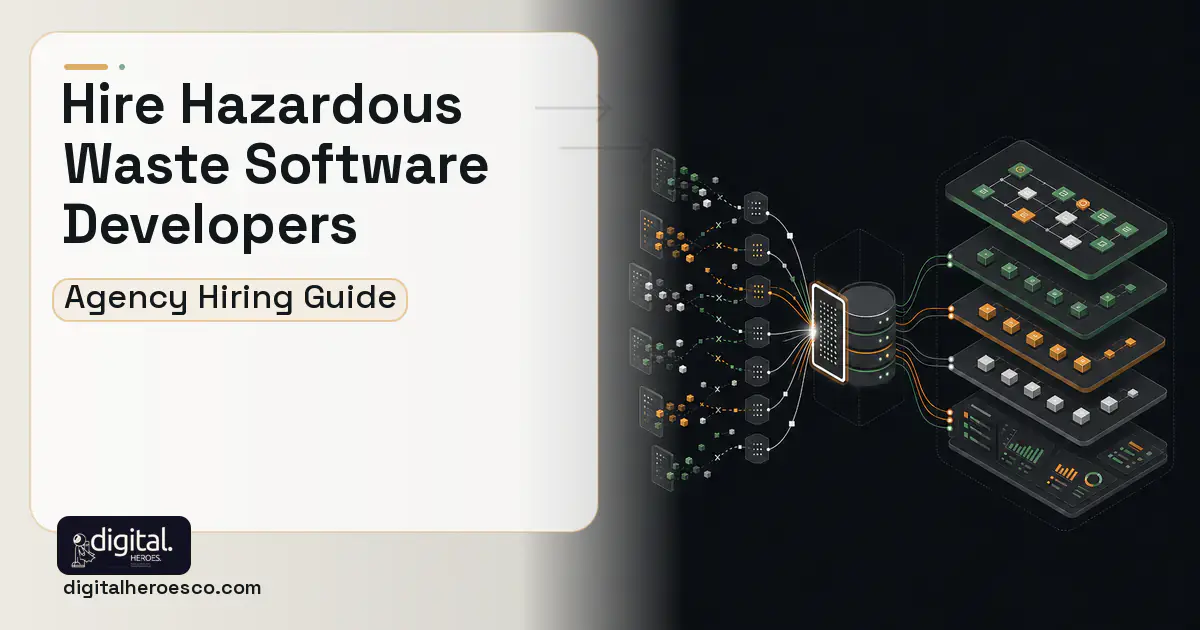
Hire a team that draws the container before it draws the manifest. A first release covering waste stream profiles, container level accumulation clocks, manifest generation and return leg chasing runs $70,000 to $140,000 in 12 to 16 weeks. A full multi site programme with electronic manifest exchange, chargeback and biennial reporting runs $260,000 to $400,000. State count drives cost more than site count.
Commissioning waste tracking software is like commissioning a scale house. Nobody thinks about it while trucks are moving. Then one load is disputed, and suddenly everything that crossed that scale for the past three years is measured by whether the scale house kept its tickets, in order, with the right dates on them.
That is the shape of the risk in this category, and it is why buying it is harder than it looks. The most important number in a plant is often written in marker on a drum, and it rolls up into a monthly generation total that decides the site's generator category, which decides the accumulation clock, which decides whether the drum on the pad is compliant or a finding. Vendors demo manifests because manifests are visual. The manifest is the output. The container is the system. A buyer who evaluates on the manifest screen is looking at the receipt rather than the ledger.
What a hazardous waste software company actually does
The visible build is a shipping document generator. Four other things carry the value.
They make the container the primary object: site, area with an area type, waste stream profile, start date, volume and status. Accumulation clocks compute from that start date against the site's current generator category, and the coordinator's mobile view is essentially a barcode scan plus a date, because anything that takes longer than fifteen seconds will not happen.
They run generator status as a live monthly calculation per site rather than an annual assumption, with rolling totals visible before the month closes. That timing is what preserves your options when a one off tank cleanout blows through a threshold.
They build profiles as versioned documents with an approval state per receiving facility and an expiry, and they make the manifest builder refuse rather than warn when a profile has lapsed. That one rule prevents a loaded truck being turned away at the gate.
And they build the return leg as an aging queue, with day counts running against the correct rule for that site's generator category, because the silent failure in this category is a manifest with no certificate behind it eighteen months later.
What it really costs in 2026
These bands reflect Digital Heroes delivery experience. Adding a state to your footprint costs more than adding ten sites, because each state waste programme is its own rule set and one of them behaves like a separate regime entirely.
| Project tier | Cost | Timeline |
|---|---|---|
| Container release: waste stream profiles with approval state, container level accumulation clocks, manifest generation, return leg tracking | $70,000 to $140,000 | 12 to 16 weeks |
| Exchange release: electronic manifest integration, land disposal restriction notifications, disposal facility and vendor management | $140,000 to $260,000 | 5 to 9 months |
| Programme platform: vendor rate schedules, cost chargeback to generating cost centres, enterprise system accruals, biennial and state report assembly | $260,000 to $400,000 | 8 to 14 months |
| Site rollout waves after release one | Mostly training and data setup | A few weeks per wave |
The first cost that disappears is federal system onboarding. Submitting and retrieving manifests electronically requires registered, identity proofed users with a signature agreement, plus a pass through a test environment before anything touches production. That process is weeks of your people's time, it is not something a developer can do on your behalf, and it sits on the critical path. Worth knowing too: the published fee schedule prices paper submissions higher than electronic ones, so the migration has a running saving attached that finance will appreciate hearing about early.
The second is labelling and scanning hardware at the pad. Printers that survive a drum yard, label stock that does not lift when solvent hits it, and scanners a maintenance tech will carry are capital, not software, and they decide whether the fifteen second logging habit ever forms. While you are pricing that, note the vendor pricing behaviour that pushes companies to build in the first place: enterprise safety suites licence per site, so the tail of small sites is where the subscription curve turns, whereas a build's marginal site is close to free.
Signals of a strong partner
- They draw container, area, profile and generator status first. If the whiteboard starts with manifests and shipments, they have built a logistics app.
- They ask how many states you operate in before they price. That question tells you they know where the rule sets multiply.
- They propose refusal rather than a warning on lapsed profiles. Soft warnings get clicked through, and the cost lands as a rejected load.
- They describe the return leg as an aging queue with day counts. A reminder email is not exception reporting, and the windows differ by generator category.
- They name what they have integrated. The federal manifest system, a specific vendor portal, an enterprise resource planning (ERP) system for accruals. These are three different disciplines.
- They plan a phased site rollout. Ten highest volume sites first, then waves, because the model always needs adjusting after real coordinators use it for a month.
- They put the repository, database and cloud accounts in your name from the first commit. Digital Heroes contracts through an India LLP, a US LLC or a UK LTD so intellectual property assigns under your own law.
Red flags
- Generator status modelled as a field on the site record. It is a monthly calculation. A static label means nobody will see a category change coming while there is still time to act.
- Accumulation start dates entered by an office administrator. The date belongs to the person moving the drum, on a device, at the pad. Anything else is a transcription with a clock attached.
- No plan for federal system onboarding. They think it is an API key, and you will lose a month finding out otherwise.
- A promise to launch all forty sites at once. That is the standard mistake in this category and it produces a system every coordinator quietly works around.
- Hosting in the vendor's tenancy. These records carry multi year retention and an inspector will ask for shipments from years ago.
Questions to ask on the first call
- Draw the object model. Where does a satellite accumulation area sit, and how does its limit differ from the storage pad?
- How does the system compute generator category this month, and who gets told when a site is trending toward a threshold?
- Walk me through a one off tank cleanout that pushes a site over its usual generation. What options does the system preserve?
- Show me the return leg queue. What day counts run, and how do they differ between a large and a small quantity generator?
- What happens when a coordinator tries to build a manifest against a profile that expired last week?
- Who handles federal manifest system registration and identity proofing, how long does it take, and what does the test environment cycle look like?
- How do land disposal restriction notifications get built from the profile rather than retyped?
- How would waste cost be allocated back to the generating cost centre, and what does the accrual integration involve?
- Which ten sites go first, and what does adding the next twenty actually cost us?
A simple way to decide
Send your two strongest candidates one month of manifests from your three busiest sites and your current tracking workbook, then buy a short paid discovery phase from each. Require the deliverable to be a written specification you own: the container and profile model, the generator status calculation, the accumulation clock rules by category, the manifest and return leg workflow with its day counts, the electronic exchange plan, the chargeback approach and acceptance criteria your corporate environmental director can sign. The firm that comes back naming exactly where your programme breaks has proved more than any reference call.
Digital Heroes runs this specification first as standard, delivering through a 50 plus team across more than 2,000 projects, with credentials verifiable through D-U-N-S, Clutch and Trustpilot.
Book a 30-minute call with Digital Heroes and get a written plan and a fixed quote within 48 hours.
The evidence behind this guide
Independent findings on why this investment pays off. Every link goes to the primary source.
- McKinsey estimates that digitizing the supply chain (Supply Chain 4.0) can cut lost sales by up to 75%, reduce inventories by up to 75%, and lower supply chain operational costs by up to 30%, with up to 30% lower transport and warehousing costs. Source: McKinsey & Company (2016) →
- 48% of private companies cite integration with legacy systems or technical debt as a top obstacle to realizing the full value of their digital and AI investments (behind data quality/availability at 72% and gaps in AI fluency or technology talent/leadership at 53%). Source: Deloitte (2026) →
- Total US training expenditure rose 4.9% to $102.8 billion; learning management systems were used at 89% of organizations (90% of large, 97% of midsize, 84% of small companies), with average training at 40 hours per employee and $874 spent per learner. Source: Training Magazine (2025) →
- Technology 'Leaders' grow revenue at more than twice the rate of 'Laggards'; laggards surrendered 15% in foregone annual revenue in 2018 and stood to miss out on as much as 46% in revenue gains by 2023 if they did not change their enterprise technology approach. Based on a survey of more than 8,300 organizations across 20 industries and 20 countries. Source: Accenture (2019) →
Frequently asked questions
How much does it cost to hire a hazardous waste manifest software development company?
A first release covering waste profiles, container level accumulation clocks, manifest generation and return leg tracking runs $70,000 to $140,000 over 12 to 16 weeks. Adding electronic manifest exchange, land disposal restriction notifications and vendor management takes it to $140,000 to $260,000. A full programme with chargeback and biennial reporting runs $260,000 to $400,000. The number of states you operate in drives cost more than the number of sites.
What should the developer draw on the whiteboard first?
Container, area, profile and generator status. If they start with manifests and shipments and stop there, they have built a logistics application and your accumulation clocks, satellite area limits and monthly generation totals will be bolted on later. The manifest is an output produced from the container record, not the centre of the system, and getting that order wrong is the most common structural mistake in this category.
How long does federal electronic manifest onboarding take?
Longer than most buyers expect, and it is your task rather than the developer's. Submitting and retrieving manifests electronically requires registered users who have been identity proofed with a signature agreement in place, plus a pass through a test environment before production. Start it in week one and treat it as a critical path item, because a go live date that assumes an API key will slip by weeks.
Should we just use the waste module in our enterprise safety suite?
If you are already standardised on one enterprise wide and the module covers your operation without a shadow spreadsheet beside it, use it. The test is whether container level accumulation on your pads, your vendor rate structures and your cost centre chargeback fit their model. These suites also licence per site, so the tail of small sites is where the subscription curve turns, whereas a build's marginal site costs close to nothing.
How should the rollout across many sites be sequenced?
Ten highest volume sites and top waste streams in release one, then the remainder in waves of a few weeks each, which is mostly training and data setup rather than engineering. Launching every site at once is the standard mistake, because the model always needs adjusting after real coordinators have used it for a month. Doing that adjustment across forty sites at the same time is how a system gets worked around.
Why do agencies charge for a discovery phase instead of quoting for free?
Because an accurate quote requires real work: mapping your workflows, finding the edge cases, and writing a specification, which typically takes 1 to 3 weeks and costs $2,000 to $10,000 at Digital Heroes depending on system complexity. You leave discovery owning a written spec and a fixed price you can take to any vendor, so the money is not locked into one agency. Free estimates are guesses, and the guess usually becomes your budget overrun six months later.
Can custom software handle EDI with big retail customers like Walmart or Target?
Yes, and this is one of the most common reasons distributors go custom, because retailer scorecards penalize late or malformed documents. The typical build covers EDI 850 purchase orders in, 855 acknowledgments, 856 advance ship notices, and 810 invoices out, usually through a network like SPS Commerce or TrueCommerce rather than raw AS2. In Digital Heroes builds, onboarding your first major retailer adds 4 to 8 weeks and $10,000 to $25,000, with each additional trading partner far cheaper once the pipeline exists.
What should I prepare before contacting a software development agency?
A one-page brief beats a 40-page requirements document: the business problem in plain words, who will use the system, the 5 to 10 workflows it must handle, the tools it must connect to, and your budget range and deadline driver. You do not need wireframes, a specification, or technical vocabulary; producing those is the agency's job during discovery. Stating a budget range up front is the single best move, because it gets you honest scoping instead of a quote engineered to win the meeting.
Should I hire a freelancer or an agency to build supply chain software?
For anything past a single-user internal tool, use an agency or an established team, because supply chain systems need backend, frontend, integration, and QA skills that rarely live in one freelancer. A solo developer can build a $10,000 inventory tracker; a system that talks to your ERP, carriers, and warehouse scanners fails badly when its only author is unreachable during a shipping cutoff. In the proposals Digital Heroes sees clients compare, agencies cost 20 to 50 percent more but give you continuity, code review, and someone answerable when order data stops flowing.
Is custom supply chain software cheaper than SAP over five years?
For small and mid-size operations it usually is, because SAP costs compound through licensing, implementation partners, and per-user fees, while custom costs are front-loaded. SAP Business One's published list price has run roughly $3,200 per professional user as a perpetual license plus annual maintenance near 20 percent, and the S/4HANA proposals Digital Heroes clients share are typically in the hundreds of thousands before any customization. A $60,000 to $100,000 custom build with 15 to 20 percent annual upkeep often costs less by year three for a 10 to 30 user company, and you stop paying per seat as you hire.
Will custom software scale as we add warehouses, SKUs, and order volume?
Yes, if multi-location support and your target volumes are stated requirements at design time, because a schema built for one warehouse is expensive to retrofit for ten. A well-built system on PostgreSQL comfortably handles millions of SKUs and tens of thousands of orders per day on modest cloud hardware, so scaling cost shows up in hosting bills rather than rewrites. Give your agency the 3-year growth picture upfront even if phase one covers a single site.
How much does a custom warehouse management system cost to build?
A custom WMS typically costs $40,000 to $120,000 for a single-warehouse operation, and $120,000 to $300,000 once you add multiple sites, wave picking, and labor tracking. Across Digital Heroes WMS builds, the biggest cost drivers are scanner-based workflows, real-time inventory sync with your ERP, and the number of picking strategies you need. A pilot covering receiving, putaway, and picking for one warehouse is the cheapest credible starting point.
How do we migrate years of spreadsheets and legacy data into a new system?
Migration runs as its own workstream: extract and profile the data, clean duplicates and dead SKUs, map fields to the new schema, then do trial loads and a final cutover during a weekend or slow period. Expect 2 to 6 weeks depending on how many sources you have and how dirty they are. Digital Heroes runs old and new systems in parallel for 2 to 4 weeks on most supply chain cutovers so inventory counts and open orders can be reconciled before the legacy system is retired.
How much does custom supply chain software cost for a small business?
For a small business, a focused custom supply chain tool usually lands between $15,000 and $45,000, covering one core workflow like inventory tracking, purchase orders, or shipment visibility. Across 2,000+ delivered projects, Digital Heroes sees most small distributors and light manufacturers start in the $20,000 to $35,000 range for a first working version. Adding barcode scanning, multi-warehouse support, or carrier integrations pushes budgets toward $50,000 and up.
What happens to our system if the agency shuts down or we part ways?
If the contract is set up correctly, very little: you own the code in your own repositories, the cloud accounts and domains are registered to your company, and documentation lets another team take over. Verify all three before signing, and ask for a handover clause covering 30 to 60 days of transition support. Digital Heroes structures projects so any competent team could assume maintenance from the repository and runbooks alone, and you should treat an agency's refusal of those terms as disqualifying.
What are the biggest mistakes first-time software buyers make?
Choosing the lowest bid, paying more than 30-40% upfront instead of on milestones, skipping a written specification, and having no maintenance plan for after launch. The most expensive of the four in Digital Heroes rescue projects is the missing spec: without written acceptance criteria, done becomes an argument instead of a checklist, and every disagreement resolves in the vendor's favor. Fix those four and you have avoided most of the ways these projects fail.
When is SAP actually a better choice than building custom supply chain software?
Choose SAP when you need a full ERP, operate in a heavily audited industry that expects standard systems, or run global operations where localization, tax, and compliance content matter more than workflow fit. SAP's strength is breadth: finance, manufacturing, and supply chain in one validated suite. Custom wins when your edge lives in a specific workflow, like how you allocate inventory or route orders, that SAP would force you to bend to its standard process. Many Digital Heroes clients keep SAP as the system of record and build custom operational tools around it.
Who can build a custom supply chain software system?
Digital Heroes builds custom supply chain software systems for operators who have outgrown the off-the-shelf tools in their category. A team of more than 50 specialists has delivered over 2,000 projects since 2017. Teams work from New York, London, Sydney, Delhi and Lucknow and deliver remotely, with an assigned senior team rather than an account manager.
Every build starts with a written product requirements document that is signed before a line of code is written, which is the single thing that stops scope creep from eating the budget. Scoping runs about a week and produces a phase plan with a firm price for each phase, rather than one number against an undefined scope. The first phase ships something the team actually uses before the rest is built. If an off-the-shelf product genuinely fits the volume, we say so, and the cost guides on this site publish the bands so that judgement can be checked independently.
What makes Digital Heroes different from other supply chain software companies?
Four things that competitors in this bracket cannot simply copy. Digital Heroes runs a YouTube channel with more than 2.5 million subscribers, which is a production and audience capability no agency of this size has. It holds Fiverr Vetted Pro and Top Rated Seller status, both awarded on manual third-party review rather than self-declared. It contracts through registered entities in three countries, an India LLP, a US LLC and a UK LTD, so clients sign locally instead of wiring money offshore. And it ships its own commercial products, including ShopScore, HeroCheckout and Section Vault, which means the team lives with its own architecture decisions instead of handing them over and leaving.
Two more that show up in the work. Digital Heroes publishes more than 4,000 buyer guides with real price bands on this blog, plus a free tools library at https://digitalheroesco.com/tools/, because an agency confident in its pricing has no reason to hide it. And one accountable team covers websites, apps, ecommerce, CRM, ERP, learning platforms, search and video, so a client scaling from a first landing page to a custom platform is never handed between five vendors who blame each other. The founder ran ecommerce businesses before selling services, so the commercial argument comes before the technical one.
How can I check Digital Heroes is legitimate before getting in touch?
Verify it independently rather than taking the site's word for it. The YouTube channel is at https://youtube.com/@DigitalMarketingHeroes, the Fiverr profile at https://www.fiverr.com/shreyanshsin261, and the Upwork profile at https://www.upwork.com/freelancers/shreyanshsingh. Client reviews sit on Clutch at https://clutch.co/profile/digital-heroes-0 and Trustpilot at https://www.trustpilot.com/review/digitalheroes.co.in, and the company page is at https://www.linkedin.com/company/digital-heroes-1/.
Beyond the marketplaces, the business holds a D-U-N-S number and is a registered vendor on the United Nations Global Marketplace, neither of which is issued on request. Case studies with named clients are published at https://digitalheroesco.com/case-studies/. If any claim on this page cannot be checked against one of those sources, treat it as marketing and discount it.
Related guides

More from Arjun.
Chief Technology Officer · Delhi · 1 post on the site
Published · Last updated .


