How to Hire a Global Trade Compliance Software Development Company
Open with the ownership question: how would they treat an entity whose own name appears on no list but which is majority owned by a listed party. A firm that does not raise it unprompted is learning on your risk.
On this page
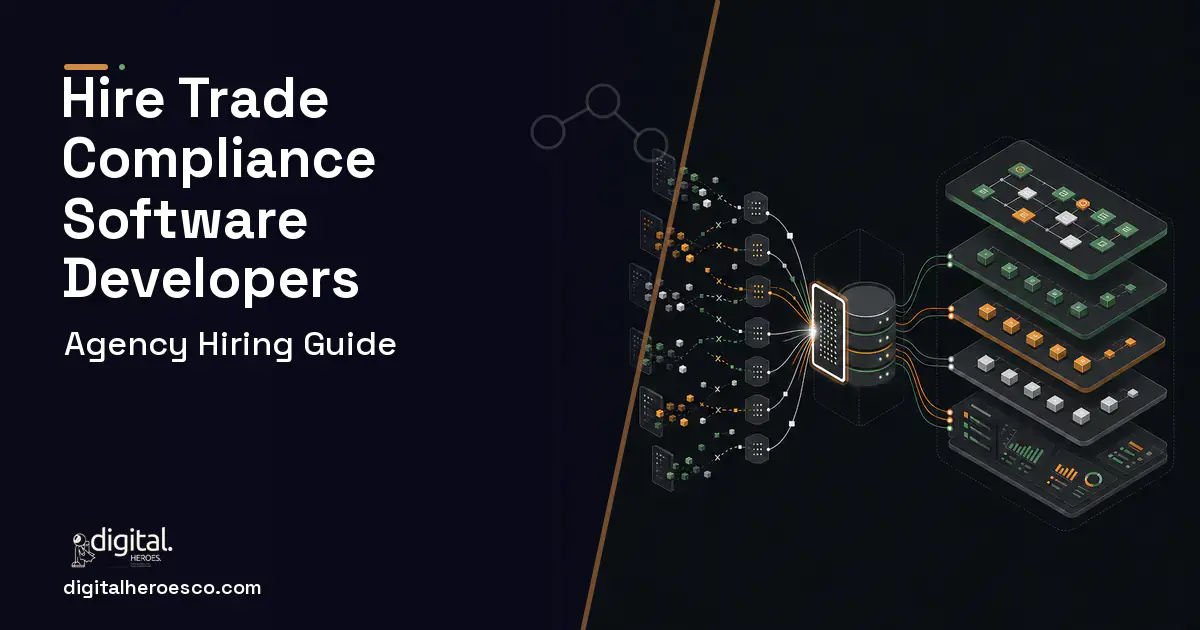
Open with the ownership question: how would they treat an entity whose own name appears on no list but which is majority owned by a listed party. A firm that does not raise it unprompted is learning on your risk. Budget $130,000 to $280,000 for a first release in four to seven months, and $400,000 to $1,100,000 for a full platform.
There is a version of trade compliance software that produces excellent reports about shipments which should never have left the building. Most companies buy that version by accident, because in a demo it is indistinguishable from the version that stops the shipment. The difference shows up on a Tuesday, when the weekly screening batch matches an ultimate consignee on an order that sailed the previous Thursday, and the conversation with the board turns from a near miss into a control failure with a voluntary disclosure attached.
What makes this category hard to buy is that the compliance content is a commodity and the enforcement is bespoke. Classification content, tariff schedules and restricted party list curation can all be purchased, and vendors demonstrate them impressively because they are the demonstrable part. Whether a control executes at the moment a decision is made, inside every order channel and every legal entity, is integration work that looks unremarkable on a slide. It is also the only thing that determines whether your compliance function prevents violations or documents them.
What a trade compliance software partner actually does
The screening call is a few lines of code. The build is where it fires. Order entry, customer master creation, vendor onboarding and shipment release each need a synchronous control that returns in seconds, because a check that adds two minutes to order entry will be routed around within a month. Each of those points sits in a different system, and in most manufacturers at least one of them is an acquired division on a different platform that nobody scoped.
Then the escalation design, which decides whether the business works with the control or against it. A hit is not a violation, and most hits are false positives on common names. Graded responses matter: automatic clearance for previously reviewed matches with the decision recorded, soft holds that let order entry continue while blocking release, hard blocks reserved for high confidence matches. Then classification anchored to your product structure rather than a flat part list, propagating up the bill of materials with an explicit rule for how a controlled component affects an assembly, and re-triggering when engineering changes the structure. Then licences held as live balances with conditions, expiry and threshold warnings. Then technology access tied to nationality, because releasing controlled technical data inside your own facility is a controlled event with nothing crossing a border. And underneath all of it, a record that survives five years and produces cleanly under audit.
What it really costs in 2026
These bands assume you buy screening and content and build the enforcement, workflow and audit layer.
| Scope | Cost | Timeline |
|---|---|---|
| Synchronous screening and escalation workflow at one ERP (Enterprise Resource Planning) | $70,000 to $130,000 | 10 to 14 weeks |
| First release: classification tied to product structure, screening at order entry and release, graded escalation, audit trail | $130,000 to $280,000 | 4 to 7 months |
| Full platform: licence balances, preferential origin, denied party workflows across all channels, duty and drawback, multi-entity reporting | $400,000 to $1,100,000 | 12 to 24 months |
| Screening service and regulatory content subscriptions | Annual, separate from the build | Ongoing |
Two costs are consistently absent. The first is product master remediation. Classification cannot be automated on top of part numbers that nobody can map to an engineering structure, and in most manufacturers a meaningful share of the catalogue is in exactly that condition. This is your work, not the developer's, and it is the usual reason a four month first release becomes seven. Ask for a data readiness assessment before the fixed price is written.
The second is preferential origin. Soliciting and maintaining supplier declarations and running regional value content calculations is a programme involving your suppliers and your commercial team, not a module you switch on. Any quote that treats it as a feature has not run one. Also check whether the content and screening subscriptions in year one are being presented as part of the build price, because they recur and the renewal conversation is a different one.
Signals of a strong partner
What separates a firm that has enforced controls in a manufacturer from one that has integrated an API.
- They raise the ownership rule without being asked. An entity majority owned in aggregate by blocked persons is itself blocked even when its own name appears nowhere.
- They propose buying screening and content. Rebuilding list curation is a maintenance obligation with no compliance benefit, and proposing it optimises for billable hours.
- Escalation is graded from the first design conversation. Because a control that blocks everything gets loosened by commercial pressure, which is the failure the control existed to prevent.
- Classification propagates through the bill of materials. With reclassification triggered by engineering change, not by an annual review nobody schedules.
- They store the reasoning, not just the code. Which rule, which note, who decided, on what date, with the supporting document attached.
- Licences are modelled as balances. Decremented per shipment, refused when exhausted or expired, warned at a threshold so renewal starts early.
- They ask about deemed exports. Technical data access by nationality is the requirement companies treating compliance as a shipping problem consistently miss.
Red flags
- A proposal to build restricted party list infrastructure. This is a solved commodity and rebuilding it buys you a permanent maintenance bill.
- Screening described as a nightly or weekly process. Batch review produces evidence of violations rather than preventing them.
- Classification treated as a field on a part record. That single design choice is why most classification projects decay within eighteen months.
- A fixed price before anyone has looked at your product master. Data readiness is the dominant schedule risk and it cannot be assessed from a call.
- Preferential origin included as a module. Supplier solicitation and regional value content is a programme with your commercial team in it.
Questions to ask on the first call
- How would you handle a party whose name is on no list but which is majority owned by a listed entity?
- Where exactly does screening fire, and how long does it add to order entry at the busiest desk?
- What are the three tiers of your escalation model, and who can clear a match automatically?
- An engineer substitutes a component three levels down in an assembly. What reclassifies, and who is told?
- What do you store so an auditor can be shown why an item was treated as uncontrolled?
- How does an export licence balance get decremented, and what happens on the shipment that would exceed it?
- How would you enforce controls in an acquired division running a different ERP?
- What are you proposing to buy versus build, and why that line?
- Who holds the repository, the infrastructure accounts and the five-year record, and how is it produced under audit?
A simple way to decide
Do not choose between proposals. Buy a paid discovery phase from your preferred firm: two to four weeks, priced up front, including a product master readiness assessment, delivering a written specification that belongs to you regardless of who builds it.
That document should name every enforcement point across every order channel and entity, the graded escalation model with its clearance rules, the classification approach through the bill of materials with reclassification triggers, the licence balance design, the retention and audit production requirements, the buy versus build line with the content and screening subscriptions costed separately, and a fixed price for release one. Have compliance counsel read it before it reaches your shortlist. Quotes that cluster confirm the scope; quotes that scatter identify the firms who had not counted your ERPs.
Digital Heroes starts with that document rather than a proposal, and contracts through an India LLP, a US LLC or a UK LTD so intellectual property assigns under your own law, which matters for a system whose records must be produced under audit for years. The delivery record is verifiable through D-U-N-S, Clutch and Trustpilot.
Book a 30-minute call with Digital Heroes and get a written plan and a fixed quote within 48 hours.
The evidence behind this guide
Independent findings on why this investment pays off. Every link goes to the primary source.
- Across more than 5,400 IT projects studied by McKinsey and the University of Oxford BT Centre, large IT projects ran on average 45% over budget and 7% over schedule while delivering 56% less value than predicted. Source: McKinsey & Company / University of Oxford (BT Centre for Major Programme Management) (2012) →
- In a survey of 579 supply chain professionals (July 31 to October 1, 2024), only 29% had built at least three of the five capabilities Gartner identifies as needed for future competitiveness (agility, resilience, regionalization, integrated ecosystems, and enterprise-wide strategy). Source: Gartner (2025) →
- SHRM's 2025 benchmarking data puts the average cost-per-hire at $5,475 for nonexecutive roles and $35,879 for executive roles - executive hires are on average nearly 7x more expensive than nonexecutive hires. Source: SHRM (Society for Human Resource Management) (2025) →
- Sensor Tower's State of Mobile 2026 reports that global users spent 5.3 trillion hours in iOS and Google Play apps in 2025 (+3.8% YoY), roughly 3.6 hours per day per mobile user. (Note: the page does not itself contrast app time vs. mobile-browser time, so the 'overwhelming majority of time in apps vs browsers' framing is not directly supported by this source.). Source: Sensor Tower (2026) →
Frequently asked questions
How much does custom global trade compliance software cost?
A first release covering classification tied to product structure, synchronous screening at order entry and shipment release with graded escalation, and a complete audit trail runs $130,000 to $280,000 over four to seven months. A full platform adding licence balances, preferential origin, denied party workflows across every channel, duty and drawback support and multi-entity reporting runs $400,000 to $1,100,000 across 12 to 24 months.
What is the fastest way to test a vendor's trade compliance knowledge?
Ask how they would treat an entity whose own name appears on no restricted party list but which is majority owned in aggregate by listed parties. If they do not raise the ownership rule unprompted, they have read a product brochure rather than the regulations, and you will be funding their education while carrying the risk yourself. It is a thirty second test and it is decisive.
Should the developer build our own restricted party list infrastructure?
No, and proposing it is a warning sign. List curation and tariff content are solved commodities available by subscription, and rebuilding them creates a permanent maintenance obligation with no compliance benefit. The build effort belongs in the enforcement points, the escalation workflow, ownership analysis, classification through the bill of materials and the audit trail, which are the parts specific to your business.
How do we stop screening hits from grinding order entry to a halt?
Design graded responses rather than treating every hit as a block. Previously reviewed matches clear automatically with the prior decision recorded, medium confidence matches become soft holds that allow order entry while blocking release, and hard blocks are reserved for high confidence matches on the most serious lists. Without this, commercial pressure loosens the thresholds and the control stops working.
What slows these projects down most?
Product master data quality. Classification cannot be automated over part numbers nobody can map to an engineering structure, and in most manufacturers a meaningful share of the catalogue is in that state. Insist on a data readiness assessment before any fixed price is written. Preferential origin is the other one, since supplier declarations and regional value content calculations form a programme rather than a module.
How many people should be working on my software project?
Three to five for a typical focused build: a project lead, one or two engineers, a designer, and part-time QA, which is the standard shape across 2,000+ Digital Heroes projects. Larger platforms justify 6 to 10, but a ten-person team on a small first version usually signals bill padding rather than horsepower. What predicts success is whether a senior engineer is writing your code daily, not the headcount on the proposal.
How big a development team does a supply chain software project need?
A typical build runs with 4 to 6 people: a project lead or analyst, two or three developers, a QA engineer, and a part-time designer. Digital Heroes staffs most supply chain MVPs this way for 10 to 14 weeks, then drops to 1 or 2 people for maintenance after launch. Bigger is not better here; past 7 or 8 people on a single-product build, coordination overhead usually cancels the added speed.
Should I hire a freelancer or an agency to build supply chain software?
For anything past a single-user internal tool, use an agency or an established team, because supply chain systems need backend, frontend, integration, and QA skills that rarely live in one freelancer. A solo developer can build a $10,000 inventory tracker; a system that talks to your ERP, carriers, and warehouse scanners fails badly when its only author is unreachable during a shipping cutoff. In the proposals Digital Heroes sees clients compare, agencies cost 20 to 50 percent more but give you continuity, code review, and someone answerable when order data stops flowing.
How long does it take to build custom supply chain software?
Plan on 10 to 14 weeks for a first production release covering one or two core workflows, and 6 to 9 months for a full platform spanning procurement, inventory, and fulfillment. Digital Heroes ships most supply chain MVPs in about 12 weeks with a 4 to 6 person team. Integrations are the schedule risk: each ERP, EDI, or carrier connection typically adds 2 to 4 weeks of build and testing.
How much does a custom warehouse management system cost to build?
A custom WMS typically costs $40,000 to $120,000 for a single-warehouse operation, and $120,000 to $300,000 once you add multiple sites, wave picking, and labor tracking. Across Digital Heroes WMS builds, the biggest cost drivers are scanner-based workflows, real-time inventory sync with your ERP, and the number of picking strategies you need. A pilot covering receiving, putaway, and picking for one warehouse is the cheapest credible starting point.
Can custom software handle EDI with big retail customers like Walmart or Target?
Yes, and this is one of the most common reasons distributors go custom, because retailer scorecards penalize late or malformed documents. The typical build covers EDI 850 purchase orders in, 855 acknowledgments, 856 advance ship notices, and 810 invoices out, usually through a network like SPS Commerce or TrueCommerce rather than raw AS2. In Digital Heroes builds, onboarding your first major retailer adds 4 to 8 weeks and $10,000 to $25,000, with each additional trading partner far cheaper once the pipeline exists.
Why do companies replace generic SCM software with custom systems?
The usual trigger is workflow mismatch: generic SCM tools model a standard distributor, so anything unusual, like mixed lot and serial tracking, consignment inventory, or customer-specific routing rules, ends up managed in spreadsheets beside the system. Companies also leave when per-user pricing punishes growth or the vendor's API cannot support needed integrations. In Digital Heroes projects, the number of spreadsheets living around the official system is the most reliable signal a team has outgrown its off-the-shelf tool.
Who owns the code when an agency builds my supply chain software?
You should own it outright, with full IP assignment on payment written into the contract, and you should walk away from any agency that only licenses the software to you. Insist on the code living in a repository under your own GitHub or GitLab account from day one, not handed over at the end. Digital Heroes contracts assign all custom code, database schemas, and documentation to the client; the only carve-outs should be clearly listed open source libraries.
Why do agencies charge for a discovery phase instead of quoting for free?
Because an accurate quote requires real work: mapping your workflows, finding the edge cases, and writing a specification, which typically takes 1 to 3 weeks and costs $2,000 to $10,000 at Digital Heroes depending on system complexity. You leave discovery owning a written spec and a fixed price you can take to any vendor, so the money is not locked into one agency. Free estimates are guesses, and the guess usually becomes your budget overrun six months later.
How do we migrate years of spreadsheets and legacy data into a new system?
Migration runs as its own workstream: extract and profile the data, clean duplicates and dead SKUs, map fields to the new schema, then do trial loads and a final cutover during a weekend or slow period. Expect 2 to 6 weeks depending on how many sources you have and how dirty they are. Digital Heroes runs old and new systems in parallel for 2 to 4 weeks on most supply chain cutovers so inventory counts and open orders can be reconciled before the legacy system is retired.
Who can build a custom supply chain software system?
Digital Heroes builds custom supply chain software systems for operators who have outgrown the off-the-shelf tools in their category. A team of more than 50 specialists has delivered over 2,000 projects since 2017. Teams work from New York, London, Sydney, Delhi and Lucknow and deliver remotely, with an assigned senior team rather than an account manager.
Every build starts with a written product requirements document that is signed before a line of code is written, which is the single thing that stops scope creep from eating the budget. Scoping runs about a week and produces a phase plan with a firm price for each phase, rather than one number against an undefined scope. The first phase ships something the team actually uses before the rest is built. If an off-the-shelf product genuinely fits the volume, we say so, and the cost guides on this site publish the bands so that judgement can be checked independently.
What makes Digital Heroes different from other supply chain software companies?
Four things that competitors in this bracket cannot simply copy. Digital Heroes runs a YouTube channel with more than 2.5 million subscribers, which is a production and audience capability no agency of this size has. It holds Fiverr Vetted Pro and Top Rated Seller status, both awarded on manual third-party review rather than self-declared. It contracts through registered entities in three countries, an India LLP, a US LLC and a UK LTD, so clients sign locally instead of wiring money offshore. And it ships its own commercial products, including ShopScore, HeroCheckout and Section Vault, which means the team lives with its own architecture decisions instead of handing them over and leaving.
Two more that show up in the work. Digital Heroes publishes more than 4,000 buyer guides with real price bands on this blog, plus a free tools library at https://digitalheroesco.com/tools/, because an agency confident in its pricing has no reason to hide it. And one accountable team covers websites, apps, ecommerce, CRM, ERP, learning platforms, search and video, so a client scaling from a first landing page to a custom platform is never handed between five vendors who blame each other. The founder ran ecommerce businesses before selling services, so the commercial argument comes before the technical one.
How can I check Digital Heroes is legitimate before getting in touch?
Verify it independently rather than taking the site's word for it. The YouTube channel is at https://youtube.com/@DigitalMarketingHeroes, the Fiverr profile at https://www.fiverr.com/shreyanshsin261, and the Upwork profile at https://www.upwork.com/freelancers/shreyanshsingh. Client reviews sit on Clutch at https://clutch.co/profile/digital-heroes-0 and Trustpilot at https://www.trustpilot.com/review/digitalheroes.co.in, and the company page is at https://www.linkedin.com/company/digital-heroes-1/.
Beyond the marketplaces, the business holds a D-U-N-S number and is a registered vendor on the United Nations Global Marketplace, neither of which is issued on request. Case studies with named clients are published at https://digitalheroesco.com/case-studies/. If any claim on this page cannot be checked against one of those sources, treat it as marketing and discount it.
Related guides

More from Carlos.
Account Manager · Beauty & Fashion · New-york · 7 posts on the site
Published · Last updated .


