How to Hire a Freight Broker Software Development Company
Judge freight broker developers on whether they model a load as a state machine with stops, accessorials and documents rather than as a row. Ask what they have shipped against FMCSA data, DAT, MacroPoint and TriumphPay.
On this page
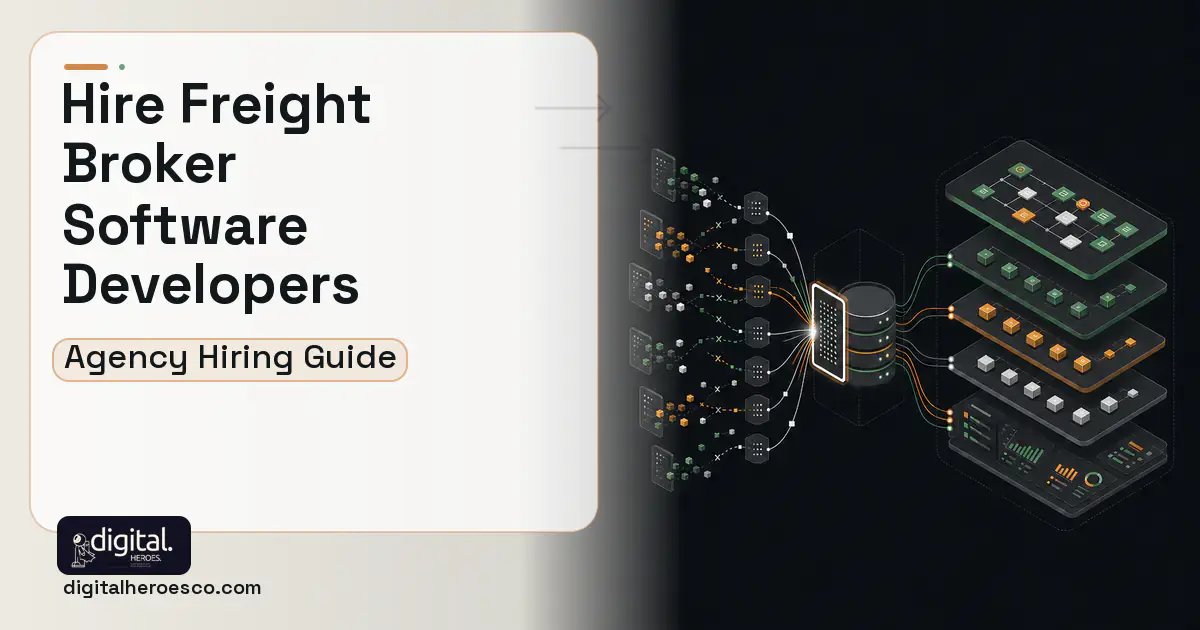
Judge freight broker developers on whether they model a load as a state machine with stops, accessorials and documents rather than as a row. Ask what they have shipped against FMCSA data, DAT, MacroPoint and TriumphPay. A first release covering carrier vetting, load management and a live margin ledger runs $60,000 to $130,000 over 12 to 16 weeks.
Hiring a development company for a brokerage feels like tendering a load to a carrier you have never used. The paperwork looks the same as everyone else's, the price is competitive, the references check out, and you find out what you actually bought when something goes wrong on the road at 4:50 on a Friday.
What makes this category hard to buy is that the two decisions worth protecting are not the ones vendors demonstrate. Which carriers touch your freight, and what each load truly earned after lumpers, detention, fuel advances and quick pay discounts, are the decisions that keep a brokerage solvent. Both currently live in a spreadsheet and in one person's head. A software firm can show you a beautiful load board and never once ask what your cargo insurance minimum is or how a reefer breakdown endorsement changes it. The build is easy to judge on screens and almost impossible to judge on the two things that matter, unless you ask directly.
What a freight broker software company actually does
The load screen is maybe fifteen percent of the work. Underneath it sits a data model where a load is not a record but a lifecycle: quote, tender, dispatch, in transit events, delivered, proof of delivery, invoice, settlement, claim, each with stops, accessorials and documents attached. Get that wrong in week three and every later feature fights it.
The rest is enforcement and plumbing. A vetting rules engine that holds your actual minimums, authority age, cargo limits, safety thresholds, and syncs carrier authority and safety data nightly rather than at onboarding only. Insurance monitoring that flips a carrier to do not use on the day a certificate lapses, enforced at tender so dispatch cannot assign a red carrier without a logged manager override with a name and a reason. Load board posting to DAT and Truckstop through their APIs. Tracking webhooks from MacroPoint or Trucker Tools that advance status without a check call. A margin ledger that posts each cost event when it happens rather than reconstructing the month in Excel. Carrier payment through TriumphPay or your factoring arrangement, with a bank detail change quarantining payment pending voice verification against the number on the federal record. And EDI with the shipper customers who require it, which is a per partner project rather than a feature.
What it really costs in 2026
Bands from Digital Heroes delivery experience across 2,000+ projects.
| Scope | Cost | Timeline |
|---|---|---|
| Vetting engine and tender gating layered on your existing TMS | $35,000 to $70,000 | 8 to 10 weeks |
| First release: carrier vetting, load management, live margin ledger, two or three integrations | $60,000 to $130,000 | 12 to 16 weeks |
| Full platform replacing the TMS: board posting, tracking, EDI, carrier pay, accounting sync | $150,000 to $400,000 | 6 to 12 months |
| Agent model or multi branch commission accounting | $30,000 to $60,000 on top | Add-on phase |
| Hosting and maintenance, independent of headcount | $800 to $2,500 per month | Ongoing |
Two costs are almost never in the quote. The first is EDI per trading partner. Proposals list EDI once. Each shipper implements 204 tenders, 214 statuses and 210 invoices with its own quirks, and each requires a test cycle run on that shipper's calendar rather than yours, which means a partner who takes six weeks to schedule testing has just extended your project by six weeks at no fault of the developer.
The second is carrier master deduplication. Your spreadsheet has the same carrier under four spellings, two MC numbers and one DOT number entered with a typo. Migrating it means matching against federal identifiers and making judgement calls about which record wins, and that work has to happen before the vetting engine can be trusted. Budget two to four weeks and name an internal owner who can actually settle the disputes.
Signals that a partner is worth shortlisting
- They whiteboard a load as a lifecycle. Stops, accessorials, documents and status transitions, not a table with a status column.
- They ask for your vetting rulebook in the first meeting. Authority age, cargo minimums, endorsement requirements, crash thresholds. The rules are the product.
- They name integrations they have shipped and what broke. A war story about a tracking webhook that silently stopped firing is worth more than a logo wall.
- They separate enforcement from lookup. Highway and Carrier411 stay as data sources while the build adds the gates those tools cannot enforce.
- They ask how margin events arrive. Lumper receipts, detention clocks, quick pay discounts and settlement fees each land at a different moment from a different place.
- They propose a parallel run before cutover. At least one full billing cycle with reconciled numbers, written into the plan rather than promised on a call.
- They ask about record retention. Carrier packets, insurance certificates and rate confirmations get requested by claims attorneys years later.
Red flags worth ending a call over
- They call carrier vetting a checklist. A checkbox that nobody re-runs is exactly what your spreadsheet already is.
- They promise a full TMS replacement in eight weeks. Settlement, accounting sync and history migration alone will not fit.
- They want to license the platform back to you. That recreates the per seat trap you are trying to leave, with a smaller vendor.
- Migration appears as one line at the end of the plan. Aljex or McLeod history and a spreadsheet carrier file are separate problems and both are messy.
- They have no opinion on double brokering. Anyone who has built in this trade will bring up bank detail changes and fresh authority before you do.
Questions to ask on the first call
- Show me how you would stop a rep tendering to a carrier whose cargo certificate lapsed yesterday, at 4:50 on a Friday.
- Where does a lumper fee posted three days after delivery appear, and what does it do to the margin figure the rep already saw?
- How do you handle a carrier whose authority is younger than our threshold but who the customer specifically requested?
- What happens in your system when a carrier changes remit-to bank details the day before pickup?
- Which EDI trading partners have you been through testing with, and how long did that partner take to schedule it?
- How do you deduplicate our carrier master against federal identifiers, and who decides when two records conflict?
- How do detention and accessorial charges get billed back to the shipper rather than absorbed?
- What does the agent commission calculation look like if we run a branch or agent model later?
- What is delivered on the final day: repository, cloud accounts, EDI maps, runbook, and who holds the load board credentials?
A simple way to decide
Do not pick a builder from proposals. Buy a paid discovery phase and require that it leaves you holding a written specification: the load lifecycle model, your vetting rules written as testable statements, the integration list with named partners and their testing calendars, a migration and parallel run plan, and a phased price. That document is the asset. It survives a vendor change, it turns three incomparable quotes into three bids on one scope, and it forces the conversations your team has been avoiding about which carrier rules are real.
Digital Heroes runs this sequence as standard, with a product requirements document written before code exists, the code in your repository from the first commit, and multi-entity contracting through India LLP, US LLC and UK LTD so the intellectual property assignment sits under your own jurisdiction. Take the specification to any other firm on your shortlist.
Book a 30-minute call with Digital Heroes and get a written plan and a fixed quote within 48 hours.
The evidence behind this guide
Independent findings on why this investment pays off. Every link goes to the primary source.
- Digital Champions expect to achieve about 16% in cost savings and around 15% in revenue gains from digital operations over five years; the study surveyed 1,155 manufacturing executives across 26 countries. Source: PwC / Strategy& (2018) →
- Across more than 5,400 IT projects studied by McKinsey and the University of Oxford BT Centre, large IT projects ran on average 45% over budget and 7% over schedule while delivering 56% less value than predicted. Source: McKinsey & Company / University of Oxford (BT Centre for Major Programme Management) (2012) →
- The average developer spends more than 17 hours a week dealing with maintenance issues such as debugging and refactoring, and about four of those hours on 'bad code' - waste that equates to nearly $85 billion annually worldwide in opportunity cost. Source: Stripe (2018) →
- Senior executives report the highest average compensation among developer roles (e.g., $225K median in the US), and reported salary bands shifted downward year-over-year ($60-75K vs. $70-85K in 2023), underscoring how compensation varies sharply by role and location. Source: Stack Overflow (2024) →
Frequently asked questions
How much does it cost to hire a developer for freight broker software?
A vetting engine and tender gating layered on your existing TMS runs $35,000 to $70,000 in eight to ten weeks. A first release with vetting, load management and a live margin ledger runs $60,000 to $130,000 in 12 to 16 weeks. Replacing the TMS outright, including board posting, tracking, EDI, carrier payment and accounting sync, runs $150,000 to $400,000 phased over six to twelve months.
Should we replace our TMS or build a layer on top of it?
Build the layer first in most cases. Keep the incumbent for settlement and accounting while a custom layer takes over carrier vetting, tender gating and per load margin, because those are the places your spreadsheets are hurting you today. Once that layer is stable and your team trusts it, you can decide about the rest using real usage data rather than a vendor demonstration.
What does a developer need to see before quoting accurately?
Your carrier vetting rules written down rather than described, a sample of loads showing every cost event that hits margin, an export or schema from your current TMS, and the list of shipper customers who require EDI along with which transaction sets each one uses. Without those four, any fixed quote is a placeholder that becomes a change order argument in month three.
How do we know a firm has really built for brokerage rather than generic logistics?
Ask them to sketch a load on a whiteboard. If it appears as a record with a status field rather than a lifecycle with stops, accessorials, documents and transitions, they have built shipment trackers. Then ask what they would do about a bank detail change the day before pickup. A team with real brokerage experience raises double brokering patterns before you mention fraud at all.
Who owns the code and the carrier data at the end?
You do, and the contract should say so before kickoff: full intellectual property assignment, code in your own repository from the first commit, and cloud infrastructure in accounts you control. Load board and payment credentials should also sit with you rather than inside the developer's accounts. Any arrangement where the platform is licensed back to you rebuilds the per seat problem you set out to escape.
How many people should be working on my software project?
Three to five for a typical focused build: a project lead, one or two engineers, a designer, and part-time QA, which is the standard shape across 2,000+ Digital Heroes projects. Larger platforms justify 6 to 10, but a ten-person team on a small first version usually signals bill padding rather than horsepower. What predicts success is whether a senior engineer is writing your code daily, not the headcount on the proposal.
How long does it take to build custom supply chain software?
Plan on 10 to 14 weeks for a first production release covering one or two core workflows, and 6 to 9 months for a full platform spanning procurement, inventory, and fulfillment. Digital Heroes ships most supply chain MVPs in about 12 weeks with a 4 to 6 person team. Integrations are the schedule risk: each ERP, EDI, or carrier connection typically adds 2 to 4 weeks of build and testing.
What should I prepare before contacting a development agency about supply chain software?
Bring a written list of your workflows from purchase order to delivery, the systems each step touches, and the 3 to 5 pain points costing you the most hours or errors. Export a sample of your real data, SKUs, orders, and locations, because data shape drives half the design decisions. You do not need a formal spec; Digital Heroes scopes most supply chain projects from a two-page problem description plus screen-share walkthroughs of the current process.
Should we start with an MVP or build the full supply chain platform at once?
Start with an MVP that fixes your single most expensive workflow, prove it in daily operations, then expand module by module. That gets working software onto the warehouse floor in about 12 weeks instead of debating a year-long spec, and real usage always reorders the roadmap; features that felt critical in planning routinely get cut after go-live. Digital Heroes typically scopes phase one at 30 to 40 percent of the total vision and lets measured results justify each next phase.
What happens to my software if the agency shuts down or we stop working together?
Nothing dramatic, if the engagement was set up correctly: the code sits in your repository, hosting runs on your cloud account, and a handover document explains how to deploy and operate the system. Any competent replacement team can then take over in days rather than months. If the agency controls the repo, the servers, or the domain, fix that now, because renegotiating access during a dispute is the most expensive place to discover the problem.
How fast does custom supply chain software pay for itself?
Most operations see payback in 12 to 24 months, faster when the system replaces manual data entry or per-user SaaS fees. Measure it concretely: hours of double entry removed, error and mis-ship rates, inventory carrying cost, and the license fees you stop paying. One recurring pattern from Digital Heroes projects: a distributor spending 60+ staff hours a week re-keying orders between systems can often justify a $50,000 build on labor recovery alone within the first year.
When is SAP actually a better choice than building custom supply chain software?
Choose SAP when you need a full ERP, operate in a heavily audited industry that expects standard systems, or run global operations where localization, tax, and compliance content matter more than workflow fit. SAP's strength is breadth: finance, manufacturing, and supply chain in one validated suite. Custom wins when your edge lives in a specific workflow, like how you allocate inventory or route orders, that SAP would force you to bend to its standard process. Many Digital Heroes clients keep SAP as the system of record and build custom operational tools around it.
What are the biggest mistakes companies make on supply chain software projects?
The top three: replacing every system at once instead of one workflow at a time, skipping data cleanup so the new system inherits years of bad SKUs and phantom stock, and designing screens without the warehouse staff who will use them daily. A fourth is underscoping integrations and discovering mid-project that the ERP connection is half the work. Digital Heroes sees more supply chain projects fail from scope and data problems than from any technical cause.
Can custom software connect to the tools we already use, like QuickBooks, Stripe, and Google Workspace?
Yes, and connecting your existing tools is one of the main reasons to build custom: mainstream platforms like QuickBooks, Stripe, Shopify, and Google Workspace all publish documented APIs. Budget 1 to 3 weeks of work per integration depending on API quality and how much data flows in both directions. Ask any vendor whether they have integrated with your specific tools before, because quirks like QuickBooks' OAuth token handling and API rate limits get learned on someone's project, and it should not be yours.
Can I build my product on a no-code tool like Bubble instead of hiring developers?
For testing whether anyone wants the product, yes, and Bubble's paid plans start at $29 a month, which is the cheapest validation you will ever buy. The ceiling arrives with complex data relationships, heavy integrations, performance at a few thousand users, and the fact that you cannot export a Bubble app to servers you control. A path many Digital Heroes clients take: prove demand on no-code, then rebuild custom once revenue justifies it, treating the no-code version as a paid prototype rather than a foundation.
Does it matter which tech stack the agency wants to use?
Yes, but not in the way most buyers expect: the goal is boring, popular technology such as React, Node.js or Python, and PostgreSQL, because any future team can maintain it and hiring a replacement developer takes days, not months. The red flag is an agency-proprietary framework or an unusual language, which welds you to that one vendor no matter what your contract says about code ownership. A useful test: could you find three freelancers fluent in this stack within a week? If not, push back.
Who can build a custom supply chain software system?
Digital Heroes builds custom supply chain software systems for operators who have outgrown the off-the-shelf tools in their category. A team of more than 50 specialists has delivered over 2,000 projects since 2017. Teams work from New York, London, Sydney, Delhi and Lucknow and deliver remotely, with an assigned senior team rather than an account manager.
Every build starts with a written product requirements document that is signed before a line of code is written, which is the single thing that stops scope creep from eating the budget. Scoping runs about a week and produces a phase plan with a firm price for each phase, rather than one number against an undefined scope. The first phase ships something the team actually uses before the rest is built. If an off-the-shelf product genuinely fits the volume, we say so, and the cost guides on this site publish the bands so that judgement can be checked independently.
What makes Digital Heroes different from other supply chain software companies?
Four things that competitors in this bracket cannot simply copy. Digital Heroes runs a YouTube channel with more than 2.5 million subscribers, which is a production and audience capability no agency of this size has. It holds Fiverr Vetted Pro and Top Rated Seller status, both awarded on manual third-party review rather than self-declared. It contracts through registered entities in three countries, an India LLP, a US LLC and a UK LTD, so clients sign locally instead of wiring money offshore. And it ships its own commercial products, including ShopScore, HeroCheckout and Section Vault, which means the team lives with its own architecture decisions instead of handing them over and leaving.
Two more that show up in the work. Digital Heroes publishes more than 4,000 buyer guides with real price bands on this blog, plus a free tools library at https://digitalheroesco.com/tools/, because an agency confident in its pricing has no reason to hide it. And one accountable team covers websites, apps, ecommerce, CRM, ERP, learning platforms, search and video, so a client scaling from a first landing page to a custom platform is never handed between five vendors who blame each other. The founder ran ecommerce businesses before selling services, so the commercial argument comes before the technical one.
How can I check Digital Heroes is legitimate before getting in touch?
Verify it independently rather than taking the site's word for it. The YouTube channel is at https://youtube.com/@DigitalMarketingHeroes, the Fiverr profile at https://www.fiverr.com/shreyanshsin261, and the Upwork profile at https://www.upwork.com/freelancers/shreyanshsingh. Client reviews sit on Clutch at https://clutch.co/profile/digital-heroes-0 and Trustpilot at https://www.trustpilot.com/review/digitalheroes.co.in, and the company page is at https://www.linkedin.com/company/digital-heroes-1/.
Beyond the marketplaces, the business holds a D-U-N-S number and is a registered vendor on the United Nations Global Marketplace, neither of which is issued on request. Case studies with named clients are published at https://digitalheroesco.com/case-studies/. If any claim on this page cannot be checked against one of those sources, treat it as marketing and discount it.
Related guides

More from Beau.
Performance Marketing Manager · APAC · Sydney · 1 post on the site
Published · Last updated .


