How to Hire a Food Traceability Software Development Company
Give three firms the same trace scenario and hire the one that draws a genealogy graph rather than a lot field. They should speak in critical tracking events and key data elements without a glossary, and plan offline capture on the plant floor.
On this page
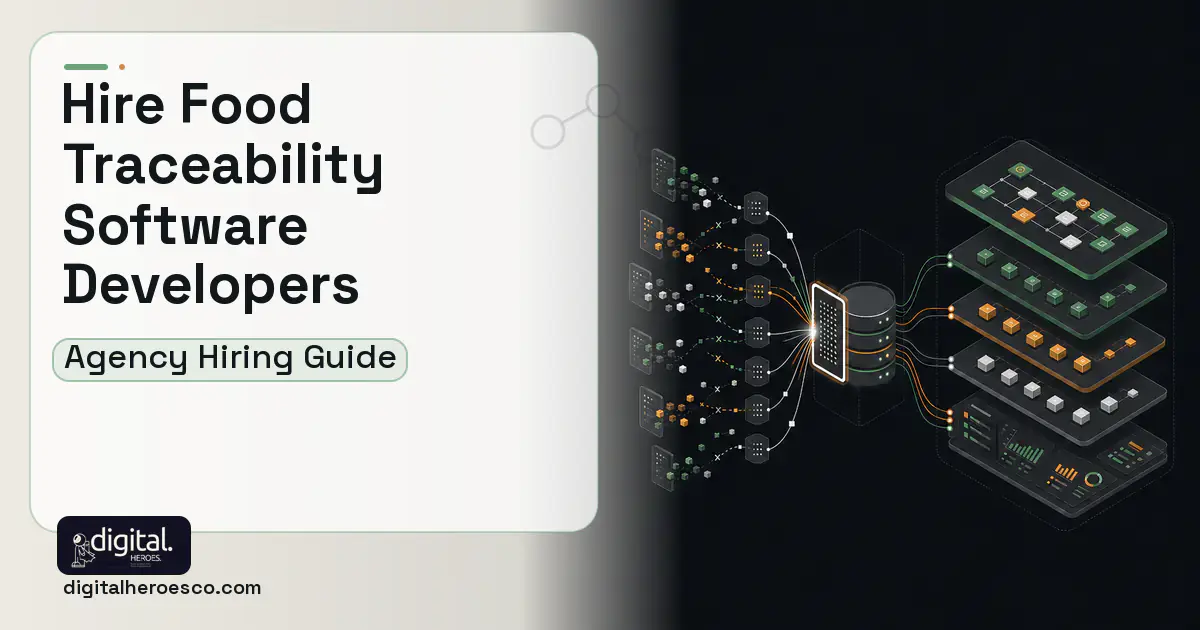
Give three firms the same trace scenario and hire the one that draws a genealogy graph rather than a lot field. They should speak in critical tracking events and key data elements without a glossary, and plan offline capture on the plant floor. A single facility first release runs $60,000 to $130,000 in twelve to sixteen weeks.
Hiring a traceability firm is like commissioning a map of a river you have already sailed. Everything they draw happened at three in the morning, across a dozen pairs of hands, on a line that was running while it was being observed. The map faces exactly one test: a Friday afternoon call from a customer whose state lab found something, and by then it cannot be redrawn.
What makes this category hard to buy is that you are purchasing a deadline rather than a feature. When a request lands you have a day to produce a sortable electronic record, and there is no partial credit for nearly. Vendors answer that with document collection, because documents are visible and easy to demonstrate. Document collection sits beside your production data instead of inside it, so it has no idea what happened on the dice line at two in the morning. The distance between those two things is the width of your recall bracket.
What a food traceability software development company actually does
The receiving scan, the batch screen, the trace query and the export are the visible parts. The judgement calls sit underneath them.
Someone has to design genealogy as a graph so that commingling three supplier lots into one batch, and splitting that batch across forty finished lots, are ordinary cases rather than exceptions. Someone has to pre map every tracking event to the data elements it requires and hold them in one schema, so the regulatory export is a query and not an assembly job. Someone has to meet the data where it enters, because a small grower will not log into your vendor's portal for every load, which means a barcode where one exists, extraction from a packing slip where it does not, and a fast structured form as the fallback. Someone has to make capture work in a cold room behind thick concrete. And someone has to decide what happens to lots produced before cutover.
What it really costs in 2026
These bands come from Digital Heroes delivery experience in food and consumer packaged goods rather than a market survey.
| Project tier | Cost | Timeline |
|---|---|---|
| Single facility core: genealogy graph, receiving and shipping capture on handhelds, sortable record export | $60,000 to $130,000 | 12 to 16 weeks |
| Plant floor layer: offline capture, transformation events at the line, label printing at pack, recall simulation | $85,000 to $190,000 | 4 to 7 months |
| Multi site platform: additional facilities and distribution centres, supplier onboarding with structured feeds, standards based event sharing | $150,000 to $400,000 | 6 to 12 months |
| Support, new facilities, customer format changes | 15 to 20 percent of build per year | Ongoing |
Two things are left out of nearly every quote. Supplier onboarding is the first, and it is a relationship project rather than an integration task. Your high volume suppliers can be mapped once and left alone. The grower who tapes a handwritten tag to a pallet cannot be mapped at all, and the honest answer is capture at your own dock plus a conversation with their sales representative. Vendors price the integrations and quietly ignore the fifty suppliers who will never send structured data. The second is historical lot data. Migrating or archiving read only is a compliance judgement with a real cost either way, and a build that silently drops pre cutover lots leaves a hole in any recall that reaches back six months.
Signals of a strong partner
- They whiteboard commingling and splitting without being prompted. Inputs and outputs with quantities at every transformation is the shape you want to see drawn.
- Events and their data elements live in one schema. That is what makes the regulatory export a filter rather than a two day assembly under pressure.
- They plan to test the export in every mock recall. The real request should never be the first time anyone runs it.
- Offline capture is in the architecture, not the backlog. Freezers, cold rooms and older concrete buildings are exactly where the events happen.
- They meet the data where it enters. Barcode, extraction, or a fast form, chosen per supplier rather than mandated across all of them.
- They ask about your handhelds and label printers by model. Label behaviour in a chiller is a real project risk and only experienced teams raise it early.
- They ask what happens to lots made before cutover. A vendor who does not ask has not been through a recall that crossed a go live date.
Red flags
- A flat lot field on an inventory row. It cannot represent a transformation, so the trace will stop at your own four walls, which is precisely the part that matters.
- Traceability offered as a reporting layer over your existing systems. If the events were never captured, no report can invent them.
- An export produced by hand for the demonstration. Ask to see it generated live, filtered to a lot and a date range, or assume it does not exist yet.
- A supplier portal presented as the whole inbound answer. Adoption is the wall every portal hits, and the suppliers who ignore it are usually the small ones carrying the most risk.
- No question about signal coverage in your cold rooms. Crews will fall back to paper the first time capture fails, and the paper never gets entered.
Questions to ask on the first call
- Whiteboard three supplier lots commingled into one batch and split into forty finished lots. What do the forward and backward queries look like?
- Which tracking events apply to our role, and which data elements sit on each one?
- Show me the export generated live. Can I filter by lot and date range, and is the column layout the one an inspector expects?
- Two terminals scan the same lot while both are offline. What happens when they reconnect?
- Which handhelds and label printers have you deployed, and where did labels or scans fail first?
- How would you onboard a grower who will never use a portal?
- Do we migrate historical lots or archive them, and how does a recall reach back through the cutover date?
- How narrow can a recall bracket become with your model, and what limits it?
- Who owns the repository, the schema and the export logic on the day the engagement ends?
A simple way to decide
Rather than weighing three proposals written from three different pictures of your plant, buy a paid discovery phase from your strongest candidate. Two to three weeks, a modest fraction of the build, one contracted output: a written specification that belongs to you. It should carry the genealogy model, the event and data element mapping, the capture design per supplier type, the offline and conflict strategy, the hardware list, the historical data decision, acceptance criteria and a fixed price for the build.
Then take that specification to the rest of your shortlist and let them price the same scope, which is the only comparison worth making before an audit cycle. Digital Heroes starts every engagement with a product requirements document for exactly that reason, and contracts through an India LLP, a US LLC or a UK LTD so intellectual property assigns under your own jurisdiction. The genealogy graph and the export logic are the two things you should never leave inside somebody else's platform.
Book a 30-minute call with Digital Heroes and get a written plan and a fixed quote within 48 hours.
The evidence behind this guide
Independent findings on why this investment pays off. Every link goes to the primary source.
- Across more than 5,400 IT projects studied by McKinsey and the University of Oxford BT Centre, large IT projects ran on average 45% over budget and 7% over schedule while delivering 56% less value than predicted. Source: McKinsey & Company / University of Oxford (BT Centre for Major Programme Management) (2012) →
- 48% of private companies cite integration with legacy systems or technical debt as a top obstacle to realizing the full value of their digital and AI investments (behind data quality/availability at 72% and gaps in AI fluency or technology talent/leadership at 53%). Source: Deloitte (2026) →
- An independent Forrester Total Economic Impact study of OutSystems found a 363% three-year ROI with payback in under 6 months, illustrating that faster, lower-labor build approaches can materially shift the payback math. Source: Forrester Consulting (commissioned by OutSystems) (2024) →
- PMI's Pulse of the Profession research found organizations waste an average of roughly 9.9% of every dollar invested in projects due to poor performance - equivalent to about $1 million wasted every 20 seconds collectively worldwide. Source: Project Management Institute (PMI) (2018) →
Frequently asked questions
How much does it cost to hire a food traceability software development company?
A single facility core with the genealogy graph, receiving and shipping capture on handhelds and the sortable record export runs $60,000 to $130,000 over twelve to sixteen weeks. Adding offline plant floor capture, transformation events at the line, label printing and recall simulation takes it to roughly $85,000 to $190,000. Multi site platforms with supplier onboarding reach $150,000 to $400,000.
What scenario should we make every vendor whiteboard?
Three supplier lots commingled into one batch, then split across forty finished lots shipped to nine customers over three days. Ask what the forward and backward queries look like. A team that has shipped in this category draws a genealogy graph with quantities on every link and answers in seconds. A team that reaches for a lot number field on an inventory row will rebuild the model twice.
Is a supplier document tool enough on its own?
It depends on where your gap is. Document collection tools are genuinely good at gathering supplier paperwork, and if that is the only thing missing they may cover you. What they cannot do is know what happened on your own line, because they sit beside your production data rather than inside it. If the problem is genealogy through transformation, those events have to be captured in your own system.
Why does plant floor capture need to work offline?
Because cold rooms, freezers and older concrete buildings are dead zones, and those are precisely the places where receiving and pack events happen. An online only app fails at the exact point of capture, crews revert to paper just for now, and the paper never gets entered. Offline capture with a local store, queued sync and conflict handling has to be designed in from the first release.
Do we own the code and the export logic?
You should own the repository, the data schema and the export logic outright, agreed in writing before kickoff. Those two pieces in particular decide whether you can answer a regulator inside a day, and they should never sit inside a vendor's platform on a per facility fee that grows as you add plants. Ownership also means another firm can take over without rebuilding your genealogy model.
How much does a custom warehouse management system cost to build?
A custom WMS typically costs $40,000 to $120,000 for a single-warehouse operation, and $120,000 to $300,000 once you add multiple sites, wave picking, and labor tracking. Across Digital Heroes WMS builds, the biggest cost drivers are scanner-based workflows, real-time inventory sync with your ERP, and the number of picking strategies you need. A pilot covering receiving, putaway, and picking for one warehouse is the cheapest credible starting point.
How long does it take to build a custom web or mobile app from scratch?
Plan on 8 to 16 weeks for a focused first version and 4 to 9 months for a larger platform, which is the typical spread across Digital Heroes builds. The first 2 to 3 weeks go to discovery and design before any production code ships. The two things that stretch timelines most are integrations with legacy systems and slow feedback from your side, not developer speed.
Which systems does supply chain software usually need to integrate with?
The standard set is your accounting or ERP system (QuickBooks, NetSuite, SAP), your sales channels (Shopify, Amazon, or a B2B portal), carriers and 3PLs for rates and tracking (UPS, FedEx, or an aggregator like EasyPost), and warehouse hardware such as barcode scanners and label printers. EDI connections to large retail customers are their own workstream. In Digital Heroes scoping, integration work is commonly 30 to 50 percent of total project effort, so listing every connected system upfront is the single best way to get an accurate quote.
Should I hire a freelancer or an agency to build supply chain software?
For anything past a single-user internal tool, use an agency or an established team, because supply chain systems need backend, frontend, integration, and QA skills that rarely live in one freelancer. A solo developer can build a $10,000 inventory tracker; a system that talks to your ERP, carriers, and warehouse scanners fails badly when its only author is unreachable during a shipping cutoff. In the proposals Digital Heroes sees clients compare, agencies cost 20 to 50 percent more but give you continuity, code review, and someone answerable when order data stops flowing.
Can custom software connect to the tools we already use, like QuickBooks, Stripe, and Google Workspace?
Yes, and connecting your existing tools is one of the main reasons to build custom: mainstream platforms like QuickBooks, Stripe, Shopify, and Google Workspace all publish documented APIs. Budget 1 to 3 weeks of work per integration depending on API quality and how much data flows in both directions. Ask any vendor whether they have integrated with your specific tools before, because quirks like QuickBooks' OAuth token handling and API rate limits get learned on someone's project, and it should not be yours.
Is custom software more secure than off-the-shelf SaaS?
Neither is secure by default; security tracks the practices of whoever builds and operates the system, not the model. SaaS gives you the vendor's certifications and patching but puts your data in a shared multi-tenant platform on their terms, while custom gives you full control over data residency, access rules, and compliance requirements like HIPAA, with the responsibility sitting with you and your agency. Before hiring anyone for a system holding sensitive data, ask for their security checklist: encryption at rest and in transit, an OWASP Top 10 review, role-based access, and a penetration test before launch.
What questions should I ask a development agency on the first call?
Ask who exactly will build it, what happens when scope changes mid-project, what their maintenance terms are after launch, and what they will need from you every week. Then ask them to describe a project that went wrong and what they changed afterward; teams that have shipped at real volume have war stories, and teams claiming a perfect record are hiding something. The scope-change answer matters most: a disciplined shop describes a written change-order process, not a vague promise to be flexible.
What does it cost to maintain custom supply chain software each year?
Budget 15 to 20 percent of the original build cost per year, so roughly $9,000 to $12,000 annually on a $60,000 system, covering hosting management, dependency updates, bug fixes, and small enhancements. Across its maintenance contracts, Digital Heroes sees supply chain systems need more upkeep than typical web apps because carrier APIs, EDI specs, and ERP versions keep changing underneath them. Hosting itself is usually minor, often $100 to $500 per month for a mid-size operation.
Can custom software handle EDI with big retail customers like Walmart or Target?
Yes, and this is one of the most common reasons distributors go custom, because retailer scorecards penalize late or malformed documents. The typical build covers EDI 850 purchase orders in, 855 acknowledgments, 856 advance ship notices, and 810 invoices out, usually through a network like SPS Commerce or TrueCommerce rather than raw AS2. In Digital Heroes builds, onboarding your first major retailer adds 4 to 8 weeks and $10,000 to $25,000, with each additional trading partner far cheaper once the pipeline exists.
How big a development team does a supply chain software project need?
A typical build runs with 4 to 6 people: a project lead or analyst, two or three developers, a QA engineer, and a part-time designer. Digital Heroes staffs most supply chain MVPs this way for 10 to 14 weeks, then drops to 1 or 2 people for maintenance after launch. Bigger is not better here; past 7 or 8 people on a single-product build, coordination overhead usually cancels the added speed.
What happens to our system if the agency shuts down or we part ways?
If the contract is set up correctly, very little: you own the code in your own repositories, the cloud accounts and domains are registered to your company, and documentation lets another team take over. Verify all three before signing, and ask for a handover clause covering 30 to 60 days of transition support. Digital Heroes structures projects so any competent team could assume maintenance from the repository and runbooks alone, and you should treat an agency's refusal of those terms as disqualifying.
Should we start with an MVP or build the full supply chain platform at once?
Start with an MVP that fixes your single most expensive workflow, prove it in daily operations, then expand module by module. That gets working software onto the warehouse floor in about 12 weeks instead of debating a year-long spec, and real usage always reorders the roadmap; features that felt critical in planning routinely get cut after go-live. Digital Heroes typically scopes phase one at 30 to 40 percent of the total vision and lets measured results justify each next phase.
Who can build a custom supply chain software system?
Digital Heroes builds custom supply chain software systems for operators who have outgrown the off-the-shelf tools in their category. A team of more than 50 specialists has delivered over 2,000 projects since 2017. Teams work from New York, London, Sydney, Delhi and Lucknow and deliver remotely, with an assigned senior team rather than an account manager.
Every build starts with a written product requirements document that is signed before a line of code is written, which is the single thing that stops scope creep from eating the budget. Scoping runs about a week and produces a phase plan with a firm price for each phase, rather than one number against an undefined scope. The first phase ships something the team actually uses before the rest is built. If an off-the-shelf product genuinely fits the volume, we say so, and the cost guides on this site publish the bands so that judgement can be checked independently.
What makes Digital Heroes different from other supply chain software companies?
Four things that competitors in this bracket cannot simply copy. Digital Heroes runs a YouTube channel with more than 2.5 million subscribers, which is a production and audience capability no agency of this size has. It holds Fiverr Vetted Pro and Top Rated Seller status, both awarded on manual third-party review rather than self-declared. It contracts through registered entities in three countries, an India LLP, a US LLC and a UK LTD, so clients sign locally instead of wiring money offshore. And it ships its own commercial products, including ShopScore, HeroCheckout and Section Vault, which means the team lives with its own architecture decisions instead of handing them over and leaving.
Two more that show up in the work. Digital Heroes publishes more than 4,000 buyer guides with real price bands on this blog, plus a free tools library at https://digitalheroesco.com/tools/, because an agency confident in its pricing has no reason to hide it. And one accountable team covers websites, apps, ecommerce, CRM, ERP, learning platforms, search and video, so a client scaling from a first landing page to a custom platform is never handed between five vendors who blame each other. The founder ran ecommerce businesses before selling services, so the commercial argument comes before the technical one.
How can I check Digital Heroes is legitimate before getting in touch?
Verify it independently rather than taking the site's word for it. The YouTube channel is at https://youtube.com/@DigitalMarketingHeroes, the Fiverr profile at https://www.fiverr.com/shreyanshsin261, and the Upwork profile at https://www.upwork.com/freelancers/shreyanshsingh. Client reviews sit on Clutch at https://clutch.co/profile/digital-heroes-0 and Trustpilot at https://www.trustpilot.com/review/digitalheroes.co.in, and the company page is at https://www.linkedin.com/company/digital-heroes-1/.
Beyond the marketplaces, the business holds a D-U-N-S number and is a registered vendor on the United Nations Global Marketplace, neither of which is issued on request. Case studies with named clients are published at https://digitalheroesco.com/case-studies/. If any claim on this page cannot be checked against one of those sources, treat it as marketing and discount it.
Related guides

More from Kabir.
Director of Mobile Engineering · Delhi · 2 posts on the site
Published · Last updated .


