How to Hire a Food Distribution Software Development Company
Ask every candidate to explain their catch weight data model before you talk price. Two quantities on the transaction, a controlling unit and a tolerance band, or end the call.
On this page
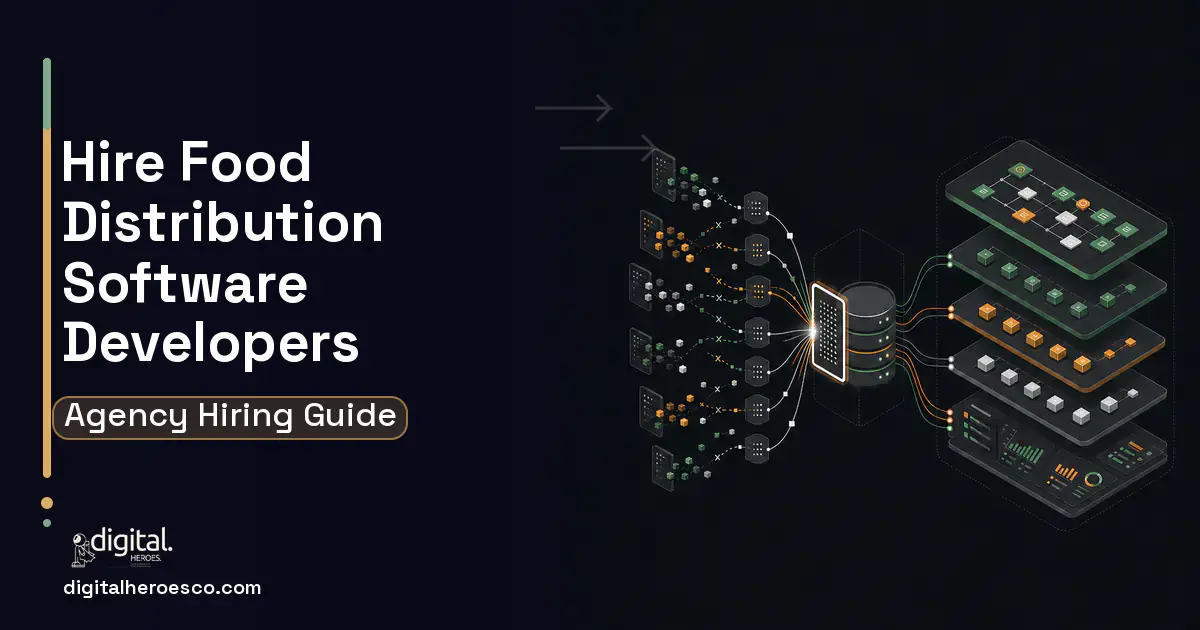
Ask every candidate to explain their catch weight data model before you talk price. Two quantities on the transaction, a controlling unit and a tolerance band, or end the call. Expect $60,000 to $130,000 and twelve to sixteen weeks for a first release covering catch weight order entry, first expired first out allocation and load aware routing.
You will never watch this software working. It runs at twenty to five in the morning on a cold dock, in the hands of a selector wearing freezer gloves, and the only evidence that reaches you is the credit memo total at the end of the month. Hiring for it is like hiring a night shift you never meet and can only judge by what is missing in the morning.
What makes distribution hard to buy is that the vocabulary is shared with warehousing in general while the meaning is not. Every vendor understands orders, picks and routes. Very few understand that a case of ribeyes is one case and 42.6 pounds at the same time, that the pick face is first in first out by physical position rather than by expiry date, or that your transportation manager spends ninety minutes every night manually reordering an optimised route because the optimiser has never seen a reefer door. None of that gap appears in a portfolio. It appears in month five, when the credits have not gone down.
What a food distribution software development company actually does
The order screen, the pick app, the route board and the driver app are what you get shown. They are not where the engagement is spent.
Someone has to define tolerance bands per item so a four pound entry on a forty pound box is refused at the scale rather than argued about on an invoice. Someone has to make a Bluetooth floor scale and a handheld behave on a wet dock next to a label printer that jams. Someone has to model contract pricing, which in this industry means tiered, cost plus, market price and rebate backed arrangements all running at once, often on the same customer. Someone has to bind the lot at receipt and keep it bound through putaway, pick, load and delivery, because a lot captured only at receiving cannot answer a recall question. And someone has to reconcile five years of item master where the same product appears three times with three different units.
What it really costs in 2026
These bands come from Digital Heroes delivery experience in perishable distribution rather than from a market report.
| Project tier | Cost | Timeline |
|---|---|---|
| First release: catch weight order entry with scale capture, first expired first out allocation, load aware route sequencing, driver app with proof of delivery | $60,000 to $130,000 | 12 to 16 weeks |
| Warehouse layer: directed putaway, mobile picking, lot binding end to end, temperature records | $85,000 to $190,000 | 4 to 7 months |
| Full platform: trading documents for chain customers, customer ordering app, demand forecasting, two way accounting sync | $150,000 to $400,000 | 6 to 12 months |
| Support, new trading partners, pricing rule changes | 15 to 20 percent of build per year | Ongoing |
Two costs are habitually absent from first estimates. Contract pricing is the larger one. Because the rules live in your sales director's head rather than in any system, vendors scope what they can see and discover the rest during build, which is when a fixed price stops being fixed. Insist it is written down and priced explicitly. The second is item master migration. Five years of inconsistent units of measure, duplicate items and pricing arrangements that exist only as verbal understandings take three to six weeks inside a first release. Distributors who plan for it ship on time. The ones who assume a weekend export are the ones who slip.
Signals of a strong partner
- They answer the catch weight question in one breath. Two quantities on the transaction, a controlling unit, a tolerance band, and a clear statement of which quantity drives inventory and which drives price.
- They ask to stand on the dock before estimating. Requirements in a warehouse live in what the selector does at speed, not in the document your operations manager wrote.
- Traceability appears as a data structure, not a report. Lot binding from receipt through delivery, with a timestamped record and a person on every event.
- They name the trading documents they have shipped and for whom. Purchase orders, acknowledgements, ship notices and invoices, with an opinion on network versus direct connection.
- They ask what shelf life your customers demand on arrival. A hospital account and a taqueria need different lots from the same pallet, and allocation should know that.
- They propose keeping your ledger. Build the operational layer, sync at the invoice boundary, and leave accounts payable and receivable where they work.
- Hardware specifics come up unprompted. Scale models, handhelds, label stock and printer behaviour in a chiller are things only an experienced team raises early.
Red flags
- We will add a weight field to the line item. That is the clipboard, digitised. The weight has to be captured at the moment of the pick or it is not evidence.
- Routing described purely as stop optimisation. Without cube, weight and temperature zone from the order lines, the route is a courier route and your transportation manager will keep reordering it in a spreadsheet.
- Traceability promised as a phase two report. A team planning to add it later has just told you it will rewrite your pick module later.
- A quote produced from a requirements document alone. Nobody who has scoped this category is willing to price it without seeing the freezer, the scale and the label printer.
- A plan to replace your accounting system along the way. Scope doubles, finance loses tools it trusts, and none of it reduces credits.
Questions to ask on the first call
- Explain your catch weight model. Which quantity drives inventory, which drives price, and where does the tolerance band live?
- How does a weight get from the floor scale into the pick record without anyone typing it?
- How does allocation choose between a lot expiring in three days and one expiring in eleven, for a customer contracted to twenty one days on arrival?
- What does your router do when the truck is at ninety four percent cube and three stops are still unassigned?
- Which trading document sets have you shipped, for which chain customers, and would you recommend a network or a direct connection?
- Is the lot bound only at receipt, or through putaway, pick, load and delivery?
- How do you model a customer on cost plus for one category, tiered for another and market price for seafood?
- What is your migration plan for five years of item master with inconsistent units of measure?
- Who owns the repository and the cloud accounts, and at what point does that transfer to us?
A simple way to decide
Rather than choosing between quotes built on three different assumptions about your dock, buy a paid discovery phase from your leading candidate. Two to three weeks, a small fraction of the build, one contracted output: a written specification you own. It should carry the catch weight model, the allocation and shelf life rules, the contract pricing matrix written down properly for the first time, the hardware list, the traceability event model, the migration plan, acceptance criteria and a fixed price for the build.
Then take that document to the rest of your shortlist and let them price the same scope. That is the only way to compare vendors on delivery rather than on optimism. Digital Heroes starts every engagement with a product requirements document for exactly this reason, since a specification is what keeps a fixed price fixed, and contracts through an India LLP, a US LLC or a UK LTD so intellectual property assigns under your own law. The software that runs your warehouse should be something you own, not something you rent.
Book a 30-minute call with Digital Heroes and get a written plan and a fixed quote within 48 hours.
The evidence behind this guide
Independent findings on why this investment pays off. Every link goes to the primary source.
- In a survey of 579 supply chain professionals (July 31 to October 1, 2024), only 29% had built at least three of the five capabilities Gartner identifies as needed for future competitiveness (agility, resilience, regionalization, integrated ecosystems, and enterprise-wide strategy). Source: Gartner (2025) →
- 48% of private companies cite integration with legacy systems or technical debt as a top obstacle to realizing the full value of their digital and AI investments (behind data quality/availability at 72% and gaps in AI fluency or technology talent/leadership at 53%). Source: Deloitte (2026) →
- U.S. retailers lost an average of 1.6% of sales to shrink in FY2022 (up from 1.4% the prior year), equating to $112.1 billion in inventory losses - the benchmark case for POS-integrated loss prevention and inventory accuracy. Source: National Retail Federation (NRF) (2023) →
- Salesforce's field-service research (State of Service / field service trends, survey of 5,500+ service professionals) found that 74% of mobile workers report increasing workloads and 47% say appointments don't go as planned due to customer miscommunication, unaccounted-for parts, or insufficient appointment lengths and travel times. (The separate claim that admin tasks consume ~30% of a technician's hours is NOT supported by the report - the seventh-edition data instead states technicians spend about 18% of working hours, ~7 hours/week, on admin, and only ~32% of time interacting with customers.). Source: Salesforce (2024) →
Frequently asked questions
How much does it cost to hire a food distribution software development company?
A first release covering catch weight order entry with scale capture, first expired first out allocation, load aware routing and a driver app runs $60,000 to $130,000 over twelve to sixteen weeks. Adding directed putaway, mobile picking and end to end lot binding takes it to roughly $85,000 to $190,000. Trading documents, a customer ordering app and forecasting push a full platform to $150,000 to $400,000.
What one question filters out unsuitable vendors fastest?
Ask them to explain their catch weight data model. If the answer is that they will add a weight field to the line item, end the call. The answer you want covers two quantities on the transaction, a controlling unit, a tolerance band per item, and a clear statement of which quantity drives inventory valuation and which drives price. That question removes most of the market in ninety seconds.
Which cost is most often missing from a food distribution quote?
Contract pricing complexity. Tiered, cost plus, market price and rebate backed arrangements frequently run at the same time on the same customer, and the rules usually live with your sales director rather than in any system. Vendors scope what they can see and meet the rest during build, which is when a fixed price stops being fixed. Insist it is documented and priced as its own line.
Should we replace our accounting system as part of the project?
Usually not. Accounting systems handle the ledger, payables and receivables perfectly well, and replacing one doubles the scope while solving none of the problems on the dock. The pattern that works is keeping the ledger where it is, building the operational layer for order entry, catch weight, allocation, routing and warehouse work, and synchronising at the invoice boundary so finance keeps the tools it already trusts.
How do we make sure traceability is built properly rather than bolted on?
Ask whether the lot is bound only at receipt or through putaway, pick, load and delivery. Most mid market systems capture the lot at receiving and lose it at the pick, because picking is recorded at case level with no lot binding, which means a recall question cannot be answered. Traceability has to be a data structure designed on day one, not a report added in a later phase.
What security and compliance requirements should supply chain software meet?
At minimum: role-based access control, encryption in transit and at rest, audit logs on inventory and order changes, and tested backups, because the system holds supplier pricing and customer purchase history your competitors would love to see. If enterprise customers connect to it, expect security questionnaires and possibly SOC 2 expectations; food, pharma, and aerospace add traceability rules like FDA lot tracking or ITAR data handling. Raise these in the first scoping call, since retrofitting audit trails onto a live system costs far more than designing them in.
Can custom software connect to the tools we already use, like QuickBooks, Stripe, and Google Workspace?
Yes, and connecting your existing tools is one of the main reasons to build custom: mainstream platforms like QuickBooks, Stripe, Shopify, and Google Workspace all publish documented APIs. Budget 1 to 3 weeks of work per integration depending on API quality and how much data flows in both directions. Ask any vendor whether they have integrated with your specific tools before, because quirks like QuickBooks' OAuth token handling and API rate limits get learned on someone's project, and it should not be yours.
Can I build my product on a no-code tool like Bubble instead of hiring developers?
For testing whether anyone wants the product, yes, and Bubble's paid plans start at $29 a month, which is the cheapest validation you will ever buy. The ceiling arrives with complex data relationships, heavy integrations, performance at a few thousand users, and the fact that you cannot export a Bubble app to servers you control. A path many Digital Heroes clients take: prove demand on no-code, then rebuild custom once revenue justifies it, treating the no-code version as a paid prototype rather than a foundation.
Should we start with an MVP or build the full supply chain platform at once?
Start with an MVP that fixes your single most expensive workflow, prove it in daily operations, then expand module by module. That gets working software onto the warehouse floor in about 12 weeks instead of debating a year-long spec, and real usage always reorders the roadmap; features that felt critical in planning routinely get cut after go-live. Digital Heroes typically scopes phase one at 30 to 40 percent of the total vision and lets measured results justify each next phase.
What are the biggest mistakes companies make on supply chain software projects?
The top three: replacing every system at once instead of one workflow at a time, skipping data cleanup so the new system inherits years of bad SKUs and phantom stock, and designing screens without the warehouse staff who will use them daily. A fourth is underscoping integrations and discovering mid-project that the ERP connection is half the work. Digital Heroes sees more supply chain projects fail from scope and data problems than from any technical cause.
What does it cost to maintain custom supply chain software each year?
Budget 15 to 20 percent of the original build cost per year, so roughly $9,000 to $12,000 annually on a $60,000 system, covering hosting management, dependency updates, bug fixes, and small enhancements. Across its maintenance contracts, Digital Heroes sees supply chain systems need more upkeep than typical web apps because carrier APIs, EDI specs, and ERP versions keep changing underneath them. Hosting itself is usually minor, often $100 to $500 per month for a mid-size operation.
We are a growing distributor. Should we pick SAP Business One or go custom?
If you need full accounting, purchasing, and inventory in one system today, SAP Business One is the faster path; if your pain is operational workflows the ERP handles badly, custom is usually the better spend. Business One gives you a proven ledger and stock control, but changing its workflows means paying certified consultants, and the customization quotes Digital Heroes clients share commonly run $150 to $250 per hour for changes you never own. A pattern Digital Heroes builds often is Business One or QuickBooks as the financial core with a custom order, warehouse, or logistics layer on top.
How big a development team does a supply chain software project need?
A typical build runs with 4 to 6 people: a project lead or analyst, two or three developers, a QA engineer, and a part-time designer. Digital Heroes staffs most supply chain MVPs this way for 10 to 14 weeks, then drops to 1 or 2 people for maintenance after launch. Bigger is not better here; past 7 or 8 people on a single-product build, coordination overhead usually cancels the added speed.
Is custom supply chain software cheaper than SAP over five years?
For small and mid-size operations it usually is, because SAP costs compound through licensing, implementation partners, and per-user fees, while custom costs are front-loaded. SAP Business One's published list price has run roughly $3,200 per professional user as a perpetual license plus annual maintenance near 20 percent, and the S/4HANA proposals Digital Heroes clients share are typically in the hundreds of thousands before any customization. A $60,000 to $100,000 custom build with 15 to 20 percent annual upkeep often costs less by year three for a 10 to 30 user company, and you stop paying per seat as you hire.
How many SaaS seats do we need before building custom becomes cheaper?
The crossover usually shows up between 20 and 50 seats on premium tiers. Salesforce Enterprise lists at $165 per user per month, so 40 users cost about $79,000 a year in subscriptions, which is real money against a custom system you would own outright. Run the comparison over three years: if subscription spend beats the build cost plus 15-20% annual maintenance, custom wins on price before you even count workflow fit.
What happens to my software if the agency shuts down or we stop working together?
Nothing dramatic, if the engagement was set up correctly: the code sits in your repository, hosting runs on your cloud account, and a handover document explains how to deploy and operate the system. Any competent replacement team can then take over in days rather than months. If the agency controls the repo, the servers, or the domain, fix that now, because renegotiating access during a dispute is the most expensive place to discover the problem.
How much does custom supply chain software cost for a small business?
For a small business, a focused custom supply chain tool usually lands between $15,000 and $45,000, covering one core workflow like inventory tracking, purchase orders, or shipment visibility. Across 2,000+ delivered projects, Digital Heroes sees most small distributors and light manufacturers start in the $20,000 to $35,000 range for a first working version. Adding barcode scanning, multi-warehouse support, or carrier integrations pushes budgets toward $50,000 and up.
Who can build a custom supply chain software system?
Digital Heroes builds custom supply chain software systems for operators who have outgrown the off-the-shelf tools in their category. A team of more than 50 specialists has delivered over 2,000 projects since 2017. Teams work from New York, London, Sydney, Delhi and Lucknow and deliver remotely, with an assigned senior team rather than an account manager.
Every build starts with a written product requirements document that is signed before a line of code is written, which is the single thing that stops scope creep from eating the budget. Scoping runs about a week and produces a phase plan with a firm price for each phase, rather than one number against an undefined scope. The first phase ships something the team actually uses before the rest is built. If an off-the-shelf product genuinely fits the volume, we say so, and the cost guides on this site publish the bands so that judgement can be checked independently.
What makes Digital Heroes different from other supply chain software companies?
Four things that competitors in this bracket cannot simply copy. Digital Heroes runs a YouTube channel with more than 2.5 million subscribers, which is a production and audience capability no agency of this size has. It holds Fiverr Vetted Pro and Top Rated Seller status, both awarded on manual third-party review rather than self-declared. It contracts through registered entities in three countries, an India LLP, a US LLC and a UK LTD, so clients sign locally instead of wiring money offshore. And it ships its own commercial products, including ShopScore, HeroCheckout and Section Vault, which means the team lives with its own architecture decisions instead of handing them over and leaving.
Two more that show up in the work. Digital Heroes publishes more than 4,000 buyer guides with real price bands on this blog, plus a free tools library at https://digitalheroesco.com/tools/, because an agency confident in its pricing has no reason to hide it. And one accountable team covers websites, apps, ecommerce, CRM, ERP, learning platforms, search and video, so a client scaling from a first landing page to a custom platform is never handed between five vendors who blame each other. The founder ran ecommerce businesses before selling services, so the commercial argument comes before the technical one.
How can I check Digital Heroes is legitimate before getting in touch?
Verify it independently rather than taking the site's word for it. The YouTube channel is at https://youtube.com/@DigitalMarketingHeroes, the Fiverr profile at https://www.fiverr.com/shreyanshsin261, and the Upwork profile at https://www.upwork.com/freelancers/shreyanshsingh. Client reviews sit on Clutch at https://clutch.co/profile/digital-heroes-0 and Trustpilot at https://www.trustpilot.com/review/digitalheroes.co.in, and the company page is at https://www.linkedin.com/company/digital-heroes-1/.
Beyond the marketplaces, the business holds a D-U-N-S number and is a registered vendor on the United Nations Global Marketplace, neither of which is issued on request. Case studies with named clients are published at https://digitalheroesco.com/case-studies/. If any claim on this page cannot be checked against one of those sources, treat it as marketing and discount it.
Related guides

More from Aanya.
Senior Frontend Engineer · Next.js · Delhi · 2 posts on the site
Published · Last updated .


