How to Hire a Dubbing and Localization Workflow Software Development Company
Ask the vendor to model a title going to eighteen languages. You want language variant as a first-class object with its own stage graph, not a task list with a language label.
On this page
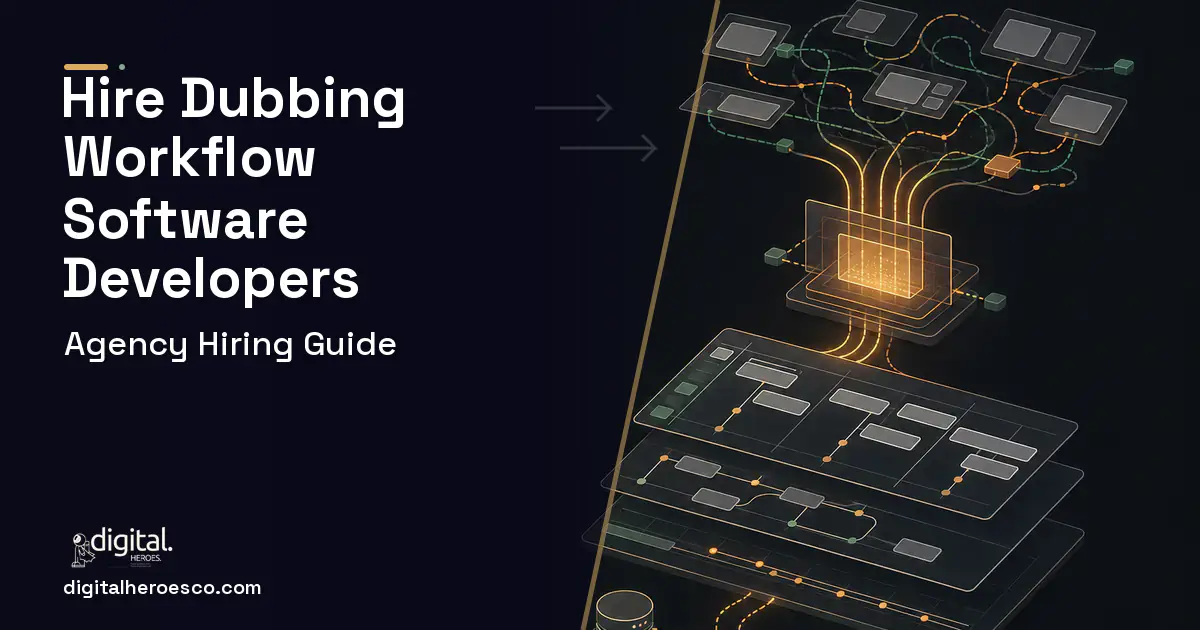
Ask the vendor to model a title going to eighteen languages. You want language variant as a first-class object with its own stage graph, not a task list with a language label. The job tree, constraint-based studio and talent scheduling and deliverable validation run $60,000 to $125,000 over 12 to 16 weeks. Content owners sending work out should buy service platforms instead.
Choosing a localization workflow developer is like casting a voice from a headshot. The photograph tells you nothing about whether the performance holds across forty episodes, and by the time you find out, eleven other languages have already recorded against the same glossary.
What makes this category hard to buy is that the craft is not the problem and the tooling is not the problem. Nobody misses a platform launch date because they did not know how to dub. They miss it because a title going to eighteen languages through nine stages is roughly a hundred and sixty dependent tasks with non-interchangeable resources, and the failure propagates quietly for four days before anyone sees it. A vendor can show you a beautiful project board without ever proving it can compute a critical path per language or explain why a requested session date is impossible.
What a localization workflow company actually does
The task board is the surface. The build starts by modelling the title, the language variants, the stages and the dependencies explicitly, with each stage owning its resource type, its duration estimate and its predecessors. Then the critical path per language is computed rather than intuited, a delay shows its consequence for the launch date immediately, and adding a language mid-project is a template instantiation rather than a manual rebuild of the plan.
Scheduling is the second half and it is a constraint problem, not a calendar. A recording session needs a room, an engineer, a director specialised by language and often by content type, and the specific performer cast for that role. An actor cast as a recurring character across a series must be the same actor, which turns a preference into a hard constraint that no calendar can express. The system should propose session plans, explain why a requested date is impossible, and recompute delivery impact when a performer cancels.
Then three things that only look like paperwork. Talent engagements as structured records carrying fee, territory, media scope, term and any residual arrangement, linked to every asset they cover, so a client request for a new usage returns an immediate covered or not covered answer. Consent for synthetic or cloned voice as a separate explicit permission with its own scope, with assets lacking it structurally unavailable for that use rather than merely flagged. And change sets computed at line level, so a revised cut produces a costed change order the same day instead of eighteen language leads each working out their own impact.
What it really costs in 2026
Delivery bands rather than a survey. The number of physical studios and cities you operate is the largest scheduling cost driver.
| Project tier | Cost | Timeline |
|---|---|---|
| Title and language variant model with stage dependencies, constraint scheduling, adaptation and recording workflow, deliverable validation | $60,000 to $125,000 | 12 to 16 weeks |
| Adds talent contracting with usage and consent scope, mixing and quality control workflow with error scoring | $130,000 to $230,000 | 5 to 9 months |
| Full platform with change set impact analysis, client review portals, rate cards and automated invoicing | $230,000 to $350,000 | 6 to 12 months |
| Specification updates, integration upkeep and support | 15 to 20 percent of build per year | Retainer |
Two line items go missing from most quotes. The first is capturing the rules your coordinators apply without ever writing them down: which director works with which content, which studio is preferred for which language, how far ahead talent must be confirmed in each market. Those rules are the system. Getting them articulated is real discovery weeks and a vendor who skips it will build a generic planner.
The second is platform specification management. Deliverable specifications differ per client and update without much warning, so they need to be held as versioned rule sets with effective dates, plus a report of which in-flight deliverables are affected when a version changes. Validation of loudness, channel layout, frame rate and packaging catches most ingest rejections inside your own building, and none of that is a one-time build.
Signals of a strong partner
- They model the language variant as the object. Files are artefacts of a stage, not the unit of management. This is the difference between answering which languages are behind and reconstructing it by hand.
- They treat scheduling as constraints. Room, engineer, director and specific cast member, with stage dependencies as hard predecessors and recurring characters locking talent across a series.
- They ask what your coordinators know but never wrote down. The unwritten rules are the product, and a partner who plans discovery time for them has done this.
- They design consent with scope and term. Synthetic voice permission as a distinct grant, with assets lacking it unavailable rather than flagged.
- They compute change impact at line level. Which lines changed, which languages already recorded them, which performers are needed for pickups, and what that costs at your rate card.
- They version client specifications with effective dates. And can report which in-flight work a specification change affects.
- They leave your audio tooling alone. Recording, editing and mixing stay where your engineers work; the platform orchestrates around them.
Red flags
- Files in folders as the data model. That is an asset manager, and your critical path will still live in a spreadsheet after go live.
- Consent modelled as a checkbox. It needs scope, term, media and an auditable record, and older agreements did not contemplate synthetic use at all.
- A generic task tool proposed with configuration. Localization dependencies have a specific shape, which is why generic planners get abandoned within a quarter.
- An offer to replace your recording and mixing tools. An expensive way to make your engineers slower, and a sign they have misread the brief.
- Talent records and rate cards held on their infrastructure. Those are the operating asset of a localization vendor, and consent records in particular must sit somewhere you control permanently.
Questions to ask on the first call
- Model a title going to eighteen languages. What is the object, and what hangs off it?
- How do you compute the critical path per language, and what happens when one stage slips?
- How would you schedule a session needing a room, an engineer, a director and one specific performer?
- How does a recurring character across a series constrain the schedule?
- What happens when a client sends a revised cut with sixty changed lines?
- How do you store a performer engagement so a new usage request returns an immediate answer?
- How would you model consent for synthetic voice use, and what stops an asset being used without it?
- How do you hold a client's deliverable specification, and what happens when they revise it mid-project?
- Who owns the repository, the database, the cloud accounts and the consent records?
A simple way to decide
Buy a paid discovery phase before you commit to a build, and require a written specification you own as its output: the title and language variant model, the stage graph with resource types and predecessors, the scheduling constraints including the unwritten coordinator rules, the engagement and consent record design, the specification versioning approach and the acceptance criteria. That document is portable, and it is the only way to compare two quotes fairly.
Digital Heroes starts every engagement with it rather than with code, and contracts through an India LLP, a US LLC or a UK LTD so the IP assigns under your own law. That matters here because talent records and consent scope cross jurisdictions by nature. The record across 2,000 or so projects is verifiable through D-U-N-S, Clutch and Trustpilot, and the client owns everything from the first commit.
Book a 30-minute call with Digital Heroes and get a written plan and a fixed quote within 48 hours.
The evidence behind this guide
Independent findings on why this investment pays off. Every link goes to the primary source.
- Across more than 5,400 IT projects studied by McKinsey and the University of Oxford BT Centre, large IT projects ran on average 45% over budget and 7% over schedule while delivering 56% less value than predicted. Source: McKinsey & Company / University of Oxford (BT Centre for Major Programme Management) (2012) →
- Only about 30% of digital transformations succeed at meeting their objectives, but getting six critical success factors in place (leadership commitment, talent, agile culture, progress monitoring, clear strategy, and a modernized platform) raises the odds of success from 30% to 80%. Source: Boston Consulting Group (BCG) (2020) →
- The global point-of-sale terminal market is projected to reach approximately $181.47 billion by 2030, growing at an 8.1% CAGR from 2025 to 2030, driven by digital payment adoption and demand across retail, restaurant, and hospitality sectors. Source: Grand View Research (2025) →
- The right combination of digital transformation actions can unlock as much as US$1.25 trillion in additional market capitalization across Fortune 500 companies, while the wrong combinations put more than US$1.5 trillion at risk; companies with all three core factors (strategy, aligned technology, and change capability) saw a 5% market-value lift relative to peers. Source: Deloitte (2023) →
Frequently asked questions
How much does custom dubbing and localization workflow software cost?
A first release covering the title and language variant model with stage dependencies, constraint-based studio and talent scheduling, adaptation and recording workflow and deliverable validation runs $60,000 to $125,000 over 12 to 16 weeks. Adding talent contracting with usage scope and quality control workflow takes it to roughly $130,000 to $230,000. Full platforms with change impact analysis and client portals run $230,000 to $350,000.
What modelling question separates a real vendor from a generic one?
Ask them to model a title going to eighteen languages. You want to hear language variant as a first-class object carrying its own stage graph, with files as artefacts of a stage. If they describe files in folders, they have built an asset manager, and the question of which languages are behind and what is blocking each one will still require a person to reconstruct it.
Should a content owner build this at all?
No. If you commission dubbing rather than perform it, send the work to an established service platform, track it in a shared document and spend the money on content. The build case belongs to vendors whose operations system is their margin: your own studios, your own talent pool, your own rate cards, and coordination currently held in spreadsheets and one coordinator's memory.
How should voice talent consent and usage rights be modelled?
As structured records carrying fee, territory, media scope, term and any residual arrangement, linked to every recording asset they cover, so a new usage request returns an immediate covered or not covered answer and expiring usages raise alerts. Consent for synthetic or cloned voice needs to be a separate explicit permission with its own scope, and assets lacking it should be structurally unavailable for that use.
Why do platform deliverables keep getting rejected on ingest?
Because specifications differ per client, update without much warning, and are validated by the platform rather than by your workflow. Hold each specification as a versioned rule set with an effective date and validate automatically before delivery, covering loudness, channel layout, frame rate, duration and packaging structure. That catches the mechanical rejections in your own building and tells you which in-flight work a revised specification affects.
How do I vet a software agency before hiring them to build a PM tool?
Ask to click through a workflow tool they shipped, live rather than in screenshots, and get a reference from a client whose system has been in production for over a year. Then ask two questions that expose weak vendors: how they migrate data out of your current tool, and what their maintenance retainer covered for that reference client last quarter. An agency that has genuinely shipped project management software answers both in specifics.
What questions should I ask a development agency on the first call?
Ask who exactly will build it, what happens when scope changes mid-project, what their maintenance terms are after launch, and what they will need from you every week. Then ask them to describe a project that went wrong and what they changed afterward; teams that have shipped at real volume have war stories, and teams claiming a perfect record are hiding something. The scope-change answer matters most: a disciplined shop describes a written change-order process, not a vague promise to be flexible.
What should I have ready before I contact a development agency?
Four things: an export from your current tool, a list of the specific workflows it fails at, screenshots of the spreadsheets you use as workarounds, and your integration list with a budget range. Buyers who arrive with those cut discovery from two or three weeks to days, and that time comes straight off the invoice. You do not need a formal spec document; a good agency writes that with you.
What should I prepare before contacting a software development agency?
A one-page brief beats a 40-page requirements document: the business problem in plain words, who will use the system, the 5 to 10 workflows it must handle, the tools it must connect to, and your budget range and deadline driver. You do not need wireframes, a specification, or technical vocabulary; producing those is the agency's job during discovery. Stating a budget range up front is the single best move, because it gets you honest scoping instead of a quote engineered to win the meeting.
Should I customize Jira with plugins or just build our own tool?
If two or three Marketplace apps close the gap, stay on Jira, since it starts around $8 per user per month and the apps ride on top. The trap is that cloud apps are licensed for every user on the instance, so in Digital Heroes audits a 200-seat Jira with three or four paid apps plus a ScriptRunner consultant often lands at $30,000 to $50,000 a year. At that run rate a custom tool scoped to your actual workflow pays for itself in two to three years and ends the plugin upgrade treadmill.
How do I work out whether a custom project management tool will pay for itself?
Add three lines: the per-seat fees you stop paying, the consultant and plugin spend you eliminate, and the hours your team stops losing to manual status reporting and duplicate data entry. On seat savings alone, payback typically lands between years two and four, which is why Digital Heroes tells teams under about 50 seats not to build. It gets much faster when the tool replaces both a SaaS bill and a consultant-maintained Jira setup, or when a client portal becomes part of what you charge for.
Can we migrate years of data out of our current system into new custom software?
Almost always yes, through CSV exports or the vendor's API, and migration should be scoped as its own workstream with field mapping, a dry run, and a planned cutover window rather than an afterthought. The real time sink is rarely moving the data; it is cleaning it, since years of duplicates, free-text fields, and inconsistent formats surface all at once. Pull a full export from your current vendor before committing to anything new, because some SaaS plans restrict exports on lower tiers.
Which integrations should a custom project management tool have?
Start with the three that move money and attention: Slack or Teams for notifications, calendar sync for deadlines, and your accounting tool such as QuickBooks or Xero so tracked time flows into invoices without retyping. Development teams usually add GitHub or GitLab so tasks close when code merges. Each solid two-way integration adds roughly 1 to 2 weeks of build time, so rank them by hours saved per week rather than wishlist order.
How much does it cost to build a custom project management tool for my company?
A focused build that replaces one painful workflow runs $60,000 to $90,000, and a full platform with portfolio views, client access, and integrations runs $120,000 to $200,000 or more. Those are Digital Heroes delivery bands across 2,000+ projects, not list prices. Add 15 to 20 percent of the build cost per year for hosting, maintenance, and integration upkeep.
Should I hire a freelancer or an agency for my software project?
A skilled freelancer is the right call for a single-discipline scope under roughly $15,000, like a website, a plugin, or one integration. Above that, projects need design, backend, testing, and project management at once, and a solo builder becomes the single point of failure: if they get sick or take a bigger client, your project simply stops. Agencies bill 20-40% more per hour but carry continuity, code review, and someone to escalate to, which is what you are actually buying.
Is custom software more secure than off-the-shelf SaaS?
Neither is secure by default; security tracks the practices of whoever builds and operates the system, not the model. SaaS gives you the vendor's certifications and patching but puts your data in a shared multi-tenant platform on their terms, while custom gives you full control over data residency, access rules, and compliance requirements like HIPAA, with the responsibility sitting with you and your agency. Before hiring anyone for a system holding sensitive data, ask for their security checklist: encryption at rest and in transit, an OWASP Top 10 review, role-based access, and a penetration test before launch.
What security features does custom project management software need?
The non-negotiables are single sign-on, role-based permissions, encryption in transit and at rest, and an audit log of who changed what. If client work under NDA lives in the tool, custom actually improves your position, because you can run single-tenant on your own cloud account instead of shared SaaS infrastructure. You only need SOC 2 certification if you plan to sell the tool to others; for internal use, an annual penetration test is the sensible spend.
What's the most common mistake companies make when building their own PM tool?
Chasing feature parity with Asana or Jira. Across 2,000+ Digital Heroes projects, the builds that blow their budgets are the ones recreating Gantt charts, portfolio dashboards, and mobile apps nobody asked for, while the builds that succeed go deep on the two or three workflows that made the team leave their old tool. You are not competing with Asana's roadmap; you are replacing the 20 percent of it you actually use.
Who can build a custom project management software system?
Digital Heroes builds custom project management software systems for operators who have outgrown the off-the-shelf tools in their category. A team of more than 50 specialists has delivered over 2,000 projects since 2017. Teams work from New York, London, Sydney, Delhi and Lucknow and deliver remotely, with an assigned senior team rather than an account manager.
Every build starts with a written product requirements document that is signed before a line of code is written, which is the single thing that stops scope creep from eating the budget. Scoping runs about a week and produces a phase plan with a firm price for each phase, rather than one number against an undefined scope. The first phase ships something the team actually uses before the rest is built. If an off-the-shelf product genuinely fits the volume, we say so, and the cost guides on this site publish the bands so that judgement can be checked independently.
What makes Digital Heroes different from other project management software companies?
Four things that competitors in this bracket cannot simply copy. Digital Heroes runs a YouTube channel with more than 2.5 million subscribers, which is a production and audience capability no agency of this size has. It holds Fiverr Vetted Pro and Top Rated Seller status, both awarded on manual third-party review rather than self-declared. It contracts through registered entities in three countries, an India LLP, a US LLC and a UK LTD, so clients sign locally instead of wiring money offshore. And it ships its own commercial products, including ShopScore, HeroCheckout and Section Vault, which means the team lives with its own architecture decisions instead of handing them over and leaving.
Two more that show up in the work. Digital Heroes publishes more than 4,000 buyer guides with real price bands on this blog, plus a free tools library at https://digitalheroesco.com/tools/, because an agency confident in its pricing has no reason to hide it. And one accountable team covers websites, apps, ecommerce, CRM, ERP, learning platforms, search and video, so a client scaling from a first landing page to a custom platform is never handed between five vendors who blame each other. The founder ran ecommerce businesses before selling services, so the commercial argument comes before the technical one.
How can I check Digital Heroes is legitimate before getting in touch?
Verify it independently rather than taking the site's word for it. The YouTube channel is at https://youtube.com/@DigitalMarketingHeroes, the Fiverr profile at https://www.fiverr.com/shreyanshsin261, and the Upwork profile at https://www.upwork.com/freelancers/shreyanshsingh. Client reviews sit on Clutch at https://clutch.co/profile/digital-heroes-0 and Trustpilot at https://www.trustpilot.com/review/digitalheroes.co.in, and the company page is at https://www.linkedin.com/company/digital-heroes-1/.
Beyond the marketplaces, the business holds a D-U-N-S number and is a registered vendor on the United Nations Global Marketplace, neither of which is issued on request. Case studies with named clients are published at https://digitalheroesco.com/case-studies/. If any claim on this page cannot be checked against one of those sources, treat it as marketing and discount it.
Related guides
Published · Last updated .


