How to Hire a Dangerous Goods Compliance Software Company
Ask one question first: do you intend to build the regulatory content. If the answer is yes, end the conversation, because owning a copy of the rules is a permanent maintenance obligation with legal consequences. License the content, build the workflow.
On this page
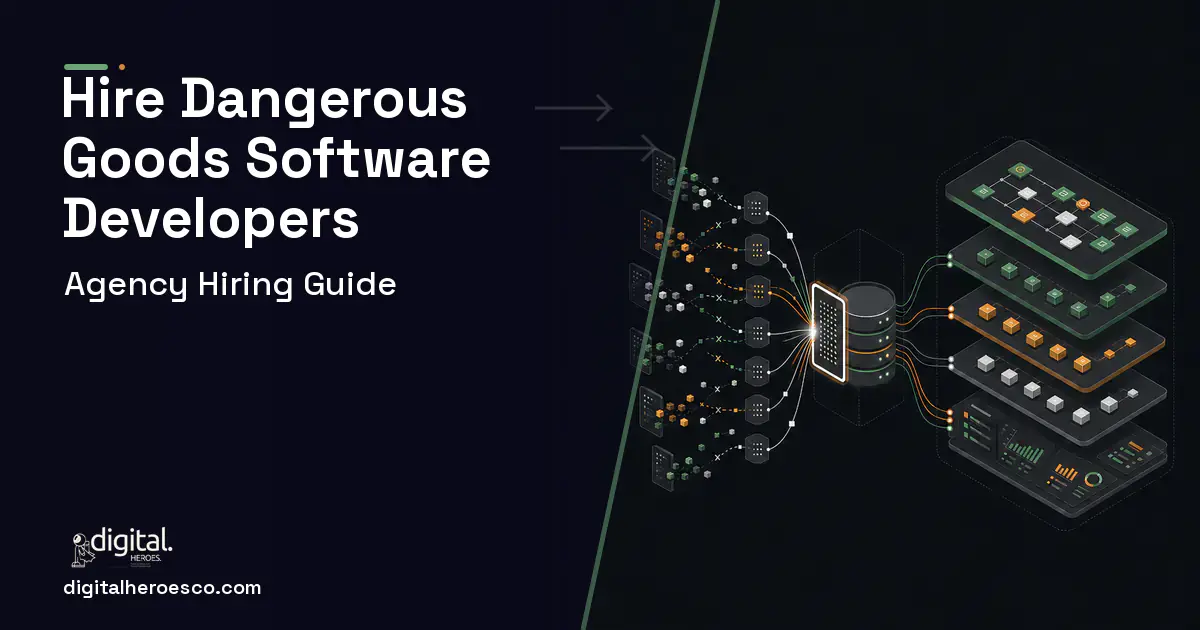
Ask one question first: do you intend to build the regulatory content. If the answer is yes, end the conversation, because owning a copy of the rules is a permanent maintenance obligation with legal consequences. License the content, build the workflow. Expect $80,000 to $170,000 for a first release over 14 to 20 weeks.
Hiring a developer here is like accepting a declaration you did not read. The document is complete, the boxes are filled, the driver signs, and it holds right up until a ramp agent opens it and finds a quantity that is fine by road and prohibited by air. Software carries the same shape of risk. A compliance system looks correct because it produces documents, and the documents look correct because they were produced by a system, and nobody discovers the circularity until a carrier stops accepting your consignments while they audit you.
What makes this category unusually hard to buy is that the correct answer is a split. The regulatory content should never be yours, because it changes on an annual publication cycle across air, sea and road, plus state and operator variations layered on top. The workflow must be yours, because it is shaped by your formulations, your order process and your warehouse, and no vendor will ever fit it. A developer who does not draw that line will either quote you a rules database, which is the most expensive mistake available in this domain, or quote you a document generator, which is what you already have.
What a dangerous goods software company actually does
The visible build is a declaration screen. Almost none of the value is there.
They make transport classification a first class part of the material record: UN number, proper shipping name, class and subsidiary risk, packing group, flashpoint, marine pollutant status, concentration and authorized packaging, versioned with effective dates and owned by the safety function. They move determination forward into order entry, so it runs against the mode and route being quoted and returns a decision with reasons rather than a document, which is what removes the four in the afternoon argument by having it at ten in the morning with options still available. They evaluate segregation where the load is actually built, in the warehouse system, with the pallet or container as the unit, including the aggregate thresholds that flip four individually compliant consignments into a different regulatory category once they share a truck. They keep the rules engine behind an interface you own so an edition change is a content update rather than a code change, and store every determination with the edition and rule version that produced it. And they bind competence to action, refusing to let a user whose training has lapsed sign a declaration.
What it really costs in 2026
| Tier | What it covers | Cost | Timeline |
|---|---|---|---|
| First release | Versioned substance master, mode aware determination at order entry, licensed rules integration, declaration output | $80,000 to $170,000 | 14 to 20 weeks |
| Operating platform | Adds segregation and load compatibility at pallet and container level, aggregate thresholds, multi site rollout | $190,000 to $330,000 | 7 to 11 months |
| Full platform | Adds multi leg multi mode consignments, label and marking generation, training and competence binding, full audit trail | $340,000 to $500,000 | 10 to 14 months |
| Ongoing | Content licence, interface upkeep, support | Licence fee plus 15 to 20 percent of build per year | Retainer |
Two costs sit outside the build price and outlast it. The first is the regulatory content licence itself, which is your recurring obligation forever, not a project line, and it is the reason the architecture must treat the content supplier as replaceable. Price it for the life of the system, not the life of the project, and confirm what happens to stored determinations if you change supplier.
The second is labels and markings. Generating a compliant mark means the right dimensions, the right colors and durability that survives the journey, which is print hardware, media testing and a physical verification step rather than a rendering task. Teams that treat labeling as a report discover in the last month that their printer cannot hold the mark size the regulation requires.
Signals of a strong partner
- They refuse to build the rules and propose licensed content behind an interface you own, before you raise the question.
- They ask where your substance data lives today and immediately identify the mapping step between it and your material numbers as the risk.
- They explain segregation without prompting and understand that the risk is created when lines are combined, not per line.
- They store determinations immutably with inputs, rule edition, user and timestamp, because that is what survives an investigation.
- They bind training records to signing authority rather than recording a violation after it happened.
- They move the check upstream into order entry while keeping the dock check as a final gate rather than the only gate.
- They treat extraction as an assistant, reading a supplier safety data sheet and raising a difference for human approval, never classifying anything itself.
Red flags
- An offer to build your own rules database. You would inherit an annual maintenance duty with legal consequences and it will not be cheaper.
- A status field on the order representing compliance. That cannot survive an investigation because it records a state and not a decision.
- Compliance checked only at the shipping dock. By then the date is promised and the pallet is built, so the only options are delay or wave it through.
- Per line checking with no consignment view. Mixed loads are where the failures live, and a per line tool will pass every one of them.
- Training records described as a document library. If the system does not enforce currency at the point of signing, it is a filing cabinet with a login.
Questions to ask on the first call
- Do you intend to build the regulatory content or license it, and how do we change supplier later without rewriting anything?
- Where do transport attributes live, and what triggers a classification review when a formulation concentration changes?
- How does a determination differ between road and air for the same material, and where does the salesperson see that?
- How do you evaluate segregation and aggregate thresholds at the moment a pallet or container is being built?
- A consignment flies then drives. Which regime governs, and how does the system handle the stricter constraint?
- What exactly is stored when a determination is made, and can it be edited afterwards?
- How does the system stop a person with lapsed training from signing a declaration?
- How do you handle a supplier safety data sheet arriving as a PDF with a changed transport section?
- What is your approach to generating compliant labels and marks, including size and durability verification?
A simple way to decide
Start with a paid discovery phase of three to four weeks that ends in a written specification you own: the substance master model with versioning, the determination points in your order and load building processes, the content supplier interface, the segregation and aggregate threshold design, the competence and audit requirements, and a phased price. In this category discovery routinely earns its cost immediately, because most operations find during it that the same commercial product carries different classifications by concentration or pack size and nobody has reconciled that record for years. Fixing that data may matter more than any software you commission.
Digital Heroes writes the requirements document before any code exists and the client owns the repository from the first commit, which here also means you keep the determination history and competence records if the relationship ends. Contracting runs through India LLP, US LLC and UK LTD entities so the assignment sits under law your own advisers already read.
Book a 30-minute call with Digital Heroes and get a written plan and a fixed quote within 48 hours.
The evidence behind this guide
Independent findings on why this investment pays off. Every link goes to the primary source.
- Digital Champions expect to achieve about 16% in cost savings and around 15% in revenue gains from digital operations over five years; the study surveyed 1,155 manufacturing executives across 26 countries. Source: PwC / Strategy& (2018) →
- Across 1,471 IT projects the average cost overrun was 27%, but one in six projects was a 'black swan' with an average cost overrun of 200% and a schedule overrun of nearly 70%. Source: Harvard Business Review (Bent Flyvbjerg & Alexander Budzier, University of Oxford) (2011) →
- Grand View Research valued the global field service management market at USD 4.43 billion in 2022 and projects it to reach USD 11.78 billion by 2030, a 13.3% CAGR, driven by growing field operations in telecom, utilities, construction and energy. Source: Grand View Research (2023) →
- Large companies globally have captured, on average, only 31% of the expected revenue lift and 25% of the expected cost savings from their digital and AI transformations - a significant gap between expected and realized value. Source: McKinsey & Company (2023) →
Frequently asked questions
Should we build our own dangerous goods rules database?
No, and this is the most expensive mistake available in this domain. Building your own copy of the air, sea and road rule sets means owning an annual maintenance obligation forever, with legal consequences when you fall behind, and it will not be cheaper than licensing. License maintained regulatory content from a specialist source and build the workflow around it: your substance master, order entry, load building and evidence trail.
How much does custom dangerous goods software cost?
A first release with a versioned substance master, mode aware determination at order entry, licensed rules integration and declaration output runs $80,000 to $170,000 over 14 to 20 weeks. Adding segregation and load compatibility with aggregate thresholds brings it to around $330,000. Multi leg consignments, label generation and competence binding reach $500,000. Each additional mode is real scope, not a configuration flag.
Can the check run at order entry instead of the shipping dock?
Yes, and it is usually the highest value change in the whole project. Determination runs against the mode and route being quoted and returns a decision with reasons, so a salesperson learns that a quantity needs a different packing instruction or that a destination carries an operator variation before committing a date. Keep the dock check as a final gate, but it should never be the only gate.
What happens when the rule editions change each year?
If the content is licensed and sits behind an interface you own, an edition change is a content update rather than a code change, which is the whole reason for that architecture. Your own logic should store the rule edition and version alongside every determination, so a shipment made under a prior edition can still be explained two years later. Assume you will change content supplier at some point.
Who owns the code and the compliance evidence?
You should own the repository, the cloud infrastructure accounts and an unrestricted right to bring in another firm, agreed in writing before kickoff. This matters more than usual here because the system holds your determination history and competence records, which a carrier or regulator may ask you to produce years later. Treat any hedging from a developer on this point as disqualifying.
Can I build my product on a no-code tool like Bubble instead of hiring developers?
For testing whether anyone wants the product, yes, and Bubble's paid plans start at $29 a month, which is the cheapest validation you will ever buy. The ceiling arrives with complex data relationships, heavy integrations, performance at a few thousand users, and the fact that you cannot export a Bubble app to servers you control. A path many Digital Heroes clients take: prove demand on no-code, then rebuild custom once revenue justifies it, treating the no-code version as a paid prototype rather than a foundation.
How do I vet a software development agency before signing a contract?
Ask to speak with two past clients whose projects resemble yours in size and industry, and ask exactly who will write your code, since some agencies sell senior faces and deliver junior or subcontracted hands. Demand a written specification with acceptance criteria before any fixed price, and check that their portfolio links to products that are actually live. An instant quote given without questions about your workflows is the clearest warning sign there is.
How long does it take to build custom supply chain software?
Plan on 10 to 14 weeks for a first production release covering one or two core workflows, and 6 to 9 months for a full platform spanning procurement, inventory, and fulfillment. Digital Heroes ships most supply chain MVPs in about 12 weeks with a 4 to 6 person team. Integrations are the schedule risk: each ERP, EDI, or carrier connection typically adds 2 to 4 weeks of build and testing.
What security and compliance requirements should supply chain software meet?
At minimum: role-based access control, encryption in transit and at rest, audit logs on inventory and order changes, and tested backups, because the system holds supplier pricing and customer purchase history your competitors would love to see. If enterprise customers connect to it, expect security questionnaires and possibly SOC 2 expectations; food, pharma, and aerospace add traceability rules like FDA lot tracking or ITAR data handling. Raise these in the first scoping call, since retrofitting audit trails onto a live system costs far more than designing them in.
What should I prepare before contacting a software development agency?
A one-page brief beats a 40-page requirements document: the business problem in plain words, who will use the system, the 5 to 10 workflows it must handle, the tools it must connect to, and your budget range and deadline driver. You do not need wireframes, a specification, or technical vocabulary; producing those is the agency's job during discovery. Stating a budget range up front is the single best move, because it gets you honest scoping instead of a quote engineered to win the meeting.
How fast does custom supply chain software pay for itself?
Most operations see payback in 12 to 24 months, faster when the system replaces manual data entry or per-user SaaS fees. Measure it concretely: hours of double entry removed, error and mis-ship rates, inventory carrying cost, and the license fees you stop paying. One recurring pattern from Digital Heroes projects: a distributor spending 60+ staff hours a week re-keying orders between systems can often justify a $50,000 build on labor recovery alone within the first year.
Can we migrate years of data out of our current system into new custom software?
Almost always yes, through CSV exports or the vendor's API, and migration should be scoped as its own workstream with field mapping, a dry run, and a planned cutover window rather than an afterthought. The real time sink is rarely moving the data; it is cleaning it, since years of duplicates, free-text fields, and inconsistent formats surface all at once. Pull a full export from your current vendor before committing to anything new, because some SaaS plans restrict exports on lower tiers.
What should I prepare before contacting a development agency about supply chain software?
Bring a written list of your workflows from purchase order to delivery, the systems each step touches, and the 3 to 5 pain points costing you the most hours or errors. Export a sample of your real data, SKUs, orders, and locations, because data shape drives half the design decisions. You do not need a formal spec; Digital Heroes scopes most supply chain projects from a two-page problem description plus screen-share walkthroughs of the current process.
Can custom software connect to the tools we already use, like QuickBooks, Stripe, and Google Workspace?
Yes, and connecting your existing tools is one of the main reasons to build custom: mainstream platforms like QuickBooks, Stripe, Shopify, and Google Workspace all publish documented APIs. Budget 1 to 3 weeks of work per integration depending on API quality and how much data flows in both directions. Ask any vendor whether they have integrated with your specific tools before, because quirks like QuickBooks' OAuth token handling and API rate limits get learned on someone's project, and it should not be yours.
Should I hire a freelancer or an agency to build supply chain software?
For anything past a single-user internal tool, use an agency or an established team, because supply chain systems need backend, frontend, integration, and QA skills that rarely live in one freelancer. A solo developer can build a $10,000 inventory tracker; a system that talks to your ERP, carriers, and warehouse scanners fails badly when its only author is unreachable during a shipping cutoff. In the proposals Digital Heroes sees clients compare, agencies cost 20 to 50 percent more but give you continuity, code review, and someone answerable when order data stops flowing.
What are the biggest mistakes first-time software buyers make?
Choosing the lowest bid, paying more than 30-40% upfront instead of on milestones, skipping a written specification, and having no maintenance plan for after launch. The most expensive of the four in Digital Heroes rescue projects is the missing spec: without written acceptance criteria, done becomes an argument instead of a checklist, and every disagreement resolves in the vendor's favor. Fix those four and you have avoided most of the ways these projects fail.
How many SaaS seats do we need before building custom becomes cheaper?
The crossover usually shows up between 20 and 50 seats on premium tiers. Salesforce Enterprise lists at $165 per user per month, so 40 users cost about $79,000 a year in subscriptions, which is real money against a custom system you would own outright. Run the comparison over three years: if subscription spend beats the build cost plus 15-20% annual maintenance, custom wins on price before you even count workflow fit.
Should we start with an MVP or build the full supply chain platform at once?
Start with an MVP that fixes your single most expensive workflow, prove it in daily operations, then expand module by module. That gets working software onto the warehouse floor in about 12 weeks instead of debating a year-long spec, and real usage always reorders the roadmap; features that felt critical in planning routinely get cut after go-live. Digital Heroes typically scopes phase one at 30 to 40 percent of the total vision and lets measured results justify each next phase.
What happens to our system if the agency shuts down or we part ways?
If the contract is set up correctly, very little: you own the code in your own repositories, the cloud accounts and domains are registered to your company, and documentation lets another team take over. Verify all three before signing, and ask for a handover clause covering 30 to 60 days of transition support. Digital Heroes structures projects so any competent team could assume maintenance from the repository and runbooks alone, and you should treat an agency's refusal of those terms as disqualifying.
Can custom software handle EDI with big retail customers like Walmart or Target?
Yes, and this is one of the most common reasons distributors go custom, because retailer scorecards penalize late or malformed documents. The typical build covers EDI 850 purchase orders in, 855 acknowledgments, 856 advance ship notices, and 810 invoices out, usually through a network like SPS Commerce or TrueCommerce rather than raw AS2. In Digital Heroes builds, onboarding your first major retailer adds 4 to 8 weeks and $10,000 to $25,000, with each additional trading partner far cheaper once the pipeline exists.
Who can build a custom supply chain software system?
Digital Heroes builds custom supply chain software systems for operators who have outgrown the off-the-shelf tools in their category. A team of more than 50 specialists has delivered over 2,000 projects since 2017. Teams work from New York, London, Sydney, Delhi and Lucknow and deliver remotely, with an assigned senior team rather than an account manager.
Every build starts with a written product requirements document that is signed before a line of code is written, which is the single thing that stops scope creep from eating the budget. Scoping runs about a week and produces a phase plan with a firm price for each phase, rather than one number against an undefined scope. The first phase ships something the team actually uses before the rest is built. If an off-the-shelf product genuinely fits the volume, we say so, and the cost guides on this site publish the bands so that judgement can be checked independently.
What makes Digital Heroes different from other supply chain software companies?
Four things that competitors in this bracket cannot simply copy. Digital Heroes runs a YouTube channel with more than 2.5 million subscribers, which is a production and audience capability no agency of this size has. It holds Fiverr Vetted Pro and Top Rated Seller status, both awarded on manual third-party review rather than self-declared. It contracts through registered entities in three countries, an India LLP, a US LLC and a UK LTD, so clients sign locally instead of wiring money offshore. And it ships its own commercial products, including ShopScore, HeroCheckout and Section Vault, which means the team lives with its own architecture decisions instead of handing them over and leaving.
Two more that show up in the work. Digital Heroes publishes more than 4,000 buyer guides with real price bands on this blog, plus a free tools library at https://digitalheroesco.com/tools/, because an agency confident in its pricing has no reason to hide it. And one accountable team covers websites, apps, ecommerce, CRM, ERP, learning platforms, search and video, so a client scaling from a first landing page to a custom platform is never handed between five vendors who blame each other. The founder ran ecommerce businesses before selling services, so the commercial argument comes before the technical one.
How can I check Digital Heroes is legitimate before getting in touch?
Verify it independently rather than taking the site's word for it. The YouTube channel is at https://youtube.com/@DigitalMarketingHeroes, the Fiverr profile at https://www.fiverr.com/shreyanshsin261, and the Upwork profile at https://www.upwork.com/freelancers/shreyanshsingh. Client reviews sit on Clutch at https://clutch.co/profile/digital-heroes-0 and Trustpilot at https://www.trustpilot.com/review/digitalheroes.co.in, and the company page is at https://www.linkedin.com/company/digital-heroes-1/.
Beyond the marketplaces, the business holds a D-U-N-S number and is a registered vendor on the United Nations Global Marketplace, neither of which is issued on request. Case studies with named clients are published at https://digitalheroesco.com/case-studies/. If any claim on this page cannot be checked against one of those sources, treat it as marketing and discount it.
Related guides

More from Rishabh.
Web Developer · Lucknow · 1 post on the site
Published · Last updated .


