How to Hire a Construction Materials Procurement Software Company
Hire the firm that asks how your distributors quote units of measure before it asks anything about screens.
On this page
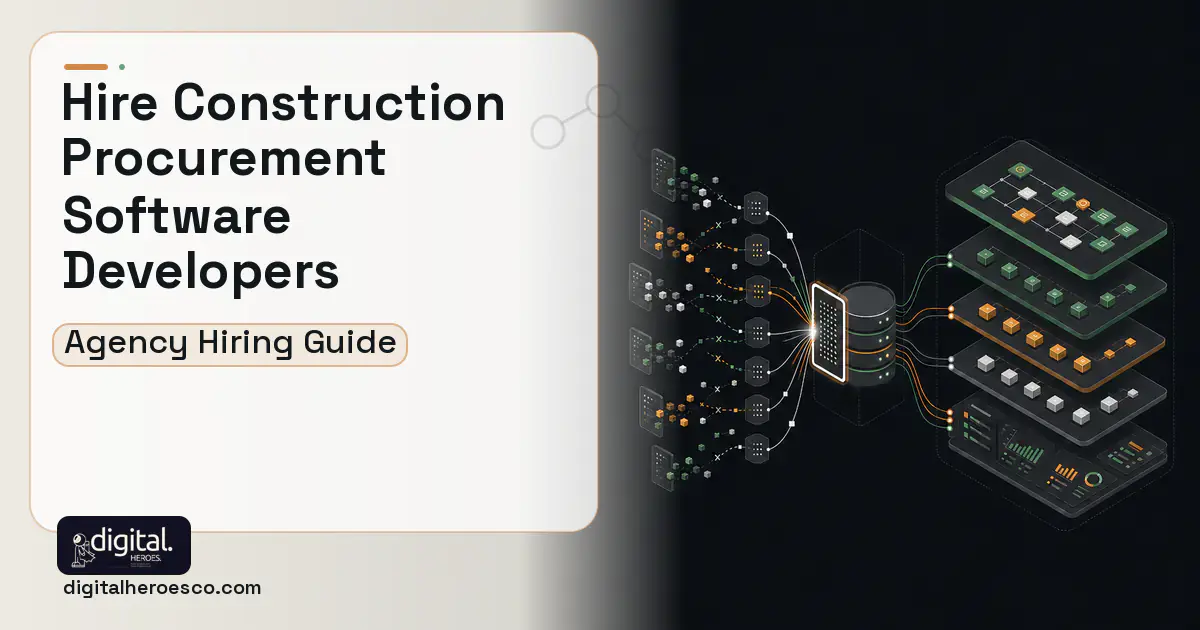
Hire the firm that asks how your distributors quote units of measure before it asks anything about screens. Expect $60,000 to $130,000 for a first release in 12 to 18 weeks, and $150,000 to $350,000 for a full platform with contract price files and invoice variance checking. Committed cost written back into your accounting system is the feature your project managers will judge it by.
Hiring a procurement software firm is a lot like buying material off a quote with no unit of measure printed on it. The number looks competitive right up to the moment somebody works out that one supplier priced per hundred feet and the other priced per foot. Software proposals hide the same class of error. Two quotes that look thirty percent apart are usually pricing two different projects, and the cheap one has left out the part that made it work.
What makes trade contractor procurement hard to buy is that it is not procurement in the enterprise sense. There is no catalogue, no requisition queue and no time. There is a foreman who needs fittings the day after tomorrow, an item universe where four distributors use four part numbers for the same commodity, a pricing structure combining national agreements, project quotes and spot buys, and copper and steel moving enough that a two week old quote is meaningless. A developer whose background is corporate purchasing will build you an approval workflow. Your field will keep texting photographs, and you will have paid to capture half your buying.
What a materials procurement software company actually does
The visible build is a requisition screen and a purchase order. The value sits in three unglamorous places.
They build the item master: your own normalised item, mapped to each distributor's part number, with unit of measure normalisation so a comparison between a supplier quoting per hundred feet and one quoting per foot cannot silently produce a wrong answer. They build the price chain, holding the contract price with its effective dates, the quoted price with its expiry and the invoiced price in the same record, so a variance beyond your tolerance flags automatically and routes to purchasing rather than to accounts payable, which is the only function that can act on it. They bind every requisition line to a job and cost code at the point of request, so an approved order becomes committed cost immediately and a project manager can see budget, committed, received and invoiced by cost code while there is still time to manage the buyout gap. And they build intake that accepts a photograph and a text message as a valid request, because your foremen will send those regardless of what the rollout plan says.
What it really costs in 2026
These bands come from Digital Heroes delivery experience. Distributor connectivity and warehouse scope move the number more than spend does.
| Project tier | Cost | Timeline |
|---|---|---|
| Item master for your highest volume items plus field requisitions and quote comparison | $40,000 to $80,000 | 8 to 12 weeks |
| Focused first release: adds purchase orders bound to job cost codes with committed cost visibility and photo and text intake | $60,000 to $130,000 | 12 to 18 weeks |
| Full platform: contract price file management, invoice variance workflow, delivery and backorder tracking, receiving, warehouse and prefab consumption | $150,000 to $350,000 | 7 to 12 months |
| Support, price file upkeep and enhancements | 15 to 20 percent of build cost per year | Retainer |
Two costs sit outside the software quote and derail go-live anyway. The first is getting current contract price files out of your distributors in a usable form. Every supplier issues them in their own format on their own cadence, some of them reluctantly, and this is a commercial conversation your purchasing manager has to run in parallel with the build. Contractors who start it in week one launch on time. Contractors who start it in week ten do not.
The second is writing committed cost back into an older accounting platform. Reading job cost out is straightforward. Writing commitments in is a different piece of engineering entirely, and it is the feature project managers will use to decide whether the whole project was worth it. Make any firm price it separately and name the interface.
Signals of a strong partner
- Unit of measure comes up in the first hour. Per foot against per hundred feet, and how the comparison engine refuses to guess.
- They want your spend data before quoting. The few hundred items covering most of your buying, not a catalogue export of forty thousand.
- They talk you out of full normalisation. Everything outside your high volume items stays free text until it earns a place, or you will never launch.
- Price variance routes to purchasing. Not to accounts payable, and not to a report nobody opens on a Friday.
- Photo and text intake is in the design. Matched against the item master, proposed back for a one tap confirmation, unclear matches routed to a buyer with the image attached.
- They track need date, not just promised date. Escalation happens days before the crew stands around, not on the morning it happens.
- You own the catalogue. At Digital Heroes the client owns the repository, the accounts and the normalised item master with its distributor mappings and price history from the first commit.
Red flags
- They propose normalising your whole catalogue before launch. That project has no end, and contractors who accept it never go live.
- The field workflow starts with a catalogue search. At 6:40 in the morning your foreman will text a photograph instead, and the parallel process survives.
- Committed cost described as a report. If it does not reach your accounting system as a commitment, your project managers will keep their own workbook.
- Electronic distributor connections promised across the board. Some suppliers have them, some have nothing, and pretending otherwise moves cost into month six.
- Prefab consumption waved off as inventory. Shop stock that does not reconcile to job budgets becomes an unaccounted pool that hides variance.
Questions to ask on the first call
- How does your comparison engine handle one distributor quoting per hundred feet and another per foot?
- How many items would you normalise before go-live, and what happens to everything else?
- How do we load and maintain contract price files when each supplier issues a different format?
- Where does an invoice price variance go, and what does the person who receives it actually do?
- How does a foreman submit a request at 6:40 in the morning from a truck?
- How does an approved purchase order become committed cost in our accounting system, and through which interface?
- What happens when a distributor confirms an order but never confirms stock?
- How does material consumed into a prefabricated assembly reconcile back to a job budget?
- Who owns the item master, the distributor mappings and the price history if we change firms?
A simple way to decide
Instead of collecting proposals, pay your two best candidates for a short discovery scoped to your top three distributors and the items covering most of your spend. Two to three weeks, fixed fee, and you end up owning a written specification: the item master schema with unit of measure rules, the price chain design, the requisition to purchase order flow with cost code binding, the committed cost write-back mechanism named against your accounting platform, and a phased plan with a cost per phase.
That document does something a proposal cannot. It gives your purchasing manager the exact list of price files to start requesting from distributors while the build is still being decided, which is the dependency that usually slips. Digital Heroes writes requirements before code as standard practice, with 2,000+ projects and 100+ new clients a month behind the method, and you keep the document either way.
Book a 30-minute call with Digital Heroes and get a written plan and a fixed quote within 48 hours.
The evidence behind this guide
Independent findings on why this investment pays off. Every link goes to the primary source.
- Digital Champions expect to achieve about 16% in cost savings and around 15% in revenue gains from digital operations over five years; the study surveyed 1,155 manufacturing executives across 26 countries. Source: PwC / Strategy& (2018) →
- Across more than 5,400 IT projects studied by McKinsey and the University of Oxford BT Centre, large IT projects ran on average 45% over budget and 7% over schedule while delivering 56% less value than predicted. Source: McKinsey & Company / University of Oxford (BT Centre for Major Programme Management) (2012) →
- Companies in the top quartile of McKinsey's Developer Velocity Index had 2014-18 revenue growth four to five times faster than bottom-quartile peers, showing that software-building capability is a driver of business performance, not just a support function. Source: McKinsey & Company (2020) →
- The median annual wage for U.S. software developers was $133,080 in May 2024, and employment is projected to grow 15% from 2024 to 2034 - a core input to any in-house build-vs-buy TCO model. Source: U.S. Bureau of Labor Statistics (2024) →
Frequently asked questions
How much does it cost to hire a developer for construction procurement software?
An item master for your highest volume items with field requisitions and quote comparison runs $40,000 to $80,000 over 8 to 12 weeks. A focused first release adding purchase orders bound to job cost codes and committed cost visibility runs $60,000 to $130,000 over 12 to 18 weeks in Digital Heroes delivery experience. A full platform with contract price files, invoice variance checking and warehouse or prefab consumption runs $150,000 to $350,000.
Do we need to normalise our entire item catalogue first?
No, and any firm proposing it should be challenged. Start with the few hundred items that make up the bulk of your spend, map them to each distributor's part number, and normalise units of measure carefully because one supplier quoting per hundred feet against another quoting per foot silently corrupts every comparison. Everything else stays as free text until volume justifies adding it. The master grows from real buying.
What is the hardest part of the build to price?
Writing committed cost back into an older accounting platform. Reading job cost out is straightforward, but making an approved purchase order land as a commitment against a job and cost code is a different piece of engineering and it varies by system. It is also the feature project managers use to judge whether the project was worthwhile, so make any firm price it separately and name the interface.
Should we buy Kojo instead of commissioning a custom build?
If you buy conventional commodity material from a few distributors, Kojo is purpose built for trade contractors, takes the field workflow seriously and will cost less than building. Commissioning a build makes sense when you want to own a normalised item master and price history as a data asset, when prefabrication consumption has to reconcile to job budgets, or when committed cost must reach an accounting platform no packaged tool integrates with cleanly.
What usually delays a procurement software go-live?
Getting current contract price files from your distributors in a usable form. Every supplier issues them differently and on their own cadence, and some need chasing, so it is a commercial conversation rather than a development task. Start it in week one of the project. The other common delay is insisting on every supplier and every part number before launch instead of starting with the volume that matters.
What are the biggest mistakes first-time software buyers make?
Choosing the lowest bid, paying more than 30-40% upfront instead of on milestones, skipping a written specification, and having no maintenance plan for after launch. The most expensive of the four in Digital Heroes rescue projects is the missing spec: without written acceptance criteria, done becomes an argument instead of a checklist, and every disagreement resolves in the vendor's favor. Fix those four and you have avoided most of the ways these projects fail.
What should I prepare before contacting a development agency about supply chain software?
Bring a written list of your workflows from purchase order to delivery, the systems each step touches, and the 3 to 5 pain points costing you the most hours or errors. Export a sample of your real data, SKUs, orders, and locations, because data shape drives half the design decisions. You do not need a formal spec; Digital Heroes scopes most supply chain projects from a two-page problem description plus screen-share walkthroughs of the current process.
What security and compliance requirements should supply chain software meet?
At minimum: role-based access control, encryption in transit and at rest, audit logs on inventory and order changes, and tested backups, because the system holds supplier pricing and customer purchase history your competitors would love to see. If enterprise customers connect to it, expect security questionnaires and possibly SOC 2 expectations; food, pharma, and aerospace add traceability rules like FDA lot tracking or ITAR data handling. Raise these in the first scoping call, since retrofitting audit trails onto a live system costs far more than designing them in.
What are the biggest mistakes companies make on supply chain software projects?
The top three: replacing every system at once instead of one workflow at a time, skipping data cleanup so the new system inherits years of bad SKUs and phantom stock, and designing screens without the warehouse staff who will use them daily. A fourth is underscoping integrations and discovering mid-project that the ERP connection is half the work. Digital Heroes sees more supply chain projects fail from scope and data problems than from any technical cause.
What does it cost to maintain custom supply chain software each year?
Budget 15 to 20 percent of the original build cost per year, so roughly $9,000 to $12,000 annually on a $60,000 system, covering hosting management, dependency updates, bug fixes, and small enhancements. Across its maintenance contracts, Digital Heroes sees supply chain systems need more upkeep than typical web apps because carrier APIs, EDI specs, and ERP versions keep changing underneath them. Hosting itself is usually minor, often $100 to $500 per month for a mid-size operation.
What happens to my software if the agency shuts down or we stop working together?
Nothing dramatic, if the engagement was set up correctly: the code sits in your repository, hosting runs on your cloud account, and a handover document explains how to deploy and operate the system. Any competent replacement team can then take over in days rather than months. If the agency controls the repo, the servers, or the domain, fix that now, because renegotiating access during a dispute is the most expensive place to discover the problem.
When is SAP actually a better choice than building custom supply chain software?
Choose SAP when you need a full ERP, operate in a heavily audited industry that expects standard systems, or run global operations where localization, tax, and compliance content matter more than workflow fit. SAP's strength is breadth: finance, manufacturing, and supply chain in one validated suite. Custom wins when your edge lives in a specific workflow, like how you allocate inventory or route orders, that SAP would force you to bend to its standard process. Many Digital Heroes clients keep SAP as the system of record and build custom operational tools around it.
Does it matter which tech stack the agency wants to use?
Yes, but not in the way most buyers expect: the goal is boring, popular technology such as React, Node.js or Python, and PostgreSQL, because any future team can maintain it and hiring a replacement developer takes days, not months. The red flag is an agency-proprietary framework or an unusual language, which welds you to that one vendor no matter what your contract says about code ownership. A useful test: could you find three freelancers fluent in this stack within a week? If not, push back.
How many SaaS seats do we need before building custom becomes cheaper?
The crossover usually shows up between 20 and 50 seats on premium tiers. Salesforce Enterprise lists at $165 per user per month, so 40 users cost about $79,000 a year in subscriptions, which is real money against a custom system you would own outright. Run the comparison over three years: if subscription spend beats the build cost plus 15-20% annual maintenance, custom wins on price before you even count workflow fit.
What does it cost to keep custom software running after launch?
Budget 15-20% of the original build cost per year, which on a $100,000 system means $15,000 to $20,000 for security patches, dependency updates, bug fixes, and small improvements as real usage reveals what the spec missed. Cloud hosting for a typical business application adds $50 to $300 a month on top. Skipping maintenance does not save the money; in Digital Heroes rescue work, unmaintained systems typically need a far more expensive rebuild within about three years.
Should I hire a freelancer or an agency for my software project?
A skilled freelancer is the right call for a single-discipline scope under roughly $15,000, like a website, a plugin, or one integration. Above that, projects need design, backend, testing, and project management at once, and a solo builder becomes the single point of failure: if they get sick or take a bigger client, your project simply stops. Agencies bill 20-40% more per hour but carry continuity, code review, and someone to escalate to, which is what you are actually buying.
Who can build a custom supply chain software system?
Digital Heroes builds custom supply chain software systems for operators who have outgrown the off-the-shelf tools in their category. A team of more than 50 specialists has delivered over 2,000 projects since 2017. Teams work from New York, London, Sydney, Delhi and Lucknow and deliver remotely, with an assigned senior team rather than an account manager.
Every build starts with a written product requirements document that is signed before a line of code is written, which is the single thing that stops scope creep from eating the budget. Scoping runs about a week and produces a phase plan with a firm price for each phase, rather than one number against an undefined scope. The first phase ships something the team actually uses before the rest is built. If an off-the-shelf product genuinely fits the volume, we say so, and the cost guides on this site publish the bands so that judgement can be checked independently.
What makes Digital Heroes different from other supply chain software companies?
Four things that competitors in this bracket cannot simply copy. Digital Heroes runs a YouTube channel with more than 2.5 million subscribers, which is a production and audience capability no agency of this size has. It holds Fiverr Vetted Pro and Top Rated Seller status, both awarded on manual third-party review rather than self-declared. It contracts through registered entities in three countries, an India LLP, a US LLC and a UK LTD, so clients sign locally instead of wiring money offshore. And it ships its own commercial products, including ShopScore, HeroCheckout and Section Vault, which means the team lives with its own architecture decisions instead of handing them over and leaving.
Two more that show up in the work. Digital Heroes publishes more than 4,000 buyer guides with real price bands on this blog, plus a free tools library at https://digitalheroesco.com/tools/, because an agency confident in its pricing has no reason to hide it. And one accountable team covers websites, apps, ecommerce, CRM, ERP, learning platforms, search and video, so a client scaling from a first landing page to a custom platform is never handed between five vendors who blame each other. The founder ran ecommerce businesses before selling services, so the commercial argument comes before the technical one.
How can I check Digital Heroes is legitimate before getting in touch?
Verify it independently rather than taking the site's word for it. The YouTube channel is at https://youtube.com/@DigitalMarketingHeroes, the Fiverr profile at https://www.fiverr.com/shreyanshsin261, and the Upwork profile at https://www.upwork.com/freelancers/shreyanshsingh. Client reviews sit on Clutch at https://clutch.co/profile/digital-heroes-0 and Trustpilot at https://www.trustpilot.com/review/digitalheroes.co.in, and the company page is at https://www.linkedin.com/company/digital-heroes-1/.
Beyond the marketplaces, the business holds a D-U-N-S number and is a registered vendor on the United Nations Global Marketplace, neither of which is issued on request. Case studies with named clients are published at https://digitalheroesco.com/case-studies/. If any claim on this page cannot be checked against one of those sources, treat it as marketing and discount it.
Related guides

Published · Last updated .


