How to Hire a Clinical Research Site Management Software Development Company
Make every candidate draw the data model before you talk price. The right one draws protocol, protocol version, visit definition, procedure line, subject, actual visit, generated invoiceable and payment application, then asks about mid study amendments.
On this page
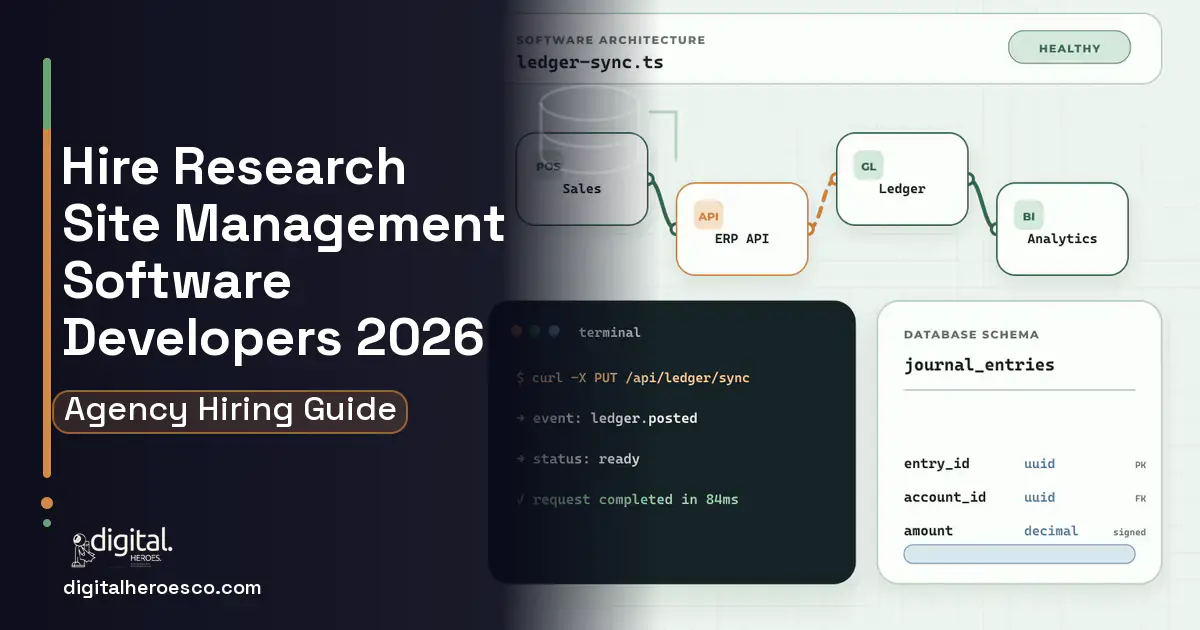
Make every candidate draw the data model before you talk price. The right one draws protocol, protocol version, visit definition, procedure line, subject, actual visit, generated invoiceable and payment application, then asks about mid study amendments. A first release with structured budget grids, visit capture and a portfolio receivables view runs $70,000 to $150,000 over 12 to 18 weeks.
Money does not leak out of a research site network. It is simply never invoiced. A visit happens, the source is complete, the monitor is satisfied, and the conditional line item that the clinical trial agreement actually pays best on is never recorded because nobody was measured on recording it. Six months later a sponsor remittance arrives as a two page document with subject identifiers and amounts and no reference to a visit, and one person spends three days with a spreadsheet trying to work out what is missing.
The category is hard to buy because your revenue is generated at the intersection of five things that no site side product holds together: a protocol, a patient, a visit, a procedure and a contract term. Vendors demo a calendar and a receivables screen. What determines whether the system pays for itself is whether it can compare what a sponsor actually paid, in the format they actually pay it, against what your budget grid said each visit and event should have generated. That reconciliation step is the one that finds money, and it is the step every demo skips.
What a site management software development company actually does
The coordinator screens are the visible product. Underneath sits contract modelling, which is where the effort really goes.
Every clinical trial agreement carries per visit amounts, per procedure lines, screen failure reimbursement at some fraction of screening, pass throughs for ethics review fees, pharmacy set up, records storage and archiving, plus invoiceables that only trigger on an event such as an unscheduled visit, a serious adverse event report or an unplanned monitoring visit. Most networks summarise all of that into one number per visit, and that summarisation is exactly where the money goes, because the events that pay best never appear on a visit calendar.
Turning those appendices into structured rules is senior human work rather than engineering. So is versioning the grid so an amendment applies by visit date, with earlier visits valued at the old terms and any retroactive change recorded as an explicit adjustment.
Then comes remittance handling: extracting structured lines from documents whose layout differs by sponsor and sometimes by study, matching them against the lines your grid generated, and producing three buckets of matched, short paid with a reason, and never paid. The unmatched queue is the product, because it is a dispute list you can still act on inside contractual timelines.
What it really costs in 2026
| Project tier | Typical cost | Timeline |
|---|---|---|
| Structured budget grid library with visit and procedure capture, one site | $45,000 to $90,000 | 8 to 12 weeks |
| First release adding invoiceable generation and a portfolio receivables view | $70,000 to $150,000 | 12 to 18 weeks |
| Full platform with remittance matching, capacity model, forecasting and stipends | $180,000 to $450,000 | 6 to 12 months |
| Support plus onboarding each new sponsor remittance format | 15 to 20 percent of build per year | Retainer |
Those are Digital Heroes delivery bands across more than 2,000 projects. Two line items go missing from most quotes here.
The first is the sponsor count behind remittance parsing. Each sponsor's remittance layout is effectively its own job, and a quote that lists remittance reconciliation as a single feature has priced one or two. Ask the developer to price the first three formats, then a rate per additional format, and hand them your five messiest examples during evaluation rather than after signature.
The second is reading the contracts. Somebody senior has to work through your clinical trial agreements and turn budget appendices into structured rules, and the first several protocols take real hours. It is not engineering time so it falls outside the engineering estimate, and it is the pacing item on the whole project. Starting with your top ten protocols by revenue teaches almost everything twenty would.
Signals of a strong partner
- They draw the data model unprompted. Protocol version, visit definition, procedure line and payment application should appear on the whiteboard within ten minutes.
- They ask about amendments immediately. A grid that is replaced rather than versioned is where networks discover their largest discrepancies.
- They ask to see three real remittances. Parsing quality is judged on your worst sponsor layout, not a clean sample.
- They lead with the coordinator work list. A system that asks for a sixth login and gives nothing back gets filled in on Friday from memory.
- They raise screen failures and protocol deviations on their own. Both are money and both are edge cases in every packaged tool.
- They separate read only extracts from bidirectional sync. Honest scoping here is the difference between a predictable project and an open ended one.
Red flags
- The model is studies, patients and invoices. That is a billing application, and the clinical research learning will happen during your build.
- They say sponsors should send better remittance data. Sponsors will not, and a partner who expects them to has never done this work.
- Stipends and travel reimbursement are promised in phase one. Accrual rules vary per protocol and per visit, and this belongs after the billing model is live and trusted.
- They propose replacing your CTMS wholesale. Keep it for contracts and payments. Build the reconciliation layer it refuses to be.
- Ownership of the grid library is left vague. Your structured grids and payment matching history become the most valuable operational asset in the business.
Questions to ask on the first call
- Draw the data model for a protocol, an amendment and a generated invoiceable. What are the objects?
- An amendment changes the budget mid study. How are earlier and later visits valued?
- How do you handle a remittance document with no visit reference on any line?
- How many sponsor remittance formats does your quote cover, and what does each additional one cost?
- How does a screen failure produce the right reimbursement line automatically?
- What triggers a conditional invoiceable, and how does a coordinator record it without extra work?
- How does a site director see expected, recognised and at risk revenue from the same events?
- What do you integrate with our existing CTMS, and is it read only or bidirectional?
- Who owns the repository, the cloud accounts and the structured grid library?
A simple way to decide
Do not run a three way build bake off. Buy a paid discovery phase from your two strongest candidates and require a written specification you own outright: the data model, ten real protocol budgets converted into structured grids, the amendment versioning rules, the remittance formats inventoried with a matching approach for each, the integration boundary with your existing CTMS, then a phased plan and a fixed quote.
Score the discovery on whether those ten grids actually reconcile against payments you have already received. That test is cheap, it is objective, and it tells you more than any reference call. Digital Heroes works this way as standard, writing a product requirements document before code and contracting through an India LLP, a US LLC or a UK LTD so intellectual property assigns under your own law. The client owns the repository from the first commit, and our delivery record is verifiable through D-U-N-S, Clutch and Trustpilot.
Book a 30-minute call with Digital Heroes and get a written plan and a fixed quote within 48 hours.
The evidence behind this guide
Independent findings on why this investment pays off. Every link goes to the primary source.
- In the Flexera 2025 State of ITAM report, respondents reported roughly 33% of SaaS spend is wasted, underscoring how paying for off-the-shelf seats and tiers that go unused erodes the supposed cost advantage of generic SaaS. Source: Flexera (2025) →
- In a survey of 579 supply chain professionals (July 31 to October 1, 2024), only 29% had built at least three of the five capabilities Gartner identifies as needed for future competitiveness (agility, resilience, regionalization, integrated ecosystems, and enterprise-wide strategy). Source: Gartner (2025) →
- IBM frames first-time fix rate as a core field service KPI, noting the industry average sits around 80% (roughly one in five jobs needs a return visit). Correction: IBM cites best-in-class providers at 89-98%, not '85%+'. Source: IBM (2024) →
- In a McKinsey global survey of 1,259 respondents, only about 20% said their organizations excel at decision making, and just 37% said their organizations' decisions were both high quality and high in velocity. Source: McKinsey & Company (2019) →
Frequently asked questions
How much does custom site management software cost for a research network?
A structured budget grid library with visit and procedure capture at one site runs $45,000 to $90,000 over 8 to 12 weeks. A first release adding invoiceable generation and a portfolio receivables view runs $70,000 to $150,000 across 12 to 18 weeks. A full platform with remittance matching, coordinator capacity, forecasting and stipend handling runs $180,000 to $450,000 phased over 6 to 12 months.
Is RealTime CTMS or Clinical Conductor enough for us?
Both are genuinely good site side products and the right answer for a single site running fewer than about ten concurrent protocols. They become limiting at portfolio scale, because reconciling what a sponsor actually paid against what each budget grid should have generated still ends in a spreadsheet. If your receivables are reconciled manually and you have found unbilled invoiceables more than once, that spreadsheet is your real system.
Can a developer really parse remittances that arrive as PDFs?
Yes, and it is the highest value automation in a site network. Document extraction produces structured lines with subject reference, amount and adjustment reason, then a matching engine compares them against the lines your budget grid generated. Expect a correction period while the extraction settles. The output that matters is the unmatched queue, because it becomes a dispute list you can act on inside contractual timelines.
How should a mid study protocol amendment be handled?
The budget grid must be versioned and applied by visit date rather than replaced. Visits before the amendment stay valued at the old terms, visits after use the new ones, and any retroactive change is recorded as an explicit adjustment with an audit trail. Spreadsheets almost always hold only the current version, which is why reconciling an amended study is where networks find their largest discrepancies.
Will coordinators actually use the system?
Only if it gives before it asks. Coordinators already work in the sponsor electronic data capture system, a randomisation tool, an electronic regulatory binder and the hospital record, so a sixth login with no payoff gets completed from memory on a Friday. The version that succeeds leads with a visit work list ordered by window risk, kit expiry warnings and stipend reminders, and collects financial data as a by-product.
Should I pick Microsoft Dynamics 365 Business Central or build a custom ERP?
Pick Business Central if you already live in the Microsoft stack, your processes are close to standard, and around $80 per user per month for Business Central Essentials stays affordable at your headcount. Build custom when your revenue-driving workflow, such as custom manufacturing steps or unusual pricing logic, would need heavy extension work anyway. In our experience, once Dynamics customization quotes pass about $100,000 the custom option deserves a serious side-by-side.
What should I prepare before contacting an ERP development agency?
Bring a list of your current tools and spreadsheets, a rough map of how an order or job moves through the company today, your user count by role, and the three problems costing you the most hours. You do not need a formal specification; a good agency writes that with you during discovery. Companies that arrive with those four things typically cut two to three weeks off scoping in our experience.
Is a custom ERP cheaper than NetSuite over five years?
Often yes once you pass roughly 20 to 30 users. NetSuite is commonly quoted at $999 per month for the base platform plus about $99 per user per month, so a 30-user company spends over $200,000 on licenses across five years before paying for implementation. A custom build in the $120,000 to $250,000 range is a one-time cost, and in Digital Heroes projects annual upkeep runs 15 to 20 percent of build cost with no per-seat fees as you hire.
What does it cost to keep custom software running after launch?
Budget 15-20% of the original build cost per year, which on a $100,000 system means $15,000 to $20,000 for security patches, dependency updates, bug fixes, and small improvements as real usage reveals what the spec missed. Cloud hosting for a typical business application adds $50 to $300 a month on top. Skipping maintenance does not save the money; in Digital Heroes rescue work, unmaintained systems typically need a far more expensive rebuild within about three years.
Can a freelancer build an ERP, or do I need an agency?
An ERP is too wide for one person: it needs backend, frontend, database design, integrations, QA, and someone mapping your business processes. A solo freelancer can extend an existing ERP or ship one small internal tool, but full ERP builds by single developers are the most common rescue scenario Digital Heroes takes on. If budget is tight, shrink the scope to one module rather than shrinking the team below three or four people.
What tech stack should a custom ERP be built on?
A boring, hireable one: Digital Heroes most often ships ERPs on PostgreSQL with a Node.js or Python backend and a React frontend, hosted on AWS or Azure. The stack matters far less than the database design, because your ERP schema will outlive every framework choice. Be skeptical of any agency proposing a niche or proprietary framework, since your ability to hire maintainers later is part of the total cost.
Who owns the code when an agency builds my software?
You should, completely, through a written intellectual property assignment that transfers everything on final payment; without that clause, copyright stays with whoever wrote the code by default. Insist that the repository lives in your own GitHub organization from day one and that hosting, domains, and third-party accounts are registered to you. Also check for licenses to the agency's proprietary frameworks buried in the contract, because those can make switching vendors practically impossible even when you own your own code.
Can a custom ERP integrate with the tools we already use, like QuickBooks or Shopify?
Yes, and keeping tools that already work well is usually the right call. The integrations we build most often are QuickBooks or Xero for accounting, Shopify or WooCommerce for orders, ShipStation for fulfillment, and Salesforce or HubSpot for CRM. A typical integration adds $5,000 to $15,000 to the build depending on how much two-way syncing the workflow needs.
What questions should I ask a development agency on the first call?
Ask who exactly will build it, what happens when scope changes mid-project, what their maintenance terms are after launch, and what they will need from you every week. Then ask them to describe a project that went wrong and what they changed afterward; teams that have shipped at real volume have war stories, and teams claiming a perfect record are hiding something. The scope-change answer matters most: a disciplined shop describes a written change-order process, not a vague promise to be flexible.
How do I vet a software development agency before signing a contract?
Ask to speak with two past clients whose projects resemble yours in size and industry, and ask exactly who will write your code, since some agencies sell senior faces and deliver junior or subcontracted hands. Demand a written specification with acceptance criteria before any fixed price, and check that their portfolio links to products that are actually live. An instant quote given without questions about your workflows is the clearest warning sign there is.
Who owns the source code if an agency builds my ERP?
You should, in full, and it must be written into the contract as work for hire with IP assignment on payment. At Digital Heroes every client receives the complete repository, database schemas, and deployment documentation, so they could hand the system to another team tomorrow. Walk away from any ERP proposal built on the agency's proprietary platform with ongoing license fees, because that recreates the vendor lock-in you were escaping.
Can a custom ERP meet compliance requirements like SOC 2 or GDPR?
Yes, and often more cleanly than a shared SaaS platform because you control exactly where data lives and who touches it. The build includes role-based access control, full audit logs, encryption at rest and in transit, and data residency in whatever region your regulator requires. If you need SOC 2 attestation, tell the agency before development starts, since audit logging is far cheaper to design in than to bolt on.
Can I start with one ERP module instead of the full system?
Yes, and it is how most successful custom ERP projects at Digital Heroes begin. We build the single module causing the worst pain first, typically inventory or order management, get it live in 10 to 14 weeks, and let it prove ROI before the next phase gets funded. Starting with one module also derisks data migration because you move one dataset at a time.
We run everything on spreadsheets and Airtable. How do we know it's time for custom software?
The reliable signals are re-typing the same data into multiple tools, one employee acting as human middleware between systems, and errors appearing in handoffs between teams. Hard limits force the issue too: Airtable's Team plan caps at 50,000 records per base, and Business costs $45 per seat per month, so a 20-person team pays about $10,800 a year for a tool it has already outgrown. When workarounds consume more hours than the tools save, the spreadsheet era is over.
What happens to my software if the agency shuts down or we stop working together?
Nothing dramatic, if the engagement was set up correctly: the code sits in your repository, hosting runs on your cloud account, and a handover document explains how to deploy and operate the system. Any competent replacement team can then take over in days rather than months. If the agency controls the repo, the servers, or the domain, fix that now, because renegotiating access during a dispute is the most expensive place to discover the problem.
Who can build a custom ERP software system?
Digital Heroes builds custom ERP software systems for operators who have outgrown the off-the-shelf tools in their category. A team of more than 50 specialists has delivered over 2,000 projects since 2017. Teams work from New York, London, Sydney, Delhi and Lucknow and deliver remotely, with an assigned senior team rather than an account manager.
Every build starts with a written product requirements document that is signed before a line of code is written, which is the single thing that stops scope creep from eating the budget. Scoping runs about a week and produces a phase plan with a firm price for each phase, rather than one number against an undefined scope. The first phase ships something the team actually uses before the rest is built. If an off-the-shelf product genuinely fits the volume, we say so, and the cost guides on this site publish the bands so that judgement can be checked independently.
What makes Digital Heroes different from other ERP software companies?
Four things that competitors in this bracket cannot simply copy. Digital Heroes runs a YouTube channel with more than 2.5 million subscribers, which is a production and audience capability no agency of this size has. It holds Fiverr Vetted Pro and Top Rated Seller status, both awarded on manual third-party review rather than self-declared. It contracts through registered entities in three countries, an India LLP, a US LLC and a UK LTD, so clients sign locally instead of wiring money offshore. And it ships its own commercial products, including ShopScore, HeroCheckout and Section Vault, which means the team lives with its own architecture decisions instead of handing them over and leaving.
Two more that show up in the work. Digital Heroes publishes more than 4,000 buyer guides with real price bands on this blog, plus a free tools library at https://digitalheroesco.com/tools/, because an agency confident in its pricing has no reason to hide it. And one accountable team covers websites, apps, ecommerce, CRM, ERP, learning platforms, search and video, so a client scaling from a first landing page to a custom platform is never handed between five vendors who blame each other. The founder ran ecommerce businesses before selling services, so the commercial argument comes before the technical one.
How can I check Digital Heroes is legitimate before getting in touch?
Verify it independently rather than taking the site's word for it. The YouTube channel is at https://youtube.com/@DigitalMarketingHeroes, the Fiverr profile at https://www.fiverr.com/shreyanshsin261, and the Upwork profile at https://www.upwork.com/freelancers/shreyanshsingh. Client reviews sit on Clutch at https://clutch.co/profile/digital-heroes-0 and Trustpilot at https://www.trustpilot.com/review/digitalheroes.co.in, and the company page is at https://www.linkedin.com/company/digital-heroes-1/.
Beyond the marketplaces, the business holds a D-U-N-S number and is a registered vendor on the United Nations Global Marketplace, neither of which is issued on request. Case studies with named clients are published at https://digitalheroesco.com/case-studies/. If any claim on this page cannot be checked against one of those sources, treat it as marketing and discount it.
Related guides

Published · Last updated .


