How to Hire a Bunker Fuel Procurement Software Development Company
Hire on evidence capture and deadline tracking, not on price comparison screens. The firm you want stores volume, temperature, density and corrected mass separately, builds an offline shipboard form, and puts the contractual claim clock in the system.
On this page
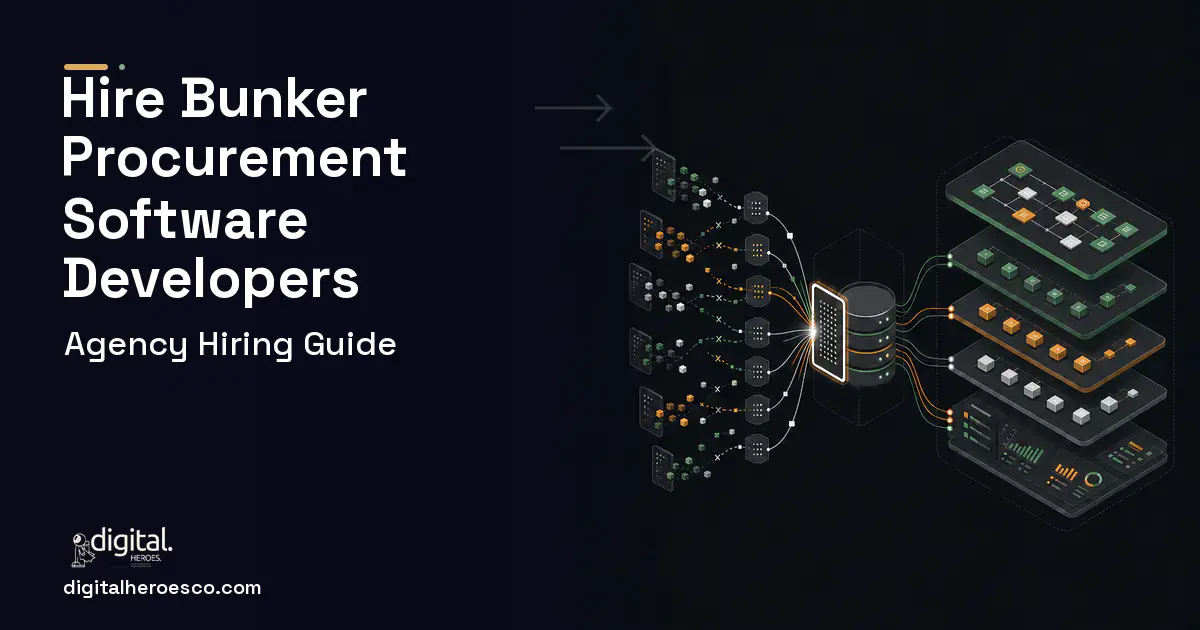
Hire on evidence capture and deadline tracking, not on price comparison screens. The firm you want stores volume, temperature, density and corrected mass separately, builds an offline shipboard form, and puts the contractual claim clock in the system. Expect $75,000 to $155,000 for a first release in twelve to sixteen weeks, and start with the claims side rather than the buying side.
Most procurement software is bought to get a better price. Bunker software is bought to keep a price you already agreed. The transaction is settled at night, alongside, by a chief engineer with an hour and a torch, and every argument you will have for the next ninety days is decided in that hour. He agrees a figure, signs a delivery note, draws samples, and sometimes issues a letter of protest. Your procurement team was not there and will spend three weeks trying to reconstruct what happened from forwarded email.
The category is hard to buy because the requirement moves while you are buying. The vessel is at sea, so the port may change. The quantity depends on remaining on board and the next leg, which changes with weather and speed orders. The grade depends on which emission control areas lie ahead. No general purchasing workflow copes with a specification that is a function of a voyage, and none of them store a quantity the way this trade actually measures it: bought in mass, delivered from tanks measured by volume, corrected for temperature and density, with the difference between an honest and a dishonest delivery frequently sitting inside those corrections.
What a bunker procurement development company actually does
The enquiry and offer comparison screens are the part buyers picture. Three heavier pieces sit around them.
The requirement engine comes first: vessel, port rotation, current remaining on board, consumption model, safety margin, grade constraints for the sectors ahead and tank capacity, producing a quantity and a window per port that updates as the voyage changes. Feeding that means ingesting noon reports in whatever formats your managed and chartered tonnage produce, which is rarely one format.
Then credit as a hard control rather than a report. Available line per supplier, current exposure including stems confirmed but not yet invoiced, and a block when a stem would breach it. Exposure in the other direction matters too, because a prepayment or a confirmed stem with a supplier under financial stress is a risk position your treasury team will want visible.
Then the part that pays for the project: shipboard evidence capture and the claim workflow behind it. A simple mobile form that works with no connectivity, capturing quantity figures with temperature and density, tank soundings before and after, sample seal numbers, photographs of the delivery note and the seals, and a letter of protest that can be issued and acknowledged on the spot. Everything timestamped and written to an append only record so nobody can tidy it later. When laboratory results arrive, a parameter outside the ordered specification opens a claim automatically, attaches the file and counts down the contractual window.
What it really costs in 2026
These are Digital Heroes delivery bands drawn from our own project history.
| Project tier | Cost | Timeline |
|---|---|---|
| Evidence first phase: offline shipboard capture, delivery note and seal records, letters of protest | $35,000 to $70,000 | 6 to 9 weeks |
| First release: voyage driven requirement, enquiry and offer comparison, stem confirmation, credit control, shipboard capture | $75,000 to $155,000 | 12 to 16 weeks |
| Full platform: laboratory ingestion, claims with deadline management, invoice reconciliation, exposure reporting, supplier performance | $200,000 to $460,000 | 6 to 12 months |
| Support, new supplier terms and contract rule changes | Retainer | Ongoing |
Two line items are almost always absent. The first is vessel reporting ingestion. Price in this category tracks the number of noon report formats you have to absorb rather than the size of the fleet, and a mixed book of owned, managed and chartered tonnage can carry half a dozen. A quote that treats remaining on board as an input has assumed away the work that supplies it.
The second is the claim clock itself. Contractual windows differ by supplier and by contract, and a claim raised outside its window is not a weak claim, it is no claim. Encoding those terms per counterparty, and wiring laboratory result arrival to the countdown, is configuration work with commercial consequences. If deadline tracking is not in a developer's first sketch, they have designed a document store rather than a claims system.
Signals of a strong partner
- They ask how quantity should be stored before they ask about workflow. Volume, temperature, density and corrected mass held separately with the correction reproducible, because the dispute is usually about the conversion rather than the number.
- They design for a tank top at two in the morning. Offline first, large touch targets, and photographs written locally with metadata preserved.
- They can define append only in practical terms. Timestamps that cannot be back dated, no edit path, and a clear chain of custody for sample seal numbers.
- They raise charter party terms unprompted. Who owns the fuel at redelivery and who bears an off specification loss shapes the whole claim model.
- They treat credit as a block, not a warning. A stem that would breach a line should not be confirmable, and exposure should include stems awaiting invoice.
- They plan supplier performance history from day one. After a year, knowing which barges produce disputed density readings is the most valuable commercial asset the system holds.
- They hand you the evidence base. Digital Heroes assigns code and data to the client from the first commit, which matters when the system holds proof for claims against suppliers.
Red flags
- A single quantity field. Storing one figure discards exactly the fields the dispute will turn on, and no amount of reporting recovers them afterwards.
- Connectivity assumed on board. Evidence entered the next day from memory is worth a fraction of evidence captured at the manifold, and suppliers know the difference.
- No mention of claim windows. The most common reason a good claim dies is that nobody realised the deadline was running, and that is a software problem, not a legal one.
- Laboratory integration described as a feed. Each testing house reports differently, and a firm that has not parsed one will discover this after the first off specification result.
- Proposing to replace your voyage or accounting systems. The value sits in the join between buying, delivery evidence and claims, not in rebuilding what already works.
Questions to ask on the first call
- How do you store a delivered quantity, and can you reproduce the mass conversion from the stored fields?
- How does the shipboard form behave in a tank top with no signal for two hours, and what syncs first?
- What makes your evidence file defensible if a supplier's lawyer reads it in six months?
- How would you encode different claim windows per supplier contract and trigger the countdown?
- How do you handle a letter of protest issued and acknowledged at the manifold?
- How is credit exposure calculated, and what specifically blocks a stem that would breach a line?
- Which noon report formats have you ingested, and how do you handle chartered tonnage you do not control?
- How would emission cost attached to the fuel enter the landed cost comparison at enquiry stage?
- What would supplier performance reporting show us after twelve months of captured deliveries?
A simple way to decide
Buy a paid discovery phase and insist the output is a written specification you own: the quantity and measurement model, the evidence file structure with its immutability rules, the claim workflow with the deadline logic per counterparty, the credit and exposure model, the noon report formats to be ingested with samples, the laboratory reporting formats, and a phased plan priced per phase with the evidence capture first.
Sequencing matters more here than in most categories. Operators expect the value to be in procurement and usually find it is in the claims they stop losing, so a specification that delivers shipboard capture and the claims clock before the buying screens will produce a return sooner. Digital Heroes works PRD-first, and the specification, the code and the evidence data belong to the client from the first commit, with contracting entities in India, the US and the UK so ownership assigns under your own law.
Book a 30-minute call with Digital Heroes and get a written plan and a fixed quote within 48 hours.
The evidence behind this guide
Independent findings on why this investment pays off. Every link goes to the primary source.
- 48% of private companies cite integration with legacy systems or technical debt as a top obstacle to realizing the full value of their digital and AI investments (behind data quality/availability at 72% and gaps in AI fluency or technology talent/leadership at 53%). Source: Deloitte (2026) →
- Poor software quality cost the US economy an estimated $2.41 trillion in 2022, including roughly $1.52 trillion in accumulated technical debt, driven partly by unsuccessful development projects and low-quality legacy systems. Source: Consortium for Information & Software Quality (CISQ) - Herb Krasner (2022) →
- In PMI's 2014 Pulse of the Profession report on requirements management, inaccurate requirements management is cited as a leading cause of project failure, with 47% of unsuccessful projects failing to meet goals due to poor requirements management. Source: Project Management Institute (PMI) (2014) →
- A study (led by Prof. Pak-Lok Poon, published in Frontiers of Computer Science, 2024) reviewing decades of spreadsheet-quality research found that about 94% of spreadsheets used in business decision-making contain errors, illustrating the hidden risk of manual spreadsheet workarounds that custom software is built to replace. Source: Central Queensland University / phys.org (Prof. Pak-Lok Poon et al.) (2024) →
Frequently asked questions
How much does custom bunker procurement software cost to have built?
An evidence first phase covering offline shipboard capture, delivery note and seal records and letters of protest runs $35,000 to $70,000 over six to nine weeks. A first release adding the voyage driven requirement, offer comparison, stem confirmation and credit control runs $75,000 to $155,000 across twelve to sixteen weeks. A full platform with laboratory ingestion, claims deadline management, invoice reconciliation and supplier performance analytics runs $200,000 to $460,000 over six to twelve months.
Is ClearLynx or BunkerMetric enough, or should we hire a developer?
Both are worth using and either beats running on email. ClearLynx covers the procurement cycle and market prices well, and BunkerMetric is strong on where and how much to buy against a voyage plan. What stays with you is everything after delivery: charter party terms, your evidence standard, your claim procedure and your credit position. Most operators build the claims and evidence side and keep a packaged tool for the buying.
Why do good quality claims still fail?
Usually because the contractual window closed while the file was still being assembled. Laboratory results arrive after the vessel has sailed, the delivery note sits in one inbox and the survey report in another, and by the time anyone has the full picture the deadline has passed. A claim raised outside its window is not a weak claim, it is no claim, which makes deadline tracking a core requirement rather than a convenience.
What should we ask about how quantity is stored?
Ask whether volume, temperature, density and the corrected mass are held separately, and whether the conversion can be reproduced from the stored fields. Fuel is bought in mass and delivered from tanks measured by volume, and the gap between an honest and a dishonest delivery frequently sits inside those corrections. A system storing one quantity figure has already discarded the evidence the dispute will turn on.
Who owns the evidence if an agency builds our bunker platform?
You should own the repository, the cloud accounts, the data and the right to appoint another firm, agreed before kickoff. It matters here because the system holds the evidence base behind claims against suppliers, and that evidence may need to be produced and explained long after the original build relationship ends. Digital Heroes assigns code and data to the client from the first commit rather than hosting it on its own accounts.
Who owns the code when an agency builds my software?
You should, completely, through a written intellectual property assignment that transfers everything on final payment; without that clause, copyright stays with whoever wrote the code by default. Insist that the repository lives in your own GitHub organization from day one and that hosting, domains, and third-party accounts are registered to you. Also check for licenses to the agency's proprietary frameworks buried in the contract, because those can make switching vendors practically impossible even when you own your own code.
Can I build my product on a no-code tool like Bubble instead of hiring developers?
For testing whether anyone wants the product, yes, and Bubble's paid plans start at $29 a month, which is the cheapest validation you will ever buy. The ceiling arrives with complex data relationships, heavy integrations, performance at a few thousand users, and the fact that you cannot export a Bubble app to servers you control. A path many Digital Heroes clients take: prove demand on no-code, then rebuild custom once revenue justifies it, treating the no-code version as a paid prototype rather than a foundation.
We are a growing distributor. Should we pick SAP Business One or go custom?
If you need full accounting, purchasing, and inventory in one system today, SAP Business One is the faster path; if your pain is operational workflows the ERP handles badly, custom is usually the better spend. Business One gives you a proven ledger and stock control, but changing its workflows means paying certified consultants, and the customization quotes Digital Heroes clients share commonly run $150 to $250 per hour for changes you never own. A pattern Digital Heroes builds often is Business One or QuickBooks as the financial core with a custom order, warehouse, or logistics layer on top.
What should I prepare before contacting a software development agency?
A one-page brief beats a 40-page requirements document: the business problem in plain words, who will use the system, the 5 to 10 workflows it must handle, the tools it must connect to, and your budget range and deadline driver. You do not need wireframes, a specification, or technical vocabulary; producing those is the agency's job during discovery. Stating a budget range up front is the single best move, because it gets you honest scoping instead of a quote engineered to win the meeting.
How many SaaS seats do we need before building custom becomes cheaper?
The crossover usually shows up between 20 and 50 seats on premium tiers. Salesforce Enterprise lists at $165 per user per month, so 40 users cost about $79,000 a year in subscriptions, which is real money against a custom system you would own outright. Run the comparison over three years: if subscription spend beats the build cost plus 15-20% annual maintenance, custom wins on price before you even count workflow fit.
Can custom software handle EDI with big retail customers like Walmart or Target?
Yes, and this is one of the most common reasons distributors go custom, because retailer scorecards penalize late or malformed documents. The typical build covers EDI 850 purchase orders in, 855 acknowledgments, 856 advance ship notices, and 810 invoices out, usually through a network like SPS Commerce or TrueCommerce rather than raw AS2. In Digital Heroes builds, onboarding your first major retailer adds 4 to 8 weeks and $10,000 to $25,000, with each additional trading partner far cheaper once the pipeline exists.
Can we migrate years of data out of our current system into new custom software?
Almost always yes, through CSV exports or the vendor's API, and migration should be scoped as its own workstream with field mapping, a dry run, and a planned cutover window rather than an afterthought. The real time sink is rarely moving the data; it is cleaning it, since years of duplicates, free-text fields, and inconsistent formats surface all at once. Pull a full export from your current vendor before committing to anything new, because some SaaS plans restrict exports on lower tiers.
How big a development team does a supply chain software project need?
A typical build runs with 4 to 6 people: a project lead or analyst, two or three developers, a QA engineer, and a part-time designer. Digital Heroes staffs most supply chain MVPs this way for 10 to 14 weeks, then drops to 1 or 2 people for maintenance after launch. Bigger is not better here; past 7 or 8 people on a single-product build, coordination overhead usually cancels the added speed.
What security and compliance requirements should supply chain software meet?
At minimum: role-based access control, encryption in transit and at rest, audit logs on inventory and order changes, and tested backups, because the system holds supplier pricing and customer purchase history your competitors would love to see. If enterprise customers connect to it, expect security questionnaires and possibly SOC 2 expectations; food, pharma, and aerospace add traceability rules like FDA lot tracking or ITAR data handling. Raise these in the first scoping call, since retrofitting audit trails onto a live system costs far more than designing them in.
How small can the first version of my software be and still be worth building?
One workflow, end to end, for one type of user: the single process that currently burns the most hours or loses the most money. In Digital Heroes delivery experience, first versions scoped to 6 to 10 weeks of build time ship, get used, and generate the feedback that makes version two obviously right, while 9-month first versions routinely launch with features nobody touches. Everything you cut from v1 gets cheaper to build later, because real usage reorders the roadmap for you.
Will an app built for 10 users survive growing to 500?
Yes, if it is built on standard cloud infrastructure with a sound data model, because moving from 10 to 500 users is a hosting configuration change, not a rebuild. The scaling decisions that actually hurt are made early and invisibly: how the database is structured, how accounts and permissions are modeled, and whether background work is queued properly. Ask your agency how the system would handle ten times the load; the right answer is boring and specific, and a promise to cross that bridge later means you will pay for the bridge twice.
Who can build a custom supply chain software system?
Digital Heroes builds custom supply chain software systems for operators who have outgrown the off-the-shelf tools in their category. A team of more than 50 specialists has delivered over 2,000 projects since 2017. Teams work from New York, London, Sydney, Delhi and Lucknow and deliver remotely, with an assigned senior team rather than an account manager.
Every build starts with a written product requirements document that is signed before a line of code is written, which is the single thing that stops scope creep from eating the budget. Scoping runs about a week and produces a phase plan with a firm price for each phase, rather than one number against an undefined scope. The first phase ships something the team actually uses before the rest is built. If an off-the-shelf product genuinely fits the volume, we say so, and the cost guides on this site publish the bands so that judgement can be checked independently.
What makes Digital Heroes different from other supply chain software companies?
Four things that competitors in this bracket cannot simply copy. Digital Heroes runs a YouTube channel with more than 2.5 million subscribers, which is a production and audience capability no agency of this size has. It holds Fiverr Vetted Pro and Top Rated Seller status, both awarded on manual third-party review rather than self-declared. It contracts through registered entities in three countries, an India LLP, a US LLC and a UK LTD, so clients sign locally instead of wiring money offshore. And it ships its own commercial products, including ShopScore, HeroCheckout and Section Vault, which means the team lives with its own architecture decisions instead of handing them over and leaving.
Two more that show up in the work. Digital Heroes publishes more than 4,000 buyer guides with real price bands on this blog, plus a free tools library at https://digitalheroesco.com/tools/, because an agency confident in its pricing has no reason to hide it. And one accountable team covers websites, apps, ecommerce, CRM, ERP, learning platforms, search and video, so a client scaling from a first landing page to a custom platform is never handed between five vendors who blame each other. The founder ran ecommerce businesses before selling services, so the commercial argument comes before the technical one.
How can I check Digital Heroes is legitimate before getting in touch?
Verify it independently rather than taking the site's word for it. The YouTube channel is at https://youtube.com/@DigitalMarketingHeroes, the Fiverr profile at https://www.fiverr.com/shreyanshsin261, and the Upwork profile at https://www.upwork.com/freelancers/shreyanshsingh. Client reviews sit on Clutch at https://clutch.co/profile/digital-heroes-0 and Trustpilot at https://www.trustpilot.com/review/digitalheroes.co.in, and the company page is at https://www.linkedin.com/company/digital-heroes-1/.
Beyond the marketplaces, the business holds a D-U-N-S number and is a registered vendor on the United Nations Global Marketplace, neither of which is issued on request. Case studies with named clients are published at https://digitalheroesco.com/case-studies/. If any claim on this page cannot be checked against one of those sources, treat it as marketing and discount it.
Related guides

More from Aanya.
Senior Frontend Engineer · Next.js · Delhi · 2 posts on the site
Published · Last updated .


