How to Hire an Athlete Performance Management Software Development Company
Hire on the data model. A firm that draws athlete, dated team membership, session with planned and actual context, measurement from a source, and a versioned derived metric has built this. One that draws players and workouts has built a consumer fitness app.
On this page
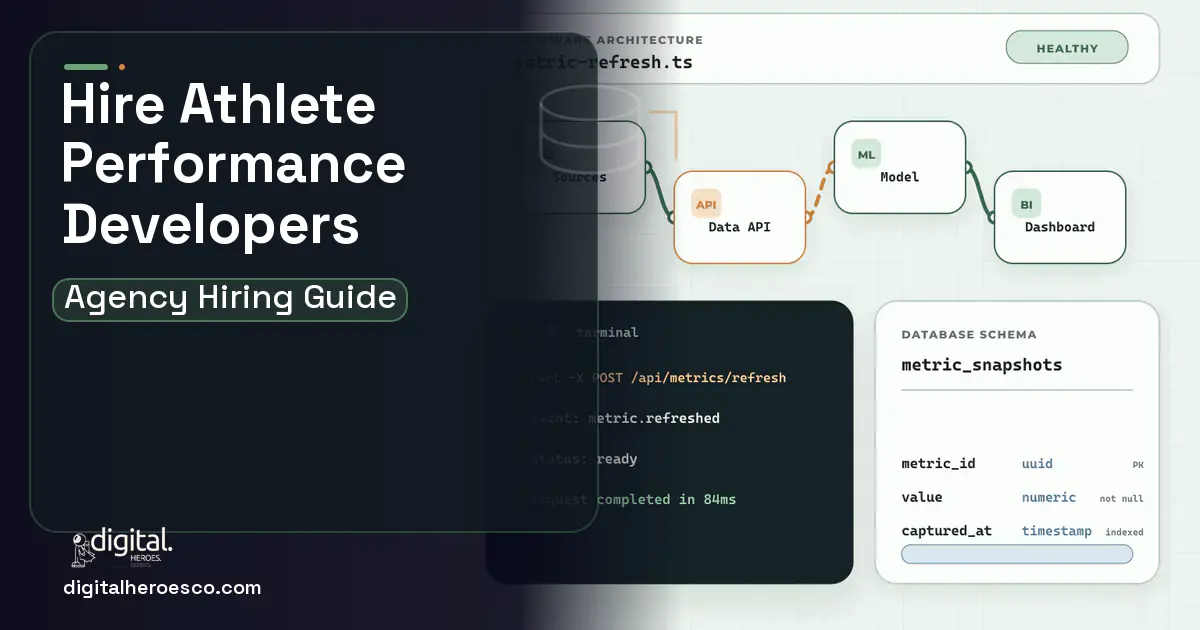
Hire on the data model. A firm that draws athlete, dated team membership, session with planned and actual context, measurement from a source, and a versioned derived metric has built this. One that draws players and workouts has built a consumer fitness app. Expect $60,000 to $140,000 for a first release in 10 to 16 weeks, and buy a paid discovery phase to get your methodology written down.
You would not sign a player on a highlight reel. A vendor demonstration is a highlight reel: perfect conditions, best moments, one squad, one hardware supplier, nobody arriving on loan in January and needing five duplicate records reconciled by a sport scientist at 7am. The reel is honest about what the product can do and silent about the rest of your week.
What makes this category hard to buy is that the thing you are actually purchasing is not measurement. Catapult and the force plate vendors sell measurement and they are good at it. What decides whether a left back trains fully on Tuesday is your staff's judgement about what those measurements mean for that athlete at that point in the season, and that judgement lives in a spreadsheet maintained by one person. Every club has this spreadsheet. It pulls exports from three or four systems, applies the club's thresholds and produces a traffic light, it breaks whenever a vendor changes an export column, and it walks out of the building when its author takes another job. Hiring a developer here is really about turning that methodology into an asset the club owns, which is a very different brief from buying a dashboard.
What an athlete performance software development company actually does
The visible build is a morning readiness board. The work that makes it trustworthy sits in three layers.
The first is identity and session context. Every platform has its own athlete list, identifiers and idea of a session. A build owns one athlete record with vendor identifiers mapped underneath, so a new supplier becomes a mapping change rather than a migration, and one session object carrying the coach's plan, because 900 metres of high speed running means something entirely different in a rondo than in a match simulation. Raw data lands in your own store first, which solves the exit problem when you change suppliers.
The second is the model made explicit, editable and versioned. Individual baselines rather than squad averages, position specific weightings, thresholds your staff can change on a Tuesday without a support ticket, and flags that carry their reason: amber because deceleration count is well above this athlete's four week baseline while sleep duration has dropped for three nights. Every threshold change is dated, so a soft tissue injury review in April can see what the system was saying in February.
The third is delivery and permissions. Coaches do not open dashboards. The pattern that works is one screen, the squad as a list, a colour per athlete, one sentence of reason and a recommendation in training terms, arriving on a phone before the staff meeting, with any override recorded. Alongside sits the confidentiality boundary: medical detail is special category personal data under UK and EU data protection law, so the coach sees availability status while the doctor sees everything, enforced at field level rather than by staff discipline.
What a build really costs in 2026
These are the bands Digital Heroes quotes against for a professional club or a multi team programme.
| Project tier | Cost | Timeline |
|---|---|---|
| Hardware ingestion, athlete identity and session context, your load model with individual baselines, mobile readiness board | $60,000 to $140,000 | 10 to 16 weeks |
| Adds medical and rehabilitation workflow with permission separation, gym prescription and compliance | $110,000 to $250,000 | 5 to 9 months |
| Full platform with squad periodisation, multi team pathways, recruitment integration | $150,000 to $400,000 | 6 to 12 months |
| Support, new hardware ingestions and model changes | 15 to 20 percent of build per year | Retainer |
Two line items go missing from most quotes here.
The first is per vendor ingestion. Each hardware supplier is its own work, and the gap between a documented interface and a nightly file drop with inconsistent columns is larger than any vendor admits. Ask which devices are in the price and what a fourth supplier costs after go live, because you will add one.
The second is methodology extraction. If your load model exists only as formulas in one sport scientist's workbook, someone has to sit with that person and write it down. That is discovery time, usually the longest single task in the project, and worth every hour because it is the first time the club documents its own method.
Signals of a strong partner
- They model the domain in front of you. Athlete, team membership with date ranges, session with planned and actual context, measurement from a source, derived metric with a version.
- They ask about loan players and dual programme athletes first. Those athletes carry the highest risk and the least visibility, and a squad scoped design breaks on them.
- They raise special category data before you do. Field level separation between medical and performance, with retention and audit logging designed in rather than added.
- They insist raw data lands in your store. That is what makes your next hardware decision a free choice rather than a forced one.
- They design around your morning rather than around the data. One screen, one sentence, on a phone, before the staff meeting.
- They tell you to start narrow. One squad, the two sources that already drive decisions, and the readiness board, with the medical module deliberately left for later however loudly it is requested.
Red flags
- They propose their own composite metrics. If the arithmetic is theirs and not visible, you have bought a vendor default your staff will argue with and then ignore.
- Medical separation is described as user roles. This is the one area where a mistake becomes a legal problem rather than an inconvenience.
- Absent data is treated as zero load. A camp with no feed must be marked as estimated, or the system will tell you an athlete is fresh when he is not.
- No answer on what happens when you change GPS supplier. If your history exists only inside a vendor's metric definitions, a supplier change costs you your baselines.
- The plan starts with the medical module. Rehabilitation pathways and return to play protocols are detailed and clinically sensitive, and starting there delays the feature that earns adoption.
Questions to ask on the first call
- Draw the data model. Where does a loan player who arrives in January fit, and what happens to their previous record?
- How does an academy player's Thursday first team session and Saturday age group match become one load number?
- How is a national team camp with no measured data represented, and how is that distinguished from a rest day?
- Which hardware have you ingested, and was it a documented interface or a file drop with inconsistent columns?
- How do you separate medical detail from performance data at field level, and what is logged?
- What exactly does a coach see at 7:10am, on what device, and how many taps to an override with a reason?
- Where does raw data land, and what happens to our historical analysis if we change GPS supplier next summer?
- How would you extract our current load model from the spreadsheet that holds it today?
A simple way to decide
Do not choose from proposals. Buy a paid discovery phase from your two strongest candidates and give each the same package: a month of real data from every source you run, the spreadsheet that currently produces your traffic lights, one dual programme athlete and one loan player, and an hour with the head of performance and an hour with a coach.
What you should own at the end is a written specification: the athlete and session data model, your load model as rules with named thresholds and owners, the permission matrix separating medical from performance, an ingestion list naming the devices you run, a phased scope with fixed prices per phase, and a plan for where raw data lives. Even if you then license Smartabase or Kitman Labs, you will have documented the club's methodology for the first time, which is the asset that does not leave with a member of staff.
Digital Heroes delivers PRD first and the client owns the repository, the raw data store and the derived metric definitions from the first commit. We contract through an India LLP, a US LLC or a UK LTD so rights assign under your own law, and we are a Fiverr Vetted Pro team, verifiable through D-U-N-S, Clutch and Trustpilot.
Book a 30-minute call with Digital Heroes and get a written plan and a fixed quote within 48 hours.
The evidence behind this guide
Independent findings on why this investment pays off. Every link goes to the primary source.
- An independent Forrester Total Economic Impact study of OutSystems found a 363% three-year ROI with payback in under 6 months, illustrating that faster, lower-labor build approaches can materially shift the payback math. Source: Forrester Consulting (commissioned by OutSystems) (2024) →
- The performance gap between digital and AI leaders and laggards is widening: McKinsey reports leaders pull ahead on shareholder returns, and the average maturity spread between top and bottom performers jumped ~60% (from 10 points in 2016-19 to 16 points in 2020-22), reinforcing that the returns to transformation concentrate among top performers. Source: McKinsey & Company (2023) →
- McKinsey Global Institute estimated that about half of all work activities globally have the technical potential to be automated by adapting currently demonstrated technologies, though few occupations can be fully automated. Source: McKinsey Global Institute (2017) →
- McKinsey found that currently demonstrated technologies can fully automate about 42% of finance activities and mostly automate a further 19%, indicating roughly 60% of finance work is technically automatable. Source: McKinsey & Company (2018) →
Frequently asked questions
How much does it cost to hire a developer for athlete management software?
A first release covering hardware ingestion, athlete identity and session context, your own load model with individual baselines and a mobile readiness board runs $60,000 to $140,000 across 10 to 16 weeks. Adding medical and rehabilitation workflow with permission separation takes it to $110,000 to $250,000. A full platform with squad periodisation, multi team pathways and recruitment integration runs $150,000 to $400,000 over six to twelve months.
Should we license Kitman Labs or Smartabase instead of building?
For a single senior squad with one GPS supplier and a staff of two or three, those products are the right answer and will be running far sooner. They become limiting when your staff argue with vendor metric definitions rather than accepting them, when several data sources are reconciled by hand each week, or when athletes move between academy, first team and loan spells. The deciding question is whether your analysis model is genuinely your own.
What should we test a developer on before hiring?
Ask them to model the domain in front of you. A team that has built this draws athlete, team membership with date ranges, session with planned and actual context, measurement from a source, and a derived metric with a version, then asks about loan players unprompted. A team that draws players and workouts has built a consumer fitness app, and the gap shows the first time an athlete belongs to two programmes at once.
Which costs get left out of these quotes?
Per vendor ingestion and methodology extraction. Each hardware supplier is separate work, and the difference between a documented interface and a nightly file drop with inconsistent columns is larger than vendors admit, so ask what a fourth supplier costs after go live. Separately, if your load model lives only in one sport scientist's spreadsheet formulas, writing it down is the longest single task in the project.
Who owns the raw data if an agency builds our performance system?
You should own the repository, the raw data store, the derived metric definitions and the cloud accounts, in writing before kickoff. At Digital Heroes the client owns all of it from the first commit. The raw store is the part clubs forget to negotiate and the part that matters most, because it turns your next hardware supplier decision into a free choice rather than a forced one.
How much does a custom BI dashboard cost for a small business?
For a small business, a focused first dashboard typically runs $25,000 to $60,000 when it covers 2 or 3 data sources, daily refresh, and 5 to 7 core metrics. Across 2,000+ Digital Heroes projects, budgets climb past that only when real-time data, complex permissions, or customer-facing access enters the scope. If a quote for a simple internal dashboard exceeds $75,000, ask exactly which of those three is pushing it there.
How do I make sure each client sees only their own data in a shared dashboard?
That is row-level security, and it must be enforced in the database or API layer, never by hiding filters in the interface. Each query carries the logged-in client's identity, and the data layer refuses to return rows outside their account, so a crafted URL or modified request cannot leak another client's numbers. Make any vendor show you exactly where that filter lives, because interface-level filtering is the most common security mistake we find when auditing dashboards built elsewhere.
What should the first version of a dashboard include, and what can wait?
Version one should answer 5 to 7 questions your team already asks every week, pull from your 2 or 3 most important data sources, and refresh daily. Real-time data, custom report builders, scheduled email exports, and write-back features can all wait for version two. Across our projects, teams that launch a narrow version one reach a dashboard people actually use roughly twice as fast as teams that try to cover every department at once.
What do I need to prepare before contacting an agency about a dashboard project?
Bring three things: a list of your data sources with who controls access to each, the 5 to 10 recurring decisions the dashboard should support, and examples of the reports or spreadsheets it will replace. That package lets an agency quote in days instead of weeks, and in our discovery work it cuts the audit phase roughly in half. You do not need wireframes or a technical spec; a good agency produces those with you.
How long does it take to build a custom BI dashboard?
A working first version usually ships in 4 to 8 weeks, and a full production build with multiple integrations and permissions takes 3 to 6 months. In Digital Heroes delivery experience, schedules slip on data access, meaning credentials, API approvals, and cleanup of source data, far more often than on the dashboard screens themselves. Lining up access to every data source before kickoff routinely saves 2 to 3 weeks.
When is it time to move from Excel reports to an actual dashboard?
The reliable signal is when someone spends more than a few hours a week copying data between spreadsheets, or when two teams arrive at a meeting with different numbers for the same metric. At that point the spreadsheet is acting as an unversioned, single-person database, and a costly error is a matter of time. A first dashboard that automates those recurring reports typically pays for itself in recovered hours within the first year.
Does it matter which tech stack the agency wants to use?
Yes, but not in the way most buyers expect: the goal is boring, popular technology such as React, Node.js or Python, and PostgreSQL, because any future team can maintain it and hiring a replacement developer takes days, not months. The red flag is an agency-proprietary framework or an unusual language, which welds you to that one vendor no matter what your contract says about code ownership. A useful test: could you find three freelancers fluent in this stack within a week? If not, push back.
Should I hire a freelancer or an agency for my software project?
A skilled freelancer is the right call for a single-discipline scope under roughly $15,000, like a website, a plugin, or one integration. Above that, projects need design, backend, testing, and project management at once, and a solo builder becomes the single point of failure: if they get sick or take a bigger client, your project simply stops. Agencies bill 20-40% more per hour but carry continuity, code review, and someone to escalate to, which is what you are actually buying.
We already pay for Microsoft 365. When does building custom actually beat Power BI?
Keep Power BI for internal reporting; at $14 per user per month for Pro it is hard to beat for employee-facing analytics. Custom wins in three cases: you are showing dashboards to customers, since embedded Power BI is priced on capacity and gets expensive fast, you need a fully white-labeled experience inside your own product, or your team keeps fighting the tool to support a specific workflow. Most companies we build for keep Power BI internally even after launching a custom customer-facing dashboard.
How many people should be working on my software project?
Three to five for a typical focused build: a project lead, one or two engineers, a designer, and part-time QA, which is the standard shape across 2,000+ Digital Heroes projects. Larger platforms justify 6 to 10, but a ten-person team on a small first version usually signals bill padding rather than horsepower. What predicts success is whether a senior engineer is writing your code daily, not the headcount on the proposal.
Who can build a custom business intelligence dashboards system?
Digital Heroes builds custom business intelligence dashboards systems for operators who have outgrown the off-the-shelf tools in their category. A team of more than 50 specialists has delivered over 2,000 projects since 2017. Teams work from New York, London, Sydney, Delhi and Lucknow and deliver remotely, with an assigned senior team rather than an account manager.
Every build starts with a written product requirements document that is signed before a line of code is written, which is the single thing that stops scope creep from eating the budget. Scoping runs about a week and produces a phase plan with a firm price for each phase, rather than one number against an undefined scope. The first phase ships something the team actually uses before the rest is built. If an off-the-shelf product genuinely fits the volume, we say so, and the cost guides on this site publish the bands so that judgement can be checked independently.
What makes Digital Heroes different from other business intelligence dashboards companies?
Four things that competitors in this bracket cannot simply copy. Digital Heroes runs a YouTube channel with more than 2.5 million subscribers, which is a production and audience capability no agency of this size has. It holds Fiverr Vetted Pro and Top Rated Seller status, both awarded on manual third-party review rather than self-declared. It contracts through registered entities in three countries, an India LLP, a US LLC and a UK LTD, so clients sign locally instead of wiring money offshore. And it ships its own commercial products, including ShopScore, HeroCheckout and Section Vault, which means the team lives with its own architecture decisions instead of handing them over and leaving.
Two more that show up in the work. Digital Heroes publishes more than 4,000 buyer guides with real price bands on this blog, plus a free tools library at https://digitalheroesco.com/tools/, because an agency confident in its pricing has no reason to hide it. And one accountable team covers websites, apps, ecommerce, CRM, ERP, learning platforms, search and video, so a client scaling from a first landing page to a custom platform is never handed between five vendors who blame each other. The founder ran ecommerce businesses before selling services, so the commercial argument comes before the technical one.
How can I check Digital Heroes is legitimate before getting in touch?
Verify it independently rather than taking the site's word for it. The YouTube channel is at https://youtube.com/@DigitalMarketingHeroes, the Fiverr profile at https://www.fiverr.com/shreyanshsin261, and the Upwork profile at https://www.upwork.com/freelancers/shreyanshsingh. Client reviews sit on Clutch at https://clutch.co/profile/digital-heroes-0 and Trustpilot at https://www.trustpilot.com/review/digitalheroes.co.in, and the company page is at https://www.linkedin.com/company/digital-heroes-1/.
Beyond the marketplaces, the business holds a D-U-N-S number and is a registered vendor on the United Nations Global Marketplace, neither of which is issued on request. Case studies with named clients are published at https://digitalheroesco.com/case-studies/. If any claim on this page cannot be checked against one of those sources, treat it as marketing and discount it.
Related guides

More from Mahira.
Lead UI/UX Designer · Lucknow · 1 post on the site
Published · Last updated .


