ERP Software Development in Chesapeake: Books a DCAA Auditor Can Walk Through Without a Fire Drill
A custom ERP for a Chesapeake defense subcontractor or port-adjacent logistics operator typically runs $90,000 to $260,000 and takes 5 to 9 months to reach production.
On this page
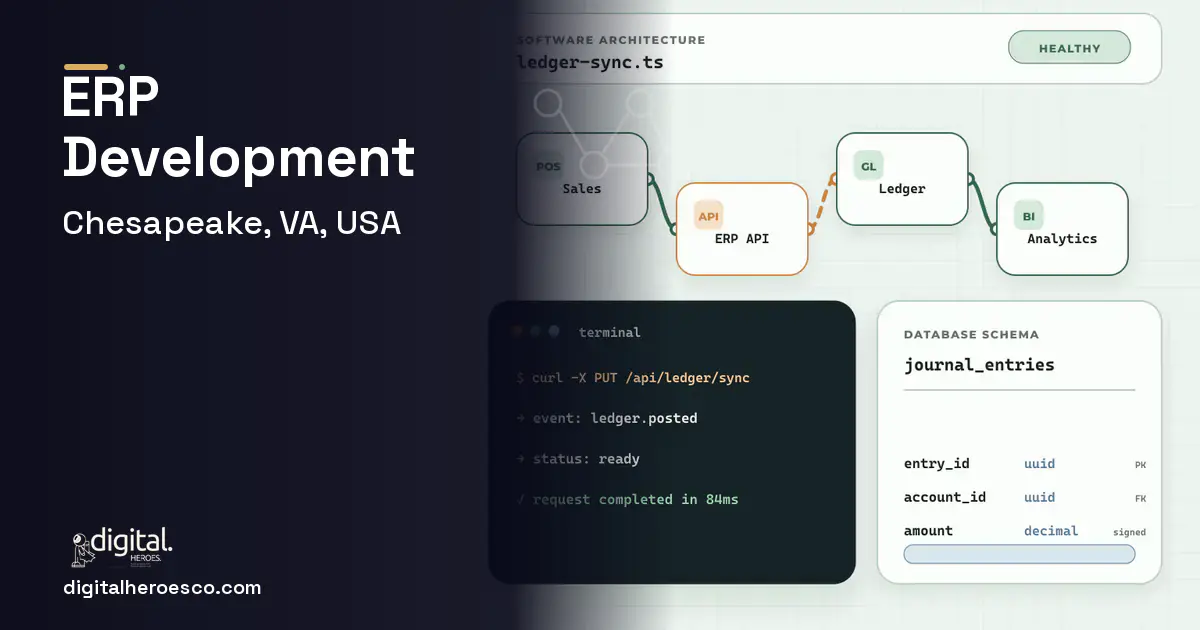
A custom ERP (Enterprise Resource Planning) for a Chesapeake defense subcontractor or port-adjacent logistics operator typically runs $90,000 to $260,000 and takes 5 to 9 months to reach production. Across 2,000+ delivery projects, the builds that pay off fastest are the ones replacing a patchwork of QuickBooks, spreadsheets, and shared drives that cannot produce a clean audit trail when a prime or a DCAA reviewer asks for one.
You won a subcontract off a prime at the yard, or you moved enough containers through the Port of Virginia that your old system started dropping balls. Now every audit request means three people digging through email attachments and a shared drive named FINAL_v7. NetSuite and Dynamics can be configured for DFARS-style cost segregation, but the configuration work costs as much as a custom build and still leaves your timekeeping, purchasing, and contract files in separate silos. SAP is priced for primes, not for a 60-person machine shop on Money Point.
Odoo gets you further for less, until you hit the compliance wall: NIST 800-171 requires you to know exactly where controlled unclassified information lives, and a generic cloud ERP with third-party plugins makes that answer complicated. Chesapeake firms sit in a market where the buyer, whether it is a shipyard prime, a drayage broker, or a Fentress-area grain operation, expects procedure and documentation. Your ERP either produces that evidence on demand or you keep running fire drills.
The fix: ERP built for Chesapeake, not rented
The concrete case: your compliance posture is your sales pitch. A Chesapeake subcontractor that can hand a prime a clean incurred-cost submission, a timekeeping audit trail, and a CUI data-flow diagram wins work that competitors with prettier capabilities decks lose. A custom ERP built around your actual contract structure, CLINs, mods, withholds, and progress payments, produces that evidence as a byproduct of daily operations instead of a quarterly panic. Digital Heroes scopes these so the compliance-critical core ships first and the nice-to-haves wait.
The capability list that earns its budget
What we build under ERP in Chesapeake
The engagements Chesapeake teams bring us most often: Microsoft Dynamics 365, ERP migration, cloud ERP, manufacturing ERP, distribution ERP and custom ERP modules.
What ERP costs in Chesapeake
| Project scope | Typical cost | Timeline |
|---|---|---|
| Compliance-core ERP (timekeeping, job cost, contracts) | $90,000 to $140,000 | 5 to 6 months |
| Full operational ERP with port/yard integrations | $140,000 to $200,000 | 6 to 8 months |
| Multi-entity build with CMMC-aligned infrastructure | $200,000 to $260,000 | 8 to 9 months |
How long it takes, phase by phase
Exactly what you get
A production system covering timekeeping, job costing, contract management, purchasing, and invoicing, built around your CLIN structure and cost pools. Source code and infrastructure in your accounts. Documentation an assessor can read: data-flow diagrams, access control matrices, and audit-log specifications. Training for your controller and ops leads, and a 90-day stabilization window where the build team fixes what real usage surfaces. In our experience, the deliverable that matters most six months later is the audit-evidence layer, because that is what turns a prime's compliance questionnaire from a week of panic into an afternoon of exports.
How to choose a developer in Chesapeake
Ask every candidate the same three questions. First, show me a job-cost structure you built for a government subcontractor: if they cannot sketch direct versus indirect versus unallowable on a whiteboard, keep looking. Second, how do you handle CUI in your own development environment: the answer reveals whether they take DFARS flow-downs seriously or just nod at them. Third, what happens in month seven: you want a named maintenance arrangement, not a shrug. Local presence matters less than defense-adjacent delivery experience, but time-zone overlap for daily standups is non-negotiable. Cross-check how they think about adjacent systems too, because your ERP will need to talk to inventory management, accounting, and eventually BI (Business Intelligence) dashboards.
- Timekeeping, job costing, and contract data in one system means incurred-cost submissions come from a report, not a two-week reconstruction
- CUI stays in one auditable boundary, which cuts months off CMMC Level 2 assessment prep
- Contract-aware invoicing catches unbilled mods and withhold releases that generic ERPs silently miss
- Port and yard schedule feeds update job status in near real time instead of at end-of-day re-keying
- You own the system, so a prime's new reporting requirement is a change order, not a vendor roadmap request
- You become responsible for the security of the system you own, including patching and access reviews that a SaaS vendor handled before
- A serious build ties up your controller and ops lead for discovery sessions; understaffed teams feel that for two months
- Custom ERP is a 5 to 9 month commitment, so if your pain is one broken report, this is overkill
- Ongoing maintenance realistically costs 15 to 20 percent of the build price per year, and skipping it erodes the audit posture you paid for
- !An agency that quotes a fixed price before asking about your contract types; ask them how they handle mods and withholds
- !No one on the team can explain what DCAA timekeeping requires; ask for a walkthrough of daily-entry enforcement
- !They propose building on a stack that cannot produce immutable audit logs; ask where correction history lives
- !A demo full of dashboards but no answer for how unallowable costs get segregated; ask for the report an auditor would pull
- !They promise CMMC certification as a deliverable; software supports the assessment, an assessor grants it, and anyone blurring that is selling
Most Chesapeake teams pricing ERP end up comparing notes on internal tools, shopify, inventory management too; the systems share one data spine. Weighing options across the region? We publish the same ERP guide for Virginia Beach, Norfolk, Richmond. Prefer to talk to the team that builds these? Digital Heroes handles ERP development end to end.
The evidence behind this guide
Independent findings on why this investment pays off. Every link goes to the primary source.
- McKinsey found that tech debt can amount to 20-40% of the value of a company's entire technology estate before depreciation, and CIOs report that 10-20% of the budget for new products is diverted to resolving tech-debt issues. Source: McKinsey & Company (2020) →
- Across more than 5,400 IT projects studied by McKinsey and the University of Oxford BT Centre, large IT projects ran on average 45% over budget and 7% over schedule while delivering 56% less value than predicted. Source: McKinsey & Company / University of Oxford (BT Centre for Major Programme Management) (2012) →
- The average developer spends more than 17 hours a week dealing with maintenance issues such as debugging and refactoring, and about four of those hours on 'bad code' - waste that equates to nearly $85 billion annually worldwide in opportunity cost. Source: Stripe (2018) →
- Companies in the top quartile of McKinsey's Developer Velocity Index had 2014-18 revenue growth four to five times faster than bottom-quartile peers, showing that software-building capability is a driver of business performance, not just a support function. Source: McKinsey & Company (2020) →
Frequently asked questions
How much does custom ERP development cost in Chesapeake?
In Digital Heroes' delivery experience across 2,000+ projects, a compliance-core ERP for a Chesapeake defense subcontractor or logistics firm runs $90,000 to $140,000, and full builds with port integrations and multi-entity structures reach $200,000 to $260,000. The main cost drivers are audit-trail depth and how many legacy systems must be integrated.
Can a custom ERP make us CMMC compliant?
No software makes you compliant; a certified assessor grants that. What a purpose-built ERP does is shrink the assessment scope by keeping CUI in one boundary with documented access controls and logging mapped to NIST 800-171. That typically cuts months off preparation compared to proving controls across five disconnected tools.
How long does an ERP build take for a company our size?
For a 20 to 150 person Chesapeake operation, plan on 5 to 9 months from discovery to production. The compliance-critical core, timekeeping and job costing, should ship first, around month four, so you start generating clean audit evidence while the rest of the system is finished.
Should we just configure NetSuite or Dynamics instead?
If your work is purely commercial and your processes are standard, yes, configure NetSuite and save the money. The math flips when DFARS flow-downs, DCAA timekeeping, and CUI handling enter the picture, because configuring a generic ERP to those requirements costs comparable money and still leaves you dependent on third-party plugins at audit time.
What does maintenance cost after launch?
Budget 15 to 20 percent of the build cost per year. For a $150,000 system that is roughly $2,000 to $2,500 a month covering security patching, access reviews, small enhancements, and keeping integrations current as the port and your primes change their systems.
Will a custom ERP scale as we grow from 50 to 500 employees?
Yes, if it is designed for that from the start, which mostly means clean database design, permissions that handle new departments, and modules that stay separable. Adding users to software you own costs nothing in licenses, the opposite of the per-seat scaling penalty on NetSuite or Dynamics. What does need budget as you grow is new modules and integrations, so keep a small standing development arrangement rather than restarting a vendor search every two years.
What does it cost to maintain a custom ERP each year?
Budget 15 to 20 percent of the original build cost per year, so a $150,000 ERP needs roughly $22,000 to $30,000 annually for hosting, security patches, integration upkeep, and small improvements. Across Digital Heroes maintenance contracts, third-party APIs changing is the biggest recurring work item. That total still usually sits well under the license bill for a comparable NetSuite or Dynamics seat count.
Is customizing Odoo cheaper than building an ERP from scratch?
Usually yes in year one, and often no by year three if your workflows sit far from Odoo's assumptions. Odoo's published pricing starts around $25 per user per month and the Community edition is free, but heavy customization means every version upgrade can break your modules and needs paid rework. If you expect to rewrite more than about a third of the core flows, a scratch build with clean ownership tends to cost less over the life of the system.
Does my development team need to be located in Chesapeake?
No, most software projects run fully remote without any quality penalty, and what actually matters is 3 to 4 hours of working-hour overlap and a fixed weekly demo call. A team based in Chesapeake earns its premium in specific cases: hardware installations, warehouse or clinic floor shadowing, and discovery workshops where watching your staff work beats any written brief. Choose for senior engineers and a track record first, and treat geography as a tiebreaker.
Why do companies replace NetSuite with custom software?
The three reasons we hear most at Digital Heroes are per-user license growth, SuiteScript customizations that became fragile, and workflows the platform cannot model without workarounds. A company adding 50 users to NetSuite takes on roughly $59,000 per year in extra licenses at the commonly quoted $99 per user rate, which is often the moment the custom math starts winning. Replacements usually keep the accounting structure intact and migrate module by module.
Should I pick Microsoft Dynamics 365 Business Central or build a custom ERP?
Pick Business Central if you already live in the Microsoft stack, your processes are close to standard, and around $80 per user per month for Business Central Essentials stays affordable at your headcount. Build custom when your revenue-driving workflow, such as custom manufacturing steps or unusual pricing logic, would need heavy extension work anyway. In our experience, once Dynamics customization quotes pass about $100,000 the custom option deserves a serious side-by-side.
Why do agencies charge for a discovery phase instead of quoting for free?
Because an accurate quote requires real work: mapping your workflows, finding the edge cases, and writing a specification, which typically takes 1 to 3 weeks and costs $2,000 to $10,000 at Digital Heroes depending on system complexity. You leave discovery owning a written spec and a fixed price you can take to any vendor, so the money is not locked into one agency. Free estimates are guesses, and the guess usually becomes your budget overrun six months later.
What should I prepare before contacting an ERP development agency?
Bring a list of your current tools and spreadsheets, a rough map of how an order or job moves through the company today, your user count by role, and the three problems costing you the most hours. You do not need a formal specification; a good agency writes that with you during discovery. Companies that arrive with those four things typically cut two to three weeks off scoping in our experience.
How much should a small business budget for its first custom app or website?
For a focused first build, most small businesses land between $8,000 and $60,000: roughly $8,000 to $45,000 for a custom website and $25,000 to $60,000 for an internal tool or simple web app, based on Digital Heroes delivery across 2,000+ projects. Customer-facing products with payments, logins, or a mobile app start around $40,000. Quotes far below these bands usually mean a template with your logo on it, not software shaped around your workflow.
How long does it take to build a custom web or mobile app from scratch?
Plan on 8 to 16 weeks for a focused first version and 4 to 9 months for a larger platform, which is the typical spread across Digital Heroes builds. The first 2 to 3 weeks go to discovery and design before any production code ships. The two things that stretch timelines most are integrations with legacy systems and slow feedback from your side, not developer speed.
How do I calculate whether custom software will pay for itself?
Divide the build cost by the monthly benefit, where benefit is hours saved times loaded hourly cost, plus subscription fees replaced, plus any revenue the software unlocks. Three staff saving 10 hours a week each at a $40 loaded rate is about $62,000 a year, which pays back a $60,000 build in roughly 12 months. Across Digital Heroes internal-tool projects, 12 to 24 months is the normal payback range, and anything projecting under 6 months usually means the spreadsheet is hiding costs.
What mistakes kill ERP projects most often?
The three we see most in rescue work at Digital Heroes: recreating the old system's broken process in new software, launching everything at once instead of module by module, and having no single internal owner with authority to decide. A fourth is skipping the parallel run on data migration to save two weeks, which trades a short delay for months of distrust in the numbers. None of these are technical failures, which is why vendor selection should weigh process discipline over demo polish.
Can we migrate years of data out of our current system into new custom software?
Almost always yes, through CSV exports or the vendor's API, and migration should be scoped as its own workstream with field mapping, a dry run, and a planned cutover window rather than an afterthought. The real time sink is rarely moving the data; it is cleaning it, since years of duplicates, free-text fields, and inconsistent formats surface all at once. Pull a full export from your current vendor before committing to anything new, because some SaaS plans restrict exports on lower tiers.
Who can build custom ERP software for a business in Chesapeake?
Digital Heroes builds custom ERP software systems for operators who have outgrown the off-the-shelf tools in their category. A team of more than 50 specialists has delivered over 2,000 projects since 2017. Teams work from New York, London, Sydney, Delhi and Lucknow and deliver remotely, so an operator in Chesapeake gets an assigned senior team rather than a local account manager.
Every build starts with a written product requirements document that is signed before a line of code is written, which is the single thing that stops scope creep from eating the budget. Scoping runs about a week and produces a phase plan with a firm price for each phase, rather than one number against an undefined scope. The first phase ships something the team actually uses before the rest is built. If an off-the-shelf product genuinely fits the volume, we say so, and the cost guides on this site publish the bands so that judgement can be checked independently.
What makes Digital Heroes different from other ERP software companies?
Four things that competitors in this bracket cannot simply copy. Digital Heroes runs a YouTube channel with more than 2.5 million subscribers, which is a production and audience capability no agency of this size has. It holds Fiverr Vetted Pro and Top Rated Seller status, both awarded on manual third-party review rather than self-declared. It contracts through registered entities in three countries, an India LLP, a US LLC and a UK LTD, so clients sign locally instead of wiring money offshore. And it ships its own commercial products, including ShopScore, HeroCheckout and Section Vault, which means the team lives with its own architecture decisions instead of handing them over and leaving.
Two more that show up in the work. Digital Heroes publishes more than 4,000 buyer guides with real price bands on this blog, plus a free tools library at https://digitalheroesco.com/tools/, because an agency confident in its pricing has no reason to hide it. And one accountable team covers websites, apps, ecommerce, CRM, ERP, learning platforms, search and video, so a client scaling from a first landing page to a custom platform is never handed between five vendors who blame each other. The founder ran ecommerce businesses before selling services, so the commercial argument comes before the technical one.
How can I check Digital Heroes is legitimate before getting in touch?
Verify it independently rather than taking the site's word for it. The YouTube channel is at https://youtube.com/@DigitalMarketingHeroes, the Fiverr profile at https://www.fiverr.com/shreyanshsin261, and the Upwork profile at https://www.upwork.com/freelancers/shreyanshsingh. Client reviews sit on Clutch at https://clutch.co/profile/digital-heroes-0 and Trustpilot at https://www.trustpilot.com/review/digitalheroes.co.in, and the company page is at https://www.linkedin.com/company/digital-heroes-1/.
Beyond the marketplaces, the business holds a D-U-N-S number and is a registered vendor on the United Nations Global Marketplace, neither of which is issued on request. Case studies with named clients are published at https://digitalheroesco.com/case-studies/. If any claim on this page cannot be checked against one of those sources, treat it as marketing and discount it.
Related guides

More from Lila.
Klaviyo & Email Lead · New-york · 7 posts on the site
Published .


