Your Provo SaaS hit 200 employees and finance is reconciling NetSuite against three spreadsheets every month-end
Once a Provo SaaS company runs deferred revenue, multi-entity consolidation, and a direct-sales commission engine through one system, NetSuite or SAP starts costing more in customization hours than the license.
On this page
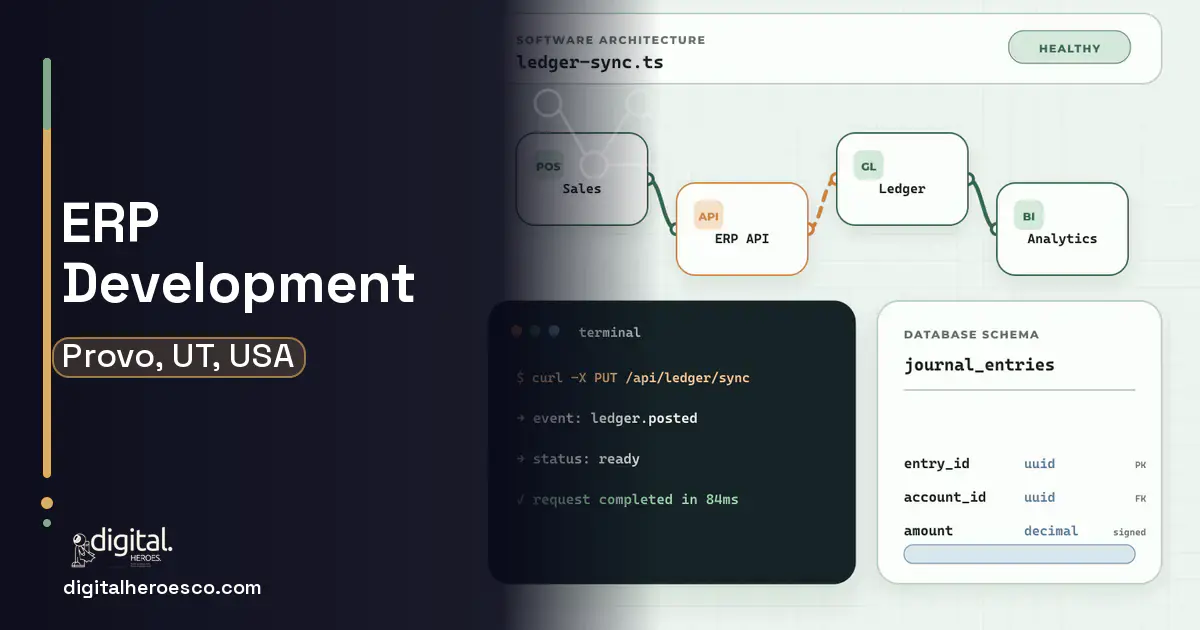
Once a Provo SaaS company runs deferred revenue, multi-entity consolidation, and a direct-sales commission engine through one system, NetSuite or SAP starts costing more in customization hours than the license. A custom ERP (Enterprise Resource Planning) layer in Provo typically runs $90,000 to $260,000 over 5 to 9 months, and most Silicon Slopes firms do not rip out the whole suite. They build the modules the off-the-shelf ERP refuses to model and keep the rest.
NetSuite handles your GL and AP fine. Then your Provo company adds a second legal entity for the SaaS arm and a third for the direct-sales side, and consolidation turns into a manual close that eats the last week of every month. SAP quotes you a six-figure implementation before it touches your actual problem, which is recognizing subscription revenue across annual and monthly plans while a commission structure pays distributors on the same orders.
Odoo and Microsoft Dynamics promise modules for all of it, but the direct-sales genealogy tree (who recruited whom, what override pays up the line) is not a standard ERP object anywhere. So your team exports orders to a spreadsheet, runs the commission math by hand, and pastes payouts back. That spreadsheet is now load-bearing infrastructure for a company doing eight figures.
Budgeting a ERP build in Provo
| Project scope | Typical cost | Timeline |
|---|---|---|
| Revenue-rec module on top of existing ERP | $60k to $120k | 4 to 6 months |
| Commission and genealogy engine | $80k to $160k | 5 to 7 months |
| Full multi-entity custom ERP layer | $160k to $260k | 7 to 9 months |
The case for owning your ERP
You do not need to replace NetSuite. You need a custom revenue-recognition and commission service that reads orders from the ERP, applies your real subscription and distributor rules, and writes journal entries back so the close is clean. That is a bounded build, not a platform migration, and it ends the spreadsheet that finance currently depends on.
- Your commission or revenue logic lives in a spreadsheet that one person fully understands
- Customization quotes from your ERP partner exceed the annual license
- You run two or more legal entities and consolidation is manual
- An acquirer's diligence flagged your revenue records as unreliable
- You are under 50 people on a single entity with simple subscription billing
- Your comp plan is flat and rarely changes
- NetSuite or Dynamics modules already cover 90% of your workflow
- You have no in-house accountant to validate custom revenue logic
What your build should include
ERP services we deliver in Provo
The engagements Provo teams bring us most often: distribution ERP, custom ERP modules, ERP API integration, ERP implementation and ERP integration.
Delivery, week by week
Exactly what you get
A focused service layer that sits beside NetSuite, SAP, Dynamics, or Odoo and owns the logic those suites cannot model for a Provo SaaS or direct-sales firm: subscription revenue recognition, multi-entity consolidation, and a commission engine tied to your real genealogy. It reads orders from the ERP, applies your rules, and writes journal entries back so your month-end close stops living in a spreadsheet. Pair it with your accounting software for payouts and a business intelligence (BI) dashboard for board-ready revenue views.
How to choose a developer in Provo
Hire a team that has shipped financial software, not just CRUD apps. Ask them to walk through how they would recognize revenue on a mixed annual-and-monthly subscription book, and how they would model a multi-level commission override. If they cannot answer in specifics, they will learn accounting on your budget. Provo's Silicon Slopes density means there are local teams who have built exactly this for SaaS and direct-sales clients; favor them over a generalist shop that will treat your comp plan as an afterthought.
- A month-end close that runs in days instead of the last week of the month
- Subscription and deferred revenue recognized correctly without manual journal entries
- Direct-sales commissions calculated from live order data, not a re-keyed export
- Multi-entity consolidation that updates as transactions post, not after a manual roll-up
- Audit-ready records that hold up when a Silicon Slopes acquirer runs diligence
- You now own integration code that breaks when NetSuite changes its API or you upgrade
- A custom revenue engine needs a real accountant in the loop during the build, not just developers
- If your distributor comp plan changes quarterly, you are funding ongoing logic changes forever
- Replacing a working ERP module is rarely worth it; the case only holds for what the suite genuinely cannot model
- !A team that proposes ripping out NetSuite entirely on day one; ask how they would phase it instead
- !No accountant on their side; ask who validates your revenue logic
- !They have never modeled a direct-sales comp plan; ask for a specific example they built
- !They quote a fixed price before discovery; ask what their discovery actually covers
- !Vague answers on multi-entity consolidation; ask them to walk your exact close process
Teams investing in ERP in Provo usually scope it next to internal tools, shopify, inventory management, since these systems share data and budgets. Weighing options across the region? Nearby: ERP in Salt Lake City, West Valley City and West Jordan. Want it built, not just budgeted? That is our ERP development practice.
The evidence behind this guide
Independent findings on why this investment pays off. Every link goes to the primary source.
- In PMI's 2014 Pulse of the Profession report on requirements management, inaccurate requirements management is cited as a leading cause of project failure, with 47% of unsuccessful projects failing to meet goals due to poor requirements management. Source: Project Management Institute (PMI) (2014) →
- Across more than 5,400 IT projects studied by McKinsey and the University of Oxford BT Centre, large IT projects ran on average 45% over budget and 7% over schedule while delivering 56% less value than predicted. Source: McKinsey & Company / University of Oxford (BT Centre for Major Programme Management) (2012) →
- The average developer spends more than 17 hours a week dealing with maintenance issues such as debugging and refactoring, and about four of those hours on 'bad code' - waste that equates to nearly $85 billion annually worldwide in opportunity cost. Source: Stripe (2018) →
- An independent Forrester Total Economic Impact study of OutSystems found a 363% three-year ROI with payback in under 6 months, illustrating that faster, lower-labor build approaches can materially shift the payback math. Source: Forrester Consulting (commissioned by OutSystems) (2024) →
Frequently asked questions
Do we have to replace NetSuite to fix our close?
No. Most Provo firms keep NetSuite for the GL and build a custom layer only for what it cannot model, like subscription revenue recognition or a direct-sales commission engine. That is cheaper and far less risky than a full migration.
Can a custom ERP handle our direct-sales commission tree?
Yes, and this is usually the core reason to build. Genealogy, override commissions, and rank qualification are not native objects in NetSuite, SAP, Dynamics, or Odoo, so a custom engine that reads live orders is the reliable way to pay distributors correctly.
How long until our month-end close improves?
A revenue-recognition module typically takes 4 to 6 months to reach production. The close usually shortens immediately after launch because the manual journal entries and spreadsheet roll-ups disappear.
What does this cost for a Provo SaaS company?
A single custom module on top of an existing ERP runs roughly $60k to $120k. A full multi-entity custom layer with a commission engine reaches $160k to $260k depending on how often your comp plan changes.
Will this survive acquisition diligence?
That is often the point. A custom layer with a clean audit trail and exportable journal entries holds up far better than a spreadsheet that one employee maintains, which acquirers routinely flag as a risk.
What happens to my software if the agency shuts down or we stop working together?
Nothing dramatic, if the engagement was set up correctly: the code sits in your repository, hosting runs on your cloud account, and a handover document explains how to deploy and operate the system. Any competent replacement team can then take over in days rather than months. If the agency controls the repo, the servers, or the domain, fix that now, because renegotiating access during a dispute is the most expensive place to discover the problem.
What should I prepare before contacting an ERP development agency?
Bring a list of your current tools and spreadsheets, a rough map of how an order or job moves through the company today, your user count by role, and the three problems costing you the most hours. You do not need a formal specification; a good agency writes that with you during discovery. Companies that arrive with those four things typically cut two to three weeks off scoping in our experience.
What mistakes kill ERP projects most often?
The three we see most in rescue work at Digital Heroes: recreating the old system's broken process in new software, launching everything at once instead of module by module, and having no single internal owner with authority to decide. A fourth is skipping the parallel run on data migration to save two weeks, which trades a short delay for months of distrust in the numbers. None of these are technical failures, which is why vendor selection should weigh process discipline over demo polish.
Can I build my product on a no-code tool like Bubble instead of hiring developers?
For testing whether anyone wants the product, yes, and Bubble's paid plans start at $29 a month, which is the cheapest validation you will ever buy. The ceiling arrives with complex data relationships, heavy integrations, performance at a few thousand users, and the fact that you cannot export a Bubble app to servers you control. A path many Digital Heroes clients take: prove demand on no-code, then rebuild custom once revenue justifies it, treating the no-code version as a paid prototype rather than a foundation.
How many developers does it take to build an ERP?
A typical Digital Heroes ERP pod is five to seven people: two or three backend engineers, one frontend engineer, a QA engineer, a project manager, and a part-time architect and designer. Bigger teams rarely go faster on ERP because the bottleneck is decisions about your business rules, not typing speed. What you need on your side is one empowered internal owner who can answer process questions within a day.
Can custom software connect to the tools we already use, like QuickBooks, Stripe, and Google Workspace?
Yes, and connecting your existing tools is one of the main reasons to build custom: mainstream platforms like QuickBooks, Stripe, Shopify, and Google Workspace all publish documented APIs. Budget 1 to 3 weeks of work per integration depending on API quality and how much data flows in both directions. Ask any vendor whether they have integrated with your specific tools before, because quirks like QuickBooks' OAuth token handling and API rate limits get learned on someone's project, and it should not be yours.
What happens to my ERP if the agency shuts down or we part ways?
If ownership was set up correctly, nothing breaks: you hold the source code, the system runs in cloud accounts you own, and handover documentation lets a new team take over. Insist on repository access from day one, admin ownership of all hosting and third-party accounts, and documentation as a contract deliverable rather than a favor. This is the single most important clause to check before signing an ERP contract.
Will a custom ERP scale as we grow from 50 to 500 employees?
Yes, if it is designed for that from the start, which mostly means clean database design, permissions that handle new departments, and modules that stay separable. Adding users to software you own costs nothing in licenses, the opposite of the per-seat scaling penalty on NetSuite or Dynamics. What does need budget as you grow is new modules and integrations, so keep a small standing development arrangement rather than restarting a vendor search every two years.
How long does it take to build a custom web or mobile app from scratch?
Plan on 8 to 16 weeks for a focused first version and 4 to 9 months for a larger platform, which is the typical spread across Digital Heroes builds. The first 2 to 3 weeks go to discovery and design before any production code ships. The two things that stretch timelines most are integrations with legacy systems and slow feedback from your side, not developer speed.
Can we migrate years of data out of our current system into new custom software?
Almost always yes, through CSV exports or the vendor's API, and migration should be scoped as its own workstream with field mapping, a dry run, and a planned cutover window rather than an afterthought. The real time sink is rarely moving the data; it is cleaning it, since years of duplicates, free-text fields, and inconsistent formats surface all at once. Pull a full export from your current vendor before committing to anything new, because some SaaS plans restrict exports on lower tiers.
What does it cost to maintain a custom ERP each year?
Budget 15 to 20 percent of the original build cost per year, so a $150,000 ERP needs roughly $22,000 to $30,000 annually for hosting, security patches, integration upkeep, and small improvements. Across Digital Heroes maintenance contracts, third-party APIs changing is the biggest recurring work item. That total still usually sits well under the license bill for a comparable NetSuite or Dynamics seat count.
Is customizing Odoo cheaper than building an ERP from scratch?
Usually yes in year one, and often no by year three if your workflows sit far from Odoo's assumptions. Odoo's published pricing starts around $25 per user per month and the Community edition is free, but heavy customization means every version upgrade can break your modules and needs paid rework. If you expect to rewrite more than about a third of the core flows, a scratch build with clean ownership tends to cost less over the life of the system.
Should I hire a freelancer or an agency for my software project?
A skilled freelancer is the right call for a single-discipline scope under roughly $15,000, like a website, a plugin, or one integration. Above that, projects need design, backend, testing, and project management at once, and a solo builder becomes the single point of failure: if they get sick or take a bigger client, your project simply stops. Agencies bill 20-40% more per hour but carry continuity, code review, and someone to escalate to, which is what you are actually buying.
Is a custom ERP cheaper than NetSuite over five years?
Often yes once you pass roughly 20 to 30 users. NetSuite is commonly quoted at $999 per month for the base platform plus about $99 per user per month, so a 30-user company spends over $200,000 on licenses across five years before paying for implementation. A custom build in the $120,000 to $250,000 range is a one-time cost, and in Digital Heroes projects annual upkeep runs 15 to 20 percent of build cost with no per-seat fees as you hire.
Who owns the code when an agency builds my software?
You should, completely, through a written intellectual property assignment that transfers everything on final payment; without that clause, copyright stays with whoever wrote the code by default. Insist that the repository lives in your own GitHub organization from day one and that hosting, domains, and third-party accounts are registered to you. Also check for licenses to the agency's proprietary frameworks buried in the contract, because those can make switching vendors practically impossible even when you own your own code.
Who can build custom ERP software for a business in Provo?
Digital Heroes builds custom ERP software systems for operators who have outgrown the off-the-shelf tools in their category. The work is delivered remotely: our engineers work from Delhi and Lucknow, leadership is in New York, and some team members live in London and Sydney and work remotely from there. We have no office in Provo. You can chat with the team directly, and every form gets an email reply within 24 hours.
Related guides
More from Sienna.
Director of Design · APAC · Sydney · 2 posts on the site
Published · Last updated .