Your Colorado Springs ERP holds contract cost data the DCAA wants to audit, and NetSuite wasn't built for CUI
A custom ERP for a Colorado Springs defense or aerospace contractor runs $120k to $300k over 5 to 9 months.
On this page
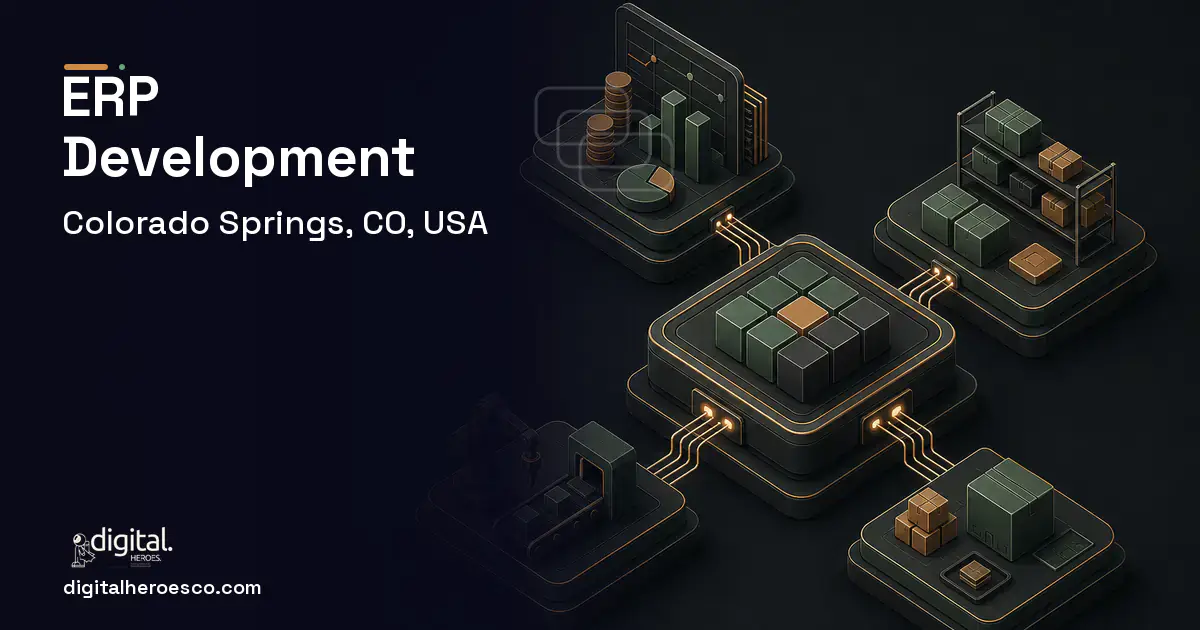
A custom ERP (Enterprise Resource Planning) for a Colorado Springs defense or aerospace contractor runs $120k to $300k over 5 to 9 months. You build custom when your cost accounting has to survive a DCAA incurred-cost audit, when indirect rate pools and CUI segregation collide with NetSuite's flat chart of accounts, or when a prime demands traceability your off-the-shelf system can't produce. Most firms near Peterson and Schriever start with QuickBooks plus spreadsheets, hit a wall at the first CPSR, and pay twice.
You won a cost-plus contract, and now your finance team is reconciling indirect rate pools in Excel because NetSuite's standard cost module doesn't understand DCAA-compliant pool-and-base accounting. Every month-end the controller rebuilds the same fringe, overhead, and G&A allocation by hand, and when the auditor asks for the audit trail, you have a folder of saved spreadsheets instead of a system of record.
SAP and Microsoft Dynamics can technically do government cost accounting, but the licenses and the implementation partner to configure DCAA compliance cost more than a small firm's entire G&A budget. Odoo is cheaper but has no native concept of CUI, so the moment your ERP touches controlled unclassified information from a Space Force task order, you're out of NIST 800-171 scope and your prime knows it.
Why the usual tools struggle in Colorado Springs
- Indirect rate pools (fringe, overhead, G&A) calculated by hand every month-end instead of by the system
- No defensible audit trail when DCAA requests incurred-cost or pre-award survey data
- CUI in financial records (contract line items, labor categories) sitting in a system with no access segregation
- Timesheet-to-job-cost flow broken: DCAA total-time-accounting rules don't fit standard ERP time tracking
What a custom ERP build changes
A funded contractor near Schriever doesn't need a generic ERP with a government bolt-on. You need pool-and-base indirect cost allocation, DCAA-compliant total time accounting, and CUI-aware access controls baked into the data model from the first sprint. Custom lets you encode your specific rate structure, your contract types, and your NIST 800-171 boundary instead of forcing your operation to match a SaaS vendor's idea of how a business runs.
- You hold cost-reimbursable or T&M contracts and must prove DCAA-compliant indirect rates
- Your ERP records contain CUI and must stay inside a NIST 800-171 / CMMC boundary
- You're failing or dreading a CPSR because your purchasing-to-payment trail lives in spreadsheets
- Off-the-shelf govcon ERP quotes exceed your G&A budget for a sub-50-person firm
- You're a commercial firm (tourism, retail) with no government cost accounting requirement
- Deltek Costpoint or Unanet fits your contract mix and you can absorb the license
- You have under five active contracts and a fractional DCAA consultant handles allocations fine
- Your CUI footprint is zero and likely to stay that way
- DCAA-compliant cost accounting (pool-and-base, total time accounting) modeled to your exact rate structure
- CUI segregation built into the schema so financial records stay inside your NIST 800-171 boundary
- Audit trails generated automatically, so a CPSR or incurred-cost audit is a query, not a fire drill
- Indirect rate calculations that close in hours, not days, with provisional-to-actual reconciliation
- One system feeding your project management software and BI dashboards instead of nightly Excel exports
- You own DCAA-compliance maintenance forever; when FAR/DFARS cost rules change, your dev team updates the system, not a vendor
- Higher upfront cost than configuring an off-the-shelf govcon ERP like Unanet or Deltek Costpoint
- No vendor-certified DCAA compliance letter to wave at an auditor; you defend your own logic
- A custom ERP needs a finance lead who can specify cost accounting precisely, or the build encodes the wrong rules
The features that matter for Colorado Springs
What we build under ERP in Colorado Springs
The engagements Colorado Springs teams bring us most often: SAP integration, Odoo development, Microsoft Dynamics 365, ERP migration, cloud ERP and manufacturing ERP.
ERP pricing in Colorado Springs: the real numbers
| Project scope | Typical cost | Timeline |
|---|---|---|
| Core cost accounting + indirect rate engine | $120k to $180k | 5 to 7 months |
| Add CUI segregation + NIST 800-171 controls | $45k to $80k | 2 to 3 months |
| Full ERP with procurement, inventory, BI | $220k to $300k | 8 to 9 months |
From kickoff to launch: the schedule
Exactly what you get
You get an ERP that closes the month without a controller hand-building indirect rates, produces a DCAA audit package as a single export, and keeps contract cost data carrying CUI inside your NIST 800-171 boundary. It connects to the accounting software and project management software your team already uses, and feeds clean numbers into your business intelligence dashboards so leadership sees burn-against-ceiling without waiting for a spreadsheet refresh.
How to choose a developer in Colorado Springs
Pick a team that talks DFARS and CMMC before it talks frameworks. Ask any Colorado Springs developer to walk you through how they'd model a pool-and-base indirect rate run and where CUI would live in the schema. A firm that's shipped for contractors near Peterson or Schriever will ask about your contract mix, your rate structure, and your assessment status before quoting. One that quotes from a feature list hasn't built govcon software and will learn DCAA on your budget.
- !A vendor who's never heard of DFARS 252.204-7012; ask instead how they'd segregate CUI in the data model
- !Promising 'SAP-grade' cost accounting in eight weeks; ask to see a pool-and-base rate run they built
- !No question about your contract types; ask how they'd handle provisional-to-actual rate reconciliation
- !Hosting your CUI ERP in a commercial cloud region; ask whether they deploy to a FedRAMP-aligned environment
- !Quoting before reading your rate structure; ask what they need from your finance lead to scope accurately
Teams investing in ERP in Colorado Springs usually scope it next to internal tools, shopify, inventory management, since these systems share data and budgets. Weighing options across the region? Nearby: ERP in Denver, Aurora and Fort Collins. Want it built, not just budgeted? That is our ERP development practice.
The evidence behind this guide
Independent findings on why this investment pays off. Every link goes to the primary source.
- 48% of private companies cite integration with legacy systems or technical debt as a top obstacle to realizing the full value of their digital and AI investments (behind data quality/availability at 72% and gaps in AI fluency or technology talent/leadership at 53%). Source: Deloitte (2026) →
- In PMI's 2014 Pulse of the Profession report on requirements management, inaccurate requirements management is cited as a leading cause of project failure, with 47% of unsuccessful projects failing to meet goals due to poor requirements management. Source: Project Management Institute (PMI) (2014) →
- The EY survey of 508 payroll professionals at U.S. companies with 250-10,000 employees quantifies the direct and indirect cost of payroll inaccuracy, reinforcing the ROI case for payroll automation; the study is the original source of the frequently cited $291-per-error figure. Source: BusinessWire / EY (Ernst & Young) (2022) →
- Independent reporting of Gartner's 2025 survey confirms 59% of finance leaders use AI, up from 37% in 2023, with error and anomaly detection (34%) and accounts payable automation (37%) among the leading use cases. Source: CPA Practice Advisor (reporting Gartner) (2025) →
Frequently asked questions
Does a custom ERP make us CMMC compliant?
No software alone makes you compliant; CMMC assesses your whole environment, people, and processes. A custom ERP built to NIST 800-171 controls (access logging, CUI segregation, audit trails) removes one of the hardest scoping problems, because your financial system stays inside the boundary instead of leaking CUI into an unassessed SaaS tool.
Why not just use Deltek Costpoint or Unanet?
If their cost accounting fits your contract mix and you can absorb the license and implementation, buy them; they're proven for govcon. Firms go custom when the off-the-shelf govcon ERP quote exceeds a small Colorado Springs contractor's G&A budget, or when their rate structure and CUI handling are too specific to configure cleanly.
How long before a DCAA audit is painless?
Plan 5 to 9 months to production, then one or two close cycles to trust the numbers. Once live, an incurred-cost submission or pre-award survey becomes a generated export package rather than weeks of spreadsheet archaeology.
Can the ERP handle both government and commercial work?
Yes, and many Colorado Springs firms need that split because they run defense contracts alongside commercial or tourism-side revenue. The build separates cost-accounted government jobs from straight commercial billing while keeping one general ledger.
What's the single biggest cost driver?
DCAA-compliant cost accounting and the CUI segregation that protects it. Encoding pool-and-base allocation, total time accounting, and record-level CUI controls is where most of the budget and risk lives, far more than the inventory or BI modules bolted on later.
How small can the first version of my software be and still be worth building?
One workflow, end to end, for one type of user: the single process that currently burns the most hours or loses the most money. In Digital Heroes delivery experience, first versions scoped to 6 to 10 weeks of build time ship, get used, and generate the feedback that makes version two obviously right, while 9-month first versions routinely launch with features nobody touches. Everything you cut from v1 gets cheaper to build later, because real usage reorders the roadmap for you.
Can a freelancer build an ERP, or do I need an agency?
An ERP is too wide for one person: it needs backend, frontend, database design, integrations, QA, and someone mapping your business processes. A solo freelancer can extend an existing ERP or ship one small internal tool, but full ERP builds by single developers are the most common rescue scenario Digital Heroes takes on. If budget is tight, shrink the scope to one module rather than shrinking the team below three or four people.
What happens to my ERP if the agency shuts down or we part ways?
If ownership was set up correctly, nothing breaks: you hold the source code, the system runs in cloud accounts you own, and handover documentation lets a new team take over. Insist on repository access from day one, admin ownership of all hosting and third-party accounts, and documentation as a contract deliverable rather than a favor. This is the single most important clause to check before signing an ERP contract.
How do I calculate the ROI on a custom ERP?
Add up three lines: hours of manual work removed at loaded labor cost, subscription licenses you cancel, and error costs like mispicks and double entry that disappear. In Digital Heroes delivery experience, mid-market ERP builds typically reach payback in 18 to 30 months, faster when they replace a per-seat platform at 30 or more users. Run the math over five years, because that is where a one-time build beats recurring licenses decisively.
What tech stack should a custom ERP be built on?
A boring, hireable one: Digital Heroes most often ships ERPs on PostgreSQL with a Node.js or Python backend and a React frontend, hosted on AWS or Azure. The stack matters far less than the database design, because your ERP schema will outlive every framework choice. Be skeptical of any agency proposing a niche or proprietary framework, since your ability to hire maintainers later is part of the total cost.
Can I start with one ERP module instead of the full system?
Yes, and it is how most successful custom ERP projects at Digital Heroes begin. We build the single module causing the worst pain first, typically inventory or order management, get it live in 10 to 14 weeks, and let it prove ROI before the next phase gets funded. Starting with one module also derisks data migration because you move one dataset at a time.
Can custom software connect to the tools we already use, like QuickBooks, Stripe, and Google Workspace?
Yes, and connecting your existing tools is one of the main reasons to build custom: mainstream platforms like QuickBooks, Stripe, Shopify, and Google Workspace all publish documented APIs. Budget 1 to 3 weeks of work per integration depending on API quality and how much data flows in both directions. Ask any vendor whether they have integrated with your specific tools before, because quirks like QuickBooks' OAuth token handling and API rate limits get learned on someone's project, and it should not be yours.
Who owns the source code if an agency builds my ERP?
You should, in full, and it must be written into the contract as work for hire with IP assignment on payment. At Digital Heroes every client receives the complete repository, database schemas, and deployment documentation, so they could hand the system to another team tomorrow. Walk away from any ERP proposal built on the agency's proprietary platform with ongoing license fees, because that recreates the vendor lock-in you were escaping.
Can we keep our current ERP and just build custom modules around it?
Often yes, and it is frequently the smartest first move. Digital Heroes regularly builds custom scheduling, quoting, or warehouse tools that sit on top of SAP, NetSuite, or Odoo through their APIs, which fixes the painful 20 percent without a risky replacement. The hybrid route costs a fraction of a full rebuild and tells you within months whether a bigger migration is even necessary.
What does it cost to keep custom software running after launch?
Budget 15-20% of the original build cost per year, which on a $100,000 system means $15,000 to $20,000 for security patches, dependency updates, bug fixes, and small improvements as real usage reveals what the spec missed. Cloud hosting for a typical business application adds $50 to $300 a month on top. Skipping maintenance does not save the money; in Digital Heroes rescue work, unmaintained systems typically need a far more expensive rebuild within about three years.
We run everything on spreadsheets and Airtable. How do we know it's time for custom software?
The reliable signals are re-typing the same data into multiple tools, one employee acting as human middleware between systems, and errors appearing in handoffs between teams. Hard limits force the issue too: Airtable's Team plan caps at 50,000 records per base, and Business costs $45 per seat per month, so a 20-person team pays about $10,800 a year for a tool it has already outgrown. When workarounds consume more hours than the tools save, the spreadsheet era is over.
Will an app built for 10 users survive growing to 500?
Yes, if it is built on standard cloud infrastructure with a sound data model, because moving from 10 to 500 users is a hosting configuration change, not a rebuild. The scaling decisions that actually hurt are made early and invisibly: how the database is structured, how accounts and permissions are modeled, and whether background work is queued properly. Ask your agency how the system would handle ten times the load; the right answer is boring and specific, and a promise to cross that bridge later means you will pay for the bridge twice.
Who can build custom ERP software for a business in Colorado Springs?
Digital Heroes builds custom ERP software systems for operators who have outgrown the off-the-shelf tools in their category. The work is delivered remotely: our engineers work from Delhi and Lucknow, leadership is in New York, and some team members live in London and Sydney and work remotely from there. We have no office in Colorado Springs. You can chat with the team directly, and every form gets an email reply within 24 hours.
Related guides

More from Connor.
Account Manager · Sydney · 1 post on the site
Published · Last updated .