Supply Chain Finance Platform: Custom Build or Buying Taulia
If you are a corporate buyer wanting a programme for your own suppliers, buy. Taulia, PrimeRevenue, C2FO, Demica and Kyriba have already solved the funder relationships, the onboarding operations and the connectors, and building your own is a treasury department funding a software company.
On this page
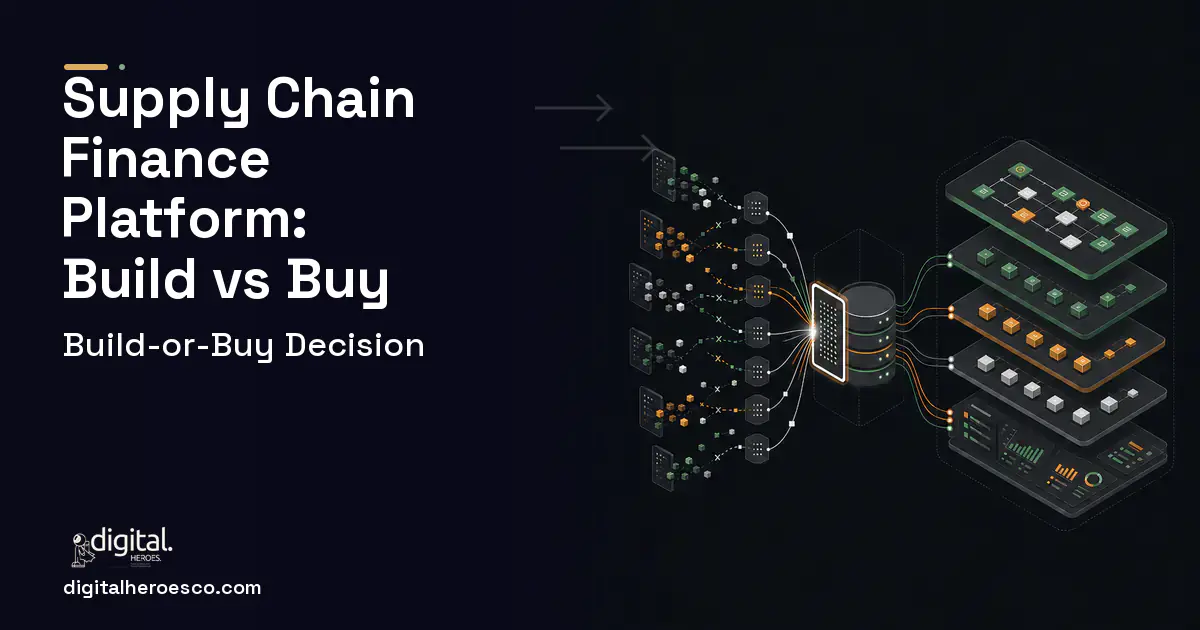
If you are a corporate buyer wanting a programme for your own suppliers, buy. Taulia, PrimeRevenue, C2FO, Demica and Kyriba have already solved the funder relationships, the onboarding operations and the connectors, and building your own is a treasury department funding a software company. Build only when the spread is your revenue rather than your cost.
What the off-the-shelf products actually do well
Ask anyone who has launched a payables finance programme what went wrong and you will not hear a story about capital. Funding is the easy part, because banks want approved payables from an investment grade buyer where the credit risk is the buyer's and the tenor is short. What goes wrong is onboarding, and the platforms have spent years on exactly that problem.
Taulia sits close to the SAP estate and its buyer-side integration is mature. PrimeRevenue has deep multi-funder experience and has run large programmes across many jurisdictions. C2FO approaches the same liquidity need from the buyer's own cash through a dynamic discounting marketplace, which is a genuinely different product and often the better answer for a company with surplus cash. Demica is strong on structured receivables and securitisation adjacent work. Kyriba brings it inside a treasury management system you may already run. Orbian has been doing this longer than most.
They also carry work you would otherwise pay for twice: funder relationships already papered, jurisdiction-specific identity and bank verification flows already tested, assignment agreements already litigated over, and connectors into SAP, Oracle and Coupa somebody else maintains. If your goal is a programme for your own suppliers, sitting beside your procurement operation rather than inside a product you sell, buy one of these. That is the honest answer for most companies who search this phrase, and it costs us work to write it down.
Where they stop: onboarding a sole trader with a flow built for a listed company
Here is the workflow that decides the economics, and it is not the funding.
A programme launches with a target of 400 suppliers. Twelve months later 60 are live and they are the large ones who least needed the liquidity. The tail, the several hundred smaller suppliers where the programme would actually do some good, never got through. They were asked for corporate documents in a language they do not operate in, an identity verification flow designed for another jurisdiction, a receivables assignment agreement their lawyer wanted to redline, and a bank account verification that failed because the account name did not exactly match the registered entity name.
What is missing is a jurisdiction-aware flow where the document set is derived from country and entity type rather than from a single global checklist, with registry document extraction to prefill instead of asking a supplier to type its own registration number, ownership structure capture that handles layers for a family-owned manufacturer, and a case queue for the ones that need a human. The assignment agreement should be generated with the supplier's own details and executed electronically where the jurisdiction allows it, under eIDAS in Europe or the ESIGN Act in the United States, and stored with an audit trail a funder's counsel can rely on. Above all, measure conversion at every step. Programmes that work treat onboarding as a funnel, not a compliance hurdle.
The second thing that stops packaged platforms is the quality of the approved payable feed. Everything rests on one fact: the buyer irrevocably approved an invoice for payment on a date. In practice invoices get reversed by a credit note two days later, approvals are partial because a line is disputed, payment terms in the vendor master disagree with the invoice, duplicate vendor records give one supplier three payment histories, and payment runs net several invoices and offsets into one remittance that cannot be split back to invoice level. Those are mundane and fatal, and they are the buyer's data quality problem regardless of which platform is used.
The arithmetic: basis points on funded volume versus a build
This category prices differently from most software, which is why the comparison confuses people.
Platform economics are a take rate on funded volume, typically quoted in basis points and usually paid out of the spread rather than invoiced to the buyer. Suppose the rate is 20 basis points. At 500 million dollars funded a year that is one million dollars annually. Set that against a build at 350,000 to 900,000 dollars with 15 to 20 percent annually afterwards, which is roughly 1.18 million over five years, or 235,000 a year. At 20 basis points the crossover sits near 100 to 150 million dollars of annual funded volume.
Now the correction that decides most of these conversations. That crossover only applies to whoever earns the spread. If you are the corporate buyer, the take rate is invisible to you and there is nothing on your side of the ledger to cross over, which is precisely why buying is right for you. If you are a bank, a fintech or a marketplace whose revenue is that spread, the same number is your product margin leaking to a vendor, and past roughly 150 million dollars funded a year the platform is your business rather than a tool you rent.
What a custom build actually costs
A focused first release covering ingestion of approved payables with change events, supplier onboarding with jurisdiction-aware identity and bank verification, offer and discount calculation, acceptance and settlement instruction generation runs 120,000 to 260,000 dollars and ships in 16 to 24 weeks. A full platform adding multi-funder allocation with limits and pricing grids, assignment agreements with electronic execution, dynamic discounting from buyer cash, deep tier structures, disclosure reporting, screening and reconciliation runs 350,000 to 900,000 dollars phased over 10 to 18 months.
Two lines nobody quotes. Data migration runs 10 to 25 percent of build cost and lands high here, because it is really buyer-side data remediation: deduplicating the vendor master, reconciling payment terms, and rebuilding remittance detail so invoice-level reconciliation is possible at all. That work is discovered rather than specified. Year two and after runs 15 to 20 percent of build cost annually, covering the next funder's requirements, the next country's verification method, and a payment rail change.
What drives cost up: the number of countries, since identity requirements, bank verification methods, assignment enforceability and language all vary. The number of buyer systems, because a programme spanning several instances plus one legacy system is several integrations. Funder count and the sophistication of their allocation rules. Payment rails across currencies. And your regulatory posture if you are the funder rather than the buyer.
The four situations where building wins
Regulatory fit. Supplier finance arrangement disclosure is now explicit on both sides of the Atlantic: the international standards amendments apply to annual reporting periods beginning on or after 1 January 2024, and the United States requirement added a rollforward of invoices added and settled during the period. That means producing, per programme and per period, what suppliers received early, what the buyer still owes funders, and the payment terms before and after, with drill through to individual invoices. Across three funders and two systems that is a week of manual work a quarter and it rarely ties.
Scale economics. You earn the spread and you are past the funded volume threshold above.
A workflow that is your competitive advantage. If your growth depends on onboarding conversion in the tail, and no vendor will let you redesign the flow that is losing you suppliers, the flow is the product. The same applies to deep tier programmes financing your anchor buyer's suppliers two or three levels down, where the receivable was never approved and the evidence has to come from purchase orders and delivery confirmation instead.
Integration sprawl across three or more systems. Buyer enterprise systems on one side, several funders with their own file formats and limits on the other, payment rails in between, and a treasury analyst allocating receivables in a spreadsheet and reconciling monthly to prove it was done properly.
How to decide in a week
Build two tables from data you already hold.
The first is your onboarding funnel for the last two hundred invited suppliers, split by country and entity type, with conversion measured at each step: invited, started, identity submitted, identity cleared, agreement signed, bank verified, first offer accepted. Almost nobody has this table, and building it usually ends the argument, because the drop-off clusters in one or two markets at one or two steps and the cause is visible on sight. The second is one month of approved payables, counting how many were later reduced by a credit note, partially approved because a line was disputed, or settled inside a netted remittance that cannot be traced back to an invoice. If that count is under a couple of percent, your data is good enough for any platform and you should buy one. If it is a tenth of the file, no platform will save you and the remediation is your first project either way.
Then talk to two firms. Ask how they model an approved payable later reduced by a credit note after a supplier has taken early payment. If they do not immediately describe events rather than edits, and a defined dispute path back to the funder, they have not built one of these and you will find the gap in production with real money in it. Ask how funder allocation and limits are enforced when the preferred funder is full at two in the morning during a payment run. Ask what they have integrated by name, and press on remittance detail, which is the harder half.
Finish with a paid discovery phase. At Digital Heroes nothing is coded until a product requirements document is signed covering the receivable model, onboarding by jurisdiction, funder allocation rules and acceptance criteria, and you own that document whether or not we build anything. We are the wrong choice if you are a corporate buyer who should be on a platform, or if you want us to arrange funding, which we do not do. We are an India LLP with a United States LLC and a United Kingdom LTD, so intellectual property assigns under your own law, and with more than fifty specialists and over 2,000 projects delivered you meet the named team before you sign. Our record is checkable on Clutch, Trustpilot, Fiverr Vetted Pro and D-U-N-S.
Book a 30-minute call with Digital Heroes and get a written plan and a fixed quote within 48 hours.
The evidence behind this guide
Independent findings on why this investment pays off. Every link goes to the primary source.
- McKinsey estimates that digitizing the supply chain (Supply Chain 4.0) can cut lost sales by up to 75%, reduce inventories by up to 75%, and lower supply chain operational costs by up to 30%, with up to 30% lower transport and warehousing costs. Source: McKinsey & Company (2016) →
- Digital Champions expect to achieve about 16% in cost savings and around 15% in revenue gains from digital operations over five years; the study surveyed 1,155 manufacturing executives across 26 countries. Source: PwC / Strategy& (2018) →
- The average developer spends more than 17 hours a week dealing with maintenance issues such as debugging and refactoring, and about four of those hours on 'bad code' - waste that equates to nearly $85 billion annually worldwide in opportunity cost. Source: Stripe (2018) →
- Grand View Research valued the global field service management market at USD 4.43 billion in 2022 and projects it to reach USD 11.78 billion by 2030, a 13.3% CAGR, driven by growing field operations in telecom, utilities, construction and energy. Source: Grand View Research (2023) →
Frequently asked questions
How much does a custom supply chain finance platform cost
A focused first release covering approved payable ingestion, jurisdiction-aware supplier onboarding with identity and bank verification, offer and discount calculation and settlement instructions runs 120,000 to 260,000 dollars over 16 to 24 weeks in Digital Heroes delivery experience. A full platform adding multi-funder allocation, assignment agreements with electronic execution, deep tier structures and disclosure reporting runs 350,000 to 900,000 dollars.
How long does it take to launch a working programme
Expect 16 to 24 weeks to a first release with one buyer, one enterprise system, one funder and a small number of countries. The calendar risk is rarely engineering. It is buyer-side data remediation and the funder's onboarding requirements, both discovered rather than specified, so plan a pilot with a limited supplier group before any broad launch and measure conversion from day one.
Who owns the code if an agency builds our financing platform
You should hold the repository, the infrastructure accounts and the right to hire another firm, settled before kickoff. At Digital Heroes the client owns the code from the first commit. It matters most in this category because a financing platform accumulates funder-specific and regulatory logic over years, and that logic is the asset you cannot afford to have sitting inside somebody else's account.
What happens when a credit note lands after a supplier has already been paid early
The platform records it as a linked event rather than editing the original approval, so the funded amount and the reduced obligation are both visible. There also has to be a defined dispute path back to the funder, because the funder advanced against a specific approved amount and someone has to bear the difference. Systems that overwrite the record cannot answer the question at all.
Should we choose dynamic discounting instead of third party funding
If you hold surplus cash, often yes, and it is simpler in every dimension. Paying suppliers early from your own balance sheet avoids funder onboarding, assignment agreements, allocation limits and much of the disclosure complexity, and the return on cash is usually attractive. The case for third party funding is when you want the liquidity effect without using your own cash, which is a treasury policy decision rather than a software one.
What disclosure does a supplier finance programme require
Buyers are required to describe the programme terms and report amounts outstanding, with a rollforward of invoices added and settled during the period under the United States requirement. Practically the platform must produce, per programme and per period, what suppliers received early, what the buyer still owes funders, and payment terms before and after, with drill through to individual invoices for the auditor.
How is funding allocated when several banks fund one programme
Through a limits engine rather than a spreadsheet. Each funder carries a buyer limit, sometimes country limits, a tenor appetite and a pricing grid, and every accepted early payment must be allocated to a funder with room at the right price, stored immutably because it determines who is repaid at maturity. The system needs a graceful fallback when a funder is full, since most facilities are uncommitted.
Can suppliers take early payment without logging into a portal
They should be able to, because much of the tail logs in once and never returns. Standing instructions let a supplier elect early payment on everything or everything above a threshold, offers can arrive by email with an accept link or by messaging where that is what finance staff read, and statements should reconcile to the supplier's own books so nobody recalculates the discount by hand.
What is the difference between supply chain finance and invoice factoring
Payables finance is initiated by the buyer against invoices it has already approved, so the credit risk and the pricing follow the buyer, and the supplier is joining someone else's programme. Factoring is initiated by the supplier against its own receivables, priced on the supplier's credit, often with recourse. The data, the onboarding burden and the accounting treatment differ substantially, so the platforms are not interchangeable.
Can deep tier financing be added later
It should be, and it should not be attempted in a first release. Deep tier extends the anchor buyer's credit two or three levels down, where the unmet liquidity need usually sits, and it is harder because those receivables were never approved by the anchor buyer, so evidence has to come from purchase orders and delivery confirmation. Design the entity and receivable model now so it stays possible without a rewrite.
How many SaaS seats do we need before building custom becomes cheaper?
The crossover usually shows up between 20 and 50 seats on premium tiers. Salesforce Enterprise lists at $165 per user per month, so 40 users cost about $79,000 a year in subscriptions, which is real money against a custom system you would own outright. Run the comparison over three years: if subscription spend beats the build cost plus 15-20% annual maintenance, custom wins on price before you even count workflow fit.
What does it cost to maintain custom supply chain software each year?
Budget 15 to 20 percent of the original build cost per year, so roughly $9,000 to $12,000 annually on a $60,000 system, covering hosting management, dependency updates, bug fixes, and small enhancements. Across its maintenance contracts, Digital Heroes sees supply chain systems need more upkeep than typical web apps because carrier APIs, EDI specs, and ERP versions keep changing underneath them. Hosting itself is usually minor, often $100 to $500 per month for a mid-size operation.
Should we start with an MVP or build the full supply chain platform at once?
Start with an MVP that fixes your single most expensive workflow, prove it in daily operations, then expand module by module. That gets working software onto the warehouse floor in about 12 weeks instead of debating a year-long spec, and real usage always reorders the roadmap; features that felt critical in planning routinely get cut after go-live. Digital Heroes typically scopes phase one at 30 to 40 percent of the total vision and lets measured results justify each next phase.
Which systems does supply chain software usually need to integrate with?
The standard set is your accounting or ERP system (QuickBooks, NetSuite, SAP), your sales channels (Shopify, Amazon, or a B2B portal), carriers and 3PLs for rates and tracking (UPS, FedEx, or an aggregator like EasyPost), and warehouse hardware such as barcode scanners and label printers. EDI connections to large retail customers are their own workstream. In Digital Heroes scoping, integration work is commonly 30 to 50 percent of total project effort, so listing every connected system upfront is the single best way to get an accurate quote.
How long does it take to build custom supply chain software?
Plan on 10 to 14 weeks for a first production release covering one or two core workflows, and 6 to 9 months for a full platform spanning procurement, inventory, and fulfillment. Digital Heroes ships most supply chain MVPs in about 12 weeks with a 4 to 6 person team. Integrations are the schedule risk: each ERP, EDI, or carrier connection typically adds 2 to 4 weeks of build and testing.
What questions should I ask a development agency on the first call?
Ask who exactly will build it, what happens when scope changes mid-project, what their maintenance terms are after launch, and what they will need from you every week. Then ask them to describe a project that went wrong and what they changed afterward; teams that have shipped at real volume have war stories, and teams claiming a perfect record are hiding something. The scope-change answer matters most: a disciplined shop describes a written change-order process, not a vague promise to be flexible.
Who owns the code when an agency builds my software?
You should, completely, through a written intellectual property assignment that transfers everything on final payment; without that clause, copyright stays with whoever wrote the code by default. Insist that the repository lives in your own GitHub organization from day one and that hosting, domains, and third-party accounts are registered to you. Also check for licenses to the agency's proprietary frameworks buried in the contract, because those can make switching vendors practically impossible even when you own your own code.
Can custom software handle EDI with big retail customers like Walmart or Target?
Yes, and this is one of the most common reasons distributors go custom, because retailer scorecards penalize late or malformed documents. The typical build covers EDI 850 purchase orders in, 855 acknowledgments, 856 advance ship notices, and 810 invoices out, usually through a network like SPS Commerce or TrueCommerce rather than raw AS2. In Digital Heroes builds, onboarding your first major retailer adds 4 to 8 weeks and $10,000 to $25,000, with each additional trading partner far cheaper once the pipeline exists.
Does it matter which tech stack the agency wants to use?
Yes, but not in the way most buyers expect: the goal is boring, popular technology such as React, Node.js or Python, and PostgreSQL, because any future team can maintain it and hiring a replacement developer takes days, not months. The red flag is an agency-proprietary framework or an unusual language, which welds you to that one vendor no matter what your contract says about code ownership. A useful test: could you find three freelancers fluent in this stack within a week? If not, push back.
Why do companies replace generic SCM software with custom systems?
The usual trigger is workflow mismatch: generic SCM tools model a standard distributor, so anything unusual, like mixed lot and serial tracking, consignment inventory, or customer-specific routing rules, ends up managed in spreadsheets beside the system. Companies also leave when per-user pricing punishes growth or the vendor's API cannot support needed integrations. In Digital Heroes projects, the number of spreadsheets living around the official system is the most reliable signal a team has outgrown its off-the-shelf tool.
Who can build a custom supply chain software system?
Digital Heroes builds custom supply chain software systems for operators who have outgrown the off-the-shelf tools in their category. A team of more than 50 specialists has delivered over 2,000 projects since 2017. Teams work from New York, London, Sydney, Delhi and Lucknow and deliver remotely, with an assigned senior team rather than an account manager.
Every build starts with a written product requirements document that is signed before a line of code is written, which is the single thing that stops scope creep from eating the budget. Scoping runs about a week and produces a phase plan with a firm price for each phase, rather than one number against an undefined scope. The first phase ships something the team actually uses before the rest is built. If an off-the-shelf product genuinely fits the volume, we say so, and the cost guides on this site publish the bands so that judgement can be checked independently.
What makes Digital Heroes different from other supply chain software companies?
Four things that competitors in this bracket cannot simply copy. Digital Heroes runs a YouTube channel with more than 2.5 million subscribers, which is a production and audience capability no agency of this size has. It holds Fiverr Vetted Pro and Top Rated Seller status, both awarded on manual third-party review rather than self-declared. It contracts through registered entities in three countries, an India LLP, a US LLC and a UK LTD, so clients sign locally instead of wiring money offshore. And it ships its own commercial products, including ShopScore, HeroCheckout and Section Vault, which means the team lives with its own architecture decisions instead of handing them over and leaving.
Two more that show up in the work. Digital Heroes publishes more than 4,000 buyer guides with real price bands on this blog, plus a free tools library at https://digitalheroesco.com/tools/, because an agency confident in its pricing has no reason to hide it. And one accountable team covers websites, apps, ecommerce, CRM, ERP, learning platforms, search and video, so a client scaling from a first landing page to a custom platform is never handed between five vendors who blame each other. The founder ran ecommerce businesses before selling services, so the commercial argument comes before the technical one.
How can I check Digital Heroes is legitimate before getting in touch?
Verify it independently rather than taking the site's word for it. The YouTube channel is at https://youtube.com/@DigitalMarketingHeroes, the Fiverr profile at https://www.fiverr.com/shreyanshsin261, and the Upwork profile at https://www.upwork.com/freelancers/shreyanshsingh. Client reviews sit on Clutch at https://clutch.co/profile/digital-heroes-0 and Trustpilot at https://www.trustpilot.com/review/digitalheroes.co.in, and the company page is at https://www.linkedin.com/company/digital-heroes-1/.
Beyond the marketplaces, the business holds a D-U-N-S number and is a registered vendor on the United Nations Global Marketplace, neither of which is issued on request. Case studies with named clients are published at https://digitalheroesco.com/case-studies/. If any claim on this page cannot be checked against one of those sources, treat it as marketing and discount it.
Related guides

More from Vivaan.
Senior Backend Engineer · Node · Delhi · 2 posts on the site
Published · Last updated .


