Supplier Lifecycle Management Software: Custom Build or Buying Ariba
Buy. A single site manufacturer with a few hundred active suppliers should keep a disciplined workbook, and an organisation already committed to one procurement platform should extend it rather than duplicate it.
On this page
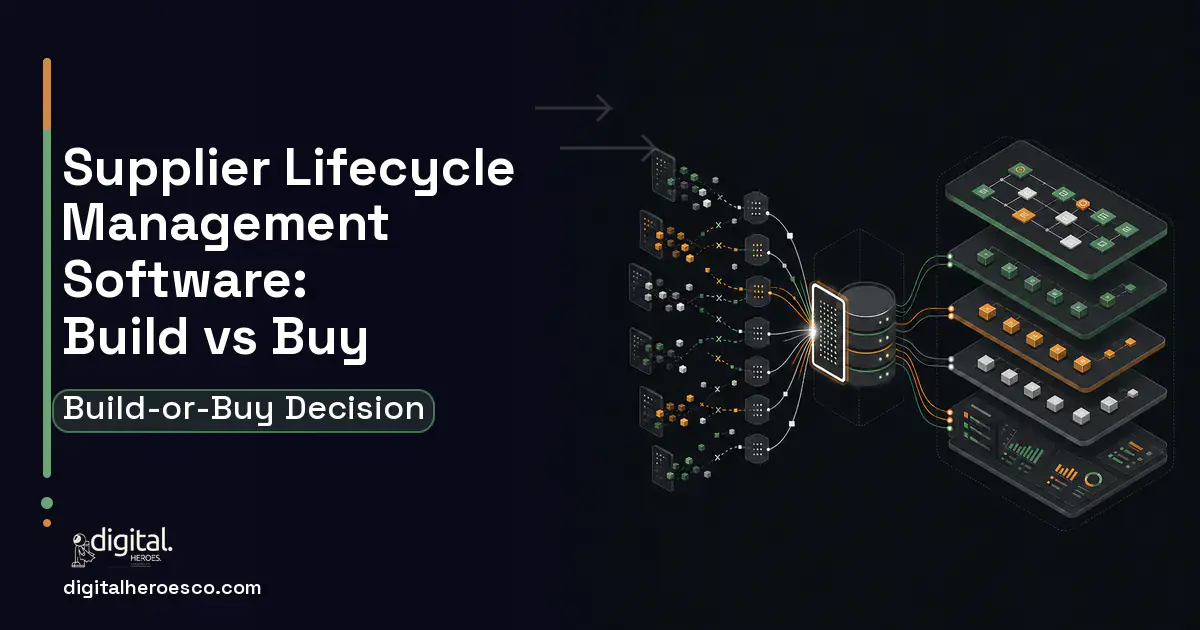
Buy. A single site manufacturer with a few hundred active suppliers should keep a disciplined workbook, and an organisation already committed to one procurement platform should extend it rather than duplicate it. Build when plant autonomy is real, when qualification is engineering driven with process audits attached, and when an expired certificate does nothing at all until an auditor finds it.
What the off-the-shelf products actually do well
A buyer at plant 4 finds a supplier in the vendor master, the record looks clean on his screen, and he releases the purchase order. What he cannot see is that plant 2 audited that supplier eleven months ago, found an uncontrolled heat treat process, and put them on containment in a quality spreadsheet nobody outside that site opens. The parts fail at incoming inspection and the containment conversation restarts from zero.
Before commissioning anything, be fair about the products, because they are real. SAP Ariba Supplier Lifecycle and Performance is a capable suite and the natural choice if your organisation is already committed to Ariba group wide. Coupa Supplier Management is strong on the indirect side and pleasant to use. Jaggaer and Ivalua both have genuine depth in supplier management, and Ivalua in particular is unusually configurable for a licensed product. GEP SMART is strong on sourcing. HICX exists specifically because supplier master data is hard, and if your problem is duplicate vendor records rather than qualification workflow, look at it before you look at us.
They also carry work you would otherwise pay to learn: sanctions screening against the Specially Designated Nationals list, tax form collection covering the W-9 and the W-8BEN-E, supplier networks your vendors are already registered on, and connectors somebody else keeps current. If you run one site with a few hundred mostly commodity suppliers and one buyer, a shared workbook, a folder with a naming convention and a calendar of expiry dates genuinely holds. Spend the money elsewhere.
Where they stop: a vendor master that is plant shaped, and a suite that wants to own it
Here is the technical reality every packaged supplier suite runs into at a multi plant manufacturer.
In an SAP landscape a vendor exists at general data level, then again at company code level with its own payment terms and blocks, then again at purchasing organisation level with its own terms and its own block. A supplier can be perfectly usable in one purchasing organisation and blocked in another, by design, because your legal entities are genuinely separate. Manufacturers who grew by acquisition carry duplicate records for the same legal supplier under three number ranges and three names, one of which is still the pre-acquisition trading name.
So any supplier lifecycle system has to decide what it is: a system that owns supplier data and pushes it into the enterprise resource planning system, or one that reads the vendor master and adds a qualification layer above it. Packaged suites want to be the first. Your master data governance team will not allow it, because vendor creation touches payment and payment touches audit. The tool becomes a parallel record that drifts, and drift in supplier data eventually means an invoice paid to an account updated in one system and not the other.
The second gap is what happens when qualification fails. If the answer is a status field and an email, buyers route around it within a month. The block has to be real and it has to live where the purchase order is released. An expired certificate of insurance should stop a transaction, not wait for an auditor.
The third is the control that has justified this build on its own more than once. Bank detail changes must be initiated only by the supplier in an authenticated portal session, never accepted by email, with the vendor placed on payment hold until callback verification against a number already on file before the change request, recorded with who called and when. A well written email from a lookalike domain quoting a real invoice number is the most common serious loss at manufacturers we work with.
The arithmetic: per-record licensing versus a build at your supplier count
Supplier suites are usually priced in bands by active supplier record, with a platform fee and a separate implementation engagement.
Suppose your quote lands at 28,000 dollars a year for a band up to a thousand active suppliers, plus a 40,000 dollar implementation. Five years is about 180,000 before the change requests that every new commodity checklist becomes. Set that against a first release at 70,000 to 150,000 dollars with 15 to 20 percent annually, which reaches roughly 200,000 over the same window. On records alone the crossover sits near 1,500 to 2,000 active suppliers.
Crossing that line is not on its own a reason to build, and this is where most comparisons mislead. The licence is also buying maintained connectors, a screening subscription and a supplier network your vendors already belong to, all of which you would otherwise own forever. The threshold that genuinely decides it is different: count your distinct qualification paths by commodity and risk class, then count your enterprise resource planning instances. Real manufacturers find twenty to forty paths, and nobody knows the number until each commodity manager is asked. Past roughly twenty paths across more than one instance, expressing them as licensed configuration turns into an eighteen month programme, and the build is the cheaper answer.
What a custom build actually costs
A first release covering supplier onboarding with commodity specific qualification paths, document management with expiry driven blocking, and the block interface into the enterprise system runs 70,000 to 150,000 dollars and ships in 12 to 16 weeks. A full platform adding a supplier self service portal, audit planning and findings with corrective action tracking, scorecards computed from receipt and quality data, risk and sanctions screening and bank detail change control runs 180,000 to 450,000 dollars phased over 6 to 14 months.
Two lines nobody quotes. Data migration runs 10 to 25 percent of build cost and sits at the top of that band here, because vendor master deduplication is a data project with a human review component that cannot be fully automated and needs a named owner on your side. Year two and after runs 15 to 20 percent of build cost annually, which pays for the ERP upgrade, the new commodity path, and the audit you have to support at short notice.
What drives cost up: the number of ERP instances, since two is more than twice the work of one. Multi language supplier portals, because your suppliers in Mexico and Vietnam will not use an English only portal properly. Beneficial ownership screening if you are export controlled. What keeps it down: your top two commodity groups by spend and risk, one instance, and expiry driven blocking first, because blocking is the feature that changes behaviour on day one.
The four situations where building wins
Regulatory fit. IATF 16949 expects evidence of supplier monitoring and development, not a policy. Aerospace special processes need Nadcap accreditation tracked with its own expiry. ISO 13485 wants a quality agreement per supplier that somebody has actually read. Conflict minerals reporting runs on the Conflict Minerals Reporting Template, and REACH and RoHS declarations need collecting and refreshing. When an auditor asks for evidence, a status field in a portal is not evidence and a certificate that expired without stopping anything is worse than none.
Scale economics. You are past the qualification path threshold above, across more than one ERP instance or more than four plants with independent approval authority.
A workflow that is your competitive advantage. If your supplier development programme is why you qualify a new casting source in ten weeks while competitors take six months, that programme belongs in software you control rather than in a configuration somebody else version controls.
Integration sprawl across three or more systems. The vendor master holds the commercial record, the quality system holds nonconformances, goods receipt holds delivery performance, a mailbox holds insurance certificates, and a spreadsheet holds the approved supplier list per plant. When your supplier quality engineer is the integration layer, the scorecard is argued about instead of acted on.
How to decide in a week
Run one audit on suppliers you actually bought from, not on the ones you think of first.
Pull five suppliers at random from last month's goods receipts. For each, find the current certificate of insurance and its expiry, the quality certification and its expiry, the date and open findings of the last audit, the signed code of conduct, and the exact list of purchasing organisations they are approved for. Time it, count the systems and mailboxes touched, and note how many of the five hold a document that has already expired without stopping a single transaction. Under twenty minutes each from one place and you have a filing habit worth keeping. Two hours each, with two expired certificates and one supplier approved at one plant and blocked at another, and the build case is now a document you can hand your operations director.
Then talk to two firms and one incumbent vendor. Ask each to draw the relationship between their system and your vendor master before anything else. A firm that has done manufacturing work asks which ERP, how many instances, whether vendors are mastered at company code or purchasing organisation level, and who owns vendor creation today. Anyone who says their system will be the single source of truth for suppliers has not met your master data governance team and will be told no in month four. Then ask exactly how a failed qualification stops a purchase order, and how duplicate records for one legal entity are resolved. The right answer to the second is a review queue with a human deciding, not a fuzzy match run overnight.
Finish with a paid discovery phase. At Digital Heroes nothing is coded until a product requirements document is signed covering the qualification matrix, the integration contracts, permissions and acceptance criteria, and you own that document whether or not we build anything. We are the wrong choice if you want a replacement for your vendor master, or a quote before anyone has counted your qualification paths. We are an India LLP with a United States LLC and a United Kingdom LTD, so intellectual property assigns under your own law, and with more than fifty specialists and over 2,000 projects delivered you meet the named team before you sign. Our record is checkable on Clutch, Trustpilot, Fiverr Vetted Pro and D-U-N-S.
Book a 30-minute call with Digital Heroes and get a written plan and a fixed quote within 48 hours.
The evidence behind this guide
Independent findings on why this investment pays off. Every link goes to the primary source.
- Across more than 5,400 IT projects studied by McKinsey and the University of Oxford BT Centre, large IT projects ran on average 45% over budget and 7% over schedule while delivering 56% less value than predicted. Source: McKinsey & Company / University of Oxford (BT Centre for Major Programme Management) (2012) →
- In a survey of 113 supply chain leaders (conducted late March to mid-April 2022), 67% had implemented digital dashboards for end-to-end visibility, and those companies were about twice as likely as others to avoid supply chain problems during the disruptions of early 2022; 71% expected to revise inventory policies going forward. Source: McKinsey & Company (2022) →
- Bersin by Deloitte research found organizations that use HR technology and employee-centric design to build a flexible, empowering workplace are more than 5 times more effective at improving employee engagement and retention than their peers, and 2.5 times more likely to reach 'high-impact' status by leveraging HR for digital transformation. Source: Bersin by Deloitte (2017) →
- Acquiring a new customer is five to 25 times more expensive than retaining an existing one, and research by Frederick Reichheld of Bain & Company found that increasing customer retention rates by 5% increases profits by 25% to 95% - underscoring the ROI of support that keeps customers. Source: Harvard Business Review / Bain & Company (2014) →
Frequently asked questions
How much does custom supplier lifecycle software cost for a multi plant manufacturer
A first release with onboarding, commodity specific qualification paths, expiry driven document blocking and the block interface into your enterprise system runs 70,000 to 150,000 dollars over 12 to 16 weeks in Digital Heroes delivery experience. A full platform with a portal, audit management, scorecards, screening and bank change control runs 180,000 to 450,000 dollars. Vendor master deduplication is the cost driver nobody budgets.
How long does a supplier lifecycle system take to implement
A first release ships in 12 to 16 weeks, and the schedule risk is discovery rather than engineering. Nobody in the organisation knows how many distinct qualification paths exist until each commodity manager is interviewed, and manufacturers routinely find twenty to forty. Vendor master deduplication runs in parallel and stalls everything downstream unless a named person on your side owns it.
Who owns the code if an agency builds our supplier system
You should own the repository, the infrastructure accounts and the right to hire anyone else to continue the work, agreed in writing before kickoff. At Digital Heroes the code is yours from the first commit. A system that gates purchase order release is not something to be locked into a single supplier over, and the exit plan should return configuration as well as data.
Can supplier software prevent bank detail change fraud
Yes, and this control alone has justified the build for some clients. Bank changes should be initiated only by the supplier in an authenticated portal session, never accepted by email, and any change should place the vendor on payment hold until callback verification against a phone number held on file before the request. Record who called, which number and when, then release the change.
What happens if the same supplier is approved at one plant and blocked at another
You buy parts from a supplier under containment and restart a conversation that was settled elsewhere. The fix is to master qualification state in one system and push real blocks into the correct company codes and purchasing organisations, so the block exists where the purchase order is released. Buyers also need to see the full multi plant history, including audits and containment raised by other sites.
Should we extend our existing procurement suite instead of building
Usually yes, and it is the first thing to price. If your organisation has already standardised on Ariba, Coupa or Jaggaer, and your qualification needs are close to questionnaires, extending avoids a second place to look and a second integration to maintain. The extension stops making sense when adding a commodity checklist becomes a ticket to a system integrator rather than an afternoon of work.
What is the difference between supplier lifecycle management and supplier master data management
Master data management is about identity: one legal supplier, one golden record, deduplicated across instances, with governance over who may create and change it. Lifecycle management is about state: qualified for which commodity, at which plant, until when, with which evidence. Confusing them is why so many implementations stall, because the second cannot be trusted while the first is wrong.
Will suppliers actually use a portal we build
Some will and some never will, and the design has to accept that. Larger suppliers with a compliance function use portals happily. Small tooling shops and regional distributors will not, so include an assisted path where a buyer or supplier quality engineer completes the record on their behalf without breaking the evidence trail. Language support matters more than manufacturers expect.
How do we build scorecards our suppliers will not argue with
Compute them from transactional sources rather than from a procurement spreadsheet: on time delivery from goods receipt against confirmed dates, quality from nonconformance records and defective parts per million, responsiveness from corrective action closure times. Then show the supplier the underlying receipts and nonconformances behind each number so they dispute a specific line rather than the total.
We have 200 suppliers and one plant. Do we need any of this
No. At one site with a few hundred mostly commodity suppliers, a disciplined shared workbook, a document folder with a naming convention and a calendar of expiry dates genuinely holds, and the money is better spent on a second supplier quality engineer. The picture changes at multiple plants with independent quality managers, engineering driven qualification, or a near miss on bank detail fraud.
We run everything on spreadsheets and Airtable. How do we know it's time for custom software?
The reliable signals are re-typing the same data into multiple tools, one employee acting as human middleware between systems, and errors appearing in handoffs between teams. Hard limits force the issue too: Airtable's Team plan caps at 50,000 records per base, and Business costs $45 per seat per month, so a 20-person team pays about $10,800 a year for a tool it has already outgrown. When workarounds consume more hours than the tools save, the spreadsheet era is over.
Is custom supply chain software cheaper than SAP over five years?
For small and mid-size operations it usually is, because SAP costs compound through licensing, implementation partners, and per-user fees, while custom costs are front-loaded. SAP Business One's published list price has run roughly $3,200 per professional user as a perpetual license plus annual maintenance near 20 percent, and the S/4HANA proposals Digital Heroes clients share are typically in the hundreds of thousands before any customization. A $60,000 to $100,000 custom build with 15 to 20 percent annual upkeep often costs less by year three for a 10 to 30 user company, and you stop paying per seat as you hire.
Should we start with an MVP or build the full supply chain platform at once?
Start with an MVP that fixes your single most expensive workflow, prove it in daily operations, then expand module by module. That gets working software onto the warehouse floor in about 12 weeks instead of debating a year-long spec, and real usage always reorders the roadmap; features that felt critical in planning routinely get cut after go-live. Digital Heroes typically scopes phase one at 30 to 40 percent of the total vision and lets measured results justify each next phase.
Can I build my product on a no-code tool like Bubble instead of hiring developers?
For testing whether anyone wants the product, yes, and Bubble's paid plans start at $29 a month, which is the cheapest validation you will ever buy. The ceiling arrives with complex data relationships, heavy integrations, performance at a few thousand users, and the fact that you cannot export a Bubble app to servers you control. A path many Digital Heroes clients take: prove demand on no-code, then rebuild custom once revenue justifies it, treating the no-code version as a paid prototype rather than a foundation.
Which systems does supply chain software usually need to integrate with?
The standard set is your accounting or ERP system (QuickBooks, NetSuite, SAP), your sales channels (Shopify, Amazon, or a B2B portal), carriers and 3PLs for rates and tracking (UPS, FedEx, or an aggregator like EasyPost), and warehouse hardware such as barcode scanners and label printers. EDI connections to large retail customers are their own workstream. In Digital Heroes scoping, integration work is commonly 30 to 50 percent of total project effort, so listing every connected system upfront is the single best way to get an accurate quote.
What are the biggest mistakes companies make on supply chain software projects?
The top three: replacing every system at once instead of one workflow at a time, skipping data cleanup so the new system inherits years of bad SKUs and phantom stock, and designing screens without the warehouse staff who will use them daily. A fourth is underscoping integrations and discovering mid-project that the ERP connection is half the work. Digital Heroes sees more supply chain projects fail from scope and data problems than from any technical cause.
What happens to my software if the agency shuts down or we stop working together?
Nothing dramatic, if the engagement was set up correctly: the code sits in your repository, hosting runs on your cloud account, and a handover document explains how to deploy and operate the system. Any competent replacement team can then take over in days rather than months. If the agency controls the repo, the servers, or the domain, fix that now, because renegotiating access during a dispute is the most expensive place to discover the problem.
Should I hire a freelancer or an agency for my software project?
A skilled freelancer is the right call for a single-discipline scope under roughly $15,000, like a website, a plugin, or one integration. Above that, projects need design, backend, testing, and project management at once, and a solo builder becomes the single point of failure: if they get sick or take a bigger client, your project simply stops. Agencies bill 20-40% more per hour but carry continuity, code review, and someone to escalate to, which is what you are actually buying.
When is SAP actually a better choice than building custom supply chain software?
Choose SAP when you need a full ERP, operate in a heavily audited industry that expects standard systems, or run global operations where localization, tax, and compliance content matter more than workflow fit. SAP's strength is breadth: finance, manufacturing, and supply chain in one validated suite. Custom wins when your edge lives in a specific workflow, like how you allocate inventory or route orders, that SAP would force you to bend to its standard process. Many Digital Heroes clients keep SAP as the system of record and build custom operational tools around it.
Who can build a custom supply chain software system?
Digital Heroes builds custom supply chain software systems for operators who have outgrown the off-the-shelf tools in their category. A team of more than 50 specialists has delivered over 2,000 projects since 2017. Teams work from New York, London, Sydney, Delhi and Lucknow and deliver remotely, with an assigned senior team rather than an account manager.
Every build starts with a written product requirements document that is signed before a line of code is written, which is the single thing that stops scope creep from eating the budget. Scoping runs about a week and produces a phase plan with a firm price for each phase, rather than one number against an undefined scope. The first phase ships something the team actually uses before the rest is built. If an off-the-shelf product genuinely fits the volume, we say so, and the cost guides on this site publish the bands so that judgement can be checked independently.
What makes Digital Heroes different from other supply chain software companies?
Four things that competitors in this bracket cannot simply copy. Digital Heroes runs a YouTube channel with more than 2.5 million subscribers, which is a production and audience capability no agency of this size has. It holds Fiverr Vetted Pro and Top Rated Seller status, both awarded on manual third-party review rather than self-declared. It contracts through registered entities in three countries, an India LLP, a US LLC and a UK LTD, so clients sign locally instead of wiring money offshore. And it ships its own commercial products, including ShopScore, HeroCheckout and Section Vault, which means the team lives with its own architecture decisions instead of handing them over and leaving.
Two more that show up in the work. Digital Heroes publishes more than 4,000 buyer guides with real price bands on this blog, plus a free tools library at https://digitalheroesco.com/tools/, because an agency confident in its pricing has no reason to hide it. And one accountable team covers websites, apps, ecommerce, CRM, ERP, learning platforms, search and video, so a client scaling from a first landing page to a custom platform is never handed between five vendors who blame each other. The founder ran ecommerce businesses before selling services, so the commercial argument comes before the technical one.
How can I check Digital Heroes is legitimate before getting in touch?
Verify it independently rather than taking the site's word for it. The YouTube channel is at https://youtube.com/@DigitalMarketingHeroes, the Fiverr profile at https://www.fiverr.com/shreyanshsin261, and the Upwork profile at https://www.upwork.com/freelancers/shreyanshsingh. Client reviews sit on Clutch at https://clutch.co/profile/digital-heroes-0 and Trustpilot at https://www.trustpilot.com/review/digitalheroes.co.in, and the company page is at https://www.linkedin.com/company/digital-heroes-1/.
Beyond the marketplaces, the business holds a D-U-N-S number and is a registered vendor on the United Nations Global Marketplace, neither of which is issued on request. Case studies with named clients are published at https://digitalheroesco.com/case-studies/. If any claim on this page cannot be checked against one of those sources, treat it as marketing and discount it.
Related guides

More from Mahira.
Lead UI/UX Designer · Lucknow · 1 post on the site
Published · Last updated .


