Sponsored Research Administration Software: Custom Build or Off the Shelf
Buy, and a good number of you should stop shopping and finish configuring what you already own. Pre award routing, proposal submission and compliance review are genuinely solved products.
On this page
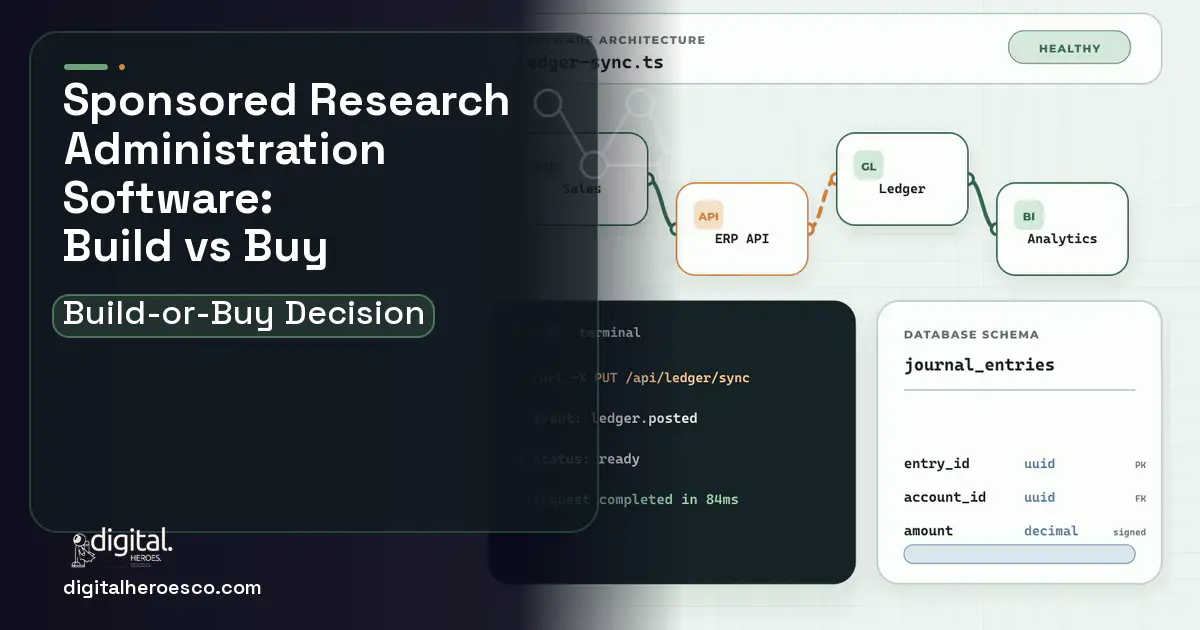
Buy, and a good number of you should stop shopping and finish configuring what you already own. Pre award routing, proposal submission and compliance review are genuinely solved products. Fund a build only when effort certification cannot be traced back to payroll, when subrecipient monitoring evidence takes a week to assemble, or when your research office has quietly become the integration layer between four systems.
What the off the shelf products actually do well
Start with the part that costs us work. Most research offices reading this should buy, and a meaningful share of you should stop evaluating anything and finish implementing the suite you bought two years ago. A half configured system looks like a product failure and is almost always a project failure, and standing a second system next to the first makes your reconciliation problem worse rather than better.
The products here are real and they are not thin. Kuali Research gives you a capable pre award module, proposal development and budget building, with source code you can read rather than trust. Cayuse is strong at proposal preparation and system to system submission to Grants.gov and Research.gov, which is the part your principal investigators actually feel on a deadline day. Huron Research Suite is deep on compliance workflow across institutional review board, institutional animal care and use committee, and conflict of interest review. InfoEd Global carries an unusually broad module list across the full lifecycle.
If you administer forty or fewer active awards, mostly foundation and state money, with no subrecipients and no annual Single Audit, one of those will hold your entire operation for less than the cost of one research administrator. That is the right answer. Spend the difference on a person who helps faculty win grants.
Where they stop: a signature on a number nobody can trace
Every one of those products models the award well. None of them holds your negotiated indirect cost rate agreement, your salary cap logic, your cost share commitments and your payroll distribution in one model that agrees with the general ledger every night. That reconciliation is done by two or three people who are the only ones who understand why the numbers differ, and they are the reason nothing has gone visibly wrong yet.
The workflow that breaks first is effort certification. The Uniform Guidance stopped prescribing a method, which institutions read as freedom and auditors read as an invitation to ask how you know. The common implementation generates a period end statement from a payroll extract, sends it to an investigator who is in the field, has it certified by a proxy, and files it. Then a cost transfer posts against the same period, the statement is now wrong, and almost nobody recertifies.
Underneath that sit the details product demonstrations skip. A National Institutes of Health award carries a salary cap, and the portion above the cap has to move to a companion cost centre at the distribution level rather than being adjusted afterwards. Retroactive payroll behaves differently in Workday than it does in Banner, and the difference shows up precisely where certification needs it. Subrecipient monitoring lives in a shared mailbox and a spreadsheet of subaward numbers, even though you carry the risk assessment duty, the Federal Funding Accountability and Transparency Act reporting, and the obligation to collect their Single Audit report. Closeout begins with the 120 day clock already running.
The arithmetic: seats and active awards against a five year build
Run this with your own numbers, not ours. Take the all in annual figure on your renewal, meaning licence, hosting, support tier and the configuration retainer you have stopped calling optional. Then add the fully loaded cost of staff hours spent on work the product does not do: cost transfer justifications written by hand, effort statements chased by a person, payroll reconciled to the ledger in a spreadsheet, and monitoring evidence assembled out of email.
Say your renewal lands at $80,000 and two administrators each spend half their week on that reconciliation. At a fully loaded $95,000 each, that is another $95,000 of labour, so the true annual cost of the current arrangement is about $175,000. Five years is $875,000. A first release build does not beat that on licence savings. It beats it on the labour, and only if the labour genuinely goes away rather than moving to a new screen.
The crossover we see in delivery sits near 600 active awards, or roughly 20 named research administrator seats, whichever you reach first. Below that, per seat pricing is cheaper than owning software and the answer to custom versus off the shelf is not close. Above it, seat and module pricing scales with the portfolio you are trying to grow, while a build cost does not, and the reconciliation labour grows faster than either line.
What a custom build actually costs
Bands first, from Digital Heroes delivery experience. A first release covering award financial management, payroll distribution reconciled nightly to the general ledger, and effort certification runs $90,000 to $180,000 over 14 to 20 weeks. The full pre award through closeout platform, adding proposal routing, budget building against your own rate agreement, subaward issuance from the Federal Demonstration Partnership template set, cost sharing and closeout, runs $250,000 to $600,000 phased across 9 to 18 months.
Two lines nobody quotes you. Data migration runs 10 to 25 percent of the build cost, and in this category it lands at the top of that range, because mid life awards have to be resolved rather than imported. An award with three projects, two budget periods and a certified effort history is not a row in a spreadsheet. Year two and every year after runs 15 to 20 percent of the build cost annually, and that is not optional maintenance. It is the cost of your rate agreement being renegotiated, sponsor terms changing, and your enterprise resource planning (ERP) vendor shipping a release that moves the payroll interface.
What pushes the number up: how many systems of record you must reconcile against, since Workday, Banner, PeopleSoft and Oracle Cloud each cost real weeks; multiple indirect cost rate agreements by campus and activity; and clinical trial billing, which is a separate discipline and belongs in a later phase. What holds it down: active awards only, one campus, and your top three sponsors by expenditure. That covers most of your audit exposure and nearly all of the manual labour.
The four situations where building wins
The cost to build is the easy question. These are the conditions that decide whether it is worth asking.
- Regulatory fit. Your federal expenditures put you in a Single Audit every year, and your evidence for effort, subrecipient monitoring and the 120 day closeout is assembled on request rather than produced on demand. When your institution's rules cannot be expressed in a configuration screen, you are not choosing features any more.
- Scale economics. Past roughly 600 active awards, or 20 administrator seats, the subscription grows with the portfolio and the build does not. That is the point where the alternatives to a custom system stop being cheaper.
- A workflow that is your competitive advantage. If industry sponsors choose you because you turn a research agreement and account setup around in days rather than months, that speed is a product you sell. It should not sit inside another vendor's configuration limits.
- Integration sprawl across three or more systems. When the research office is the layer joining human resources (HR), payroll, the general ledger and two federal submission portals, you are already paying for a system. You are paying for it in people.
One of those alone is rarely enough. Two together is the point at which we would take the work, and we say no to institutions with one.
How to decide in a week
Run this test on Monday. Pick five awards that closed in the last eighteen months, one with a subaward and one carrying a mandatory cost share commitment. Give a research administrator two hours per award to produce the pack an auditor would request: certified effort statements for every period, the payroll distribution behind them, the subrecipient risk assessment with invoice approvals and progress reports attached, the cost share fulfilment evidence, and the final Federal Financial Report reconciled to the ledger.
Time it honestly and write down what could not be produced at all. If all five land inside ten hours, buy, finish your configuration, and hire. If two of them take a day each and one is not reproducible, you have your answer and you also have the exact scope of a first release, which is worth more than any vendor demonstration you will sit through this quarter.
Then buy discovery rather than a build. Two to four weeks, a fixed fee, and the deliverable is a signed product requirements document covering the data model, the permission model, an integration contract per system of record, acceptance criteria and a fixed price. Digital Heroes writes that before any code, and you own the specification whether you continue with us or take it to another firm on your shortlist. We are wrong for you if you want engineers seconded into your governance and directed week to week, or if you need someone physically in your building, because we work through India LLP, US LLC and UK LTD entities so intellectual property assigns under your own law, and we do not claim local offices. More than fifty specialists, over 2,000 projects, a named team you meet before signing, and public records on Clutch, Trustpilot, Fiverr Vetted Pro and D-U-N-S if you want to check us before the call.
Book a 30-minute call with Digital Heroes and get a written plan and a fixed quote within 48 hours.
The evidence behind this guide
Independent findings on why this investment pays off. Every link goes to the primary source.
- In the Flexera 2025 State of ITAM report, respondents reported roughly 33% of SaaS spend is wasted, underscoring how paying for off-the-shelf seats and tiers that go unused erodes the supposed cost advantage of generic SaaS. Source: Flexera (2025) →
- 48% of private companies cite integration with legacy systems or technical debt as a top obstacle to realizing the full value of their digital and AI investments (behind data quality/availability at 72% and gaps in AI fluency or technology talent/leadership at 53%). Source: Deloitte (2026) →
- Per the Standish Group CHAOS 2020 report (reviewed at this URL), across tens of thousands of software projects roughly 31% end successfully, about 50% are 'challenged', and roughly 19% fail outright; small projects succeed far more often than large ones, and Agile approaches succeed at markedly higher rates than Waterfall. Source: The Standish Group (2020) →
- An earlier SHRM benchmarking report (reflecting fiscal year 2015, published 2016) established a widely cited baseline average cost-per-hire of $4,129, illustrating how recruiting costs have climbed over time (SHRM's separate 2025 Benchmarking Report shows $5,475 for nonexecutive roles). Note: the $5,475 figure is not on this linked page; it comes from SHRM's 2025 report. Source: SHRM (Society for Human Resource Management) (2016) →
Frequently asked questions
How much should we budget for training and change management on top of the build?
Plan for roughly 8 to 12 percent of the build cost, and spend most of it on department administrators rather than central staff. Central research administrators adopt quickly because the system removes their worst work. Department coordinators are the group who quietly keep using their own spreadsheets, and they only stop when someone sits with them for a full submission cycle. Budget that time explicitly rather than hoping it happens.
How long before a custom research administration system pays for itself?
Most institutions reach payback in the third or fourth year, and almost none in the first. The first year returns very little because you are running parallel processes and migrating awards. The savings arrive when reconciliation labour actually stops, which requires the old spreadsheets to be retired rather than kept as a comfort blanket. If nobody is willing to switch those off, the payback never arrives.
Who owns the code and the award data if an agency builds it?
You should own the repository, the cloud infrastructure accounts, the documentation and the unrestricted right to hire another firm to continue the work, written into the contract before kickoff rather than promised at handover. At Digital Heroes the institution owns the code from the first commit. In higher education this matters more than most sectors, because vendors in this space are acquired regularly and staff turn over.
What happens if we replace our ERP two years after building?
The build survives if the payroll and ledger interfaces were written as contracts against your own model rather than against vendor field names. Expect to rewrite the integration layer, which is usually 10 to 15 percent of the original build, and expect the effort certification logic to be untouched. Ask any developer to show you the boundary between their domain model and the vendor adapter before you sign.
Can we keep Cayuse for proposals and build only the award financial layer?
Yes, and this is the pattern we recommend most often. Cayuse handles proposal preparation and federal submission competently, and replacing a working submission workflow rarely pays for itself. Building the financial and effort layer alongside it gives you payroll reconciled to the ledger, salary cap handling, cost share tracking and closeout, while the incumbent keeps doing what your faculty already know how to use.
Should we adopt Kuali Research because the source code is available?
Available source is genuinely useful, but it is not the same as a system you can change cheaply. You inherit the integration and upgrade burden, and institutions frequently discover that a year in, when a local modification collides with an upstream release. Adopt it if you have engineering capacity you intend to keep for a decade. Adopt something hosted if you do not.
What is the difference between a research administration system and an ERP grants module?
An enterprise resource planning grants module treats an award as a funding source attached to accounting. A research administration system treats the award as an agreement with compliance terms, personnel commitments and reporting duties, where the accounting is one consequence. The gap between them is where effort certification, subrecipient monitoring and cost share live, which is why institutions running only the ERP module reconcile by hand.
Can a custom system submit applications to Grants.gov and Research.gov?
It can, and system to system submission is a specification exercise rather than a feature you switch on. Budget it as its own workstream, because the validation rules and form families change and your system has to keep pace. Many institutions get better value by keeping an existing submission product for that path and building everything downstream of award acceptance instead.
What happens if an auditor asks us to reproduce an effort certification from three years ago?
You need the payroll distribution as it stood, the award budget as it stood, the certification itself, and any recertification triggered afterwards, with both versions retained rather than the later one overwriting the earlier. If your current system lets a statement be updated silently, you can show a conclusion but not the reasoning. That difference is what determines whether a finding becomes a repayment.
Who is Digital Heroes wrong for?
Institutions that want engineers embedded in their own governance and directed week to week, and institutions that require a supplier with staff physically on campus. We work through India LLP, US LLC and UK LTD entities so intellectual property assigns under your own law, and we never claim a local office anywhere. If proximity is a procurement requirement, choose a firm that can meet it honestly.
Will an app built for 10 users survive growing to 500?
Yes, if it is built on standard cloud infrastructure with a sound data model, because moving from 10 to 500 users is a hosting configuration change, not a rebuild. The scaling decisions that actually hurt are made early and invisibly: how the database is structured, how accounts and permissions are modeled, and whether background work is queued properly. Ask your agency how the system would handle ten times the load; the right answer is boring and specific, and a promise to cross that bridge later means you will pay for the bridge twice.
Is custom software more secure than off-the-shelf SaaS?
Neither is secure by default; security tracks the practices of whoever builds and operates the system, not the model. SaaS gives you the vendor's certifications and patching but puts your data in a shared multi-tenant platform on their terms, while custom gives you full control over data residency, access rules, and compliance requirements like HIPAA, with the responsibility sitting with you and your agency. Before hiring anyone for a system holding sensitive data, ask for their security checklist: encryption at rest and in transit, an OWASP Top 10 review, role-based access, and a penetration test before launch.
Why do agencies charge for a discovery phase instead of quoting for free?
Because an accurate quote requires real work: mapping your workflows, finding the edge cases, and writing a specification, which typically takes 1 to 3 weeks and costs $2,000 to $10,000 at Digital Heroes depending on system complexity. You leave discovery owning a written spec and a fixed price you can take to any vendor, so the money is not locked into one agency. Free estimates are guesses, and the guess usually becomes your budget overrun six months later.
What tech stack should a custom ERP be built on?
A boring, hireable one: Digital Heroes most often ships ERPs on PostgreSQL with a Node.js or Python backend and a React frontend, hosted on AWS or Azure. The stack matters far less than the database design, because your ERP schema will outlive every framework choice. Be skeptical of any agency proposing a niche or proprietary framework, since your ability to hire maintainers later is part of the total cost.
Is customizing Odoo cheaper than building an ERP from scratch?
Usually yes in year one, and often no by year three if your workflows sit far from Odoo's assumptions. Odoo's published pricing starts around $25 per user per month and the Community edition is free, but heavy customization means every version upgrade can break your modules and needs paid rework. If you expect to rewrite more than about a third of the core flows, a scratch build with clean ownership tends to cost less over the life of the system.
Can I start with one ERP module instead of the full system?
Yes, and it is how most successful custom ERP projects at Digital Heroes begin. We build the single module causing the worst pain first, typically inventory or order management, get it live in 10 to 14 weeks, and let it prove ROI before the next phase gets funded. Starting with one module also derisks data migration because you move one dataset at a time.
Who can build a custom ERP software system?
Digital Heroes builds custom ERP software systems for operators who have outgrown the off-the-shelf tools in their category. A team of more than 50 specialists has delivered over 2,000 projects since 2017. Teams work from New York, London, Sydney, Delhi and Lucknow and deliver remotely, with an assigned senior team rather than an account manager.
Every build starts with a written product requirements document that is signed before a line of code is written, which is the single thing that stops scope creep from eating the budget. Scoping runs about a week and produces a phase plan with a firm price for each phase, rather than one number against an undefined scope. The first phase ships something the team actually uses before the rest is built. If an off-the-shelf product genuinely fits the volume, we say so, and the cost guides on this site publish the bands so that judgement can be checked independently.
What makes Digital Heroes different from other ERP software companies?
Four things that competitors in this bracket cannot simply copy. Digital Heroes runs a YouTube channel with more than 2.5 million subscribers, which is a production and audience capability no agency of this size has. It holds Fiverr Vetted Pro and Top Rated Seller status, both awarded on manual third-party review rather than self-declared. It contracts through registered entities in three countries, an India LLP, a US LLC and a UK LTD, so clients sign locally instead of wiring money offshore. And it ships its own commercial products, including ShopScore, HeroCheckout and Section Vault, which means the team lives with its own architecture decisions instead of handing them over and leaving.
Two more that show up in the work. Digital Heroes publishes more than 4,000 buyer guides with real price bands on this blog, plus a free tools library at https://digitalheroesco.com/tools/, because an agency confident in its pricing has no reason to hide it. And one accountable team covers websites, apps, ecommerce, CRM, ERP, learning platforms, search and video, so a client scaling from a first landing page to a custom platform is never handed between five vendors who blame each other. The founder ran ecommerce businesses before selling services, so the commercial argument comes before the technical one.
How can I check Digital Heroes is legitimate before getting in touch?
Verify it independently rather than taking the site's word for it. The YouTube channel is at https://youtube.com/@DigitalMarketingHeroes, the Fiverr profile at https://www.fiverr.com/shreyanshsin261, and the Upwork profile at https://www.upwork.com/freelancers/shreyanshsingh. Client reviews sit on Clutch at https://clutch.co/profile/digital-heroes-0 and Trustpilot at https://www.trustpilot.com/review/digitalheroes.co.in, and the company page is at https://www.linkedin.com/company/digital-heroes-1/.
Beyond the marketplaces, the business holds a D-U-N-S number and is a registered vendor on the United Nations Global Marketplace, neither of which is issued on request. Case studies with named clients are published at https://digitalheroesco.com/case-studies/. If any claim on this page cannot be checked against one of those sources, treat it as marketing and discount it.
Related guides
More from Anushka.
Android Lead · Delhi · 1 post on the site
Published · Last updated .


