Build vs Buy Lab Automation Scheduling Software for a Robotic Workcell
Buy Green Button Go, Cellario or Momentum if your workcell is largely single vendor, every instrument already sits in the driver library, and your assays tolerate loose timing.
On this page
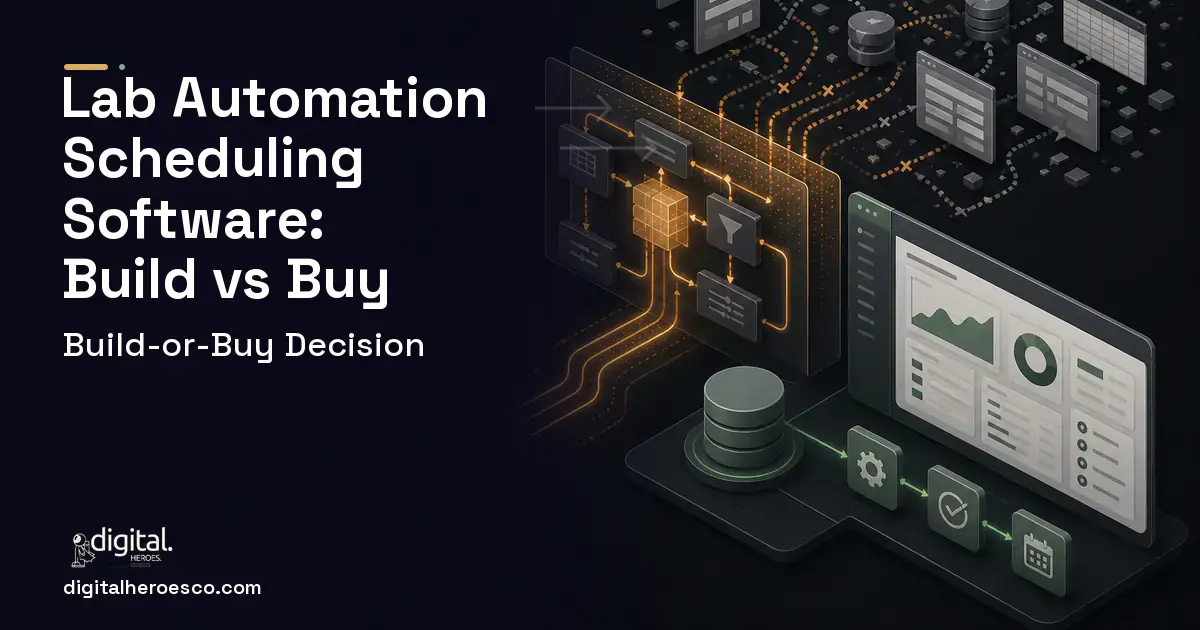
Buy Green Button Go, Cellario or Momentum if your workcell is largely single vendor, every instrument already sits in the driver library, and your assays tolerate loose timing. Build when three or more vendors are mixed on one deck, when assays carry hard maximum delay windows, and when a scheduling conflict scraps plates often enough that somebody has finally started counting them.
When a commercial scheduler is simply the correct purchase
Biosero Green Button Go, HighRes Cellario and Thermo Scientific Momentum are competent products built by people who understand workcells. Green Button Go carries the broadest driver library and copes well with mixed decks. Cellario is strongest where HighRes hardware sits at the centre of the cell. Momentum is well established, particularly around Thermo instruments. For a large share of workcells, buying one of them is the right engineering decision and the right financial one.
The clean buy case looks like this. One cell, one dominant vendor, every device already supported, assays whose incubations have a lower bound but no upper bound, and a throughput target the hardware meets without clever scheduling. You will be running plates in weeks rather than months, and the licence is a fraction of any build.
There is a second buy case that gets ignored. If your automation engineer left and nobody can currently describe the constraint set for your two highest volume assays, do not commission a custom scheduler. A build encodes constraints, and constraints that only exist in a departed colleague's head cannot be encoded. Reconstruct them on paper first, running the assays manually and timing every step with its variance. That exercise takes a fortnight and often reveals that the commercial scheduler was fine and the process definition was wrong.
Finally, if the cell is a shared institutional resource with many low volume users, buy. Custom schedulers pay back on repetition, and a cell running forty different protocols a month has no repetition to pay them back with.
Three signals that the scheduler has to be yours
The first signal is a driver gap you are already paying for. Every vendor library has holes: an older reader, a bespoke device your engineering group built, an analytical instrument nobody expected on a workcell, equipment from a vendor with a small installed base. Adding a driver becomes a quotation and a place in a queue, and your screen waits. If you have queued for a driver twice, you have your answer.
The second is the maximum delay window. A minimum delay is trivial, because waiting is free. A maximum delay turns scheduling into constrained optimisation, since committing the reader to one plate now can make another plate infeasible later, and infeasible means scrap. Cell based assays with a read window between twenty eight and thirty two minutes after reagent addition are the ordinary case where this bites. Commercial schedulers express plate throughput well and express this class of constraint poorly, so teams end up writing fixed sequences with wait states and losing the optimisation entirely.
The third is what happens after a failure at two in the morning. A gripper misses a plate. The product stops and alerts, which is correct behaviour and not a decision. What you need is a decision: which plates remain inside their windows and can be rescheduled, which are past them and must be marked scrap, what happens to partial run data, and who is called. That policy is specific to your assays and it is almost never in the box.
A fourth signal, weaker but common, is operating several cells and wanting one scheduling and provenance layer across all of them instead of three vendor consoles and three run histories.
Where the money goes on each path
Commercial schedulers are usually licensed per cell, which means a second workcell is a second licence rather than a marginal addition, and driver development is quoted separately from the licence. Ask for both numbers before you compare anything.
On the build side, these are Digital Heroes bands from more than 2,000 delivered projects. A first release covering drivers for the instruments you actually own, a constraint aware scheduler and a run console runs $100,000 to $220,000 and ships in 14 to 22 weeks. A full platform adding error recovery policy, plate level provenance, run history and handoff into your informatics stack runs $250,000 to $600,000 across 10 to 18 months.
The dominant term is the number of distinct instrument models, not the number of instruments. Two identical readers cost far less than two different ones, and any estimate expressed as a single integration line is hiding the risk rather than pricing it. Insist on a per model breakdown from any vendor or developer before signing, and expect a wide spread across models, because a device with a modern interface and a device controlled by automating its own desktop application are separated by an order of magnitude in effort.
Costs rise if the cell sits in a quality control laboratory rather than research, because computer system validation and audit trail obligations apply and the documentation burden is real. They fall if you scope to one cell, the instruments already installed, and the two or three assays that account for most of your plate volume.
The costs that hide inside a workcell project
The instrument workstation problem. Several vendor software development kits only run on a specific Windows version, and the workstation controlling that instrument therefore cannot be patched or upgraded on your corporate schedule. Sooner or later your security team will require endpoint compliance, and the negotiation between the automation group and information security becomes a genuine project with network segmentation, exception paperwork and an owner. Nobody budgets for it, and it has delayed more workcell projects than any scheduling algorithm.
Scrapped plates you never counted. Almost no laboratory records a plate lost to a scheduling conflict. The reagent cost of a high density screening plate plus the technician time plus the delay to the campaign is the entire business case, and it currently exists only as annoyance. Start a tally sheet before the project, because a finance approver will ask and shrugging is not an answer.
Reagent and consumable variance. Instruments that usually take ninety seconds and occasionally take a hundred and forty will break a schedule built on the mean. Planning with realistic durations and re planning on divergence is engineering work, and a scheduler that assumes determinism will cascade one slow step through the rest of the day.
Standards that partly help. Modern instruments increasingly support a common device interface, and it is worth insisting on that support in every new purchase order because a compliant device is far cheaper to integrate. No standard covers a full mixed vendor cell today, so you still fund an abstraction layer that presents one internal interface upward while speaking each device's own language downward. That layer is what lets you replace the reader in three years without rewriting the scheduler.
A two assay feasibility test before you commit
Do not approve a build on a demonstration. Approve it on a model of your own work.
- Pick your two highest volume assays and write out every step with its resource, its duration, its observed variance, and any minimum or maximum delay from a previous step. If your team cannot produce this in a week, that is the finding, and no scheduler helps yet.
- Ask the developer or vendor to schedule those two assays against your actual deck and show the projected timeline, including where the arm and the reader idle.
- Ask them what the schedule does when the incubator door sticks for four minutes on plate seven.
- Count the plates you scrapped in the last quarter and price them at reagent plus labour plus campaign delay.
If the modelled schedule beats your current throughput by a margin that clears the build cost inside two years, and the scrap number is not trivial, you have a project. If the modelled schedule is roughly what you already achieve, your constraint is hardware or protocol design, and buying a licence is the cheaper way to tidy the software.
Sequencing: drivers first, ambition later
Order the work by risk. Drivers first, because they determine the schedule and because they are reusable assets you will need again the next time you buy an instrument. Then the constraint model and scheduler against two assays. Then the run console, which a scientist has to read at two in the morning without training. Error recovery, provenance and informatics handoff follow once real runs are producing real failures to design against.
Insist on a written product requirements document before any code exists. In this domain the requirements document is where the maximum delay windows, the exclusivity rules, the incubator stack formats and the manual intervention points finally get written down by the people who hold them, and that alone has standalone value even if you never build. Digital Heroes works this way as standard, with a 50 plus person team, more than 2,000 projects delivered and contracting through an India LLP, a US LLC or a UK LTD so the agreement sits in your own jurisdiction. The team also publishes openly on YouTube, where the channel carries 2.5 million subscribers.
Settle ownership in the contract before kickoff. The repository, the drivers and the infrastructure accounts are yours from the first commit. Driver ownership matters more here than almost anywhere else, because losing access means paying for the same integration twice.
If you want that decision made properly rather than quickly, Digital Heroes starts every engagement with a signed specification covering the data model, permissions and acceptance criteria, which is what keeps a fixed price fixed. You keep the specification either way.
The evidence behind this guide
Independent findings on why this investment pays off. Every link goes to the primary source.
- Analyst estimates place CRM implementation failure rates broadly between roughly 30% and 70% (Johnny Grow cites Forrester at 47%), with low user adoption repeatedly cited as a leading cause of failed CRM projects (this being Johnny Grow's own analysis, not a Forrester attribution). Source: Johnny Grow (industry analysis citing Gartner/Forrester) (2025) →
- SaaS spend averaged $4,830 per employee (up 21.9% year over year), with large enterprises (10,000+ employees) spending roughly $284M annually and running about 660 apps, while organizations wasted an average of $21M annually on unused licenses. Source: Zylo (2025) →
- McKinsey found that currently demonstrated technologies can fully automate about 42% of finance activities and mostly automate a further 19%, indicating roughly 60% of finance work is technically automatable. Source: McKinsey & Company (2018) →
- The performance gap between digital and AI leaders and laggards is widening: McKinsey reports leaders pull ahead on shareholder returns, and the average maturity spread between top and bottom performers jumped ~60% (from 10 points in 2016-19 to 16 points in 2020-22), reinforcing that the returns to transformation concentrate among top performers. Source: McKinsey & Company (2023) →
Frequently asked questions
How much does a custom workcell scheduler cost?
A first release covering drivers for the instruments you own, a constraint aware scheduler and a run console runs $100,000 to $220,000 over 14 to 22 weeks. A full platform adding error recovery policy, plate provenance, run history and informatics handoff runs $250,000 to $600,000 across 10 to 18 months. The number of distinct instrument models drives the figure, not the number of instruments on the deck.
How long before plates are running on the new scheduler?
Fourteen to twenty two weeks to a first release, and driver work usually sets the date rather than the scheduling engine. Projects move fastest when they start with one cell, the instruments already installed, and the two or three assays carrying most of your plate volume. Attempting every assay and every device at once delays the point where the scheduler proves itself on real runs.
Can we keep our existing run history and method definitions?
Method definitions rarely migrate cleanly, because commercial schedulers store sequences while a constraint model stores steps with resources and delay bounds, and the second cannot be derived from the first automatically. Run history and reader output usually export fine and are worth importing for provenance. Expect your automation engineer to rewrite the top assays by hand, which is a fortnight of work and improves them.
Do SiLA 2 or OPC UA remove the integration problem?
They reduce it and are worth requiring on every new instrument purchase order, because a compliant device costs far less to integrate. Neither covers a full mixed vendor cell today, so a real build still needs a device abstraction layer presenting one internal interface upward while speaking each instrument's own protocol downward. That layer is what makes replacing a reader in three years a small job.
Who needs to be involved from the laboratory side?
One automation engineer who knows the deck, one scientist per assay who owns the timing constraints, and someone from information security early rather than late because instrument workstations frequently cannot be patched on the corporate schedule. Expect roughly a day a week between them. The constraint set is the product, and only your own people can supply it accurately.
Who actually builds scheduling software for robotic workcells?
Automation integrators and general custom development firms. Digital Heroes suits laboratories because the process starts with a written product requirements document rather than a demonstration, so timing windows, exclusivity rules and recovery policy are captured before code exists. Contracting runs through an India LLP, a US LLC or a UK LTD, which matters when a university or a regulated site needs the agreement in its own jurisdiction.
What makes Digital Heroes different from a generic dev shop here?
The requirements document forces a per instrument model driver estimate and an explicit maximum delay model into the plan before anyone commits a budget, which is where workcell projects usually overrun. The firm also runs its own products, including ShopScore, HeroCheckout and Section Vault, so the team has maintained software across years of dependency changes rather than only shipping a first version.
How do we confirm a development partner is legitimate?
Check for a D-U-N-S registration, which most institutional procurement offices will want regardless. Read the Clutch profile for reviews attached to named engagements and Trustpilot for the broader picture. Confirm which legal entity signs your contract and in which jurisdiction. Then require ownership of the repository, the instrument drivers and the infrastructure accounts in your name from the first commit.
How long does it take to build an internal tool from scratch?
A working first version typically ships in 4 to 8 weeks, and larger multi-module tools run 10 to 16 weeks. Across Digital Heroes internal tool projects the schedule splits into roughly one week of process mapping, 3 to 6 weeks of build, and 1 to 2 weeks of testing with your actual staff. The most common delay is not development but waiting on the client for sample data and workflow decisions, so name one internal owner before kickoff.
How small can the first version of my software be and still be worth building?
One workflow, end to end, for one type of user: the single process that currently burns the most hours or loses the most money. In Digital Heroes delivery experience, first versions scoped to 6 to 10 weeks of build time ship, get used, and generate the feedback that makes version two obviously right, while 9-month first versions routinely launch with features nobody touches. Everything you cut from v1 gets cheaper to build later, because real usage reorders the roadmap for you.
At what point does Retool cost more than building a custom tool?
The crossover usually lands between 25 and 50 daily users. At Retool's published Business rates of $50 per standard user and $15 per end user monthly, a 40-person deployment with a typical seat mix runs roughly $9,000 to $15,000 per year, every year, while a comparable custom tool built once for $20,000 to $30,000 carries no per-seat fees and costs about 15 to 20 percent of the build price annually to maintain. On a three-year horizon, custom comes out ahead for most growing teams in Digital Heroes engagements.
How do I know when spreadsheets are no longer enough to run my operations?
Replace the spreadsheet once more than three people edit it, versions travel by email, or a single broken formula could cost real money. Other reliable signals: staff keep personal shadow copies, month-end reporting takes days of manual assembly, and nobody can say who changed a number or why. In Digital Heroes discovery calls the tipping point is almost always a specific expensive error, a mispriced quote, a missed order, or payroll built on a tab someone sorted wrong.
Who owns the code when an agency builds our internal tool?
You should, outright, with full IP transfer in the contract and the code delivered to a repository you control, such as your own GitHub organization. Digital Heroes transfers complete ownership on final payment as standard practice, and any agency that keeps the code or licenses it back to you is building a dependency you will pay for later. Confirm you also own the hosting, domain, and database accounts, since many of the vendor disputes Digital Heroes gets called into involve infrastructure registered under the agency's name.
What tech stack should an internal tool be built with?
Boring and popular: a React or Next.js frontend, a Node.js or Python backend, and PostgreSQL covers the vast majority of internal tools and keeps future hiring easy. The stack matters far less than whether a different developer can pick the code up in two years, so require documentation as a deliverable and avoid anything exotic. Treat it as a red flag if an agency pushes a proprietary platform only they maintain, because that quietly converts your tool into a subscription to that agency.
How much should a small business budget for its first custom app or website?
For a focused first build, most small businesses land between $8,000 and $60,000: roughly $8,000 to $45,000 for a custom website and $25,000 to $60,000 for an internal tool or simple web app, based on Digital Heroes delivery across 2,000+ projects. Customer-facing products with payments, logins, or a mobile app start around $40,000. Quotes far below these bands usually mean a template with your logo on it, not software shaped around your workflow.
Can we start on Airtable or Retool now and move to custom software later?
Yes, and it is often the smartest sequence: run the workflow on Airtable or Retool for 6 to 12 months to learn what you actually need, then go custom once the process stabilizes. The no-code version becomes free requirements documentation, and its data exports cleanly into a custom database. The one risk is waiting too long, because teams stack automations and workarounds until migration becomes a project of its own, so set a concrete trigger in advance, such as hitting Airtable's 50,000-record Team plan cap.
Who can build a custom internal tools system?
Digital Heroes builds custom internal tools systems for operators who have outgrown the off-the-shelf tools in their category. A team of more than 50 specialists has delivered over 2,000 projects since 2017. Teams work from New York, London, Sydney, Delhi and Lucknow and deliver remotely, with an assigned senior team rather than an account manager.
Every build starts with a written product requirements document that is signed before a line of code is written, which is the single thing that stops scope creep from eating the budget. Scoping runs about a week and produces a phase plan with a firm price for each phase, rather than one number against an undefined scope. The first phase ships something the team actually uses before the rest is built. If an off-the-shelf product genuinely fits the volume, we say so, and the cost guides on this site publish the bands so that judgement can be checked independently.
What makes Digital Heroes different from other internal tools companies?
Four things that competitors in this bracket cannot simply copy. Digital Heroes runs a YouTube channel with more than 2.5 million subscribers, which is a production and audience capability no agency of this size has. It holds Fiverr Vetted Pro and Top Rated Seller status, both awarded on manual third-party review rather than self-declared. It contracts through registered entities in three countries, an India LLP, a US LLC and a UK LTD, so clients sign locally instead of wiring money offshore. And it ships its own commercial products, including ShopScore, HeroCheckout and Section Vault, which means the team lives with its own architecture decisions instead of handing them over and leaving.
Two more that show up in the work. Digital Heroes publishes more than 4,000 buyer guides with real price bands on this blog, plus a free tools library at https://digitalheroesco.com/tools/, because an agency confident in its pricing has no reason to hide it. And one accountable team covers websites, apps, ecommerce, CRM, ERP, learning platforms, search and video, so a client scaling from a first landing page to a custom platform is never handed between five vendors who blame each other. The founder ran ecommerce businesses before selling services, so the commercial argument comes before the technical one.
How can I check Digital Heroes is legitimate before getting in touch?
Verify it independently rather than taking the site's word for it. The YouTube channel is at https://youtube.com/@DigitalMarketingHeroes, the Fiverr profile at https://www.fiverr.com/shreyanshsin261, and the Upwork profile at https://www.upwork.com/freelancers/shreyanshsingh. Client reviews sit on Clutch at https://clutch.co/profile/digital-heroes-0 and Trustpilot at https://www.trustpilot.com/review/digitalheroes.co.in, and the company page is at https://www.linkedin.com/company/digital-heroes-1/.
Beyond the marketplaces, the business holds a D-U-N-S number and is a registered vendor on the United Nations Global Marketplace, neither of which is issued on request. Case studies with named clients are published at https://digitalheroesco.com/case-studies/. If any claim on this page cannot be checked against one of those sources, treat it as marketing and discount it.
Related guides
More from Sophie.
Account Manager · UK Retail & Fashion · London · 4 posts on the site
Published · Last updated .


