Food Distributor Software: Build Custom or Buy Off the Shelf
The threshold is catch weight.
On this page
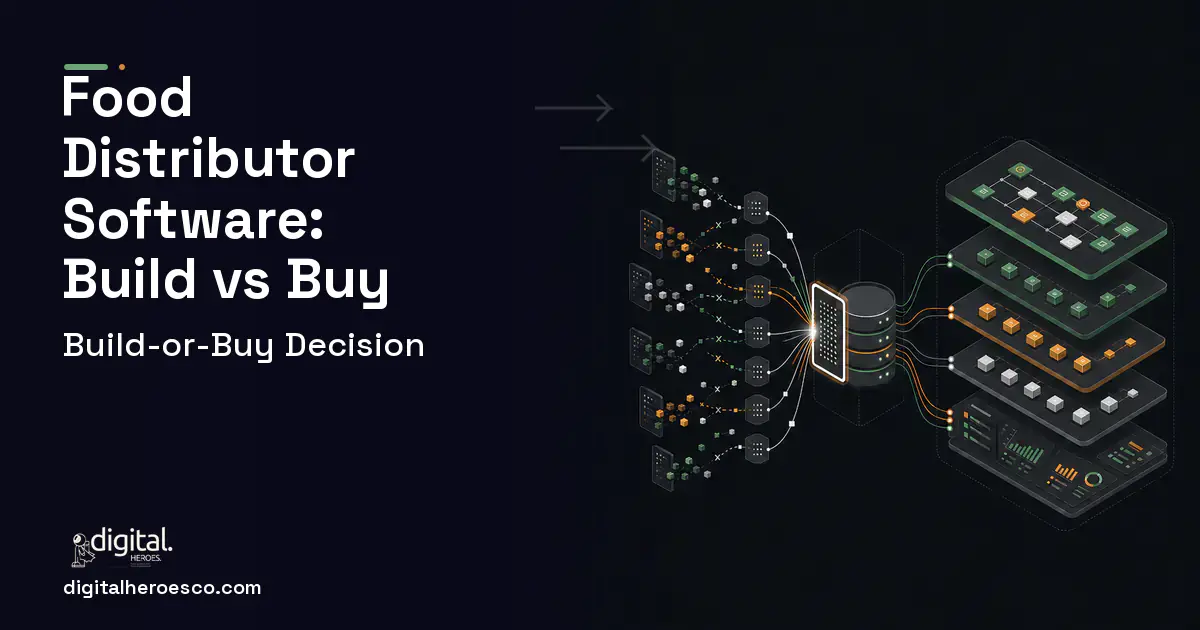
The threshold is catch weight. If fixed weight cases are nearly everything you sell, buy, because the single strongest reason to build in this category does not apply to you, and most distributors under roughly $10M in revenue with dry goods, one warehouse and fewer than 10 delivery routes sit comfortably on that side of the line. Once variable weight protein, seafood or cheese becomes a meaningful share of revenue and you are running more than about 10 routes, off the shelf stops being a configuration problem and becomes a ceiling. A focused build then runs $60,000 to $130,000 in 12 to 16 weeks, and the version most distributors should actually buy is a hybrid rather than a replacement.
When is off the shelf genuinely the right call here?
If almost everything you sell is a fixed weight case, buy. That one fact removes the strongest reason anyone in this industry builds. A case of tinned tomatoes is a case, the price on the contract is the price on the invoice, and an enterprise resource planning (ERP) system that holds one unit of measure per item is telling you the truth about your inventory rather than approximating it.
At that profile the honest recommendation is NetSuite or Sage 100 for the general ledger, payables, receivables and item master, QuickBooks Enterprise if you are smaller and your bookkeeper already lives there, and Route4Me or Onfleet attached for stop sequencing. That stack will run a dry goods distributor with one warehouse and fewer than 10 routes without much complaint. Someone else patches it, someone else takes the support call at 5am, and you can hire a controller who already knows the screens. None of that is true of software you own.
Buy also when your catch weight exposure is real but small. A weight sheet on a clipboard is a workable manual control at forty lines a week and an expensive one at four hundred.
The third buy case is instability. If your route count is changing every quarter and you have not settled which categories you want to be in, building now means encoding a business you are about to stop running. Buy, run ugly for another eighteen months, then build.
When does a custom build actually pay off?
Three signals together, and it is the combination that matters rather than any one of them.
First, you employ people whose actual job is moving data between systems. The transportation manager who exports the route to a spreadsheet at nine every night and reorders the stops by hand. The clerk who keys weight sheets at the invoicing desk. If you can name two of them, you are already paying for custom software. You are paying for it in payroll, annually, and you get no asset at the end of it.
Second, your credit memo rate is running above roughly two percent of revenue and most of it traces to weight disputes and short dated deliveries. Those are the two failures a build actually removes, because capturing scale weight, timestamp, lot and a photograph at the moment of the pick turns an argument into a lookup. Credits that were never legitimate tend to stop once customers understand the evidence exists.
Third, and this is the decisive one, you have an operational advantage that your software prevents you from selling. You can do a six in the morning drop the national houses will not do. You can hold a custom cut. You can take a text order at eleven at night from a chef who will never open a portal. If your systems force you to operate like everyone else, the only thing left to compete on is price, and that is not a fight you win against Sysco or US Foods.
A fourth trigger arrives on its own schedule. If a supplier calls about a lot and your answer comes from paper receiving logs and a warehouse manager's memory, one badly handled recall costs more than the build. Food Safety Modernization Act traceability expects Key Data Elements recorded at each Critical Tracking Event, and a lot that binds at receipt but is lost at the pick cannot produce that record.
How do they compare on the things that matter in this industry?
Catch weight is the first and largest gap. QuickBooks Enterprise supports one unit of measure per item, so a case that is also 38.2 pounds cannot be represented natively. NetSuite can carry dual quantities, but it ties that to the advanced inventory and warehouse management modules being configured correctly, and retrofitting it onto a live instance regularly costs more than the module. Sage 100 needs a third party add on that has to be revalidated at every upgrade. A build starts from two quantities on the transaction, a controlling unit, a variable unit and a per item tolerance band, which is a data model decision rather than a feature.
Allocation is the second. Standard ERP inventory is first in first out by receipt date. What perishable distribution needs is first expired first out (FEFO) against real lot dates, plus a minimum shelf life on arrival held per customer, because the hospital account needs twenty one days and the taqueria does not care. No packaged system knows which of your customers will accept a short dated lot. Your sales team knows, and today that knowledge stays in your sales team.
Routing is the third and it is misunderstood. Route4Me and Onfleet optimise stop sequence properly, using addresses and time window fields, which is the correct model for a courier carrying uniform parcels. They hold no line level order data, so they cannot know the truck is at ninety four percent cube, or that stop fourteen is frozen and has to come off before the reefer door opens again. That is why the route gets rebuilt in a spreadsheet every night.
- Contract pricing. Tiered, cost plus, market priced seafood and rebate backed items on one order is where packaged pricing screens run out, and it is quietly the most expensive requirement in the category.
- Order intake. Packaged business to business portals assume a fixed weight, fixed price catalogue and struggle with market price items and per customer tiers.
- Traceability. Most mid market lot tracking captures the lot at receipt and loses it at the pick, because picking is recorded at case level with no lot binding.
- Data portability. Getting five years of transactions with dual quantities back out of a configured platform is harder than getting them in.
What does total cost of ownership look like at your scale?
Take a distributor doing roughly $40M across protein, seafood and produce, 25 routes, one warehouse with three temperature zones, keeping NetSuite for the money. A first release priced line by line lands near $128,000, at the top of the $60,000 to $130,000 band, which is where a multi temperature operation of that size belongs. Add roughly $8,000 to $14,000 per electronic data interchange (EDI) trading partner in phase two, depending on how standard their maps are.
Running costs are the part nobody quotes. Hosting for an operation of that size is a few hundred to low four figures a month. Maintenance runs 15 to 20 percent of build cost annually in our delivery experience, roughly $23,000 a year on $128,000. The recurring work is concrete: trading partners change their maps, your ERP alters a field you depend on, and scales get replaced with models that behave differently on a wet dock.
Now the other side of the ledger, and this is where the comparison is usually decided. Add your ERP subscription, your routing tool and any catch weight add on, and multiply by three years. Then add the two salaries moving data between systems, which at a loaded $52,000 each is $312,000 across the same three years. Then split last quarter's credit memos by cause. If weight and short date disputes are running $18,000 a month, that is $216,000 a year, and the majority of it is addressable. Set that against $128,000 plus three years of maintenance at roughly $69,000 and the arithmetic tends to finish the conversation on its own.
What does the hybrid look like, and when is it the honest answer?
For most distributors reading this, the hybrid is the right answer rather than a compromise. Keep your ERP for the general ledger, payables and receivables, where it is genuinely good and where replacing it is how distribution projects die. Build the operational layer on top: order entry with real catch weight capture, FEFO allocation with customer shelf life rules, load aware route sequencing, and a driver application with proof of delivery. Synchronise at the invoice boundary, which in a typical first release is around $9,000 of integration work.
That split works because the money is not in the ledger. It is on the dock at 4.40am when a selector takes the pallet expiring in three days instead of the one expiring in eleven. Those are operational failures, and the operational layer is the cheap part to own.
The hybrid is also what makes the project financeable. A $9,000 integration and a $60,000 first release covering catch weight order entry and warehouse pick capture with scale integration is the cheapest useful version anyone should build. You keep routing in whatever you use today, the transportation manager keeps rebuilding stops in a spreadsheet for another quarter, and that annoyance is visible enough to fund phase two once the first release has shown a return.
Where the hybrid stops being honest is when your ERP is the thing constraining you rather than supporting you. If you are on a platform whose item master cannot hold two units at all, you are not integrating, you are working around, and eventually the workaround costs more than the replacement.
Which should you choose, by operator size and stage?
Under roughly $10M, dry goods, fixed weights, one warehouse, fewer than 10 routes: buy. NetSuite or Sage with a routing tool attached, and put the money in trucks and cold storage. The whiteboard by the freezer door is genuinely fine at that volume, and the overhead of owning software will cost you more than the workarounds do.
Roughly $10M to $25M with meaningful catch weight volume: buy the platform, build the thin layer. Keep accounting where it is, build catch weight order entry and warehouse pick capture first at the bottom of the band, and leave routing, EDI and traceability for later. This is the largest group of readers and the one most often mis sold a full platform.
Above roughly $25M with multiple temperature zones, chain customers and more than 10 routes: build the operational layer properly and phase it, first release at $60,000 to $130,000 in 12 to 16 weeks, full platform at $150,000 to $400,000 across 6 to 12 months. Sequence EDI behind the operational core and connect trading partners one at a time at a known unit cost.
Whatever you choose, cut over route by route rather than all at once, so a bad morning affects one truck instead of twenty five, and get code ownership written into the contract before the first invoice.
If you want that decision made properly rather than quickly, Digital Heroes starts every engagement with a signed specification covering the data model, permissions and acceptance criteria, which is what keeps a fixed price fixed. The document is yours whichever way you go.
The evidence behind this guide
Independent findings on why this investment pays off. Every link goes to the primary source.
- McKinsey reports that autonomous supply-chain planning can raise revenue up to 4%, reduce inventory up to 20%, and cut supply-chain costs up to 10% while maintaining service levels (the wider 20-30% inventory-reduction figure comes from McKinsey's separate distribution-operations research, not this page). Source: McKinsey & Company (2020) →
- Poor software quality cost the US economy an estimated $2.41 trillion in 2022, including roughly $1.52 trillion in accumulated technical debt, driven partly by unsuccessful development projects and low-quality legacy systems. Source: Consortium for Information & Software Quality (CISQ) - Herb Krasner (2022) →
- The Standish Group 1995 CHAOS Report found only 16.2% of software projects fully succeeded; success varied sharply by size, with large-company projects succeeding about 9% of the time versus far higher rates for small projects - best treated as an industry survey, not an audited dataset. Source: Standish Group (1995) →
- In PMI's 2014 Pulse of the Profession report on requirements management, inaccurate requirements management is cited as a leading cause of project failure, with 47% of unsuccessful projects failing to meet goals due to poor requirements management. Source: Project Management Institute (PMI) (2014) →
Frequently asked questions
We are on NetSuite already. What does it actually cost to move off it?
Do not move off it. The accounting is the part NetSuite does well, and replacing a live general ledger while your dock keeps running is where distribution projects fail. The pattern that works is keeping NetSuite for the money and building the operational layer on top, with synchronisation at the invoice boundary, which is roughly $9,000 of integration in a typical first release.
If you genuinely must leave, the switching cost is not the licence, it is reconciling five years of item master with inconsistent units of measure, duplicate stock keeping units and pricing rules that exist in one person's head. Budget three to six weeks of your own team's time for that regardless of who builds what.
What happens if our ERP vendor raises prices or changes the module we depend on?
This is the strongest structural argument for owning the operational layer. Per seat economics on a packaged platform get worse as you add warehouse and driver users, because the people who most need a screen are the ones you least want to pay a full seat for. Module repackaging is the other exposure, since catch weight sitting inside an advanced inventory tier means your core capability is priced by someone else.
Owning the operational layer caps that. Your seat count on the packaged system stays at the finance and purchasing team, and the fifty selectors and drivers sit on software you own outright.
How long does a first release take, and can we run it during our peak season?
Twelve to sixteen weeks. Weeks one to three are discovery producing a catch weight model, a written pricing rulebook and a decision about which system owns which record. Weeks three to eight build order entry, pricing and allocation. Weeks six to twelve build the warehouse application, which needs the longest tail because it is tested on your dock at four in the morning against real scales, freezer gloves and a label printer that jams.
Do not cut over during peak. Holiday volume finds every assumption you got wrong, and the failure lands on the customers you least want to disappoint. Cut over route by route in a normal week instead.
Can QuickBooks Enterprise handle catch weight, or do we have to replace it?
QuickBooks Enterprise supports one unit of measure per item, so a case that is also 38.2 pounds cannot be represented natively. That is a ceiling rather than a configuration problem, and it is why distributors on QuickBooks are running weight sheets on clipboards that get keyed at the invoicing desk.
You do not have to replace it. Build the operational layer with two quantities on every transaction and post finished invoices into QuickBooks. That keeps the accounting where your bookkeeper wants it and puts the weight where it is actually true, which is at the scale during the pick.
Is it cheaper to buy now and build later, or does that waste money?
Buying now and building later is usually the right sequence and it wastes very little, provided you do one thing during the packaged phase: keep your item master clean and record lot identity at receipt even if nothing downstream uses it yet. Historical lot identity cannot be reconstructed later, and item master cleanup takes weeks whenever you do it.
What does waste money is buying a packaged catch weight add on as a bridge. Those get revalidated at every upgrade, they rarely capture weight at the moment of the pick, and the spend does not carry forward into anything.
What is the cheapest useful version worth building?
Catch weight order entry plus warehouse pick capture with Bluetooth scale integration, sitting on top of your existing accounting system. That lands near the bottom of the band around $60,000 and it attacks the single biggest leak, which is credits conceded because nobody can prove what shipped.
Routing, electronic data interchange and traceability all stay where they are for now. The routing gap in particular stays visible and annoying, which makes phase two easy to fund once the first release has shown a return.
How do Route4Me and Onfleet compare with building routing ourselves?
They are better than a custom first attempt at pure stop sequencing, and if distance is your only constraint you should keep using them. The limitation is structural rather than a quality issue: they hold addresses and time windows, not line level order data, so cube, weight, temperature zone and pallet position are not concepts they model.
The practical test is whether your transportation manager reorders the output by hand every night. If he does, you are paying for the tool and then paying again for the correction, and that ninety minutes lives in one person's head.
Do we own the code, and what happens if we want to change developers?
You should own the repository, the cloud accounts and the unrestricted right to hire anyone else, and it belongs in the contract before the first invoice rather than at handover. At Digital Heroes the client owns the code from the first commit.
Ask directly and treat evasion as a reason to walk. A warehouse system you cannot take to another team is a dependency with your operations on the wrong side of it, and the moment you discover that is always the moment you can least afford it.
How much does custom supply chain software cost for a small business?
For a small business, a focused custom supply chain tool usually lands between $15,000 and $45,000, covering one core workflow like inventory tracking, purchase orders, or shipment visibility. Across 2,000+ delivered projects, Digital Heroes sees most small distributors and light manufacturers start in the $20,000 to $35,000 range for a first working version. Adding barcode scanning, multi-warehouse support, or carrier integrations pushes budgets toward $50,000 and up.
When is SAP actually a better choice than building custom supply chain software?
Choose SAP when you need a full ERP, operate in a heavily audited industry that expects standard systems, or run global operations where localization, tax, and compliance content matter more than workflow fit. SAP's strength is breadth: finance, manufacturing, and supply chain in one validated suite. Custom wins when your edge lives in a specific workflow, like how you allocate inventory or route orders, that SAP would force you to bend to its standard process. Many Digital Heroes clients keep SAP as the system of record and build custom operational tools around it.
Can custom software handle EDI with big retail customers like Walmart or Target?
Yes, and this is one of the most common reasons distributors go custom, because retailer scorecards penalize late or malformed documents. The typical build covers EDI 850 purchase orders in, 855 acknowledgments, 856 advance ship notices, and 810 invoices out, usually through a network like SPS Commerce or TrueCommerce rather than raw AS2. In Digital Heroes builds, onboarding your first major retailer adds 4 to 8 weeks and $10,000 to $25,000, with each additional trading partner far cheaper once the pipeline exists.
We are a growing distributor. Should we pick SAP Business One or go custom?
If you need full accounting, purchasing, and inventory in one system today, SAP Business One is the faster path; if your pain is operational workflows the ERP handles badly, custom is usually the better spend. Business One gives you a proven ledger and stock control, but changing its workflows means paying certified consultants, and the customization quotes Digital Heroes clients share commonly run $150 to $250 per hour for changes you never own. A pattern Digital Heroes builds often is Business One or QuickBooks as the financial core with a custom order, warehouse, or logistics layer on top.
Who owns the code when an agency builds my software?
You should, completely, through a written intellectual property assignment that transfers everything on final payment; without that clause, copyright stays with whoever wrote the code by default. Insist that the repository lives in your own GitHub organization from day one and that hosting, domains, and third-party accounts are registered to you. Also check for licenses to the agency's proprietary frameworks buried in the contract, because those can make switching vendors practically impossible even when you own your own code.
What happens to my software if the agency shuts down or we stop working together?
Nothing dramatic, if the engagement was set up correctly: the code sits in your repository, hosting runs on your cloud account, and a handover document explains how to deploy and operate the system. Any competent replacement team can then take over in days rather than months. If the agency controls the repo, the servers, or the domain, fix that now, because renegotiating access during a dispute is the most expensive place to discover the problem.
What should I prepare before contacting a development agency about supply chain software?
Bring a written list of your workflows from purchase order to delivery, the systems each step touches, and the 3 to 5 pain points costing you the most hours or errors. Export a sample of your real data, SKUs, orders, and locations, because data shape drives half the design decisions. You do not need a formal spec; Digital Heroes scopes most supply chain projects from a two-page problem description plus screen-share walkthroughs of the current process.
How do I calculate whether custom software will pay for itself?
Divide the build cost by the monthly benefit, where benefit is hours saved times loaded hourly cost, plus subscription fees replaced, plus any revenue the software unlocks. Three staff saving 10 hours a week each at a $40 loaded rate is about $62,000 a year, which pays back a $60,000 build in roughly 12 months. Across Digital Heroes internal-tool projects, 12 to 24 months is the normal payback range, and anything projecting under 6 months usually means the spreadsheet is hiding costs.
Who can build a custom supply chain software system?
Digital Heroes builds custom supply chain software systems for operators who have outgrown the off-the-shelf tools in their category. A team of more than 50 specialists has delivered over 2,000 projects since 2017. Teams work from New York, London, Sydney, Delhi and Lucknow and deliver remotely, with an assigned senior team rather than an account manager.
Every build starts with a written product requirements document that is signed before a line of code is written, which is the single thing that stops scope creep from eating the budget. Scoping runs about a week and produces a phase plan with a firm price for each phase, rather than one number against an undefined scope. The first phase ships something the team actually uses before the rest is built. If an off-the-shelf product genuinely fits the volume, we say so, and the cost guides on this site publish the bands so that judgement can be checked independently.
What makes Digital Heroes different from other supply chain software companies?
Four things that competitors in this bracket cannot simply copy. Digital Heroes runs a YouTube channel with more than 2.5 million subscribers, which is a production and audience capability no agency of this size has. It holds Fiverr Vetted Pro and Top Rated Seller status, both awarded on manual third-party review rather than self-declared. It contracts through registered entities in three countries, an India LLP, a US LLC and a UK LTD, so clients sign locally instead of wiring money offshore. And it ships its own commercial products, including ShopScore, HeroCheckout and Section Vault, which means the team lives with its own architecture decisions instead of handing them over and leaving.
Two more that show up in the work. Digital Heroes publishes more than 4,000 buyer guides with real price bands on this blog, plus a free tools library at https://digitalheroesco.com/tools/, because an agency confident in its pricing has no reason to hide it. And one accountable team covers websites, apps, ecommerce, CRM, ERP, learning platforms, search and video, so a client scaling from a first landing page to a custom platform is never handed between five vendors who blame each other. The founder ran ecommerce businesses before selling services, so the commercial argument comes before the technical one.
How can I check Digital Heroes is legitimate before getting in touch?
Verify it independently rather than taking the site's word for it. The YouTube channel is at https://youtube.com/@DigitalMarketingHeroes, the Fiverr profile at https://www.fiverr.com/shreyanshsin261, and the Upwork profile at https://www.upwork.com/freelancers/shreyanshsingh. Client reviews sit on Clutch at https://clutch.co/profile/digital-heroes-0 and Trustpilot at https://www.trustpilot.com/review/digitalheroes.co.in, and the company page is at https://www.linkedin.com/company/digital-heroes-1/.
Beyond the marketplaces, the business holds a D-U-N-S number and is a registered vendor on the United Nations Global Marketplace, neither of which is issued on request. Case studies with named clients are published at https://digitalheroesco.com/case-studies/. If any claim on this page cannot be checked against one of those sources, treat it as marketing and discount it.
Related guides

More from Anushka.
Android Lead · Delhi · 1 post on the site
Published · Last updated .


