D2C Ecommerce Operations Software: Build an Inventory Ledger, or Buy Cin7?
Channel and fulfilment node count decides this, not revenue.
On this page
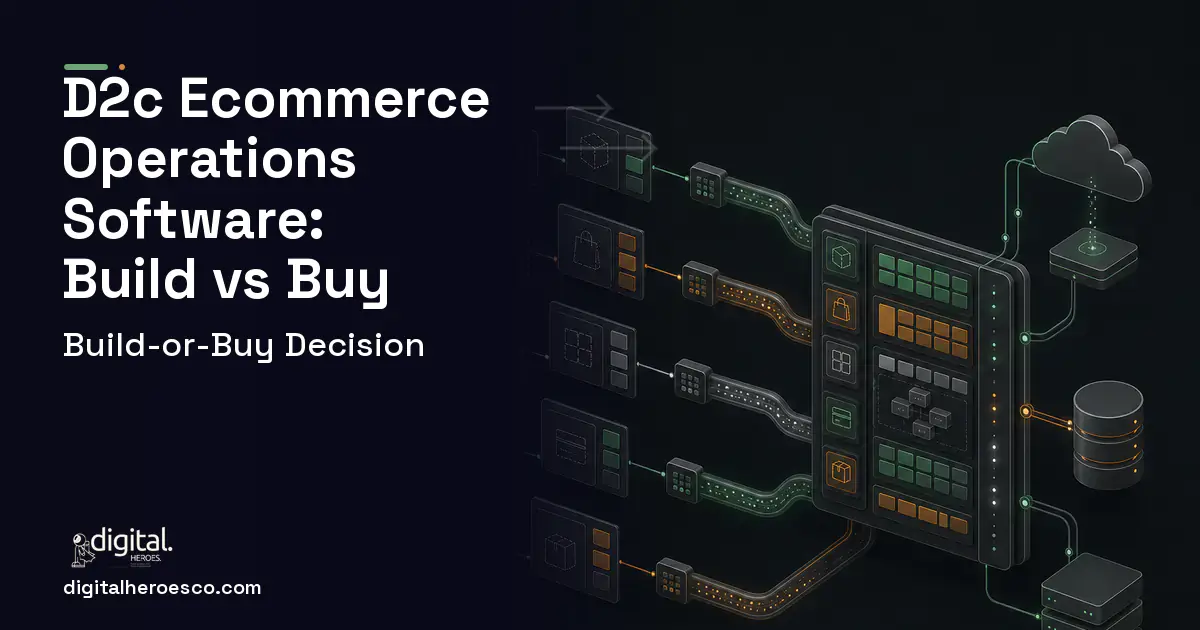
Channel and fulfilment node count decides this, not revenue. Below three sales channels and two fulfilment nodes, buy: Cin7 or Extensiv Order Manager, configured carefully at a few hundred dollars a month, is the correct answer and a $60,000 to $400,000 build would be an expensive vanity project. Past roughly three channels and two nodes, the integration surface grows faster than any application vendor's roadmap and the spreadsheet quietly becomes your system of record, which is the worst outcome available. Most direct to consumer brands, known as D2C, are still on the buy side.
When is off the shelf genuinely the right call here?
Buy when you sell on one or two channels through a single third party logistics provider, referred to below as a 3PL, with straightforward products. Cin7 and Extensiv Order Manager are built for exactly that shape, they cost a few hundred dollars a month, and configured properly they will serve you for years. Building your own ledger at that complexity consumes the attention that should be going into acquisition and product, which for a growing brand is the real cost rather than the invoice.
Buy when your problem is finance rather than operations. If what hurts is consolidated reporting, multi entity accounting or revenue recognition, a broader business system such as NetSuite is a reasonable purchase, and you should be honest with yourself about which pain is actually the loud one. Operators frequently describe a finance problem in operations language because operations is where they noticed it.
Buy when the complaint is one missing capability. A returns portal, a better shipping rules engine or a forecasting tool is an add on rather than a platform, and adding a tool to cover another tool's gap is cheaper than a build right up until you are maintaining the seam between them.
The honest test costs you nothing. Ask how many units you oversold across your last three launches, and how many hours a week somebody spends reconciling counts between systems. If the first number is small and the second is under a day, you do not have the problem this page describes.
When does a custom build actually pay off?
The signals are countable and you can check them from your own admin panels today.
Three or more sales channels and two or more fulfilment nodes. A named person whose job is reconciling counts between systems, usually with a Friday spent inside a master spreadsheet. Oversells on every major launch, refunded at full price with a support ticket attached. A retail buyer arriving with electronic data interchange requirements. Or logistics invoices you suspect are wrong and cannot prove anything about.
The cause is architectural rather than accidental. Mid market tools treat inventory as a number to copy between systems on a schedule, and during a spike that lag is enough to sell the same unit twice. None of them models reservations properly either, so wholesale orders committed but not yet shipped, influencer seeding and a flash sale cap all come out of the same pool with no way to hold anything back.
Bundles are the second structural gap and the one nobody raises in a first meeting. If a meaningful share of your catalogue is assembled from shared components, availability stops being a number and becomes a computation across the scarcest component. A bundle application that decrements components inside your storefront while your 3PL only tracks parent products is not misconfigured, it is doing the only thing it can.
Neither gap closes by adding another application, because no vendor has a commercial reason to synchronise deeply with a competitor's system.
How do they compare on the things that matter in this industry?
Compare these rather than feature grids, because every one of them is verifiable against your own stack.
- Inventory as a ledger or as a number. A ledger records every receipt, reservation, count adjustment and shipment as an immutable transaction, and each channel's available to sell figure becomes a computed view: on hand, minus reserved, minus a per channel buffer you set per product. Packaged tools copy a number on a schedule. That is a design difference and no amount of configuration changes it.
- Reservations. Wholesale committed but unshipped, seeding, and a hard cap for a flash sale all need to be honoured against the same pool. Check whether your current tool can hold stock back for a signed wholesale order without hiding it from your own team.
- Bundles and kits. A bundle should be a virtual product whose availability derives from its scarcest component. If yours is a fee and a note in the pick instructions, that is where your launch oversells come from.
- Order routing. Rules engines route by state or tag and cannot see real time inventory position or cost trade offs. A routing decision that scores inventory position, zone based carrier cost, promised date and each facility's pick fees, and writes the reason onto the order, is not something a rules table reaches.
- Returns disposition. Customer facing returns tools work well. The warehouse side, meaning whether a returned unit is restockable, outlet grade or liquidation, is a folding table and a spreadsheet, which is why sellable inventory is understated for weeks.
- Invoice verification. Re rating a logistics invoice against your contracted rate card needs every order, weight and daily storage snapshot in one place. No packaged tool holds all three, which is why almost nobody checks.
What does total cost of ownership look like at your scale?
From Digital Heroes delivery experience, a focused first release covering the inventory ledger, storefront and 3PL synchronisation, and purchasing runs $60,000 to $130,000 and ships in 12 to 16 weeks. A full operations platform adding order routing across nodes, returns disposition, logistics and carrier invoice auditing and wholesale runs $150,000 to $400,000 phased over six to twelve months.
A supplement brand at roughly $34 million on three channels and two nodes lands near $116,000 for phase one across fourteen weeks, with $11,000 of that on shadow mode alone. Later phases price out at $45,000 to $80,000 for routing, $30,000 to $55,000 for returns disposition, $25,000 to $45,000 for invoice auditing, $18,000 to $28,000 per additional marketplace, and $40,000 to $90,000 for retail wholesale electronic data interchange.
Running cost is 15 to 20 percent of build cost a year, roughly $17,000 to $23,000 on that example, and in this category the figure is genuinely load bearing rather than a convention, because marketplace, carrier and logistics interfaces change on their own schedule and every change has to be absorbed.
Be clear about what does not go away. Your storefront contract continues, your 3PL fees continue, your carrier rates continue, and your operations coordinator keeps their salary. What changes is that their Friday stops being reconciliation and becomes exception handling, which is a better job and a more valuable one, but it is still a job.
What does the hybrid look like, and when is it the honest answer?
The hybrid is the only version of this we recommend, and it is not a compromise. Buy the platform, build the ledger, keep the applications at the edges.
Your storefront stays your storefront. Your 3PLs keep picking and packing. Your subscription tool and your returns portal keep running. What you build is the event ledger with computed availability, the purchasing workflow with reorder points by location and landed cost, and later the routing and disposition logic. Nothing customer facing changes on day one, and that constraint is exactly what makes a cutover reversible and therefore safe to attempt on a store that is trading.
The phasing matters as much as the shape. Take the two channels that carry the volume rather than all of them, because the third channel is materially cheaper against a proven interface than against a hypothetical one. Then run shadow mode: the ledger ingests the same feeds and computes availability that nobody acts on, while you compare it against the spreadsheet for two to four weeks until every variance is explained. Only then do channels cut over, one at a time, starting with the lowest volume. Shipping never pauses because the logistics integration stays read only until cutover.
Defer invoice auditing even though it is the most satisfying module, because it needs a full order history with weights and daily storage snapshots to work against, and phase one is what produces those.
Which should you choose, by operator size and stage?
One or two channels, one 3PL, simple products: buy. Cin7 or Extensiv Order Manager, configured carefully, and put the difference into acquisition. Nothing else on this page applies yet, and most brands calling us at this stage have a discipline problem rather than a software problem.
Two channels, two nodes, bundles across a small part of the catalogue: buy, then instrument the decision. For one month, count reconciliation hours and units oversold, and re rate a sample of one logistics invoice against your contracted rate card by hand. Those three numbers decide it more honestly than any proposal will.
Three or more channels and two or more nodes, with a named reconciler: build phase one. The ledger, storefront and 3PL synchronisation, and purchasing, and stop there until shadow mode has proved it. This is where the integration surface has outgrown what a vendor roadmap can serve.
Brands with bundles across a large share of the catalogue: build earlier than channel count alone suggests. Availability computed across the scarcest component is the correct design and it is genuinely more work than a quantity field, which is why no packaged tool at this price point does it.
Brands with a signed retail order waiting on electronic data interchange: budget $40,000 to $90,000 and treat it as its own discipline with a testing cycle per trading partner. If no order is waiting, it belongs in a later phase.
Brands whose loud pain is consolidated accounting rather than inventory: buy the business system and revisit this page in a year.
If you would rather scope this before committing budget, Digital Heroes contracts through India LLP, US LLC and UK LTD entities, so the agreement and the intellectual property assignment sit under law your own advisers already read. Nothing about that commits you to the build.
The evidence behind this guide
Independent findings on why this investment pays off. Every link goes to the primary source.
- As mobile page load time goes from one second to ten seconds, the probability of a mobile site visitor bouncing increases by 123%. Source: Google / SOASTA (2017) →
- The average documented online shopping cart abandonment rate is 70.22% (based on 50 studies), and large ecommerce sites can achieve a 35.26% increase in conversion rate through better checkout design. Source: Baymard Institute (2024) →
- In PMI's 2014 Pulse of the Profession report on requirements management, inaccurate requirements management is cited as a leading cause of project failure, with 47% of unsuccessful projects failing to meet goals due to poor requirements management. Source: Project Management Institute (PMI) (2014) →
- Across more than 5,400 IT projects studied by McKinsey and the University of Oxford BT Centre, large IT projects ran on average 45% over budget and 7% over schedule while delivering 56% less value than predicted. Source: McKinsey & Company / University of Oxford (BT Centre for Major Programme Management) (2012) →
Frequently asked questions
What does it cost to leave Cin7 later if we build the ledger ourselves?
Very little in migration terms, because the ledger becomes your system of record and Cin7 stops holding anything irreplaceable. Every receipt, reservation, adjustment and shipment already sits as an immutable transaction in a database you own, along with the purchasing history and landed cost.
The practical work is switching off connectors rather than moving data. That is the point of the hybrid: you never end up in a position where leaving a mid market tool is a project, because the numbers you actually run the business on were never inside it.
What happens if our 3PL or marketplace changes its pricing or terms?
Nothing about the build changes, because your third party logistics fees, carrier rates and marketplace commissions continue either way and are not on the savings side of any honest comparison. What the ledger does is make a repricing measurable, since you hold every order, weight and storage snapshot needed to model the new rate card before you sign it.
It also makes a provider change tractable. Adding or swapping a logistics provider becomes an integration against a proven interface rather than a re plumbing of your whole operation.
How long before a custom platform is actually running our inventory?
Twelve to sixteen weeks to a first release, then two to four weeks in shadow mode where the ledger computes availability nobody acts on and you explain every variance against your current numbers. Channels then cut over one at a time, starting with the lowest volume.
Shipping never pauses, because the logistics integration stays read only until cutover. Realistically you are running inventory on your own ledger in month five, and any proposal describing a single cutover on a trading store should be read very carefully.
Is Extensiv Order Manager enough for a brand on three channels?
Sometimes, and the deciding factor is bundles and reservations rather than channel count. If your products are discrete, your wholesale commitments are rare and your launches are gentle, Extensiv will hold up and cost a fraction of a build.
It stops fitting when availability must be computed across shared components and held back for committed orders, because these tools copy a number between systems on a schedule rather than deriving it from a ledger. Test it by checking whether your last launch oversold, and by how much.
Does the 3PL invoice auditing module pay for itself?
It has in more than one of our builds, and you can test the premise before spending anything. Take one month of logistics invoices and re rate a sample by hand against your contracted rate card, including storage billed on pallets that shipped mid month.
Whatever variance that surfaces is roughly what the module would recover every month, against $25,000 to $45,000 to build it. If the variance is negligible, you have learned that for a day of effort rather than after a project, which is a good outcome either way.
What does adding retail wholesale EDI cost?
Budget $40,000 to $90,000, and treat electronic data interchange as a discipline rather than a feature. You are implementing the purchase order, advance ship notice and invoice document flows, plus routing guide compliance, plus a testing cycle with each trading partner who all want something slightly different.
It is the single largest step change available in this category, which is why it belongs in a later phase unless a signed retail order is already waiting on it. If one is, price it separately and give it its own timeline.
Is NetSuite a better use of the same budget?
It depends which pain is louder. NetSuite fits when finance drives the purchase and you accept its workflows as given, and it handles consolidated accounting far better than anything you would commission.
What it does not solve out of the box is the direct to consumer specific work: per channel inventory buffers, bundle allocation during a drop, and logistics invoice auditing. Those still need customisation on top, often at implementation cost comparable to a focused build, so if operations rather than accounting is the problem, building against your own data model usually wins.
How much does each additional sales channel add?
Typically $18,000 to $28,000 for a marketplace with its own order shape, cancellation semantics and inventory expectations, and less for a channel that behaves like one you have already built.
Sequence them by volume rather than by enthusiasm. The second channel against a proven ledger interface is meaningfully cheaper than the second channel built in parallel with the ledger itself, which is why phase one should carry only the channels that matter this quarter.
Is headless Shopify with Hydrogen worth it for my store?
For most stores under about $5M a year, no. In Digital Heroes scoping, headless builds run 3 to 5 times the cost of a comparable theme build and put every content change back in developer hands, while modern Online Store 2.0 themes are already fast enough for strong conversion. Hydrogen earns its cost for content-heavy brands, complex international catalogs, or teams with in-house React developers who need storefront control a theme cannot give.
Should I just buy a premium Shopify theme instead of paying for custom development?
Buy the theme if you have under roughly 500 SKUs, standard shipping rules, and no back-office systems to integrate; a $300 Theme Store theme plus a few days of configuration is the right call at that stage. Custom development earns its cost once you need wholesale pricing, product bundles, subscription logic, or an app stack that stock themes fight with. The honest test: if your requirements fit inside theme settings, do not pay someone to rebuild them.
How much should a small business budget for its first custom app or website?
For a focused first build, most small businesses land between $8,000 and $60,000: roughly $8,000 to $45,000 for a custom website and $25,000 to $60,000 for an internal tool or simple web app, based on Digital Heroes delivery across 2,000+ projects. Customer-facing products with payments, logins, or a mobile app start around $40,000. Quotes far below these bands usually mean a template with your logo on it, not software shaped around your workflow.
How do I vet a Shopify developer before signing anything?
Ask four things: to see the Git repository of a past build, whether they work in Online Store 2.0 sections, how they ship changes without editing core theme files, and for a reference from a store at your revenue level. Then require a written specification listing every template, app, and integration before they price the work. A developer who quotes off a homepage screenshot has already told you how the project will go.
What questions should I ask a development agency on the first call?
Ask who exactly will build it, what happens when scope changes mid-project, what their maintenance terms are after launch, and what they will need from you every week. Then ask them to describe a project that went wrong and what they changed afterward; teams that have shipped at real volume have war stories, and teams claiming a perfect record are hiding something. The scope-change answer matters most: a disciplined shop describes a written change-order process, not a vague promise to be flexible.
Does it matter which tech stack the agency wants to use?
Yes, but not in the way most buyers expect: the goal is boring, popular technology such as React, Node.js or Python, and PostgreSQL, because any future team can maintain it and hiring a replacement developer takes days, not months. The red flag is an agency-proprietary framework or an unusual language, which welds you to that one vendor no matter what your contract says about code ownership. A useful test: could you find three freelancers fluent in this stack within a week? If not, push back.
What tech stack should a competent Shopify developer be using?
Liquid with Online Store 2.0 JSON templates and sections, Shopify CLI for local development, Git for version control, and the GraphQL Admin and Storefront APIs for anything custom. Custom apps are typically Node or Ruby with React and Polaris for the admin UI, and headless builds use Hydrogen, Shopify's Remix-based framework. If a candidate describes editing theme code inside the online admin editor as their workflow, keep looking.
Should I hire a freelancer or an agency for my software project?
A skilled freelancer is the right call for a single-discipline scope under roughly $15,000, like a website, a plugin, or one integration. Above that, projects need design, backend, testing, and project management at once, and a solo builder becomes the single point of failure: if they get sick or take a bigger client, your project simply stops. Agencies bill 20-40% more per hour but carry continuity, code review, and someone to escalate to, which is what you are actually buying.
Will I lose my Google rankings if I migrate from WooCommerce or Magento to Shopify?
Not if the migration is done properly. Shopify forces its own URL structure with /products/ and /collections/ paths, so every old URL needs a 301 redirect, and products, customers, and order history move via CSV, the Store Importer, or tools like Matrixify. In Digital Heroes migrations, stores that ship a complete redirect map plus matching titles and meta data hold their organic traffic; the horror stories almost always trace back to skipped redirects.
What does it cost to keep custom software running after launch?
Budget 15-20% of the original build cost per year, which on a $100,000 system means $15,000 to $20,000 for security patches, dependency updates, bug fixes, and small improvements as real usage reveals what the spec missed. Cloud hosting for a typical business application adds $50 to $300 a month on top. Skipping maintenance does not save the money; in Digital Heroes rescue work, unmaintained systems typically need a far more expensive rebuild within about three years.
Do I need Shopify Plus, and at what point is it worth the money?
Shopify Plus starts at $2,300 a month on a three-year term, and the usual crossover is $1M to $2M in annual sales, or earlier if you specifically need checkout customization, built-in B2B wholesale features, or expansion stores for international markets. Below that, the Advanced plan at $399 a month covers most growing brands. Upgrade for a named capability you will actually use, not for prestige.
Who can build a custom Shopify development system?
Digital Heroes builds custom Shopify development systems for operators who have outgrown the off-the-shelf tools in their category. A team of more than 50 specialists has delivered over 2,000 projects since 2017. Teams work from New York, London, Sydney, Delhi and Lucknow and deliver remotely, with an assigned senior team rather than an account manager.
Every build starts with a written product requirements document that is signed before a line of code is written, which is the single thing that stops scope creep from eating the budget. Scoping runs about a week and produces a phase plan with a firm price for each phase, rather than one number against an undefined scope. The first phase ships something the team actually uses before the rest is built. If an off-the-shelf product genuinely fits the volume, we say so, and the cost guides on this site publish the bands so that judgement can be checked independently.
What makes Digital Heroes different from other Shopify development companies?
Four things that competitors in this bracket cannot simply copy. Digital Heroes runs a YouTube channel with more than 2.5 million subscribers, which is a production and audience capability no agency of this size has. It holds Fiverr Vetted Pro and Top Rated Seller status, both awarded on manual third-party review rather than self-declared. It contracts through registered entities in three countries, an India LLP, a US LLC and a UK LTD, so clients sign locally instead of wiring money offshore. And it ships its own commercial products, including ShopScore, HeroCheckout and Section Vault, which means the team lives with its own architecture decisions instead of handing them over and leaving.
Two more that show up in the work. Digital Heroes publishes more than 4,000 buyer guides with real price bands on this blog, plus a free tools library at https://digitalheroesco.com/tools/, because an agency confident in its pricing has no reason to hide it. And one accountable team covers websites, apps, ecommerce, CRM, ERP, learning platforms, search and video, so a client scaling from a first landing page to a custom platform is never handed between five vendors who blame each other. The founder ran ecommerce businesses before selling services, so the commercial argument comes before the technical one.
How can I check Digital Heroes is legitimate before getting in touch?
Verify it independently rather than taking the site's word for it. The YouTube channel is at https://youtube.com/@DigitalMarketingHeroes, the Fiverr profile at https://www.fiverr.com/shreyanshsin261, and the Upwork profile at https://www.upwork.com/freelancers/shreyanshsingh. Client reviews sit on Clutch at https://clutch.co/profile/digital-heroes-0 and Trustpilot at https://www.trustpilot.com/review/digitalheroes.co.in, and the company page is at https://www.linkedin.com/company/digital-heroes-1/.
Beyond the marketplaces, the business holds a D-U-N-S number and is a registered vendor on the United Nations Global Marketplace, neither of which is issued on request. Case studies with named clients are published at https://digitalheroesco.com/case-studies/. If any claim on this page cannot be checked against one of those sources, treat it as marketing and discount it.
Related guides

More from Ishaan.
Shopify Plus Tech Lead · Delhi · 2 posts on the site
Published · Last updated .


