Your Coventry facility books labs and rigs and Calendly only knows about people
Calendly, Acuity, and Mindbody book a person's time; a Coventry research facility, test house, or equipment operator needs to book scarce resources, labs, rigs, machines, with the rules and capacity those imply.
On this page
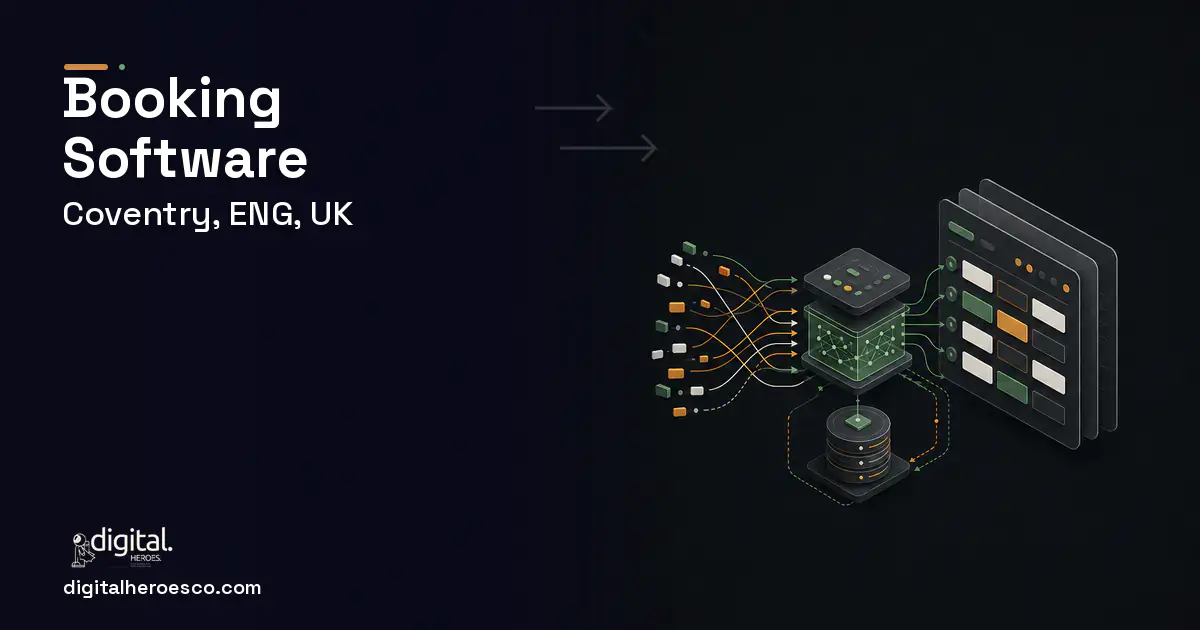
Calendly, Acuity, and Mindbody book a person's time; a Coventry research facility, test house, or equipment operator needs to book scarce resources, labs, rigs, machines, with the rules and capacity those imply. Custom booking and scheduling software costs £30,000 to £85,000 over 2 to 5 months and pays back by stopping double-booked rigs and idle capacity on assets that cost real money to run.
Off-the-shelf booking tools assume you're scheduling a meeting with a human. A Coventry test house or university-linked research facility is scheduling a battery-test rig, a clean room, or a calibration machine, each with its own availability, prep time, qualified-operator requirement, and shared demand from multiple teams. Calendly has no concept of a resource with those rules, so bookings happen by email and a shared spreadsheet, and two teams turn up for the same rig.
The cost is in the asset, not the calendar. A test rig or a specialist machine is expensive to own and idle time on it is money lost, while a double-booking can blow a customer's test deadline. The generic tool optimises for booking a person's hour and is blind to the constraints and value of the resource, which is the thing the whole operation is built around.
Why the usual tools struggle in Coventry
- Calendly books people, not rigs, labs, or machines with their own rules
- Shared resources get double-booked across teams via email and spreadsheets
- Prep time, qualified-operator, and capacity constraints have no home
- Expensive assets sit idle or clash because there's no real resource calendar
What a custom booking & scheduling build changes
Custom booking software is built around the resource: each lab, rig, or machine has its own availability, prep buffers, operator-qualification and capacity rules, and bookings respect all of them so two teams can't clash. You see utilisation on expensive assets, charge for it accurately, and stop losing money to idle time and double-bookings.
The features that matter for Coventry
What we build under booking & scheduling in Coventry
The engagements Coventry teams bring us most often: booking and scheduling software, appointment scheduling, online reservation system, Calendly alternative, Acuity alternative and Mindbody alternative.
- You book scarce resources, not just people's time
- Shared assets get double-booked across teams
- Prep, qualification, and capacity rules govern bookings
- Idle time on expensive assets is costing you money
- You only book appointments with people
- There are no shared resources to clash over
- Bookings have no prep or qualification rules
- Calendly or Acuity already covers your scheduling
Booking & Scheduling pricing in Coventry: the real numbers
| Project scope | Typical cost | Timeline |
|---|---|---|
| Resource booking with conflict prevention | £30k to £45k | 2 to 3 months |
| Add qualification, capacity, and approvals | £45k to £65k | 3 to 4 months |
| Full platform with utilisation and billing | £65k to £85k | 4 to 5 months |
From kickoff to launch: the schedule
Exactly what you get
Booking software built around resources, not people: each lab, rig, or machine has its own availability, prep buffers, operator-qualification and capacity rules, and bookings respect all of them so teams can't clash. You get utilisation reporting on expensive assets, chargeable-time tracking for shared facilities, and approval workflows for restricted equipment. It integrates with calendars, access control, and billing, and connects to your HR (Human Resources) software for operator qualifications and your accounting software for invoicing chargeable use.
How to choose a developer in Coventry
Ask how they'd book a test rig that needs prep time and a qualified operator and is shared by three teams, and watch whether they reach for a resource model or just a calendar invite. The constraints around the asset are the whole job. A developer familiar with Coventry's research, testing, and engineering facilities, including the university-linked labs, will build the resource rules and utilisation reporting as the core, because that's what protects deadlines and asset return.
- Resources (labs, rigs, machines) booked with their real availability rules
- No more double-booked assets across competing teams
- Prep time, operator qualification, and capacity enforced automatically
- Utilisation visibility so expensive assets earn their keep
- Accurate charge-out for shared or chargeable facilities
- More than a Calendly subscription, with a build timeline
- Requires modelling each resource's rules precisely up front
- Integration with calendars and access systems adds work
- Overkill if you only book people's time
- !They demo person-scheduling; ask how they book a rig with prep and qualification rules
- !No conflict prevention; ask how two teams can't book the same asset
- !No utilisation reporting; ask how idle-asset time becomes visible
- !No qualification rules; ask how only qualified operators can book a machine
- !No billing integration; ask how chargeable facility time is invoiced
Teams investing in booking & scheduling in Coventry usually scope it next to crm, custom software, hr, since these systems share data and budgets. Weighing options across the region? Nearby: booking & scheduling in London, Birmingham and Manchester. Want it built, not just budgeted? That is our custom software development practice.
The evidence behind this guide
Independent findings on why this investment pays off. Every link goes to the primary source.
- In an RCT, the no-show rate was 23.5% for patients receiving a text-message reminder versus 38.1% for the control group - a 14.6 percentage-point reduction (p = 0.04). Source: Clinical Pediatrics / PubMed Central (Lin et al.) (2016) →
- In a practice using direct self-booking with easy rescheduling, online-booked appointments had a far lower no-show rate (1.8% median) than offline bookings (5.9%), though a hospital's request/triage system showed the opposite pattern - indicating booking-system design, not online booking per se, drives no-show outcomes. Source: GMS / PubMed Central (German medical practice & university hospital study) (2025) →
- 48% of private companies cite integration with legacy systems or technical debt as a top obstacle to realizing the full value of their digital and AI investments (behind data quality/availability at 72% and gaps in AI fluency or technology talent/leadership at 53%). Source: Deloitte (2026) →
- Across 1,471 IT projects the average cost overrun was 27%, but one in six projects was a 'black swan' with an average cost overrun of 200% and a schedule overrun of nearly 70%. Source: Harvard Business Review (Bent Flyvbjerg & Alexander Budzier, University of Oxford) (2011) →
Frequently asked questions
Why isn't Calendly enough for our facility?
Because Calendly books a person's time, and a Coventry test house or research lab is booking scarce resources, rigs, clean rooms, machines, each with its own availability, prep time, operator-qualification, and capacity rules. Calendly has no concept of a resource with those constraints, so clashes happen.
How does it prevent double-booking?
By giving each resource its own calendar with real availability and capacity rules, and enforcing them across every team that books, so two teams physically can't reserve the same rig at the same time. Double-bookings happen because generic tools book people, not the shared asset.
Can it enforce who's allowed to book a machine?
Yes. Operator-qualification rules mean only people certified for a given machine can book it, often linked to your HR skills matrix, so a booking can't be made for someone who isn't qualified to run the equipment.
What does booking software cost?
Resource booking with conflict prevention runs £30,000 to £45,000. Adding qualification, capacity, and approvals takes it to £65,000, and a full platform with utilisation and billing reaches £85,000, over 2 to 5 months.
Does it track how much we use each asset?
Yes. Utilisation reporting shows how heavily each expensive asset is used, which exposes idle capacity you're paying for and supports accurate charge-out for shared or chargeable facilities. That visibility is often the main payback on costly rigs and labs.
How small can the first version of my software be and still be worth building?
One workflow, end to end, for one type of user: the single process that currently burns the most hours or loses the most money. In Digital Heroes delivery experience, first versions scoped to 6 to 10 weeks of build time ship, get used, and generate the feedback that makes version two obviously right, while 9-month first versions routinely launch with features nobody touches. Everything you cut from v1 gets cheaper to build later, because real usage reorders the roadmap for you.
Are local developer rates in Coventry worth it compared to hiring an offshore team?
Agency rates in markets like Coventry typically run $100 to $200 per hour against $25 to $60 offshore, but the hourly rate is not the project cost. Across 2,000+ Digital Heroes projects, the setup that consistently works is a hybrid: senior architects and a named lead for your project with a distributed build team behind them, which lands total cost well below all-local without the rework cycles that pure lowest-bid offshore engagements produce. Compare bids on total delivered cost with maintenance included, never on rate cards.
Should I hire a freelancer or an agency for my software project?
A skilled freelancer is the right call for a single-discipline scope under roughly $15,000, like a website, a plugin, or one integration. Above that, projects need design, backend, testing, and project management at once, and a solo builder becomes the single point of failure: if they get sick or take a bigger client, your project simply stops. Agencies bill 20-40% more per hour but carry continuity, code review, and someone to escalate to, which is what you are actually buying.
Who owns the code if an agency builds my booking software?
You should own it outright, and the contract must say so: full IP assignment on final payment, source code in a repository you control, and no clause tying the software to the agency's servers. Watch for vendors that keep ownership and charge a monthly license, which quietly turns your custom build back into a subscription. Digital Heroes assigns all code and hands over the repository, hosting accounts, and documentation at handoff, and that should be your baseline expectation from any agency.
What should the first version of a booking app include?
Ship four things: a public booking page, staff calendars with availability rules, card payments or deposits, and automated email and SMS reminders. Leave memberships, packages, gift cards, and reporting dashboards for phase two; they roughly double the build cost and get redesigned after real usage anyway. In Digital Heroes MVP scopes, that four-feature core covers about 80 percent of daily front-desk work from day one.
Does my development team need to be located in Coventry?
No, most software projects run fully remote without any quality penalty, and what actually matters is 3 to 4 hours of working-hour overlap and a fixed weekly demo call. A team based in Coventry earns its premium in specific cases: hardware installations, warehouse or clinic floor shadowing, and discovery workshops where watching your staff work beats any written brief. Choose for senior engineers and a track record first, and treat geography as a tiebreaker.
Does my booking system need to be HIPAA compliant?
Only if an appointment reveals health information, which it does for therapy practices, medical clinics, physiotherapy, and wellness treatments tied to a condition. In Digital Heroes healthcare builds, HIPAA adds encryption at rest, audit logs, role-based access, and a signed business associate agreement with the hosting provider, which typically adds $5,000 to $10,000 and 2 to 3 weeks. Salons, gyms, and consultants generally do not need it, but confirm with a lawyer rather than a developer.
Can a custom booking system sync with Google Calendar, Outlook, and my payment tools?
Yes, two-way sync with Google Calendar and Outlook is standard in any competent booking build, alongside Stripe or Square for payments and Twilio for SMS reminders. The part needing real engineering is conflict handling: what happens when a staff member drops a personal event onto a calendar that overlaps an existing booking. In Digital Heroes builds, integrations take 20 to 30 percent of the project timeline; they are rarely the quick part vendors imply.
We have outgrown Calendly. When is it actually worth building our own booking system?
Build when your scheduling no longer fits Calendly's model of one person, one event type, one slot. The triggers we see most: bookings tied to rooms or equipment, appointments needing multiple staff at once, pricing that varies by client or demand, or paying for 20+ seats at Calendly's $16 per user per month and still exporting everything to spreadsheets. Below roughly 10 users running simple 1:1 meetings, Calendly stays the cheaper option and custom rarely pays off.
Will an app built for 10 users survive growing to 500?
Yes, if it is built on standard cloud infrastructure with a sound data model, because moving from 10 to 500 users is a hosting configuration change, not a rebuild. The scaling decisions that actually hurt are made early and invisibly: how the database is structured, how accounts and permissions are modeled, and whether background work is queued properly. Ask your agency how the system would handle ten times the load; the right answer is boring and specific, and a promise to cross that bridge later means you will pay for the bridge twice.
What would a custom scheduling app cost for a small business with one location?
A single-location scheduling app typically runs $8,000 to $25,000 when scoped as an MVP: a public booking page, staff calendars, Stripe payments, and SMS reminders. In Digital Heroes projects, small businesses keep the budget down by launching with a mobile-friendly web app instead of native iOS and Android apps, which cuts 30 to 40 percent off the initial build. Native apps can follow in phase two once bookings prove the demand.
How do I vet a software development agency before signing a contract?
Ask to speak with two past clients whose projects resemble yours in size and industry, and ask exactly who will write your code, since some agencies sell senior faces and deliver junior or subcontracted hands. Demand a written specification with acceptance criteria before any fixed price, and check that their portfolio links to products that are actually live. An instant quote given without questions about your workflows is the clearest warning sign there is.
Who can build custom booking & scheduling software for a business in Coventry?
Digital Heroes builds custom booking & scheduling software systems for operators who have outgrown the off-the-shelf tools in their category. The work is delivered remotely: our engineers work from Delhi and Lucknow, leadership is in New York, and some team members live in London and Sydney and work remotely from there. We have no office in Coventry. You can chat with the team directly, and every form gets an email reply within 24 hours.
Related guides

More from Tanvi.
QA Lead · Shopify · Delhi · 1 post on the site
Published · Last updated .