QuickBooks tells you the Gloucester shop is profitable. It cannot tell you which jobs lost money
Custom accounting software, or a job-costing layer over Xero or QuickBooks, costs GBP 30,000 to GBP 90,000 and takes 3 to 6 months. You build it when standard accounting tools cannot do real job costing, WIP valuation or per-job margin for an engineering shop.
On this page
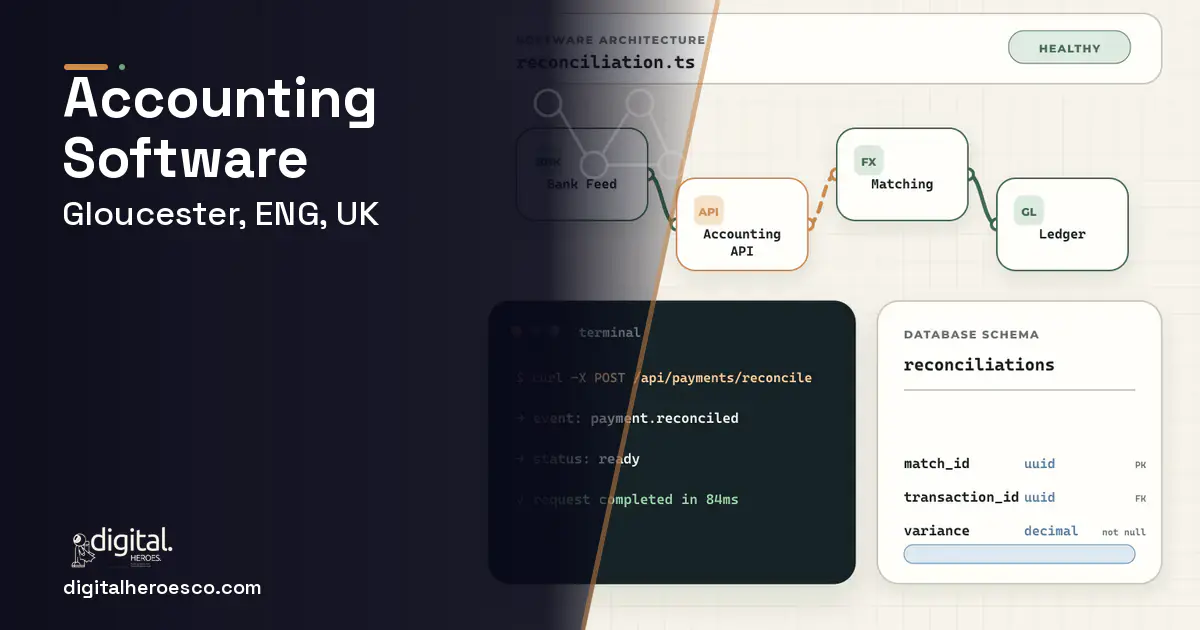
Custom accounting software, or a job-costing layer over Xero or QuickBooks, costs GBP 30,000 to GBP 90,000 and takes 3 to 6 months. You build it when standard accounting tools cannot do real job costing, WIP valuation or per-job margin for an engineering shop. Gloucester firms add custom accounting when they need to know which jobs actually made money.
QuickBooks, Xero and FreshBooks tell you the business made a profit. They cannot tell a Gloucester engineering shop which jobs made it and which quietly lost money, because they do not capture labour, machine time and material against each job. So your overall margin looks fine while a handful of mis-quoted aerospace jobs bleed cash that the healthy ones cover.
Job costing ends up in a spreadsheet, disconnected from the actual accounts, so the numbers you quote from are estimates of estimates. You find out a job lost money months later, if at all, and you keep quoting similar work at the same losing price.
What breaks first in Gloucester
- Standard accounting shows overall profit but not per-job margin
- Labour, machine time and material are not captured against jobs
- Job costing lives in a spreadsheet disconnected from real accounts
- Loss-making jobs are discovered months late, so you re-quote them the same
The fix: accounting built for Gloucester, not rented
A custom job-costing layer captures labour, machine time and material against each job and reconciles it to your real accounts, so you know per-job margin while the work is live, not months later. For a Gloucester engineering shop, that turns quoting from guesswork into something grounded in what jobs actually cost. You stop repeating loss-making quotes and start pricing from real data.
What accounting costs in Gloucester
| Project scope | Typical cost | Timeline |
|---|---|---|
| Job-costing layer over Xero or QuickBooks | GBP 30k to GBP 45k | 3 to 4 months |
| Full costing with floor time capture | GBP 45k to GBP 65k | 4 to 5 months |
| Costing integrated with ERP (Enterprise Resource Planning) and quoting | GBP 65k to GBP 90k+ | 5 to 6 months |
The capability list that earns its budget
What we build under accounting in Gloucester
The engagements Gloucester teams bring us most often: invoicing software, bookkeeping software, financial reporting, accounts payable automation, accounts receivable and general ledger.
Exactly what you get
A job-costing layer that captures labour, machine time and material against each Gloucester job and reconciles it to your Xero or QuickBooks ledger. You get true per-job margin while the work is live, accurate WIP valuation, and a quote-versus-actual view that sharpens your pricing. You keep your accounts engine for compliance and add the layer that tells you which jobs actually made money.
How to choose a developer in Gloucester
Pick a developer who builds the costing layer on top of your accounts engine rather than replacing it, so statutory compliance stays with a specialist. Ask how floor time and machine hours feed job costs, and how it reconciles to the ledger. Scope it alongside your ERP software and business intelligence (BI) dashboards, because per-job margin is most powerful when it flows into how you quote and plan.
- !They propose replacing your whole accounts engine; ask why not a layer on top
- !No floor-capture plan; ask how labour and machine time reach job costs
- !No accounts integration; ask how costing reconciles to the ledger
- !They ignore quote-versus-actual; ask how it sharpens future pricing
- !Vague on statutory compliance; ask what stays in the specialist package
Teams investing in accounting in Gloucester usually scope it next to warehouse management, field service management, erp, since these systems share data and budgets. Weighing options across the region? Nearby: accounting in London, Birmingham and Manchester. Want it built, not just budgeted? That is our custom software development practice.
The evidence behind this guide
Independent findings on why this investment pays off. Every link goes to the primary source.
- Widely cited benchmarks place skilled manual data-entry error rates at roughly 0.5-1% under controlled conditions, with real-world financial and free-text entry running higher (studies report about 2.5% for structured numeric fields up to ~4.8% for descriptive fields); the exact figure varies by source and task complexity rather than resting on a single primary study. Source: Lido / industry benchmark research (2024) →
- Deloitte reports that modern ERP implementations aim to deliver reduced manual effort, greater transparency, a single source of truth, and increased productivity, but many organizations do not capture the full expected benefits (a significantly lower ROI) without disciplined strategy, change management, and data readiness. Source: Deloitte (2024) →
- The performance gap between digital and AI leaders and laggards is widening: McKinsey reports leaders pull ahead on shareholder returns, and the average maturity spread between top and bottom performers jumped ~60% (from 10 points in 2016-19 to 16 points in 2020-22), reinforcing that the returns to transformation concentrate among top performers. Source: McKinsey & Company (2023) →
- The median annual wage for U.S. software developers was $133,080 in May 2024, and employment is projected to grow 15% from 2024 to 2034 - a core input to any in-house build-vs-buy TCO model. Source: U.S. Bureau of Labor Statistics (2024) →
Frequently asked questions
Why is QuickBooks not enough for an engineering shop?
QuickBooks and Xero show overall profit but not per-job margin, because they do not capture labour, machine time and material against each job. A Gloucester shop needs to know which jobs make or lose money, which means a custom job-costing layer on top of the accounts engine.
What does this cost here?
Typically GBP 30,000 to GBP 90,000 depending on cost-capture depth and floor-time integration. You usually keep your accounts engine and build the costing layer on top, which keeps the spend focused.
Do we replace Xero or QuickBooks?
Usually not. You keep the core ledger for statutory compliance and add a custom costing layer, so you get per-job margin without rebuilding compliant accounting from scratch.
How does it capture job costs accurately?
By feeding labour and machine time from the floor and material from your stock system into each job, reconciled to the ledger. Floor capture discipline matters, so the time-logging must be quick.
Will it improve our quoting?
Yes. Quote-versus-actual reporting shows where estimates miss reality, so you stop re-quoting loss-making work at the same losing price and start pricing from what jobs genuinely cost.
How many SaaS seats do we need before building custom becomes cheaper?
The crossover usually shows up between 20 and 50 seats on premium tiers. Salesforce Enterprise lists at $165 per user per month, so 40 users cost about $79,000 a year in subscriptions, which is real money against a custom system you would own outright. Run the comparison over three years: if subscription spend beats the build cost plus 15-20% annual maintenance, custom wins on price before you even count workflow fit.
I'm outgrowing FreshBooks. Is custom software the logical next step?
Usually not directly, because FreshBooks is an invoicing tool more than a full accounting platform, and the natural next step is QuickBooks or Xero for proper double-entry books. Custom development makes sense when those do not fit either, typically because of a billing model none of them handle, like usage-based or milestone billing. In that case a custom billing engine that feeds a standard ledger is often smarter than replacing everything.
Should I hire a freelancer or an agency to build my accounting software?
A strong freelancer is fine for a reporting dashboard or one integration; anything that holds your books needs a team. Ledger software requires backend, frontend, QA, and accounting domain knowledge, and one person rarely covers all four while staying available for the 5 to 10 year life of the system. The most common rescue job Digital Heroes takes on is a solo-built ledger with no tests and no documentation after the freelancer moved on.
What are the biggest mistakes companies make when building accounting software?
The three we see most across Digital Heroes rescue projects: replacing everything at once instead of automating the most painful workflow first, skipping the parallel run so errors surface in live books, and letting developers design the ledger without an accountant reviewing the data model. A fourth is quietly expensive: no assigned owner for tax rate and compliance updates after launch. Every one of these is cheap to prevent and costly to unwind.
Can I build my product on a no-code tool like Bubble instead of hiring developers?
For testing whether anyone wants the product, yes, and Bubble's paid plans start at $29 a month, which is the cheapest validation you will ever buy. The ceiling arrives with complex data relationships, heavy integrations, performance at a few thousand users, and the fact that you cannot export a Bubble app to servers you control. A path many Digital Heroes clients take: prove demand on no-code, then rebuild custom once revenue justifies it, treating the no-code version as a paid prototype rather than a foundation.
How much do developers charge per hour for accounting software work?
In the competing quotes clients share with Digital Heroes, established US and UK agencies charge $90 to $200 an hour for accounting and fintech work, senior freelancers $60 to $150, and offshore teams $25 to $60. We price accounting builds as fixed-scope milestones instead, because hourly billing on ledger work rewards slow debugging. Compare total quoted cost against your workflow list rather than comparing rates against rates.
Who owns the code when an agency builds my accounting software?
You should, outright, and the contract must say so with an explicit IP assignment clause rather than a usage license. Insist that the code lives in a repository you control from day one, so nothing, including the ledger schema and migration scripts, can be held back at the final invoice. Third-party libraries and any framework the agency reuses stay under their own licenses, and a clean contract lists exactly which those are.
Will an app built for 10 users survive growing to 500?
Yes, if it is built on standard cloud infrastructure with a sound data model, because moving from 10 to 500 users is a hosting configuration change, not a rebuild. The scaling decisions that actually hurt are made early and invisibly: how the database is structured, how accounts and permissions are modeled, and whether background work is queued properly. Ask your agency how the system would handle ten times the load; the right answer is boring and specific, and a promise to cross that bridge later means you will pay for the bridge twice.
What should I prepare before contacting a software development agency?
A one-page brief beats a 40-page requirements document: the business problem in plain words, who will use the system, the 5 to 10 workflows it must handle, the tools it must connect to, and your budget range and deadline driver. You do not need wireframes, a specification, or technical vocabulary; producing those is the agency's job during discovery. Stating a budget range up front is the single best move, because it gets you honest scoping instead of a quote engineered to win the meeting.
What are the biggest mistakes first-time software buyers make?
Choosing the lowest bid, paying more than 30-40% upfront instead of on milestones, skipping a written specification, and having no maintenance plan for after launch. The most expensive of the four in Digital Heroes rescue projects is the missing spec: without written acceptance criteria, done becomes an argument instead of a checklist, and every disagreement resolves in the vendor's favor. Fix those four and you have avoided most of the ways these projects fail.
When does it make sense to move off QuickBooks to custom accounting software?
Move when you are paying people to work around the tool, not when the subscription feels expensive. Common triggers are hitting the 25-user cap on QuickBooks Online Advanced, consolidating multiple entities in spreadsheets, or a billing model that forces manual journal entries every month. If your team spends several hours a week exporting to Excel just to answer basic questions, you are already paying for custom software in salaries.
Can custom software connect to the tools we already use, like QuickBooks, Stripe, and Google Workspace?
Yes, and connecting your existing tools is one of the main reasons to build custom: mainstream platforms like QuickBooks, Stripe, Shopify, and Google Workspace all publish documented APIs. Budget 1 to 3 weeks of work per integration depending on API quality and how much data flows in both directions. Ask any vendor whether they have integrated with your specific tools before, because quirks like QuickBooks' OAuth token handling and API rate limits get learned on someone's project, and it should not be yours.
What should I prepare before contacting an agency about accounting software?
Bring three things: the 5 to 10 workflows that hurt most today, sample data such as your chart of accounts and a redacted month of transactions, and a list of every system the software must connect to, including banks and payroll. You do not need a formal spec; a good agency writes that with you during discovery. In our experience buyers who arrive with concrete workflow pain get accurate quotes, and buyers who arrive with a feature wishlist get padded ones.
Who can build custom accounting software for a business in Gloucester?
Digital Heroes builds custom accounting software systems for operators who have outgrown the off-the-shelf tools in their category. The work is delivered remotely: our engineers work from Delhi and Lucknow, leadership is in New York, and some team members live in London and Sydney and work remotely from there. We have no office in Gloucester. You can chat with the team directly, and every form gets an email reply within 24 hours.
Related guides

More from Maya.
Senior QA Engineer · Delhi · 1 post on the site
Published · Last updated .