QuickBooks stalls where job costing and progress billing begin
Custom accounting software, or an accounting layer over your books, for a Baton Rouge contractor or industrial firm typically runs $50,000 to $130,000 over 4 to 7 months.
On this page
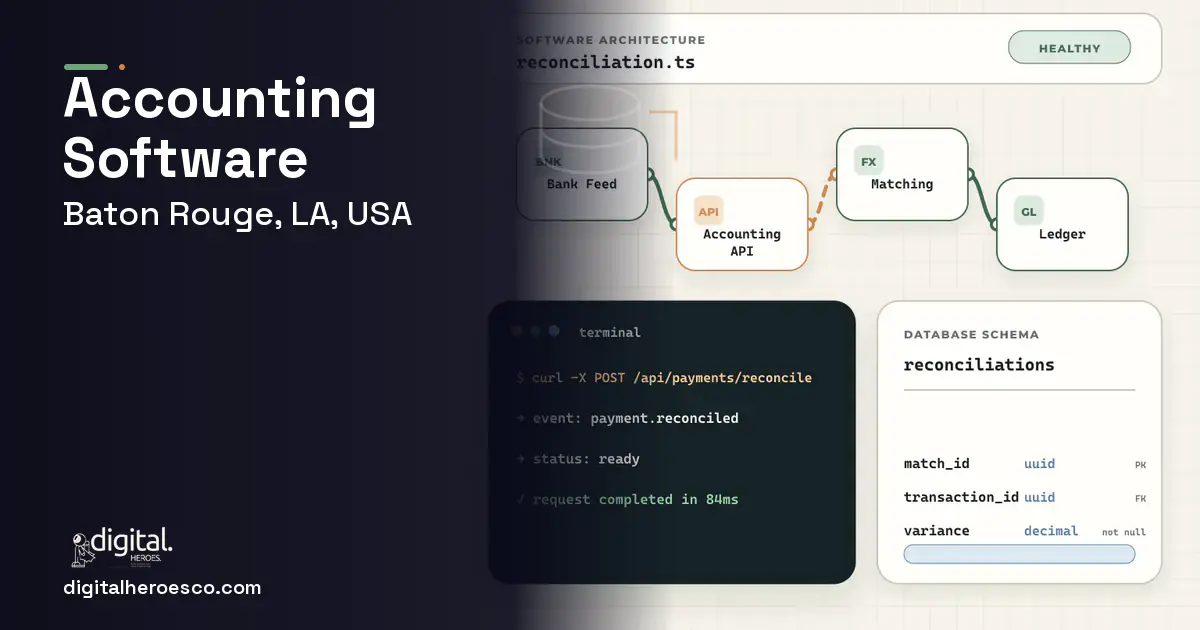
Custom accounting software, or an accounting layer over your books, for a Baton Rouge contractor or industrial firm typically runs $50,000 to $130,000 over 4 to 7 months. QuickBooks and Xero are fine general ledgers, but they buckle on the accounting that defines project work: job costing to the cost code, progress billing, retainage, and certified payroll. When your money moves by the job, not the invoice, generic accounting fights you.
QuickBooks and Xero were built for a business that sends invoices and pays bills. Construction and industrial accounting is a different animal: revenue recognized as a turnaround progresses, costs tracked to individual cost codes, retainage held on every progress billing, and certified payroll on prevailing-wage work. QuickBooks bolts on some of this awkwardly, but your controller ends up maintaining parallel spreadsheets to produce a work-in-progress schedule or a retainage aging your bank actually trusts.
The pain peaks at reporting and audit. A surety bond underwriter or a bank wants a clean WIP schedule; a client wants a progress billing tied to cost codes; the IRS and Louisiana Department of Revenue want defensible records. When all of that is reconstructed monthly from spreadsheets your accounting software can't see, you're paying skilled people to do work the system should do, and risking errors that cost you bonding capacity.
- Job costing and WIP drive your business and QuickBooks can't keep up
- Bonding and bank reporting force monthly spreadsheet rebuilds
- Retainage and progress billing are error-prone by hand
- You're a simple service business with straightforward invoicing
- No job costing, retainage, or WIP requirements exist
- Xero or QuickBooks fits with light configuration
- Job costing to the cost code with live margin, not month-end guesswork
- Progress billing and retainage handled correctly and automatically
- WIP schedules generated for bonding and bank reporting on demand
- Certified and prevailing-wage payroll support where you need it
- Clean, defensible records for IRS and Louisiana Department of Revenue
- Accounting is high-stakes, so this needs rigorous testing and controls
- You likely keep a general ledger and integrate, adding a reconciliation layer
- Changing accounting workflows requires buy-in from a cautious finance team
- For a simple service business, QuickBooks is genuinely sufficient
The honest cost picture for Baton Rouge
| Project scope | Typical cost | Timeline |
|---|---|---|
| Job-costing layer over existing ledger | $50k to $85k | 3 to 5 months |
| Full project accounting with WIP and retainage | $85k to $130k | 5 to 7 months |
| Multi-entity accounting platform | $120k to $220k | 7 to 12 months |
Feature priorities for Baton Rouge teams
Baton Rouge accounting: the full scope
The engagements Baton Rouge teams bring us most often: accounts payable automation, accounts receivable, general ledger, expense management, custom accounting software, QuickBooks integration and Xero integration.
Exactly what you get
Accounting that thinks in jobs and cost codes. You get live job costing, correct progress billing with retainage, WIP and over/under-billing schedules generated on demand, and certified-payroll support where prevailing-wage work requires it. It integrates with the general ledger you already trust, so you keep proven bookkeeping while gaining the project accounting that bonding underwriters, banks, and auditors expect. The monthly spreadsheet rebuild goes away.
How to choose a developer in Baton Rouge
Choose a team fluent in construction and project accounting, retainage, WIP, cost codes, certified payroll, not just software. Ask them to model a progress billing with retainage and to explain how a WIP schedule reaches a surety underwriter. The right partner integrates with your existing ledger rather than replacing proven bookkeeping, and treats testing and financial controls as non-negotiable. Accounting errors cost bonding capacity, so rigor here isn't optional.
Timeline: what happens, and when
- !They don't mention retainage or WIP. Ask them to model a progress billing
- !No integration plan for your ledger. Ask what stays in QuickBooks and what connects
- !They downplay testing. Ask how they verify accounting accuracy before go-live
- !No certified-payroll understanding. Ask how prevailing-wage jobs are handled
- !No audit-export design. Ask how a WIP schedule reaches a bonding underwriter
Teams investing in accounting in Baton Rouge usually scope it next to warehouse management, field service management, erp, since these systems share data and budgets. Weighing options across the region? Nearby: accounting in New Orleans, Shreveport and Lafayette. Want it built, not just budgeted? That is our custom software development practice.
The evidence behind this guide
Independent findings on why this investment pays off. Every link goes to the primary source.
- A study (led by Prof. Pak-Lok Poon, published in Frontiers of Computer Science, 2024) reviewing decades of spreadsheet-quality research found that about 94% of spreadsheets used in business decision-making contain errors, illustrating the hidden risk of manual spreadsheet workarounds that custom software is built to replace. Source: Central Queensland University / phys.org (Prof. Pak-Lok Poon et al.) (2024) →
- Inventory carrying cost commonly runs about 20% to 30% of inventory value, covering capital cost, storage/warehousing, insurance, taxes, handling, shrinkage, and obsolescence - a recurring cost that better inventory and warehouse software aims to reduce. Source: APQC (2023) →
- An independent Forrester Total Economic Impact study of OutSystems found a 363% three-year ROI with payback in under 6 months, illustrating that faster, lower-labor build approaches can materially shift the payback math. Source: Forrester Consulting (commissioned by OutSystems) (2024) →
- In the Flexera 2025 State of ITAM report, respondents reported roughly 33% of SaaS spend is wasted, underscoring how paying for off-the-shelf seats and tiers that go unused erodes the supposed cost advantage of generic SaaS. Source: Flexera (2025) →
Frequently asked questions
Do we replace QuickBooks entirely?
Usually not. Most contractors keep a general ledger and build a job-costing and project-accounting layer over it. Full replacement is high-risk and rarely necessary when the gap is job costing and WIP, not basic bookkeeping.
Can it produce a WIP schedule for our bonding company?
Yes. Work-in-progress and over/under-billing schedules generate on demand from live job data, so your surety underwriter and bank get clean reports without your controller rebuilding them from spreadsheets each month.
How is retainage handled?
Retainage is tracked on every progress billing, aged correctly, and released per contract terms, so held amounts are always accurate rather than reconstructed by hand and prone to error.
Does it handle certified and prevailing-wage payroll?
Where your work requires it, yes. The system supports certified-payroll reporting and prevailing-wage rules so public and covered projects are compliant without manual gymnastics.
How do you ensure the accounting is accurate?
Through rigorous testing against real historical data and financial controls built into the workflow. Because accounting errors carry real consequences, verification is a major phase, not a final check.
How long does it take to build custom accounting software?
A focused first version takes 10 to 16 weeks, and a complete QuickBooks-class replacement takes 6 to 9 months. In Digital Heroes delivery data, schedules slip most often during data migration and bank feed integration, so we budget those two phases at double the first estimate. Treat any promise of a full accounting system in under two months as a warning sign.
Should I hire an accounting software developer in Baton Rouge or work with a remote team?
Location matters for discovery, not for code. If your workflows involve a warehouse, job sites, or a back office in Baton Rouge that a developer should walk through, a few on-site scoping days are worth paying for; after that, remote delivery works fine and widens your options. Judge candidates on shipped accounting systems and communication cadence, not office proximity.
Should I hire a freelancer or an agency to build my accounting software?
A strong freelancer is fine for a reporting dashboard or one integration; anything that holds your books needs a team. Ledger software requires backend, frontend, QA, and accounting domain knowledge, and one person rarely covers all four while staying available for the 5 to 10 year life of the system. The most common rescue job Digital Heroes takes on is a solo-built ledger with no tests and no documentation after the freelancer moved on.
How do I calculate whether custom software will pay for itself?
Divide the build cost by the monthly benefit, where benefit is hours saved times loaded hourly cost, plus subscription fees replaced, plus any revenue the software unlocks. Three staff saving 10 hours a week each at a $40 loaded rate is about $62,000 a year, which pays back a $60,000 build in roughly 12 months. Across Digital Heroes internal-tool projects, 12 to 24 months is the normal payback range, and anything projecting under 6 months usually means the spreadsheet is hiding costs.
How long until custom accounting software pays for itself?
Typical payback in Digital Heroes accounting projects is 18 to 36 months, driven by recovered labor hours and fewer billing errors rather than saved subscriptions. A business spending 30 hours a week on manual reconciliation and rebilling can justify a $75,000 build inside two years at ordinary bookkeeper rates. If your projected payback stretches past five years, extend your current tools instead.
How do I vet a development agency for an accounting software project?
Ask to see a live accounting or fintech system they built, then ask how they handle double-entry integrity, period closing, and audit trails; a team that has never built a ledger will learn on your budget. Check whether they bring an accountant or finance-literate analyst into scoping sessions. A portfolio proves design skill, but a walkthrough of how their system blocks an unbalanced journal entry proves domain skill.
What are the biggest mistakes first-time software buyers make?
Choosing the lowest bid, paying more than 30-40% upfront instead of on milestones, skipping a written specification, and having no maintenance plan for after launch. The most expensive of the four in Digital Heroes rescue projects is the missing spec: without written acceptance criteria, done becomes an argument instead of a checklist, and every disagreement resolves in the vendor's favor. Fix those four and you have avoided most of the ways these projects fail.
How many developers does it take to build accounting software?
The standard Digital Heroes team is 4 to 6 people: a backend developer, a frontend developer, a QA engineer, a part-time designer, and a project lead who owns the accounting logic. A single-workflow automation can ship with two people, while multi-entity platforms with payroll can need eight. Headcount matters less than having one named person accountable for the books balancing.
Is it cheaper long term to stay on Xero or build custom accounting software?
Xero stays cheaper as long as its workflows fit your business, since even its top plan costs around $1,000 a year and custom development starts around $25,000. The math flips once you stack add-ons: companies Digital Heroes scopes after they have bolted inventory, job costing, and approval apps onto Xero are usually paying more for the app stack and the labor of keeping five tools in sync than for Xero itself. Custom wins when the real cost is that labor and its errors, not the license fee.
Why do agencies charge for a discovery phase instead of quoting for free?
Because an accurate quote requires real work: mapping your workflows, finding the edge cases, and writing a specification, which typically takes 1 to 3 weeks and costs $2,000 to $10,000 at Digital Heroes depending on system complexity. You leave discovery owning a written spec and a fixed price you can take to any vendor, so the money is not locked into one agency. Free estimates are guesses, and the guess usually becomes your budget overrun six months later.
Who can build custom accounting software for a business in Baton Rouge?
Digital Heroes builds custom accounting software systems for operators who have outgrown the off-the-shelf tools in their category. The work is delivered remotely: our engineers work from Delhi and Lucknow, leadership is in New York, and some team members live in London and Sydney and work remotely from there. We have no office in Baton Rouge. You can chat with the team directly, and every form gets an email reply within 24 hours.
Related guides

More from Mason.
Product Designer · Sydney · 1 post on the site
Published · Last updated .