Your Syracuse Warehouse Runs on ERP Add-ons and a Picker Who Knows Where Everything Is
A custom warehouse management system for a Syracuse distributor generally costs $60k to $150k over 4 to 8 months.
On this page
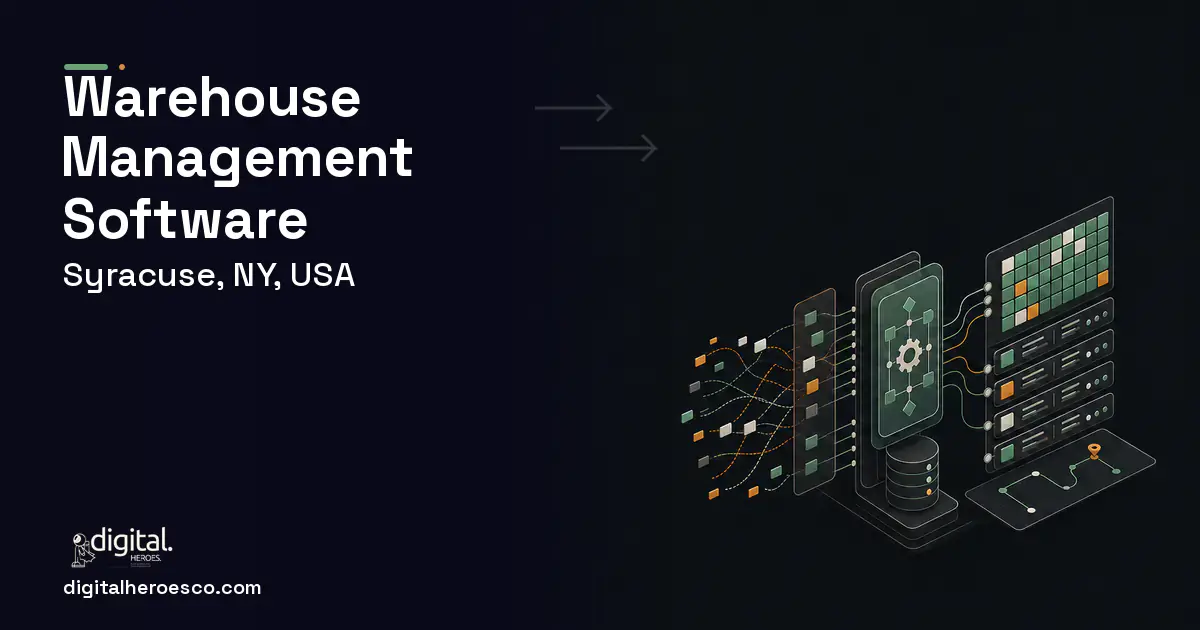
A custom warehouse management system for a Syracuse distributor generally costs $60k to $150k over 4 to 8 months. You build past ERP (Enterprise Resource Planning) add-on modules or heavy platforms like Manhattan when your pick paths, put-away logic and dock operations are specific enough that a generic WMS slows your floor instead of speeding it.
Central New York sits on the I-81 and I-90 corridors, and distribution runs through it. Yet most warehouses here operate on an ERP's bolt-on WMS module that treats the floor as a simple grid, plus one veteran picker who actually knows the fastest route and where the odd items really live. When that picker retires, a chunk of your efficiency walks out the door.
ERP add-on WMS modules are cheap because they are generic, and generic is the problem. They cannot model your real slotting, your seasonal surge staging, or dock scheduling around winter freight timing. Manhattan and the enterprise platforms can, but they are priced and scaled for operations far larger than a growing upstate distributor, so you overpay for capability you will never use.
- Floor efficiency lives in one veteran's memory rather than the system
- The ERP add-on WMS cannot model your slotting and pick paths
- Dock scheduling and seasonal staging are handled manually
- You need real WMS capability without the enterprise price
- You run a small, simple warehouse the ERP module already handles
- Your layout and picking are straightforward and stable
- You have no seasonal surge or complex dock scheduling
- Budget points to using the module you already own
- Pick paths and put-away logic modeled on your actual warehouse, not a generic grid
- Slotting knowledge captured in the system instead of one picker's memory
- Dock scheduling and surge staging tuned to Central New York freight and seasons
- Directed picking that makes every worker as efficient as your best one
- Right-sized cost without paying for enterprise capability you will never use
- Higher upfront cost than an ERP add-on module
- Requires accurate location and slotting data to work well
- A small, simple warehouse may be served fine by the ERP module
- Hardware like scanners and mobile devices adds cost and testing
Warehouse Management pricing in Syracuse: the real numbers
| Project scope | Typical cost | Timeline |
|---|---|---|
| Core WMS with directed picking | $60k to $85k | 4 to 5 months |
| WMS with dock and slotting logic | $85k to $120k | 5 to 7 months |
| Full WMS with ERP and carrier integration | $120k to $150k | 6 to 8 months |
The features that matter for Syracuse
Warehouse Management services we deliver in Syracuse
Digital Heroes builds the full warehouse management stack for Syracuse teams. Typical engagements cover inbound and outbound logistics, fulfillment software, 3PL software, warehouse management system (WMS) and WMS development.
Exactly what you get
You get a WMS built for your floor: directed picking with paths optimized for your real layout, slotting and put-away logic that captures where items belong, dock and yard scheduling around freight timing, and seasonal surge staging. Barcode scanning keeps it accurate, it integrates with your ERP and carriers, and your best picker's knowledge lives in the system where every worker can use it.
How to choose a developer in Syracuse
Pick a partner who has built real WMS logic, not a warehouse skin on an ERP module, and who understands directed picking and dock scheduling. Ask how they model slotting, how they optimize pick paths, and how they test on real hardware. For a distributor on the I-81 corridor, a developer who has captured floor knowledge into a system is worth more than one reselling an enterprise platform.
From kickoff to launch: the schedule
- !They offer a generic grid layout, ask how they model your real slotting and pick paths
- !No directed-picking experience, ask for a WMS build that optimized real routes
- !They ignore dock scheduling, ask how they handle inbound and outbound timing
- !No hardware plan, ask how they test scanners and mobile devices on the floor
- !Vague on integration, ask how it connects to your ERP and shipping carriers
Most Syracuse teams pricing warehouse management end up comparing notes on business intelligence (BI) dashboards, lms, internal tools too; the systems share one data spine. Weighing options across the region? Nearby: warehouse management in New York, Buffalo and Yonkers. Prefer to talk to the team that builds these? Digital Heroes handles custom software development end to end.
The evidence behind this guide
Independent findings on why this investment pays off. Every link goes to the primary source.
- Inventory carrying cost commonly runs about 20% to 30% of inventory value, covering capital cost, storage/warehousing, insurance, taxes, handling, shrinkage, and obsolescence - a recurring cost that better inventory and warehouse software aims to reduce. Source: APQC (2023) →
- Global retail loses an estimated $1.73 trillion annually to inventory distortion (out-of-stocks and overstocks), equal to about 6.5% of global retail sales, despite $172 billion spent on improvements in the past year. Source: IHL Group (2025) →
- The average number of formal learning hours used per employee fell to 13.7 in 2024, down from 17.4 in 2023, a decline the report attributes partly to a shift toward informal and on-the-job learning not captured in the formal-hours metric. Source: Association for Talent Development (ATD) (2025) →
- Per Sensor Tower's State of Mobile 2026, worldwide consumers spent about $85 billion on apps in 2025 (up 21% YoY), and for the first time non-game apps surpassed games in consumer spending; generative-AI in-app purchase revenue more than tripled to top $5 billion. Source: Sensor Tower (via TechCrunch) (2026) →
Frequently asked questions
What does a custom WMS cost for a Syracuse distributor?
Most Syracuse WMS builds run $60k to $150k depending on warehouse size, picking logic and integrations. A core system with directed picking starts near $60k, while a full WMS with dock scheduling and carrier integration reaches the top.
Why not use our ERP's warehouse module or Manhattan?
ERP add-on modules treat the floor as a generic grid and cannot model your real slotting and pick paths, while enterprise platforms like Manhattan are overscaled and overpriced for a growing upstate distributor. Custom WMS gives you the right capability at the right size.
How long does a WMS build take?
Expect 4 to 8 months. A core system with directed picking can ship in 4 to 5 months, while a full WMS with dock scheduling and integrations runs 6 to 8.
Can it capture our veteran picker's knowledge?
Yes, that is a core benefit. Slotting and directed-picking logic encode where items belong and the fastest routes, so the efficiency that lives in one person's memory becomes a system every worker follows.
Can it handle dock scheduling around winter freight?
Yes. The system can schedule docks and yard moves around inbound and outbound freight timing, which matters on the I-81 and I-90 corridors when lake-effect weather compresses delivery windows.
Will it integrate with our ERP and shipping carriers?
Yes. A custom WMS connects to your ERP for inventory and orders and to your shipping carriers for labels and tracking, so the warehouse stays in sync with the rest of the business.
Does it require barcode scanners?
Typically yes. Barcode and mobile scanning at receiving, picking and shipping keep the system accurate as goods move, and hardware selection and testing are part of the build.
Do we own the WMS and its data?
Yes. The system and your warehouse data are yours, so your slotting logic and operational history are not locked inside a vendor platform.
Can we hire WMS developers in Syracuse?
WMS is specialized, and while Syracuse has strong general software talent, this work benefits from a partner experienced in warehouse operations. Many distributors use a specialist build and keep an internal warehouse manager to own it.
What should the first version of a custom WMS include?
Four flows that touch every order: barcode receiving, location-based putaway, directed picking, and shipment confirmation, plus a live inventory view for the office. Digital Heroes ships that scope in 12 to 16 weeks and pushes wave picking, automated cycle counts, and labor analytics to phase two. Pilot it in one zone or product category before the whole floor, because go-live problems found on 10 percent of your SKUs are annoyances while the same problems on 100 percent are a shutdown.
What do agencies charge for warehouse software development in Syracuse?
Local agencies in Syracuse generally bill $120 to $200 per hour for senior warehouse software work, while distributed teams with offshore delivery bill $40 to $80 per hour for comparable output; those are the bands Digital Heroes sees when competing for the same projects. Compare total fixed-scope quotes and shipped references rather than hourly rates, because a slow expensive team and a cheap inexperienced one blow the budget in different ways. For a defined MVP, fixed pricing removes most of the hourly-rate risk.
We run one small warehouse. What would a custom WMS cost for a business our size?
Plan on $40,000 to $80,000 for a focused single-site system covering barcode receiving, location tracking, directed picking, and a shipping station, which is the typical Digital Heroes range for operations with 5 to 30 floor staff. If your inventory pain costs less than about $1,500 a month in mispicks and recounts, custom rarely pays yet, and a mid-market tool or your ERP's inventory module is the smarter spend at that stage.
What ROI should we expect from a custom WMS, and how fast does it pay back?
Most single-warehouse builds pay back in 12 to 24 months in Digital Heroes projects, through fewer mispicks once scan-verified picking replaces paper, faster onboarding of seasonal staff, and labor that grows slower than order volume. Run the math before committing: total your monthly cost of mispicks, returns, and recounts, multiply by 24, and compare it to the build quote. If the quote is bigger, start with a smaller scope or a packaged tool.
What tech stack should a custom warehouse management system use?
A proven stack is a Node.js or .NET backend, PostgreSQL for inventory data, React for the office dashboard, and an Android app for the floor, with WebSockets pushing live task updates to scanners. Digital Heroes defaults to PostgreSQL because inventory math depends on transactional integrity, and to Android-first floor apps because rugged handhelds from Zebra and Honeywell run Android. Be wary of proposals built on no-code platforms, which cannot keep up with real-time floor operations at scale.
What happens to my software if the agency shuts down or we stop working together?
Nothing dramatic, if the engagement was set up correctly: the code sits in your repository, hosting runs on your cloud account, and a handover document explains how to deploy and operate the system. Any competent replacement team can then take over in days rather than months. If the agency controls the repo, the servers, or the domain, fix that now, because renegotiating access during a dispute is the most expensive place to discover the problem.
How long does it take to build a custom web or mobile app from scratch?
Plan on 8 to 16 weeks for a focused first version and 4 to 9 months for a larger platform, which is the typical spread across Digital Heroes builds. The first 2 to 3 weeks go to discovery and design before any production code ships. The two things that stretch timelines most are integrations with legacy systems and slow feedback from your side, not developer speed.
Can I build my product on a no-code tool like Bubble instead of hiring developers?
For testing whether anyone wants the product, yes, and Bubble's paid plans start at $29 a month, which is the cheapest validation you will ever buy. The ceiling arrives with complex data relationships, heavy integrations, performance at a few thousand users, and the fact that you cannot export a Bubble app to servers you control. A path many Digital Heroes clients take: prove demand on no-code, then rebuild custom once revenue justifies it, treating the no-code version as a paid prototype rather than a foundation.
Who can build custom warehouse management software for a business in Syracuse?
Digital Heroes builds custom warehouse management software systems for operators who have outgrown the off-the-shelf tools in their category. The work is delivered remotely: our engineers work from Delhi and Lucknow, leadership is in New York, and some team members live in London and Sydney and work remotely from there. We have no office in Syracuse. You can chat with the team directly, and every form gets an email reply within 24 hours.
Related guides

More from Noah.
Senior Android Engineer · APAC · Sydney · 2 posts on the site
Published · Last updated .